I look up at the sky-aye-aye-aye
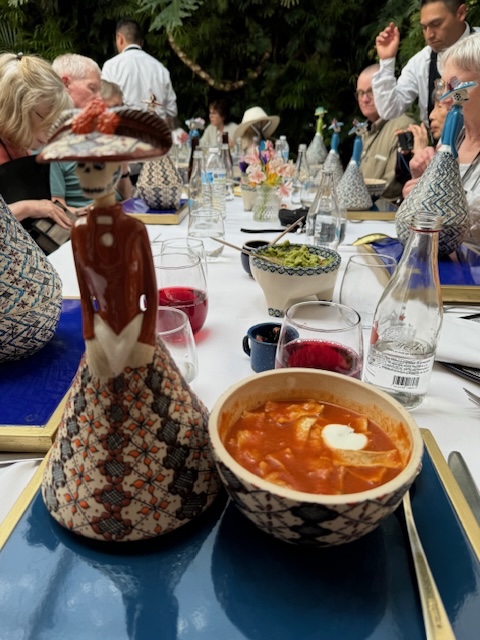
In my initial post about this trip I wrote that I was motivated in part by receiving the promotional email for it while I was in the midst of planning my trip to Lake Placid. Besides it timing, I was enticed by its description as “A Taste of Mexico.” Food tours always attract me. Each day of this trip was curated with a sumptuous lunch that had some relationship to our broader experience of CDMX. Unfortunately, for those who read these posts, one of my shortcomings as a chronicler is not providing much in the way of visual reminders of my meals. Fortunately, in this instance, several members of the group took and shared such photos. Unless otherwise noted, those are the source of images from Thursday’s lunch at
Azul Condesa.
At the trip’s end, we received a short document from our Air Soul tour leader about the restaurants where we’d dined, what they represented and why they were chosen. We began our week at El Cardenal
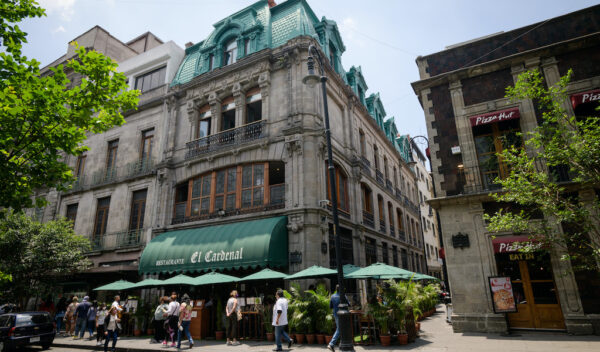
[From Culinary Backstreets]
described as.:
A classic introduction to traditional Mexican cuisine that is a historic institution beloved by locals and visitors alike, showcasing handmade tortillas and preserved recipes.
Its importance was grounding the group in authentic local flavors.
Wednesday we’d lunched at Corazón de Maguey in Coyoacán.
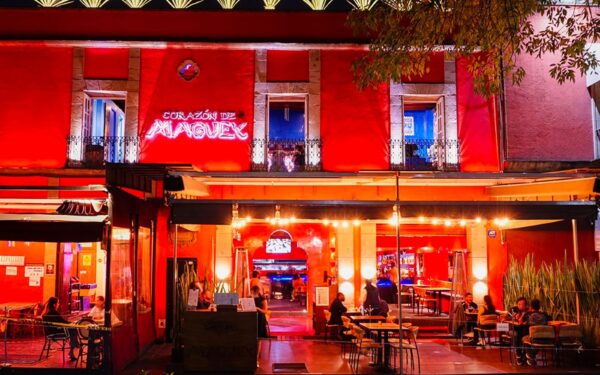
[From Escapadas]
Its description read.:
The spirit of Mexico: agave, heritage, and living tradition. Located in Coyoacán’s plaza introducing agave culture and mezcal traditions.
It was to serve as a bridge between gastronomy and anthropology.
Today we are at Azul Condesa
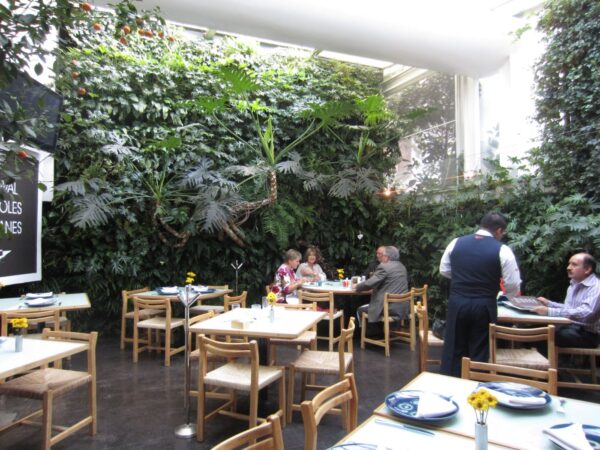
[From Trev’s Bistro]
because, according to our guide, it represents: refined Mexican cuisine – tradition interpreted by a chef who elegantly presents regional recipes that evolve while still honoring the past. Here’s a little more of the restaurant’s history for you to chew over.
Sometime around 1998 Chef Ricardo Muñoz Zurita published the first article in what would become the massive reference work titled Diccionario Enciclopédico de Gastronomía Mexicana that would establish and cement his reputation as the principal anthropologist of Mexican cuisine.
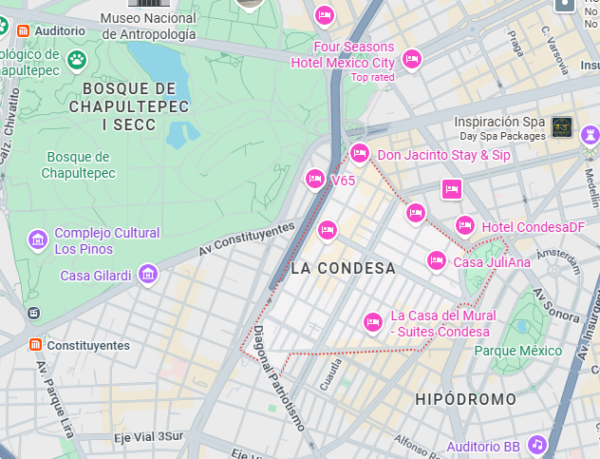
In the early years of this century, Muñoz Zurita opened Azul y Oro at the Universidad Nacional Autónoma de México (National Autonomous University of México or UNAM). Its name refers to UNAM’s colors of blue and gold. Several years later, sometime around 2010 or 2011, he opened Azul Condesa expanding his vision to this city-neighborhood
and extending his mission of bringing ancestral recipes into the public eye – sometimes updating them with a 21st century twist. He opened a third restaurant, Azul Histórico, in the historic center of CDMX.
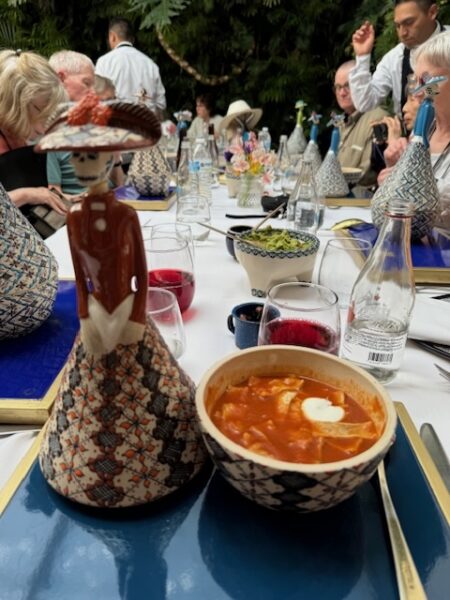
Azul Condesa is known for traditional Mexican cooking with an emphasis on regional dishes – especially Oaxacan-influenced preparations. The restaurant serves dishes such as mole-based specialties, cochinita pibil, and sopa de tortilla – this last is dramatically presented in a La Catrina bowl.
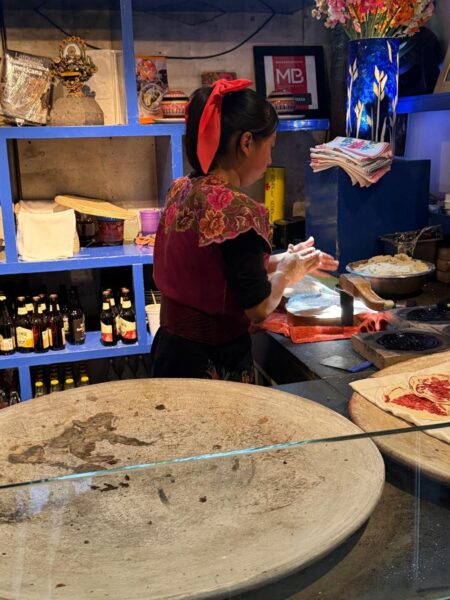
They also make their tortillas in house
and add to them unique designs.
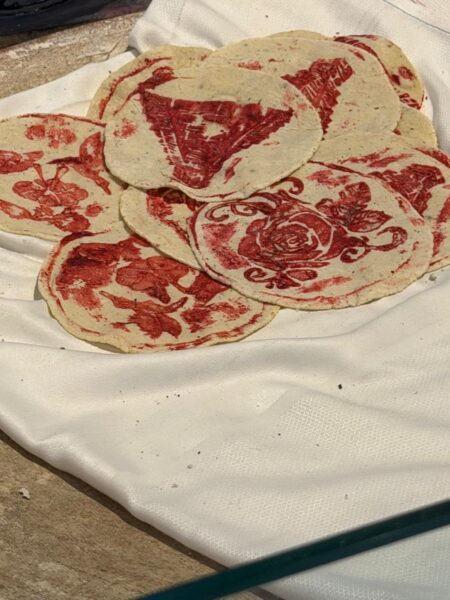
(By the way, every tortilla I had during my week in CDMX was made with masa harina. There were no wheat flour tortillas in my dining especiences.)
I want to say that I had the Tacos Gobernador – tacos filled with grilled shrimp and chihuahua cheese with a creamy chipotle chili sauce and a mango pico de gallo. There. I said it but I wouldn’t guarantee it.
At the end of our meal, we were all invited to try chocolate caliente – hot chocolate prepared either de agua or con leche and traditionally frothed with a molinillo.
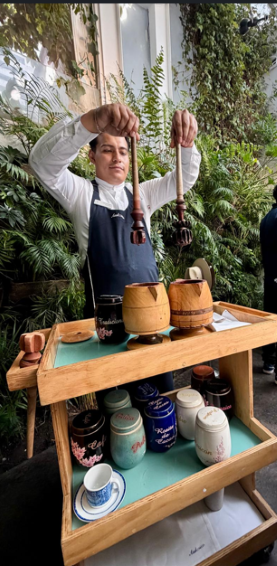
I had mine with cinnamon and a dash of chili powder.
After lunch it was on to
Chapultepec Castle.
Construction on Chapultepec Castle began in the late 18th century as a viceregal palace on Chapultepec Hill in CDMX. It subsequently served as a military academy, battlefield symbol, imperial residence, presidential residence, and is today the National Museum of History.
The place-name of Chapultepec comes from the Nahuatl and means “at the grasshopper hill.” The word’s root, chapul, means grasshopper
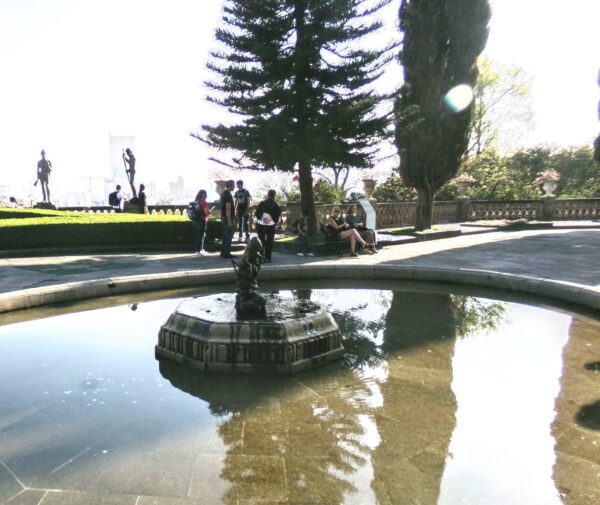
but historians don’t know whether this refers to the physical shape of the hill, the presence of many grasshoppers in the surrounding woods, or has a symbolic or mythological association with grasshoppers or crickets. They do know that in 1325, after the founding of Tenochtitlan, Chapultepec was considered a sacred place and strategic site due to the springs that supplied drinking water to the city.
In 1530 the emperor Carlos V issued a royal decree making the forest of Chapultepec property of México City. The first viceroys used it to hunt deer, hares, and rabbits. Viceroy Luis de Velasco (1590-1595) built a small palace on the side of the hill that was destroyed in 1784 by a gunpowder explosion. A year later, the Viceroy Bernardo de Gálvez began the construction of another palace on the top of the hill. This is the Castillo de Chapultepec we will visit today.
In 1833, a little more than a decade after Mexican independence the government began the process of converting the building into the Military College. During this construction the builders added a tower called Caballero Alto and this was when it was first called Castillo.
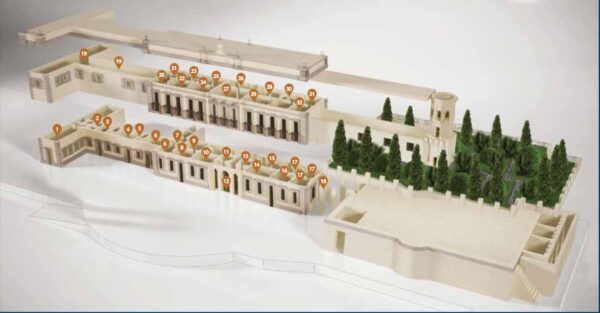
[From Museo Nacional de Historia]
On 13 September 1847, near the culmination of the US – Mexican War, a group of young cadets were among the forces who died defending the hill and castle. They became known as the Niños Héroes and are a central element in México’s national memory.
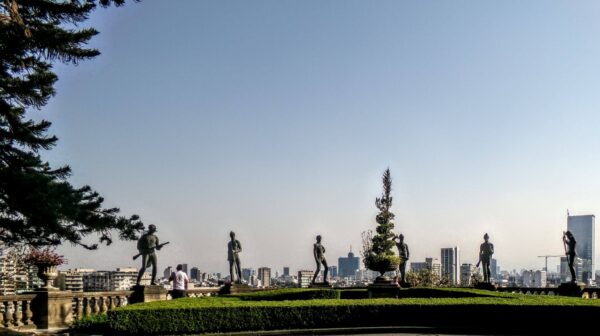
In 1859, Miguel Miramón, became the first to use the Castillo as his presidential residence during his term as interim agent of the conservative side (1859-1860). He oversaw construction of new rooms on the second floor of the Alcázar (the central royal-style wing) and the south balustrade.
The Alcázar acquired its current appearance when the Austrian archduke Maximilian and his wife, princess Carlota Amalia resided there during the Second French Intervention. (This was a military invasion by France, initially joined by Britain and Spain, to enforce debt repayment. Napoleon III attempted to expand this into an imperial project by appointing Maximilian as Emperor of the Second Mexican Empire.)
In 1878 México established its first National Astronomical Observatory in Chapultepec Castle a dome was added to the tower.
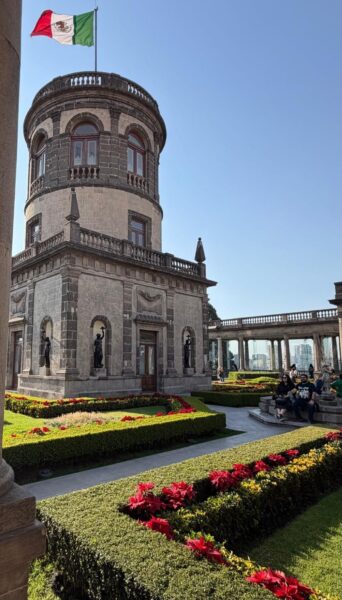
Then, in 1883, the observatory was transferred to the town of Tacubaya. The Castle could again be a Military College but it also became the summer residence of Porfirio Diaz.
It remained the presidential residence until President Lázaro Cárdenas decreed its conversion to the National Museum of History. He also declared the entire area to be a national heritage site. The adaptation of the building began in 1941 and the National Museum of History opened on 27 September 1944.
Not exactly a chamber but chamber music
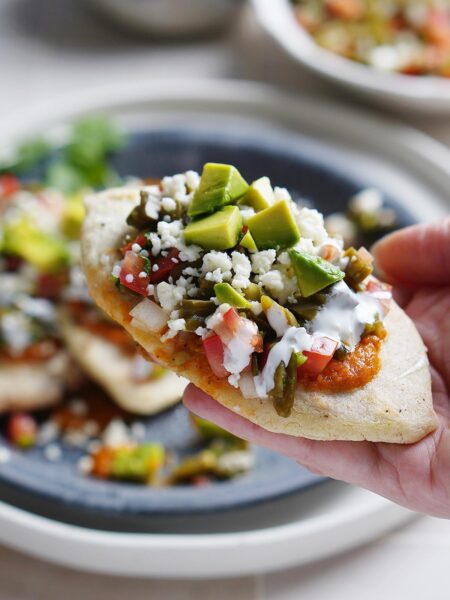
Following our visit to the Castillo we returned to the hotel and, after a brief washup, I went off to Calle Rio Sena for a little snack. I knew we’d be served some sort of tapas prior to the concert but was concerned they’d be too little and that I’d be disinclined to go out for a meal afterward. I had two tlacoyos.
[From Muy Delish]
As you can see from the photo, although considerably thicker than a typical tortilla, they are small enough to be a fine snack. The oval-shaped pockets are cooked on a comal and mine were filled with black beans and cheese then topped with a bit of salsa, cilantro, queso fresco, and avocado. With my beverage, it was everything I needed to ebb the tide of hanger and get me through the evening.
According to the note from T, our NPR host, the performers called themselves the Clazzic Musik String Quartet
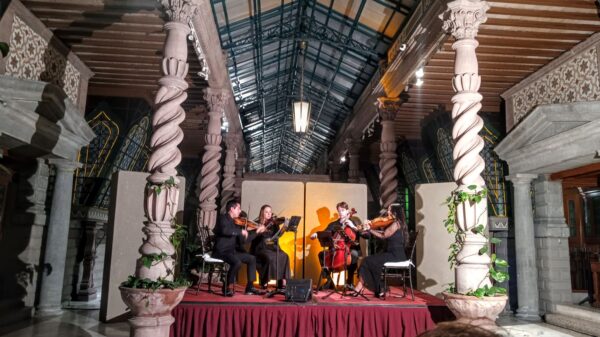
and the program had two sections and I’ll share much of it with you. The first was arrangements of music from what I’d call the standard European canon beginning with the first movement of Mozart’s Eine Kleine Nachtmusik followed by music from Brahms First Symphony. The third selection was Serenade Number 4 by Franz Schubert. This was a bit unusual for a string quartet because this piece is often performed on solo piano and often with a vocalist. Here’s a version with piano and cello.
Perhaps I’m being elitist but I think that simply writing that the fourth piece was Minuet by Luigi Boccherini will mean very little. Once you hear it, I think most of you will react with something along the lines of, “Oh, that.”
I think the closing piece – a return to Brahms and the Hungarian Dance Number 5 – will elicit a similar reaction.
Following a brief intermission, the performers returned with, for me, a more fulfilling section of music by Mexican composers and I felt their playing reflected a deeper emotional connection with the music. While I was familiar with these melodies, I was intrigued by the arrangements.
First was El danzón Nereidas by Amador Perez Torres. Here’s an interesting arrangement performed by Orquesta Juvenil de Guitarras Ciudad de México.
Next we heard Sobre las Olas (Over the Waves) by Juventino Rosas. My guess is that your reaction will be along the lines of, “I didn’t know that was written by a Mexican.” And an Indigenous Mexican at that.
T described the third selection as simply, “Traditional arrangement of South American Tango so I’ll skip a video of it and move on to the closing number – Danzon Number 2 by Arturo Márquez. This video is another performance conducted by Gustavo Dudamel (and yes, I know he’s Venezuelan not Mexican and by full orchestra not by a quartet but please cut me some slack here).
I’ll also ask for leniency with regard to the length of this post and hope the music more than compensates. Meanwhile, there are also a few more photos.
-
Photos and their stories – Lisbon – Summer 2026 part two – plus an egg-straordinary bonus
August 21, 2026 -

Photos and their stories – Lisbon – Summer 2026 – part one
August 21, 2026 -

The indigenous people of Da?ow?aga? (Olympic Valley and me supplement three)
August 19, 2026 -
The indigenous people of Da?ow?aga? (Olympic Valley and me Supplement two)
August 17, 2026 -
Olympic Valley in the time before humans (Olympic Valley and Me Supplement one)
August 14, 2026
2 responses to “I look up at the sky-aye-aye-aye”
Mole-based foods and chihuahua cheese? Jeez, seems like little critters are served up down there…. 😜
Clever. If I could give this a ‘rec’, I would. But I can’t. So I won’t.