Olympic (Squaw) Valley and Me – part one
Until 2025, visiting places that had hosted the Olympic Games arose through happenstance and, as I noted in the first post for this series, I didn’t make a connection between them until Covid-19 shut down my travel and delayed the Tokyo Olympics until 2021. Once I realized the percentage was substantial, it fueled my collecting and quantifying personality and, when a choice was available, prompted me to seek out more host cities. Last summer, Lake Placid became the first place I traveled to solely because it had hosted the Games. This summer, the location now known as Olympic Valley – that was called Squaw Valley when it hosted the 1960 Winter Games – became the second.
The impetus for this west coast trip was to share a celebration with my grandnephews at the end of June and, despite my friends K & P’s willingness to drive halfway across the state to meet me for dinner, I don’t think I’d have otherwise chosen to begin this trip in Sacramento. However, the trip to Lake Placid in July 2025 and the week in Mexico City earlier this year, meant that, among the 11 Olympic host sites in the Americas, Squaw Valley was the lone location I’d yet to visit. It is that no longer.
But first a mountain top stop
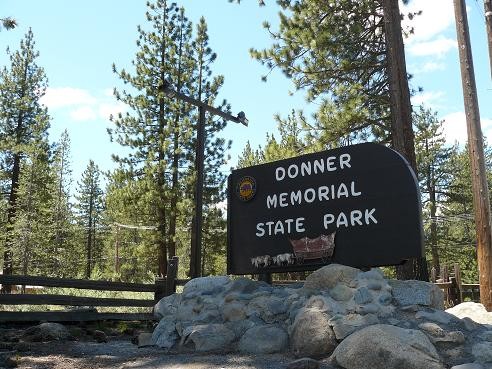
Drive roughly 90 miles east along I-80 from Sacramento where I began the morning – and take exit 184 Donner Pass Road. A quick right at the traffic circle puts you on Donner Memorial Drive and, in a few feet you’ll see this sign on your left
and be quickly greeted by this memorial.
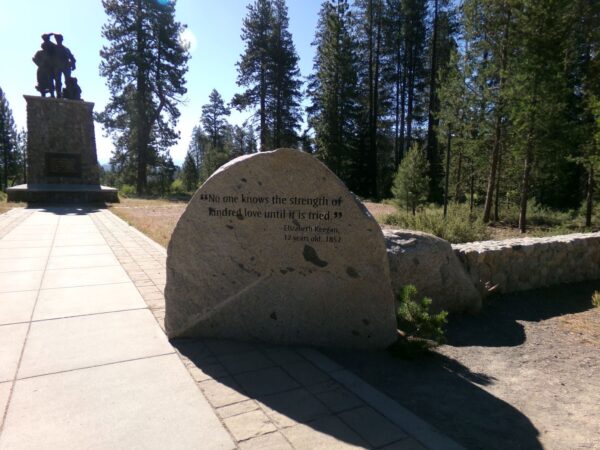
In Lake Placid, I felt compelled to explore John Brown’s farm there. In Truckee, a mere 12 miles north of the Olympics site, I again felt compelled to dip my toe in another bit of American history by stopping at Donner Memorial State Park.
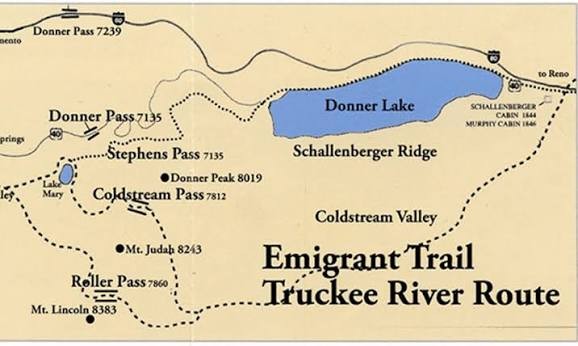
Used for perhaps seven millennia by Native Americans, this relatively low break in the Sierra Nevada (7,056 feet above sea level) first appeared in Euro-American history when, in 1844, the Stephens – Townsend – Murphy Party, ten families from Iowa heading to California by wagon train, became the first overland European settlers to cross the range at this place. With no known Native American name, it was initially called Stephens Pass but within two years, a tragic disaster would attach a new name for posterity. It would become Donner Pass.
[From Donner Summit Historical Society]
In mid-April 1846, an estimated 31 people led by George Donner and James Reed left Springfield, Illinois on their way to California. When they reached Independence, Missouri, the group joined a larger main wagon train heading west. As they continued their journey more individuals and families including the Breen and Clarke families joined the larger wagon train. At the Little Sandy River in Wyoming, George Donner finalized his fateful decision.
Some historical sources describe Lansford W Hastings as “an unscrupulous trail guide.” In 1845, Hastings published the Emigrants Guide to Oregon and California – a book that not only brought him considerable notoriety but one that promoted California as superior to Oregon. It’s believed that he hoped his plan to expand American population and influence there would prompt its separation from Mexico and, simultaneously feed his own ambitions as a land developer.
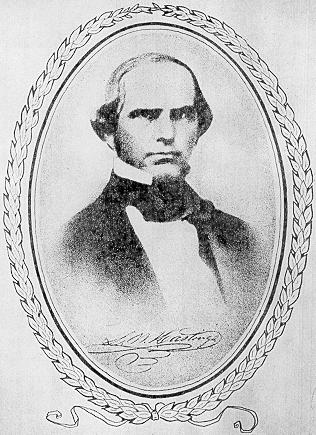
[From Wikipedia – Public Domain]
His Emigrants Guide contained this advice, “The most direct path would be leave to the Oregon route, about two hundred miles east of Fort Hall; thence bearing west-south west, to the Salt Lake; and thence continuing down to the bay of San Francisco.” Curiously, Hastings hadn’t himself traveled that route at the time he published the guide and when he did make his first attempt, he traveled from Fort Bridger to Salt Lake City, in mild weather, without time constraints, and crucially, never attempted to cross the desert portion of the route.
The large wagon train of which the Donner-Reed Party was now a part was called the Boggs Company. When they reached Independence Rock (which I visited in 2017) on 17 July 1846,
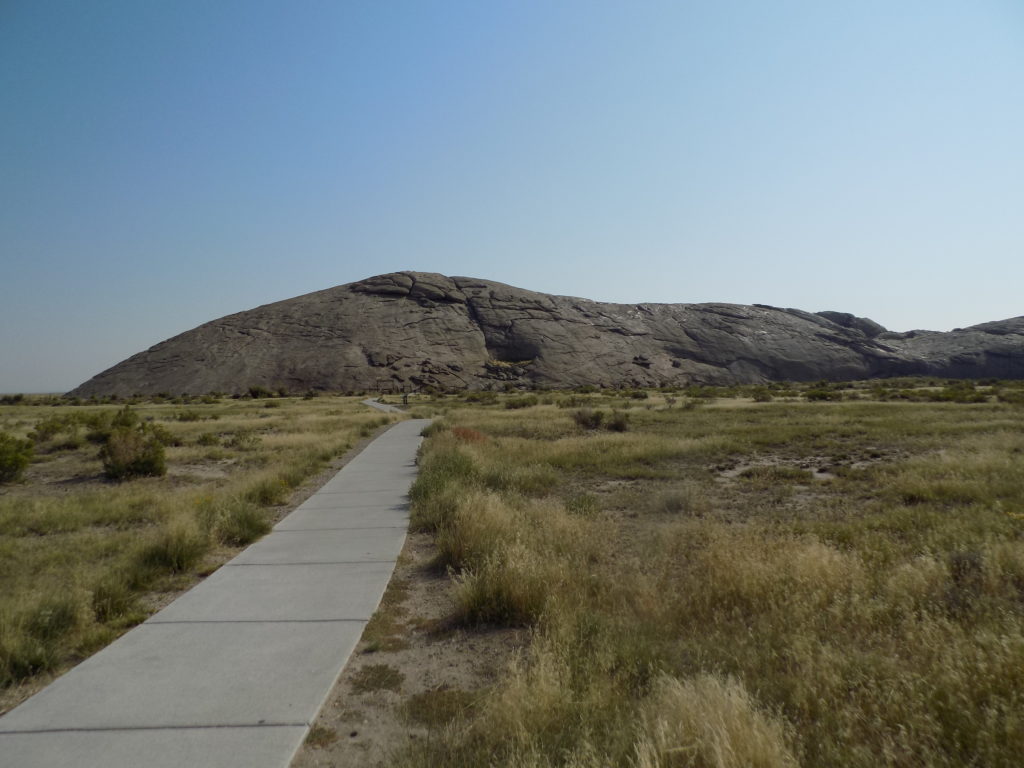
they met a lone eastbound rider who carried a letter from Hastings that encouraged “all emigrants now on the road” to meet him at Fort Bridger whence he would guide them along his trail.
Hastings’ fame and encouragement was enough to convince George Donner to use the proposed shortcut that would have shaved some 300 miles off their journey. Between 56 and 58 people joined with the original 31 of the Donner-Reed Party and formally elected George Donner as their leader on 19 July. The next day they separated from the other wagon trains taking the left-hand road to Fort Bridger where they arrived a week later. Unfortunately, Hastings had left with another group of emigrants at about the time the Donners read his letter at Independence Rock.
The Donner Party spent two days at the corral and two cabins of mountaineer Jim Bridger. Before they left on 31 July, James Reed wrote, “Hastings Cutoff is said to be a saving of 350 or 400 miles and a better route. The rest of the Californians went the long route, feeling afraid of Hastings’ cutoff. But Mr. Bridger informs me that it is a fine, level road with plenty of water and grass. It is estimated that 700 miles will take us to Captain Sutter’s fort, which we hope to make in seven weeks from this day.”
And, for the first five or six days, the group’s transit was smooth. Then, on 6 August 1846, they reached Echo Canyon where they found a note from Hastings informing them that the road was impassable. Someone, probably James Reed, went ahead and met Hastings who proposed an alternate route. This proved worse than the Weber Canyon Road in Hastings’ initial proposed route because they had to carve a fresh road through the thick trees and boulder-strewn ground of the Wasatch Mountains. The shortcut put them at least 18 days behind schedule and the imposing Great Salt Lake Desert – that was twice as wide as the 40 mile crossing Hastings had claimed – lay ahead. (The photo below is looking east from Pilot Peak, Nevada.)
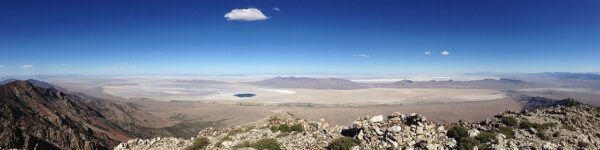
[From Wikipedia – By Famartin – Own work, CC BY-SA 3.0]
During the arduous five-day journey, they lost 36 head of cattle, half of them Reed’s, and have to abandon four wagons. They spent the next week at the foot of Pilot Peak recuperating.
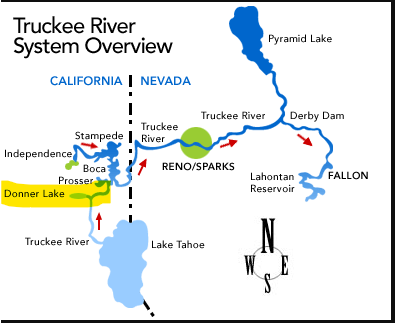
When they finally reached Truckee Lake (now called Donner Lake) in late October,
[From TWMA]
an early snowfall blocked their way. In late November, Patrick Breen, a member of the party wrote in his diary, “Came to this place on the 31st of last month that it snowed. We went on to the pass, the snow so deep we were unable to find the road, when within 3 miles of the summit, then turned back to this shanty on the Lake… We now have killed most part of our cattle, having to stay here until next spring & live on poor beef without bread or salt. It snowed during the space of eight days with little intermission, after our arrival here.”
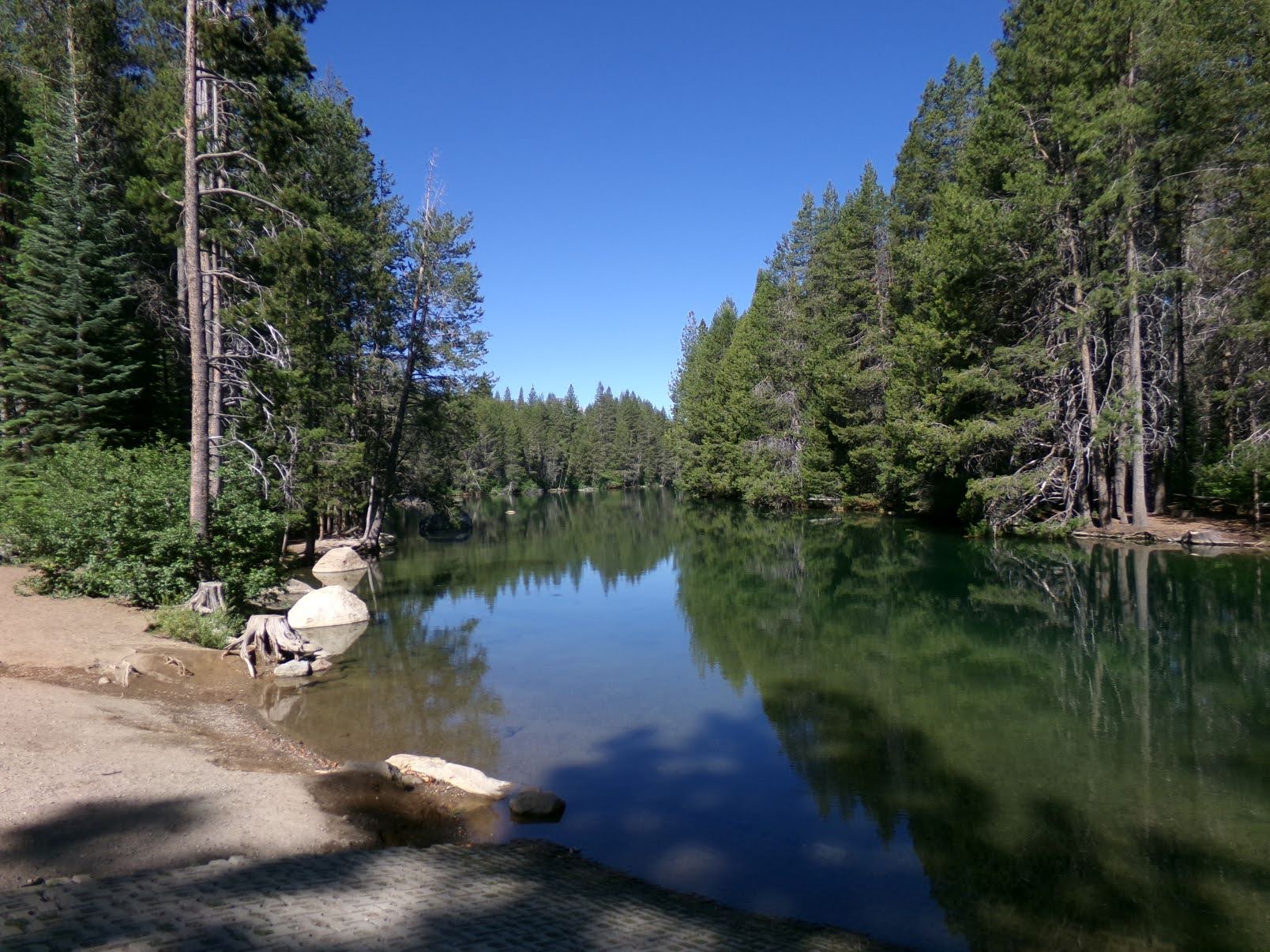
On my visit, the top of Donner Lake looked like this.
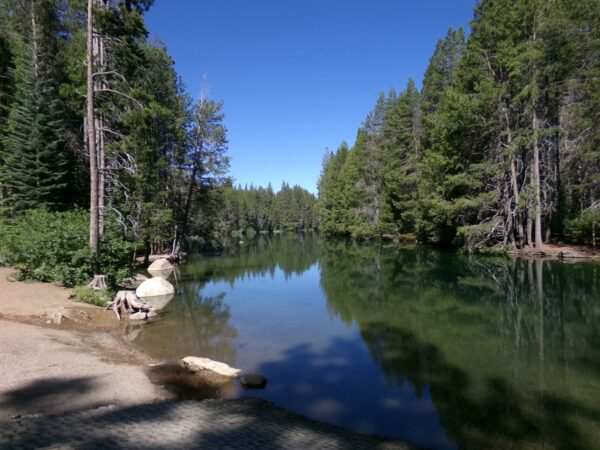
Records indicate that 10 major storms blanketed the area with varying amounts of snow beginning with the first snowfall on 18 October and ending in April 1847. The winter became one of multiple rescue attempts that set out from Sutter’s Fort, a struggle for survival, and of death with nearly half the party – including George Donner – perishing before reaching their goal.
This alone might have been enough to prompt the renaming of the pass and the lake. However, emigrant diaries and testimony coupled with sensationalist press reporting created a legend. As the winter exhausted their food supplies and wild game became scarce, some in the party, by their own admission, resorted to cannibalism in their desperate efforts to survive. It wasn’t a regular practice and, with the possible exception of two Indian guides, no one was murdered for their flesh.
The party divided into two main base encampments one at Alder Creek that was occupied by 21 emigrants including the Donner family and the other at the lake that’s the site of the park. The Breen and Reed families were among those in this place and marked by this stone and plaque.
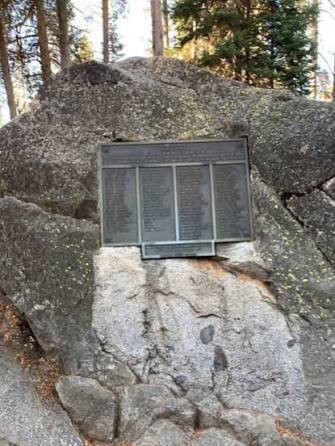
Twenty-first century archaeological excavations at Alder Creek recovered over 16,000 bone fragments mostly from deer, rabbits, rodents, cattle, oxen, horses, and one dog but no cooked or clearly human bones. Researchers concluded that if cannibalism occurred at Alder Creek, it was limited, or that human bones were not burned/boiled and thus decomposed more quickly.
Thus, credible historical evidence shows that while some members of the Donner Party practiced cannibalism, it was limited, desperate, and not as all‑encompassing as the popular legend sometimes implies.
As you can see from the photos above (and here) the park in June 2026 is lovely and everyone I met as I walked through the forest and along the lake shared a pleasant and unprompted, “Good morning.”
Next stop, Palisades Tahoe – nee Squaw Valley.
-
Photos and their stories – Lisbon – Summer 2026 part two – plus an egg-straordinary bonus
August 21, 2026 -
Photos and their stories – Lisbon – Summer 2026 – part one
August 21, 2026 -
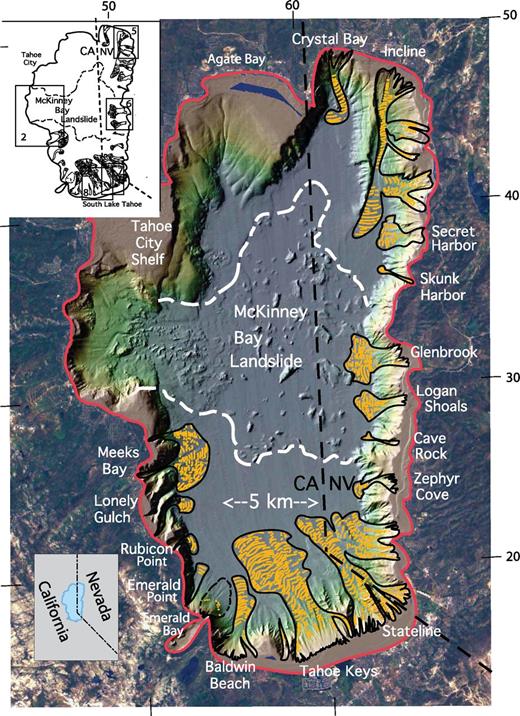
The indigenous people of Da?ow?aga? (Olympic Valley and me supplement three)
August 19, 2026 -
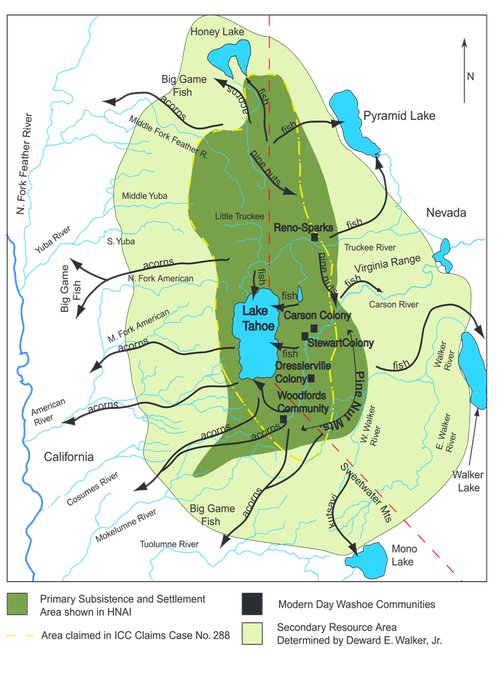
The indigenous people of Da?ow?aga? (Olympic Valley and me Supplement two)
August 17, 2026 -
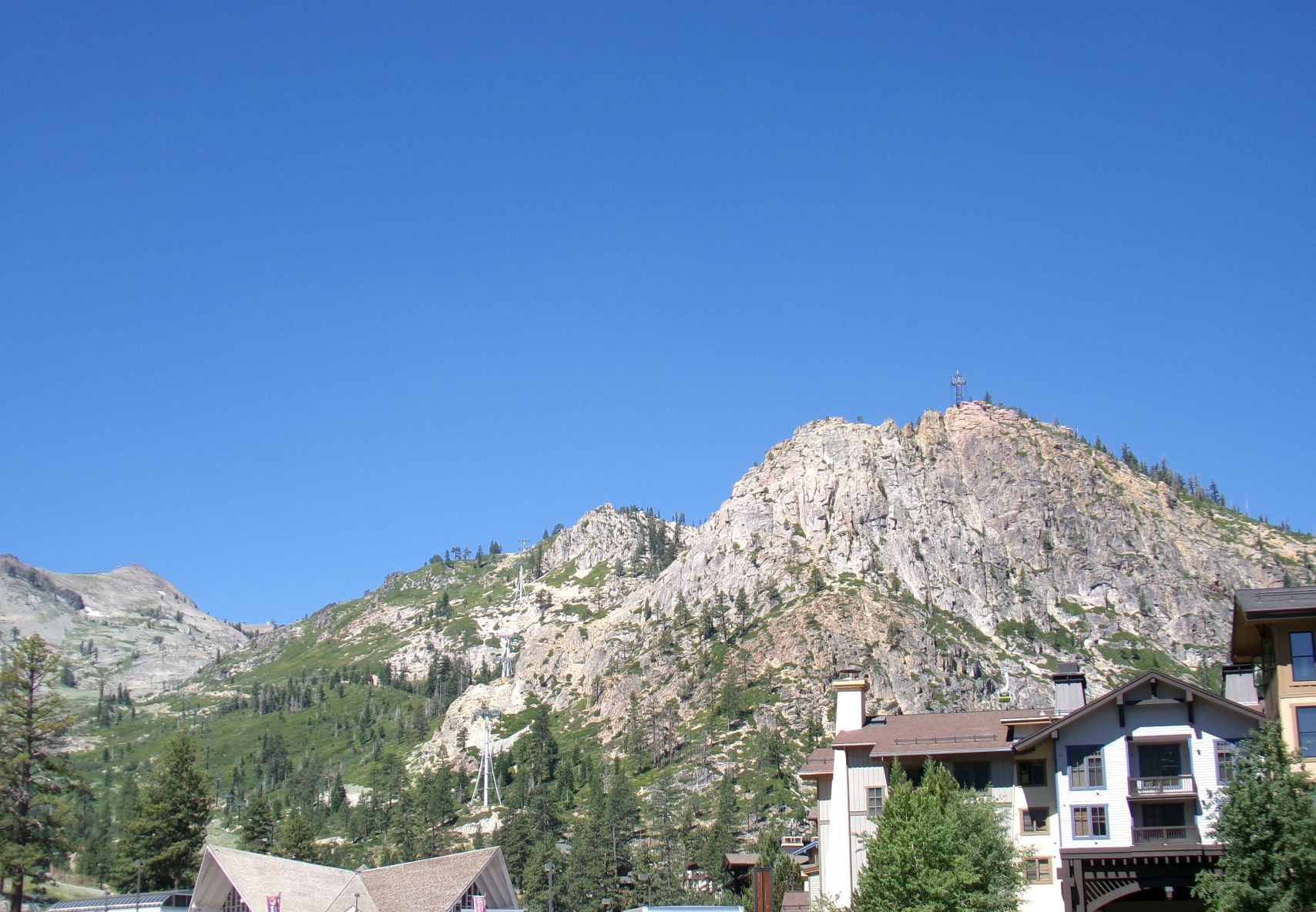
Olympic Valley in the time before humans (Olympic Valley and Me Supplement one)
August 14, 2026
2 responses to “Olympic (Squaw) Valley and Me – part one”
Dear T, didn’t know you were intending to stop at Donner Lake on this trip. It is the place we try to visit every winter to snowshoe in solitude. We generally drive up on a quiet weekday after a major winter storm has subsided and I-80 has just reopened. There are so many trails in the vicinity, including the famed Pacific Crest Trail, on which we once trudged along blindly (could see no trail whatsoever, only knew we were on it by GPS) until avalanche conditions forced us to turn back. We definitely have communed with the spirits of the Donner Party when we have been cold, isolated, and alone on Donner Peak. It can be a wild, spectacular, scary place in the middle of winter.
And a calm beautiful one at the beginning of summer.