Photos and their stories – Lisbon – Summer 2026 part two – plus an egg-straordinary bonus
Welcome to part two of Photos and their stories.
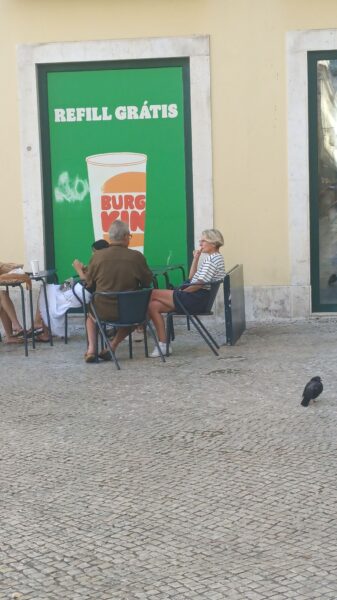
Once again I took a picture of something that never struck me as unusual until my brain flipped a switch. For some reason I never thought about this sign being in Portuglish. Pure English would, of course, be “Free Refills.” Pure Portuguese would, I think, be. “Recargas grátis.”
I took this next group of photos Monday afternoon in Alhandra a small town on the rio Teju about 30 kilometers northeast of Lisbon.
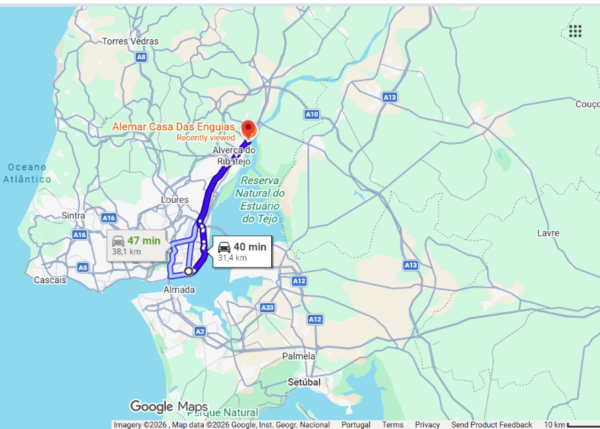
It’s a 25-minute train ride that cost me €2.20 because I get a 50% senior discount on the fare. I was there to meet an attorney and arrived rather early so I walked around the town a bit. (By the way, here’s an object lesson about the trains in Portugal: Don’t believe the schedule. As you might expect, trains regularly get delayed and even canceled. Monday, the opposite happened. The train listed with a 10:45 departure on the schedule Sunday night, left at 10:20. Fortunately, I arrived at the station about 10:15 and, rushing, got on board.)
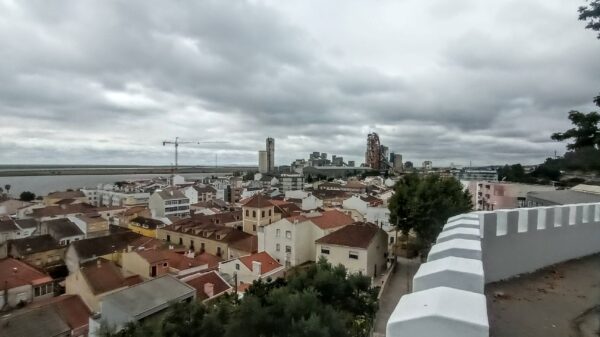
My first stop was the town’s miradouro. Charming if you look to the left,
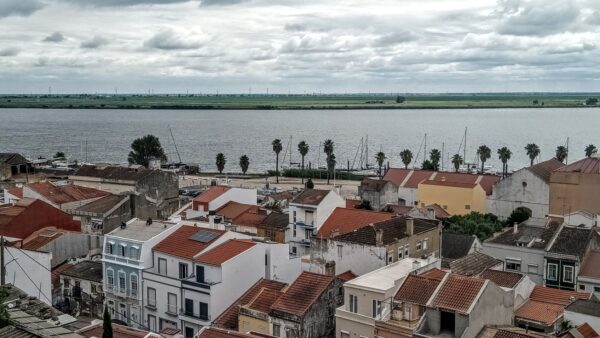
a little less so looking right.
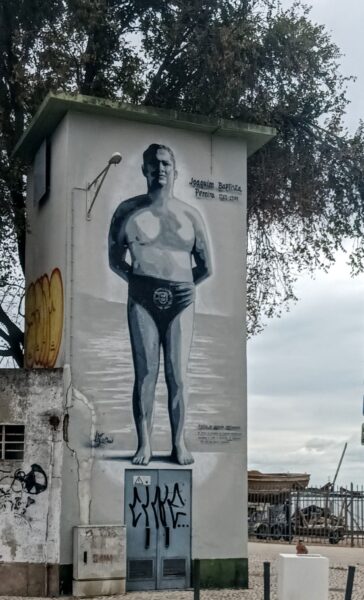
There was some wall art (and you know I like that)
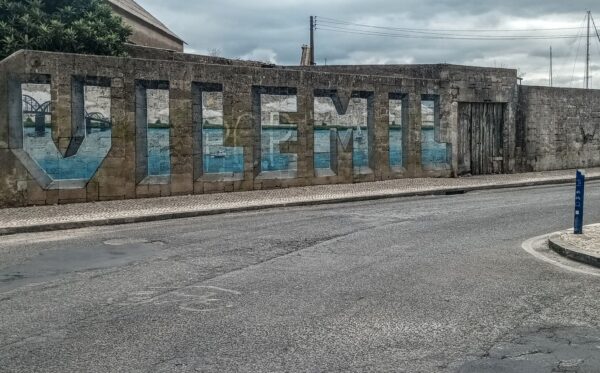

even if I’m a little unsure about Speedo Man.
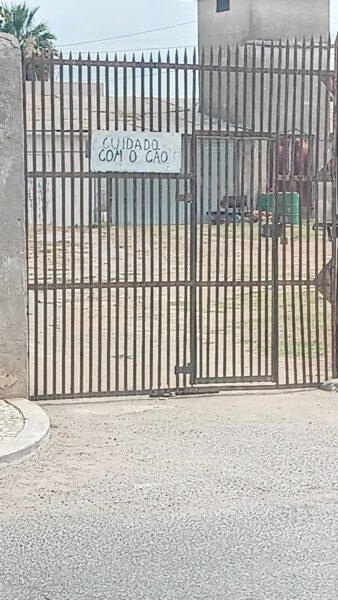
This homemade “Beware of dog” sign brought a wry smile.
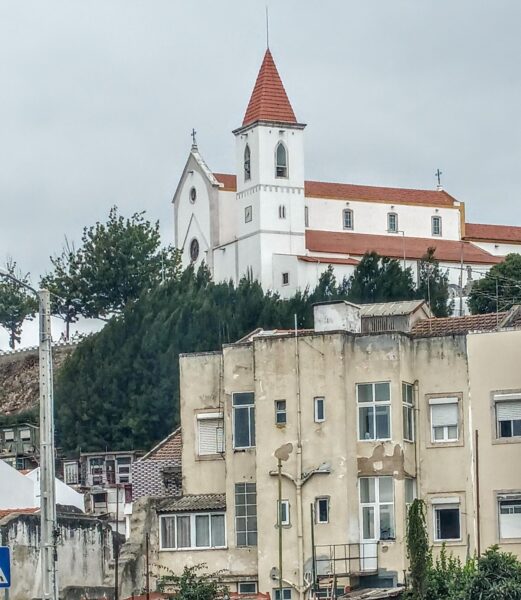
And finally a look back at the church and adjacent miradouro.
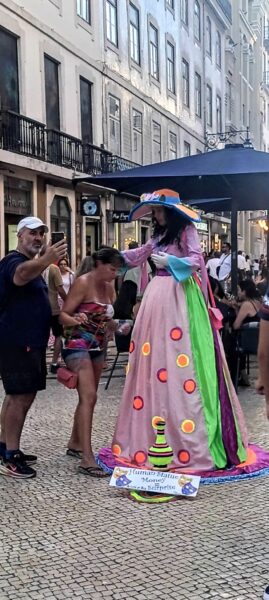
Below are two pictures of P. She’s been doing this act as a “human statue” on rua Augusta for several years and we’ve come to know each other a little because I see her many nights when I walk through the neighborhood, have occasionally dropped a coin or two into her jar (because I had to discover the promised “surprise”), and have had the chance to talk with her. She’s from Argentina, speaks very little Portuguese and even less English. But somehow we manage to communicate.

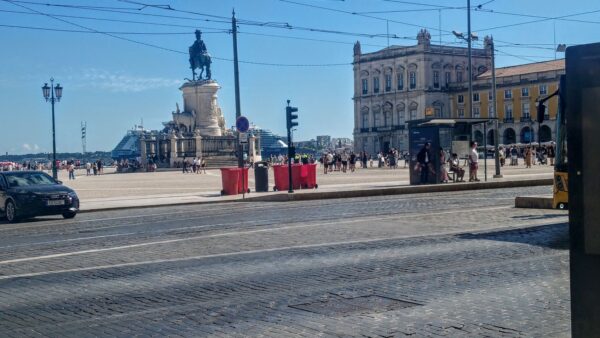
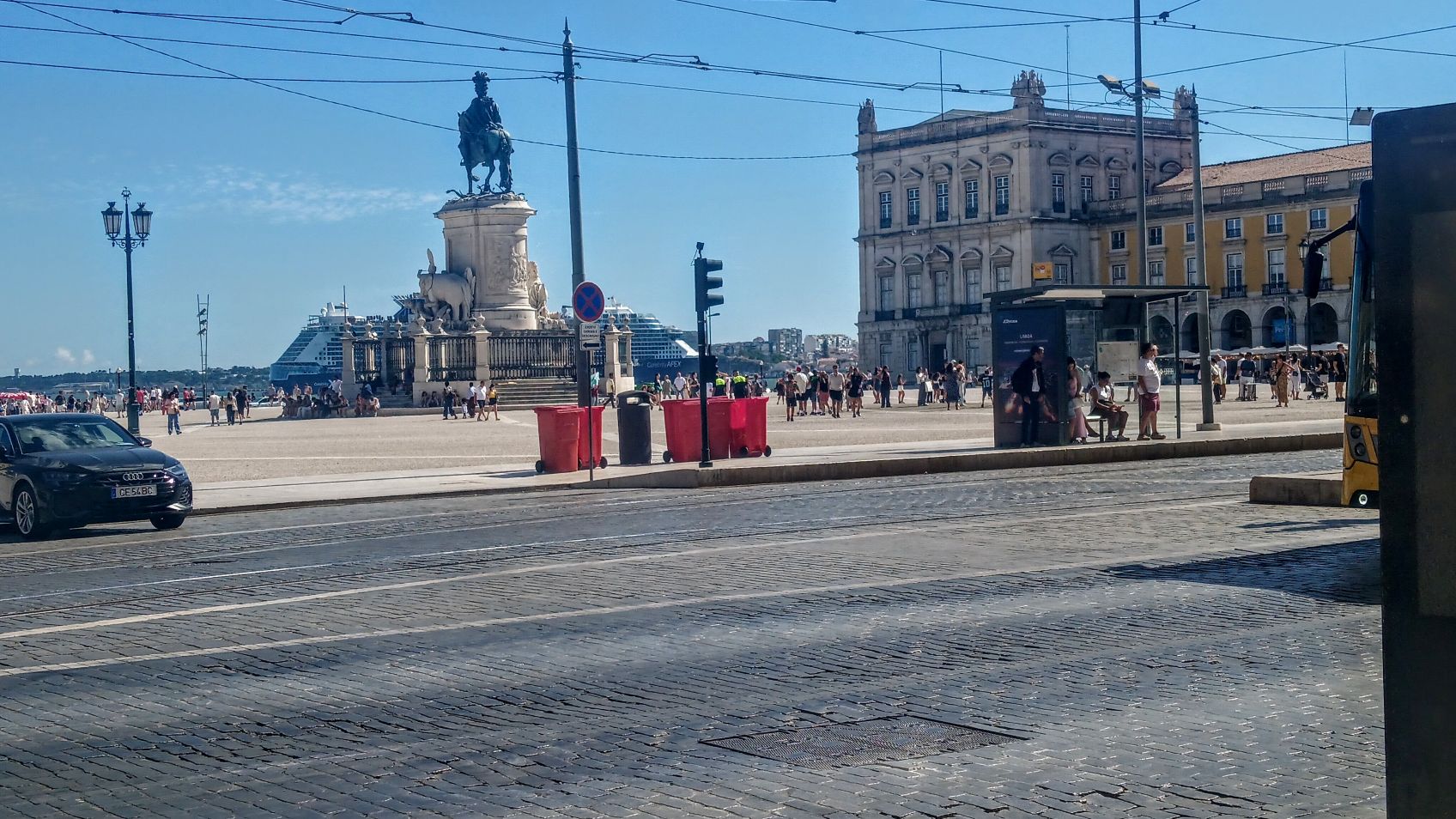
I took this last picture of a departing cruise ship Tuesday afternoon as I walked past o rio Tejo e Praça do Comercio. because departing cruise ships are one of my favorite sights as those who read my rant about cruise ships might recall.
Some final thoughts
This section has nothing to do with pictures from Portugal. I hope you don’t find this first part egg-scrutiating.
I’ll step back in time to Saturday night when I was chatting with my friend B. Though I’d finished my supper, it was midafternoon for him. During our conversation, I mentioned that I’d cooked the last of my vegetables and that, beginning Monday, because of my impending Wednesday departure, I planned to eat out for most of my meals. He wondered why this would be necessary since we’d previously discussed that I shopped for groceries almost daily.
I reminded him that since I won’t be back here for three months, fresh vegetables would spoil even with excellent refrigeration. Bread will get stale. Butter will turn rancid. And so on. Sunday morning, my eyes fell on more comestibles that I’d need to finish. They were in this packaging.:
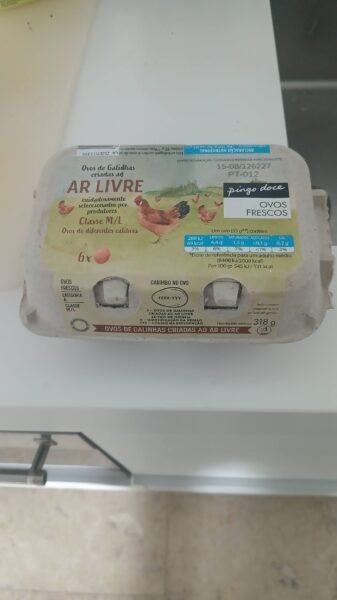
What’s unusual about a container with a half-dozen eggs you might wonder. As would I – until I noticed my kitchen scale that’s calibrated to grams. I connected the two by wondering, with most of the world using the base ten metric system, why are eggs not sold in similar quantities. This became a question I wanted to answer and I’m about to share with you the answer I learned.
(And, among the first things I learned is that, while the practice is widespread, it’s not uniform. Selling eggs in half dozen containers seems to be common. However, ten seems to be the default larger size especially in northern European countries such as Germany and Poland. Japan also seems to have a preference for packages of ten.)
Before I started my investigation, I puzzled over why we don’t use the number 12 in more contexts. In many ways, it seems a more convenient number than ten. Yes, ten matches the number of digits on our hands and feet but it’s only divisible by two and five. Twelve, on the aye-aye’s hand,

[From Wikipedia – By nomis-simon – https://www.flickr.com/photos/nomissimon/15819070729/, CC BY 2.0.]
is divisible by 2, 3, 4, and 6 – making it easily divisible into halves, thirds, quarters, and even sixths with no fractions. Seems more convenient than ten – at least to me.
The practice of selling loaves of bread and eggs by the dozen began in medieval England. (The word dozen stems from the Latin root duodecim meaning “twelve.” It entered Middle English from the Anglo‑French word douzeine, became Anglicized as dozen, and has denoted exactly twelve items since at least the 14th century.) It’s unclear which product, if either, initiated the practice but currency division might have been the impetus.
As early as the 13th century, and continuing for much of its history, an English shilling equated to 12 pence. The ease of making change for quantities less than a dozen became advantageous for both vendors and buyers and the custom was long-settled before the earliest British settlers established themselves in North America. It was also a system the British carried with them as they expanded their empire.

[From IMDB]
Industrial farming and supermarket chains in the 20th century helped lock in the dozen (and half‑dozen) as default package sizes in many markets. So, it turns out that this packaging is a relatively recent development.
Bonus material
I suspect that my readers from the UK and the US are familiar with the term “baker’s dozen” describing a count of thirteen items. Here’s how that came to be.
Medieval England had a law called Assize of Bread and Ale. (My research showed that neither the baker’s nor the brewer’s buttocks had any connection to the law.) It fixed the price of a standard loaf of bread but allowed its weight to change with the price of wheat. When grain got more expensive, loaves could weigh less; when grain got cheaper, loaves had to be heavier.
The law defined a sliding scale based on the market price of a quarter of wheat. This was equivalent to eight bushels or about 480 pounds (218 kilograms). For example, when wheat sold for 12 pence, a farthing (1/4 of a penny) loaf of white bread had to weigh a specified amount; as wheat rose in price, the required loaf weight was reduced in fixed steps. The assize covered both price and quality as well as weight, with different kinds of bread assigned different rules.
Bakers faced monetary fines for violating the rule but repeat offenders could also be sent to the pillory.
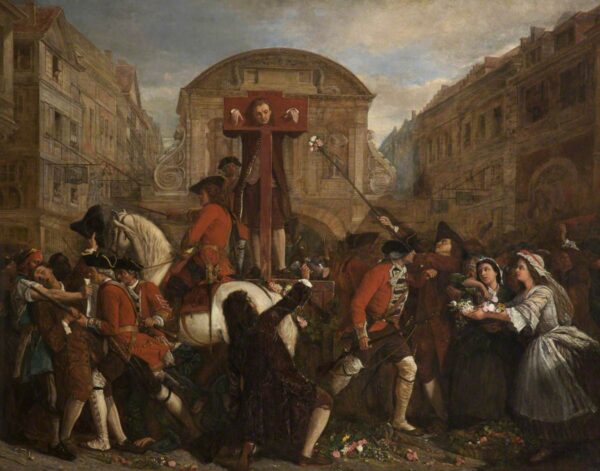
[From Wikipedia – Public Domain]
Since the determinative factor of the Assize was weight, many bakers added a thirteenth loaf to avoid the penalty.
Whether this history was new or known to you, I hope you at least found my presentation interesting and perhaps picked up a tasty crumb or two and I’m not yolk-ing.
Retro travel and Veniam Peto
As I prepared to leave Lisbon, I anticipated my midsummer return would, technologically speaking, have retro echoes of the twentieth century because I’d be traveling without a computer. Yes, I had my telemóvel but I’d deliberately left my laptop in Lisbon and I don’t think I’ve traveled without a computer since before I stared this project in 2013.
All my Microsoft Office files are stored on one of the laptop’s hard drives so I can’t update Word or Excel with my phone. (Or at least I’m not technologically competent enough to do so.) Further, I expected no internet access while on my Air France flights because I neither have nor want to establish an account with them for the limited free access I’d receive. (My Delta medallion status provides unlimited internet on their flights.) So it was that I turned back the clock and read the physical hard cover book I’d brought and also penned an early draft of this section in a spiral notebook. Retro, no?
In this post, I wrote a disparaging passage about Charles de Gaulle Airport (CDG) in Paris that my subsequent passages through it reinforced.
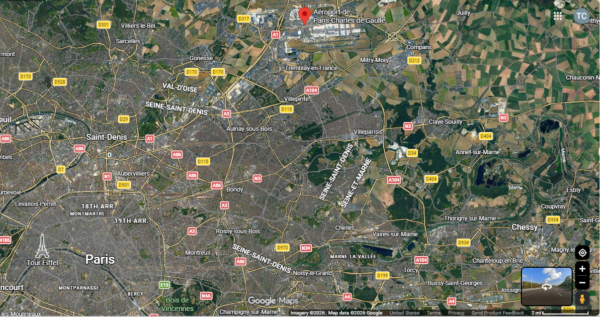
I wasn’t relishing the prospect of this transit from Lisbon to Dulles via a stop at CDG. While exiting might be a different experience from entering, this time was so pleasant it has all but erased that negative past. The signs were clear, the walk to Passport Control was a reasonable length, and clearing Passport Control couldn’t have been easier. When I asked someone for directions to the Air France Lounge his response was courteous and professional. So, CDG, I apologize.
That’s all I have for now. To those of you who travel, I hope you have safe voyages of great pleasure and discovery.
To those who travel vicariously through these posts, I hope they are voyages of pleasure and discovery.
And to all of you, até à próxima.
-
Photos and their stories – Lisbon – Summer 2026 part two – plus an egg-straordinary bonus
August 21, 2026 -
Photos and their stories – Lisbon – Summer 2026 – part one
August 21, 2026 -

The indigenous people of Da?ow?aga? (Olympic Valley and me supplement three)
August 19, 2026 -
The indigenous people of Da?ow?aga? (Olympic Valley and me Supplement two)
August 17, 2026 -
Olympic Valley in the time before humans (Olympic Valley and Me Supplement one)
August 14, 2026