The indigenous people of Da?ow?aga? (Olympic Valley and me supplement three)
The very abbreviated version of Wá∙šiw creation
The story of the Wá∙šiw begins when the Maker of All Things decided to sort the seeds that would become the tribes of humanity. The Maker planned to count the same number of seeds for all the tribes. When the Maker was nearly done, the mischievous West Wind blew a great gust across the Maker’s winnowing tray scattering seeds in every direction.
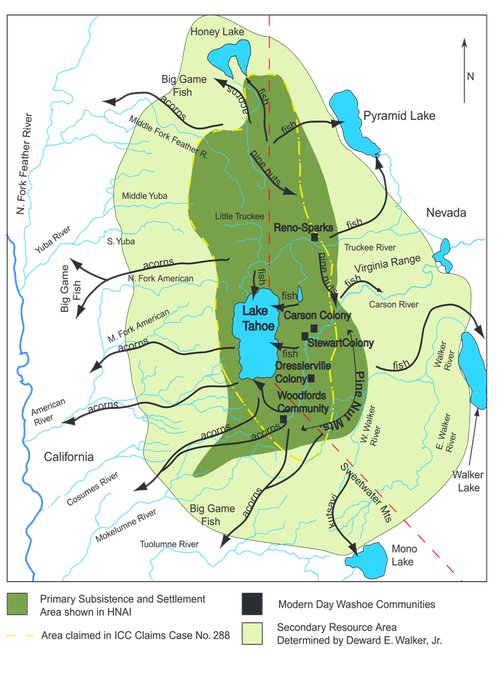
Only a small number of the seeds that would become the Wá∙šiw remained on the tray and the Maker placed this small tribe in the basin of the lake that would be called Da?ow?. Géwe, the Coyote and Lizard reorganized the watery world and, in doing so, created the conditions for life on land and made the world fit for people. The lake became the center of all things for the Wá∙šiw but the mountains, the valleys, the streams, and the caves were already named and part of the story. Those stories told the people who they were and how to live.
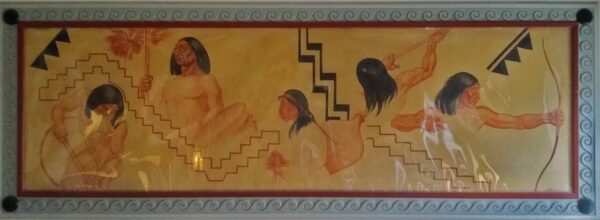
[Painting by Robert Cole Caples From Wikipedia – Public Domain]
Géwe and showed the people where the fish gathered in spring, where the deer moved in the high country, and where the pine nuts ripened in the fall but the lake stood as the heart of everything. Its waters were sacred, with power to heal and to sustain. It gave life to the land, to the plants and animals, and to the people themselves and carried on season after season.
In spring, the people moved toward the lake as the fish ran thick in the streams. Families gathered and shared stories. In summer they went higher into the mountains, to alpine lakes and meadows. In fall they spread out to harvest seeds, acorns, and above all the piñon nuts. When they completed this work they held a ceremony of thanks to the Maker. In winter they lived in low, round houses of bark and brush and the elders repeated the stories of the seeds and the wind, of Géwe and the lake, and of how the Wá∙šiw came to be here and why they are few.
The Wá∙šiw say they were here in the beginning, placed at the center of their world by the Maker, guided by Géwe, and taught by the cycle of the seasons. The land is not simply where they live; it is the story of how they came to be, told again each time they move through it, speak its names, and gather around the fire to remember.
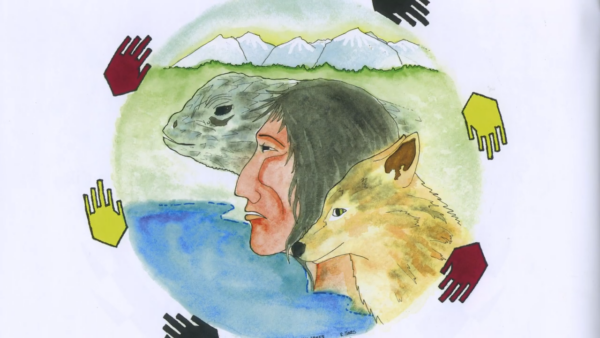
[From YouTube]
The obverse purpose of a culture’s creation story is shaping its knowledge of and its spiritual link to the local environment. The reverse is also true. The environment shapes the creation story. Thus, as I read and listened to variations of the creation as told by the Wá∙šiw, it elicited a strong memory of the Rainbow Serpent present in many Dreaming stories of Australia’s first people. The Rainbow Serpent moves across a flat, dry earth carving riverbeds, forming hills and mountains, and creating waterholes, before awakening or bringing forth animals and people.
For the Wá∙šiw, the narrative of Géwe and Lizard encodes how people should relate to the land and its beings, rooted in the origins of Lake Tahoe and the surrounding country. For the First Australians, the story of the Rainbow Serpent teaches respect for Country and warns of consequences if people abuse the land.
Where legend and geology meet
Travel roughly 265 kilometers west along the A1 from Melbourne across the Australian state of Victoria and you’ll reach the town of Warrnambool that’s near the eastern edge of Gunditjmara Country. I’ve provided a very general outline on the screenshot below from Google Maps.
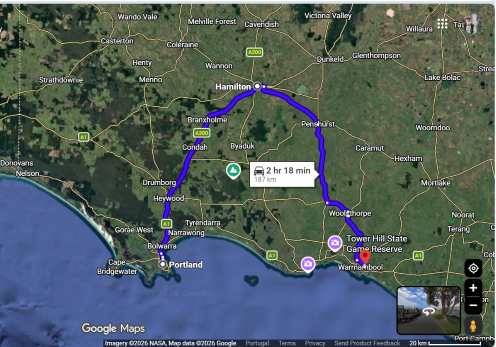
There’s a symbol just to the left of the annoying drive time label that marks the location of Budj Bim that’s also identified as Mount Eccles.
The Dreaming tells of four giant beings who arrived in the land. Three continued their journey inland and one, Budj Bim remained behind. When he laid down on the ground, his body transformed into a volcano. He spat out his teeth and, with his blood, they flowed like lava. This shaped the landscape forming rocks, channels, and large wetlands in the area. The ancestors used the changes to the land and, using the channels formed by lava flows they built weirs that controlled water flow on the rivers and created a system of aquaculture that trapped kooyang (short-finned eels). This provided a year-round food supply and often a surplus that could be used in trade with other nations.
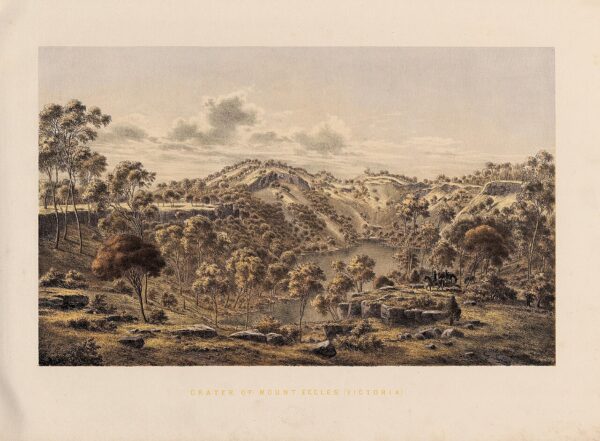
[From Wikipedia – By Eugene von Guerard]
A 2020 study led by Dr Erin Matchan of the University of Melbourne working with researchers at Curtin University used argon-argon (40Ar/39Ar) dating on volcanic rock samples to confirm the eruption. The best-estimate age they reported for Budj Bim was 37,000 years ago (± 3,100 years). Budj Bim is a scoria cone volcano – a type that forms rapidly as it erupts from nearly flat earth to tall peaks many feet or meters high in a matter of days or weeks. A stone axe found beneath the hardened lava flow indicates that there were humans in the area to witness the eruption. (This would be unsurprising given that these people populated the continent at least 60,000 years ago.) In its description of volcanic eruptions, the Budj Bim Dreaming may be the oldest known oral tradition tied to a specific geological event.
20,000 years later on another continent
The Wá∙šiw tell of two trickster brothers, Puwecili and Damalali, who were tied to the lake and the sacred places around it but who also moved through the world in a way that changed the land itself. Damalali, the younger brother does something that brings forth a great wave with the water rising on the western side of the lake and rushing across to the south shore. (Here, you can hear a slightly more detailed telling of this story told by Herman Fillmore the Director of Culture and Language Resources for the Wá∙šiw.) As the wave passed, it changed the lake and its shores creating sacred sites such as De-ek Wadapush (Cave Rock)
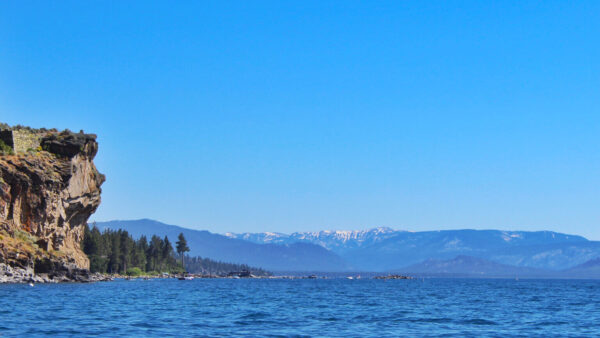
[From Travel Nevada]
and other features of the local geography including Dawgašašíwa (Taylor Creek) and Debeyúmewe? (Truckee River). As is true for the Gunditjmara, this is not simply a disaster tale. Rather, it’s a record of place, power, and it serves as a guide for the people in their relationship to the basin and one another both physically and spiritually.
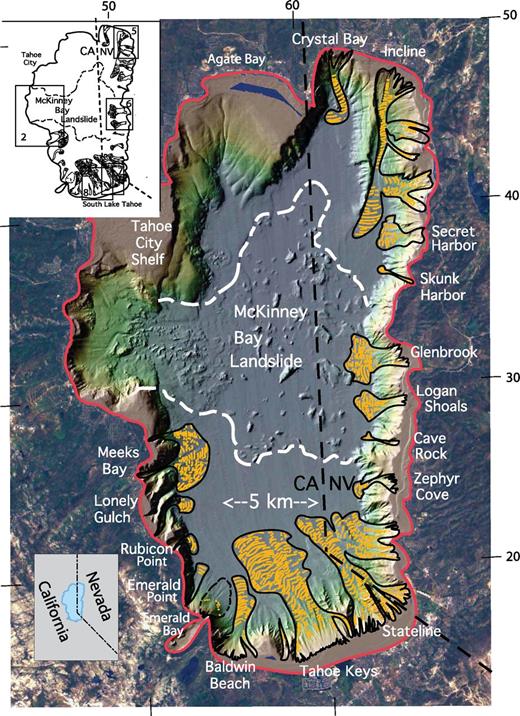
Conventional geology spotted the first signs to possibly confirm the Wá∙šiw account when the first sonar survey of Lake Tahoe showed evidence that McKinney Bay, in the middle of the lake’s western shore, is a scar left by a very large landslide.
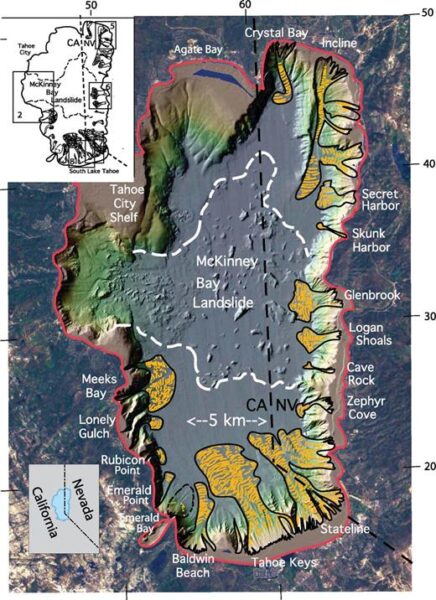
In 2014, James G. Moore, Richard A. Schweickert, and Christopher A. Kitts published an article in GeoScienceWorld (the source of the map above) with evidence showing that a landslide of more than 12 cubic kilometers, “detached from the west wall of Lake Tahoe (California-Nevada, USA), and slid 15 km east across the lake. The splash, or tsunami, from this landslide eroded Tioga-age moraines dated as 21,ooo years ago (ka). Lake-bottom short piston cores recovered sediment as old as 12 ka that did not reach landslide deposits, thereby constraining the landslide age as 21–12 ka.”
According to the website Visit Lake Tahoe, archaeological evidence supports a Wá∙šiw presence in the Great Basin of at least 12,000 years placing them in the region at the younger end of the time range discussed by Moore, et al. While spirituality isn’t within the purview of geologists, here’s yet another instance where the geology comports with the legend in a way that indicates it might behoove Western science to take greater heed of indigenous knowledge.
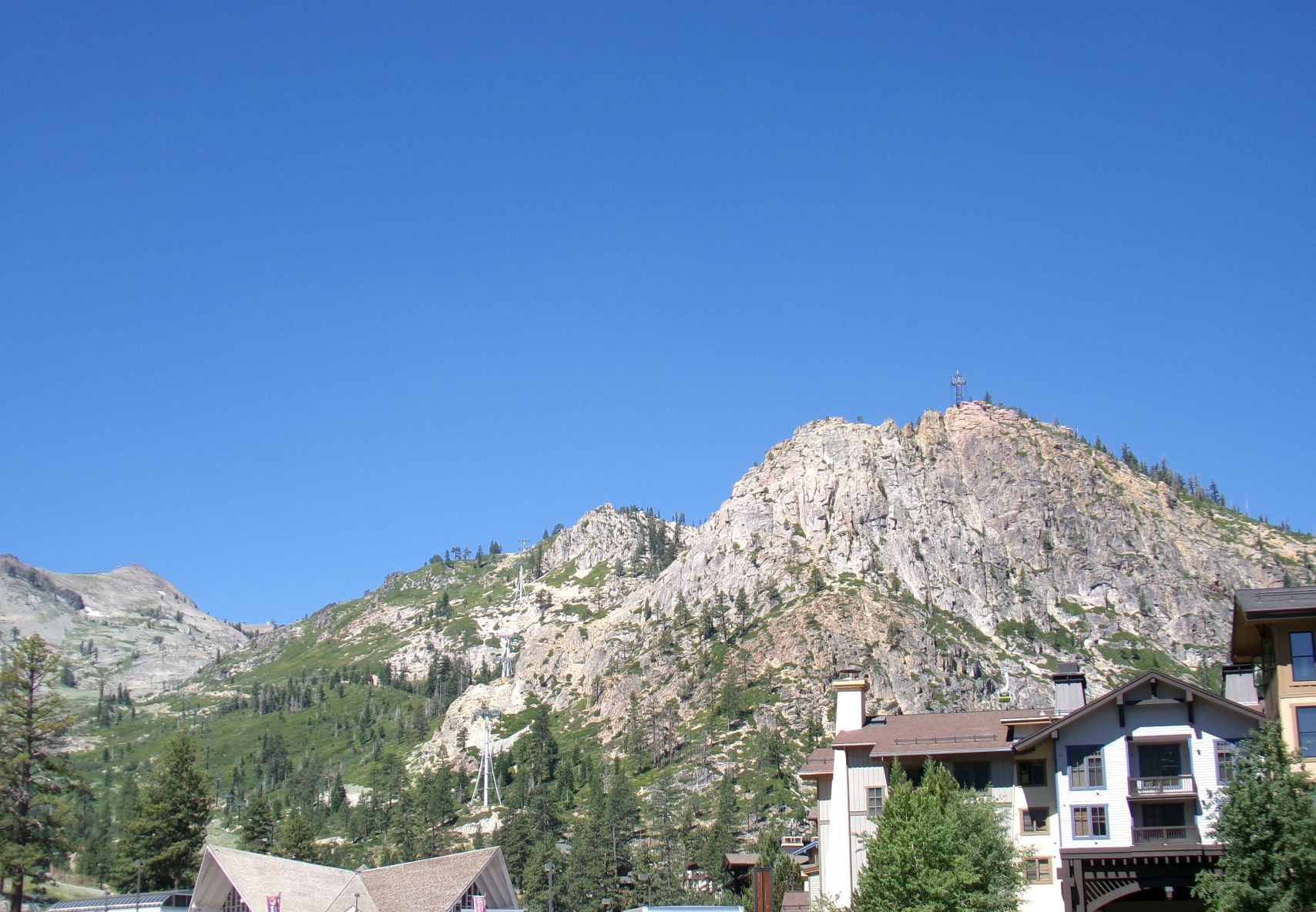
For those of you not counting with me (and I suspect none of you are), Squaw Valley is the 25th of the 46 cities plus one resort to have hosted an Olympic Games I’ve visited. I’m reasonably certain I’ll add to this total before too long but will not do so on either of the next two trips I have planned. Until I write about those, I wish you all safe and enjoyable travels.
-
Photos and their stories – Lisbon – Summer 2026 part two – plus an egg-straordinary bonus
August 21, 2026 -
Photos and their stories – Lisbon – Summer 2026 – part one
August 21, 2026 -
The indigenous people of Da?ow?aga? (Olympic Valley and me supplement three)
August 19, 2026 -
The indigenous people of Da?ow?aga? (Olympic Valley and me Supplement two)
August 17, 2026 -
Olympic Valley in the time before humans (Olympic Valley and Me Supplement one)
August 14, 2026