Sentir, algo misterioso Cosas que me llamen voces que me griten
For me, Thursday was among the most unusual days I’ve ever had on a tour because I was inattentive for much of the morning. Let me explain. I’ve noted that most of my research for the material in these posts has two stages – one before I leave that provides me with both some foreknowledge of the location’s history and culture and one after I return that uses what I learned and expands upon both. In the case of CDMX, because if its status as an Olympic host city, I’d done considerably more pre-trip research then I typically do. Thus, soon after we began our tour in the National Museum of Anthropology, I found myself doing a lot of looking but very little listening because I already had extensive notes on most of the information our guide presented.
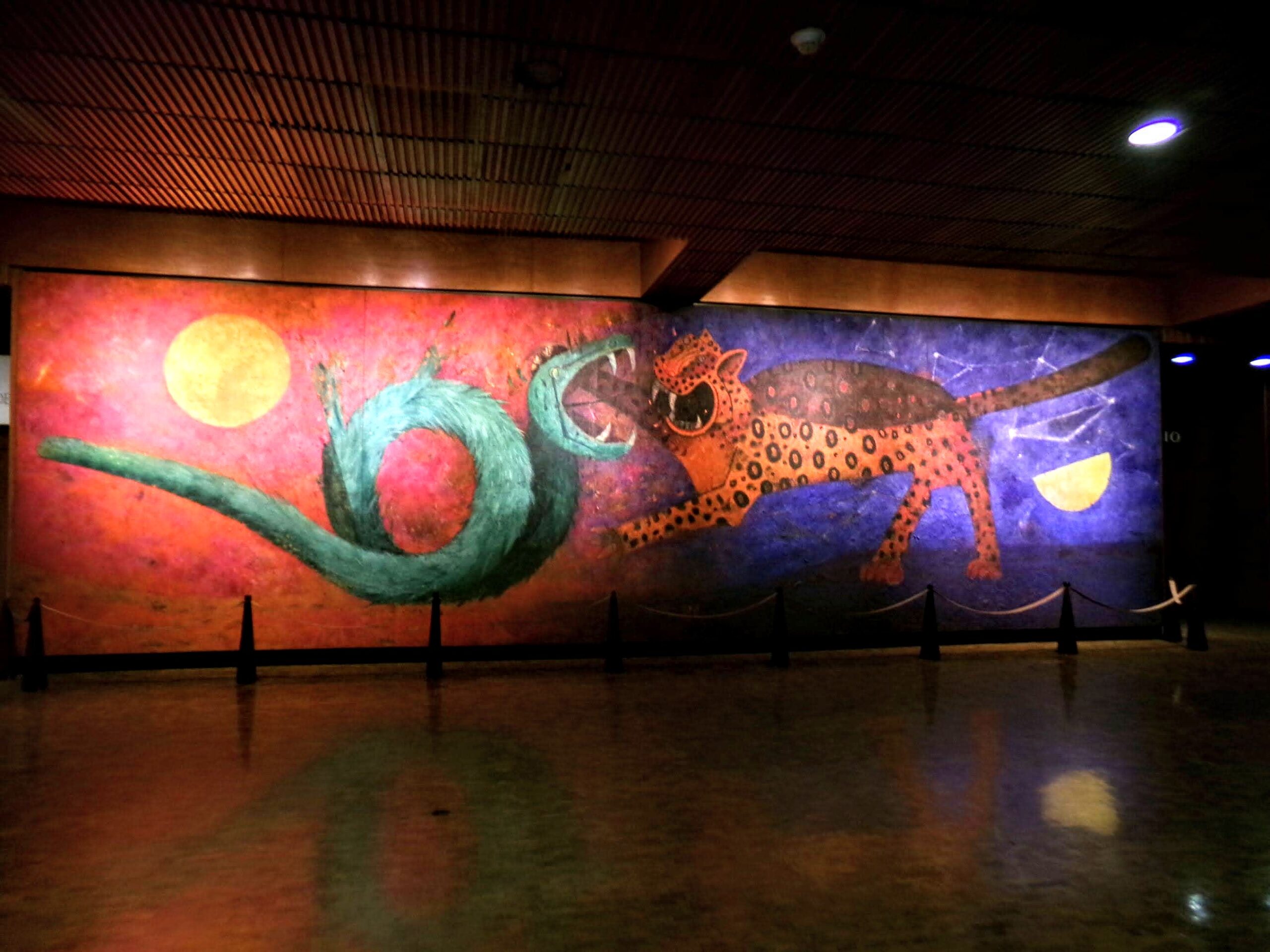
That’s not to say I didn’t learn anything. And my education began in the museum’s entry hall with the arresting Rufino Tomayo mural called Dualidad (Duality).
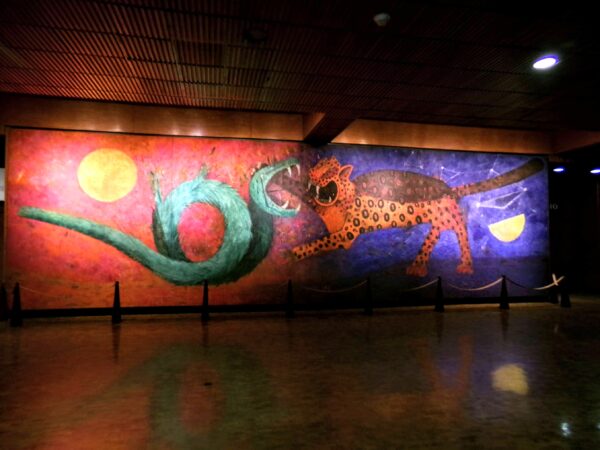
The painting merits a mention on Atlas Obscura that notes, “The mural often goes unnoticed by visitors eager to see the archaeological treasures of the museum, but it’s worth pausing a moment to contemplate this enigmatic art piece.”
The two main elements are the jaguar and the plumed serpent. The former represents darkness and Tezcatlipoca – the god of night and human sacrifice. The serpent is Quetzalcoatl – god of knowledge and creator of humankind.
Tezcatlipoca manifests as a jaguar because of the animal’s primarily crepuscular and nocturnal behavior and because its spotted coat was believed to resemble the night sky. The name Quetzalcoatl combines the Nahuatl words quetzal – a brilliantly plumed bird – and coatl meaning serpent. The symbolism of the image unites sky and earth into a single sacred being, expressing his role as a creator, culture-bringer, and uniter of earth and sky.
In the cosmology of the Mexica, Quetzalcoatl and Tezcatlipoca were not only brothers but divine opposites who controlled the successive cycles of creation and destruction of the universe – a cycle they called “suns.” Their sibling rivalry was a battle for cosmic supremacy that was believed to be the reason for the phenomena of night and day.
In the painting, Quetzalcoatl – the Feathered Serpent who rules the day – is accompanied by the sun and is shown in confrontation with the Jaguar Tezcatlipoca who is accompanied by the stars and moon. Their positioning and ferocious expressions allude to their ongoing battle. However, the image presents a symmetrical and balanced composition that is a dramatization of pre‑Hispanic duality – life/death, light/dark, day/night – channeling ancient Mexica and, in a broader sense, Mesoamerican symbolism.
El Paraguas
My education continued in the courtyard with the fountain called El Paraguas.
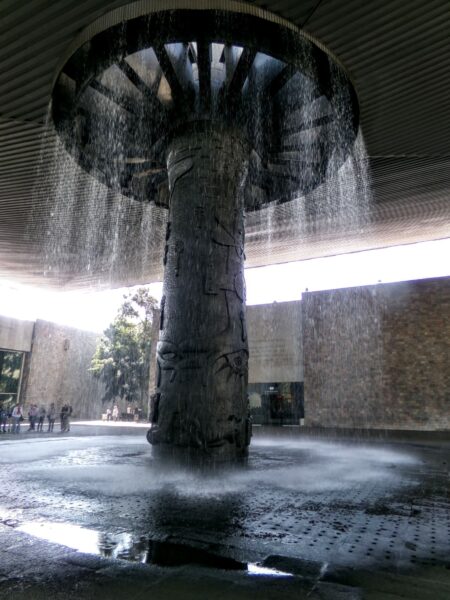
The engravings on the fountain’s central column represent México’s cultural fusion. As Amalia Hernández had done with her choreography, the sculptors chose not to portray the violence that inextricably accompanies conquest. The images on the east side depict mestizaje – the integration and fusion of Indigenous people with Spanish conquistadores – illustrating the hagiography of national identity the government wanted portrayed.
Whether you proceed clockwise to the column’s southern side or anti-clockwise to its north, you will see images emphasizing national liberation and reform. These are drawn from the Independence War, the early Reformation laws, and the Mexican Revolution. The artists use symbolic figures of rebels, leaders, and revolutionary motifs like rifles and agrarian symbols to communicate this.
Finish on the west side with carvings of historical expeditions from the Viceroyalty era such as the Manila galleons. These symbolize México’s economic and cultural global projections.
Perhaps as preparation for Friday’s balloon ride, we spent most of our visit in the Sala Teotihuacán – a place I’d studied and written about in this post – so I focused more on the objects than on the posted explanations or the commentary of our guide.
One of the first artifacts that attracted my attention was this one
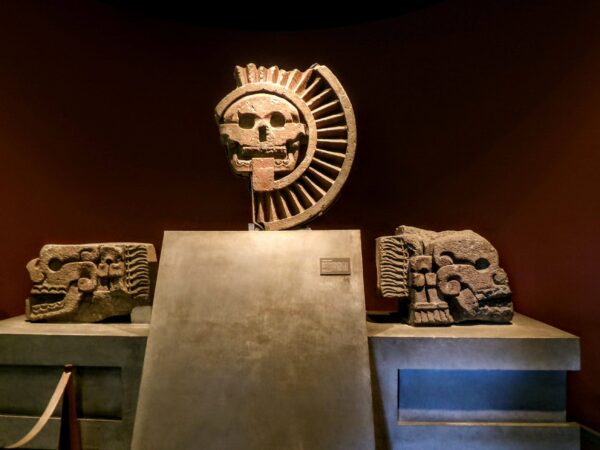
called the Disk of Mictlāntēcutli. It’s also called the Disk of Death and was uncovered directly in front of the Pyramid of the Sun in Teotihuacán during an archaeological dig in 1964. They speculate that the saint-like halo could allude to the rising and setting sun – a not unreasonable inference since day and night were in conflict as represented by the mural discussed above.
The museum also has copies of several important codices displayed such as this one.
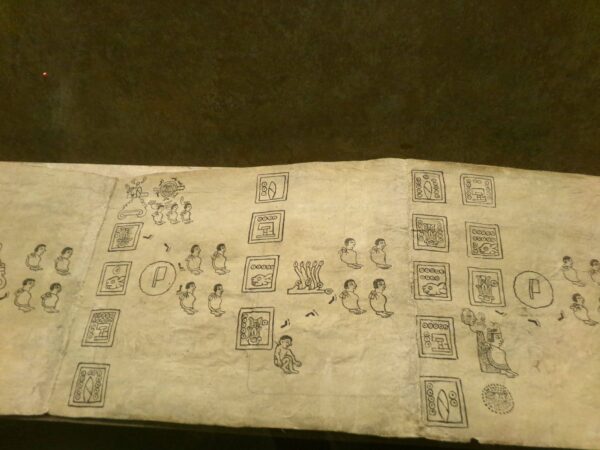
Each codex is a pictorial manuscript created by Mexica tlacuilos (scribes) that present vital records of history, cosmology, genealogy, and rituals. Many that were created after the arrival of the Spanish in 1519 include Nahuatl or Spanish text.
One can’t visit the Mexica section in the Museo Nacional de Antropología without paying some attention to the Piedra del Sol or Sun Stone. Carved during the reign of Moctezuma II, it weighs about 24 tons, measures 3.6 meters across, and embodies core aspects of Aztec cosmology.
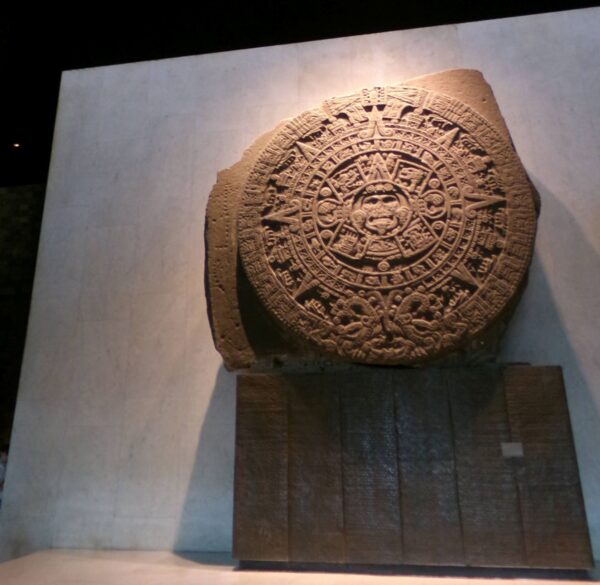
Archbishop Alonso de Montúfar ordered its burial soon after the Spanish conquest of Tenochtitlan. He ordered it buried face-down near the Templo Mayor site in the Zócalo with the intent of erasing memories of Aztec sacrifices and suppressing indigenous religious practices. Workers unearthed the massive stone when repairing the cathedral in 1790.
The face at the center is most likely Tonatiuh – the sun god. Concentric surrounding rings illustrate the Four previous “suns” that were the cosmic eras ending in jaguar, wind, rain, and flood. It also displays the current sun (Ollin), 20 day glyphs, fire serpents (Xiuhcoatl), and cosmic markers like the date 13 Reed (1479).
-
Photos and their stories – Lisbon – Summer 2026 part two – plus an egg-straordinary bonus
August 21, 2026 -
Photos and their stories – Lisbon – Summer 2026 – part one
August 21, 2026 -
The indigenous people of Da?ow?aga? (Olympic Valley and me supplement three)
August 19, 2026 -
The indigenous people of Da?ow?aga? (Olympic Valley and me Supplement two)
August 17, 2026 -
Olympic Valley in the time before humans (Olympic Valley and Me Supplement one)
August 14, 2026