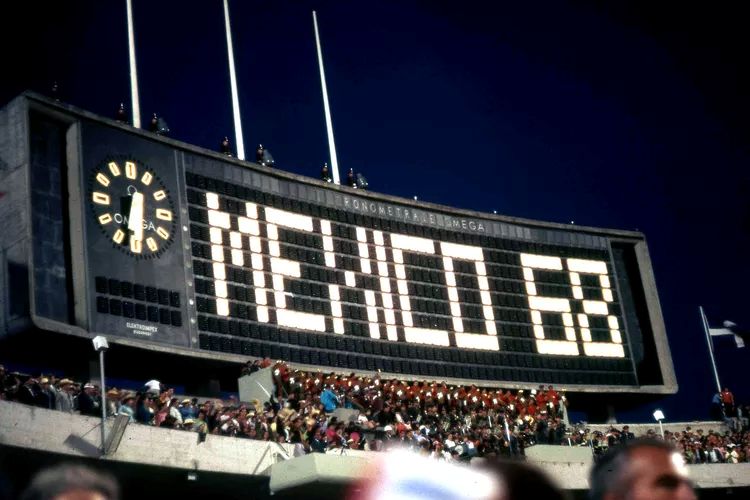
Notes on the XIX Olympiad – Successes, failures, and a Flop – (México City and Me addendum two)
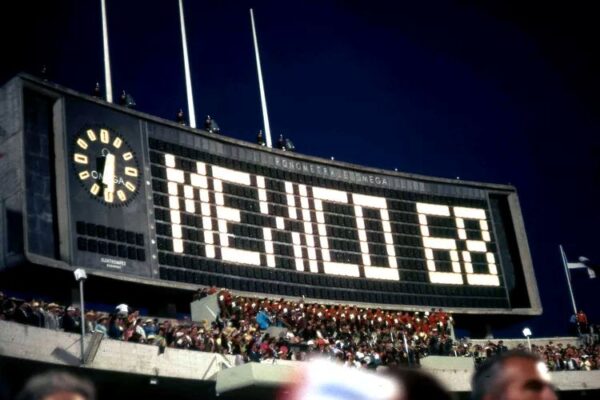
[From Wikimedia Commons By Sergio Rodriguez CC by SA 3.0]
Unlike some of the Olympic host cities I’ve visited, México City had an easy time securing the bid to host the Games of 1968. The IOC held only a single round of voting at its 1963 meeting when 30 of the 58 members voted for México City choosing it over bids from Detroit, Lyon, and Buenos Aires. For many IOC members, awarding the Games to México City symbolized taking the Olympics to Latin America and to Western a non-European, non–North Atlantic country for the first time. However, I suspect that the charm offensive initiated by then Mexican President Adolfo López Mateos that featured intensive hospitality and “inspection” trips for IOC members and their spouses to México City also played a role.
By the numbers and a noteworthy first
Nineteen new National Olympic Committees (NOC) sent athletes to Mexico City expanding the total to 112 and continuing the growth of the Olympics as a global event. The biggest increases came from Africa and the Caribbean with each region sending seven first time participants. It was also the first time the FRG (West Germany) and GDR (East Germany) competed as separate teams. According to Olympedia, the 112 NOCs sent 5,558 athletes – 4,775 men and 783 women to compete in 172 medal events in 23 disciplines.
Two gymnasts – Czechoslovakian Věra Čáslavská (about whom I’ll have more to say) and Japan’s Akinori Nakayama – each won four gold medals and six overall. Soviet gymnast Mikhail Voronin won seven medals besting the total count of the others but only two of his medals took him to the top of the podium.
Mexican hurdler, Norma Enriqueta Basilio Sotelo was the last torch bearer in the torch relay. She entered the stadium and ascended 90 steps to the cauldron where she lit the flame becoming the first woman to do so in the history of the modern games.
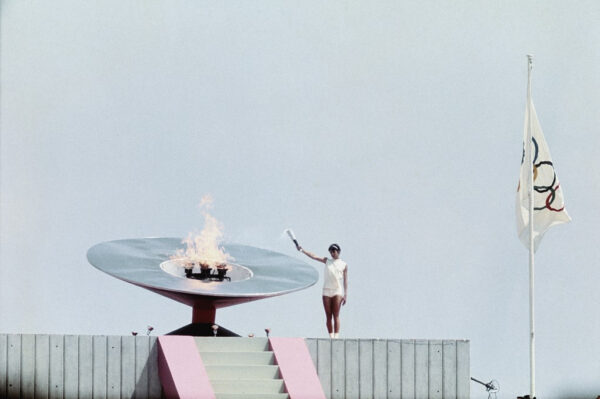
(One can’t help but wonder how Baron de Coubertin might have reacted to this.)
A failure, successes and a successful failure
Mark Spitz’s failure
American swimmer Mark Spitz probably delivered the most noteworthy failure of the Games. Just 18, Spitz had been a world class swimmer since the age of ten and had won five gold medals at the 1967 Pan American games. He audaciously made the cocksure prediction that he would win six gold medals at the Olympics in México City.
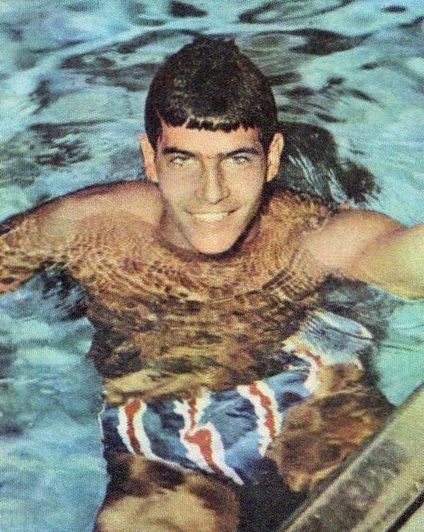
[From Wikipedia – Public Domain]
Although he won a pair of gold medals in the 4×100 and 4×200 meter free style relays, he fell well short of his brash prediction and failed to win a gold medal in any of the individual races. He won silver in the 100 meter butterfly, bronze in the 100 meter freestyle, and finished eighth in the 200 meter butterfly. (Spitz did come back to win seven gold medals – all in world record time – at the 1972 Olympics in Munich. That set a record for most gold medals won at a single Olympic Games that stood until 2008 when another American, Michael Phelps, won eight.)
From my perspective, it was the Athletics competition that gave the Games its most notable successes. One happened on the track and two came in the field events. Here they are in no particular order.
Jim Hines’ success
I’ll start with the men’s 100-meter final. Many people were concerned the effect of the thin air (a reduction of about 5%) and slightly lower gravity (a reduction of about seven-tenths of one percent) at México City’s 2240 meter altitude might have on the competition. In the sprint events, world records toppled like dominoes – between 24 and 26 new world records were set. While in the distance events, it was often the competitors who toppled. (Australian Ron Clark, who was the pre-race favorite in the 10,000 meters, finished sixth, collapsed, and lay unconscious for 10 minutes at the end of that race.)
The México City Olympics were the first to use electronic timing and, although his time was officially adjusted to 9.95 seconds, Hines became the first man to run a legal (e g non-wind aided) time of less than 10 seconds in that sprint. And, as I often say, you never forget your first.
Bob Beamon’s success
In May 1965 at the Modesto Relays, Ralph Boston recorded a world record long jump of 8.35 meters. At the Little Olympics held in México City a year before the Games, Soviet jumper Igor Ter-Ovanesyan equaled Boston’s jump. In the finals of the XIX Olympiad, Bob Beamon jumped an astonishing 8.90 meters.
To provide some perspective for this 55 centimeter improvement, let’s take a look at how that record progressed. In 1935, Jesse Owens established a world record in the long jump of 8.13 meters. That record stood for a quarter century until Ralph Boston jumped 8.21 meters in 1960 besting Owens’ record by 8 centimeters. Over the ensuing eight years, the record increased incrementally by a total of another 14 centimeters to the one held jointly by Boston and Ter-Ovanesyan. It took thirty-three years to lengthen the record by twenty-two centimeters. It took Bob Beamon one jump in the Olympics to move it two and a half times as far.
Beamon’s world record stood for 23 years until Mike Powell pushed it out by five centimeters but Beamon still holds the Olympic record. It’s the longest standing record in the modern Olympic Games.
Dick Fosbury’s revolutionary success
Many people don’t realize that Wilt Chamberlain, the man I consider the greatest basketball player of all-time, probably could have achieved the GOAT designation in many other athletic endeavors. One of them was the high jump. This video shows Chamberlain clearing 1.99 meters at the Drake Relays in 1957. (The world record at the time was 2.16 meters.)
The straddle jumping technique – a variation of the Western Roll – that Chamberlain uses is one of four that were common at the time. The others were the scissors and the Eastern Cutoff. All high jumpers of the time used one of these techniques. Until 1963, that is. In that year, at a meet in Grant’s Pass, Oregon, a high-school sophomore name Dick Fosbury introduced a new method of clearing the bar.
After failing to clear a height using the straddle, Fosbury took an unconventional approach. He jumped with his back to the bar, raising his hips, and then kicking his legs up and over it. Using the scissors technique, Fosbury often failed to clear 1.5 meters. Once he made the change, he regularly jumped 1.78m and higher.
In 1964, the Medford Mail-Tribune published a photo with the caption, “Fosbury Flops Over Bar” and the technique now had a moniker – the Fosbury Flop. Ignoring the snide derision of his competitors and the worries of his coaches that landing head and neck first in the sand and wood-chip filled pits of the time, Fosbury continued using and perfecting the Flop. Eventually, it propelled him to the Pac-8 and NCAA high jump titles.
The Flop came to the world stage for the first time at the Olympic Games in México City and, when Fosbury not only captured the gold medal, he set a new Olympic record of 2.24 meters, and his sport was irrevocably changed. (You can read more about the Fosbury Flop in this Smithsonian article.)
John Akhwari – the man who succeeded in failure
Does “successful failure” seem like it should be classified as an oxymoron? In some instances, yes. At the Olympic Games, perhaps not. You might be familiar with two such stories from the XV Winter Olympics in Calgary – those of Michael Edwards (AKA Eddie the Eagle) and the Cool Runnings Jamaican bobsled team. Or, even more recently the story of Equatorial Guinean swimmer Eric Moussambani Malonga at the 2000 Sydney Games. The story of John Akhwari is no less inspirational.
Marathoner John Stephen Akhwari was one of the four athletes representing the United Republic of Tanzania – that sent competitors to the Olympics for the first time. On 20 October, Akhwari set out with 78 other runners on the 42,195m course. By the race’s end, México City’s altitude would take a devastating toll. Only 57 would finish the race. Of those 57, Akhwari would not merely finish last, but more than an hour behind gold medalist Mamo Wolde and 19 minutes behind Enoch Muemba who finished 56th.
Approximately 30 kilometers into the race when Wolde was pressing to take a lead he wouldn’t relinquish, Akhwari, who had begun to suffer cramps from the altitude, was knocked to the ground from some jostling a bit farther back in the pack. The fall injured his head, one shoulder, and dislocated his knee. Against all medical advice, Akhwari bandaged his knee, rose to his feet and continued the race.
The medals had been awarded and only a few thousand spectators remained in the massive Estadio Olympico Universitario when Akhwari hobbled in. All rose to their feet as he limped across the finish line. Asked by a reporter why he continued, he gave a succinct and moving answer, “My country did not send me 5,000 miles to start the race; they sent me 5,000 miles to finish the race.”
-

Photos and their stories – Lisbon – Summer 2026 part two – plus an egg-straordinary bonus
August 21, 2026 -

Photos and their stories – Lisbon – Summer 2026 – part one
August 21, 2026 -

The indigenous people of Da?ow?aga? (Olympic Valley and me supplement three)
August 19, 2026 -
The indigenous people of Da?ow?aga? (Olympic Valley and me Supplement two)
August 17, 2026 -

Olympic Valley in the time before humans (Olympic Valley and Me Supplement one)
August 14, 2026