Notes on the XIX Olympiad – Understanding Carlos and Smith – (México City and Me addendum one)
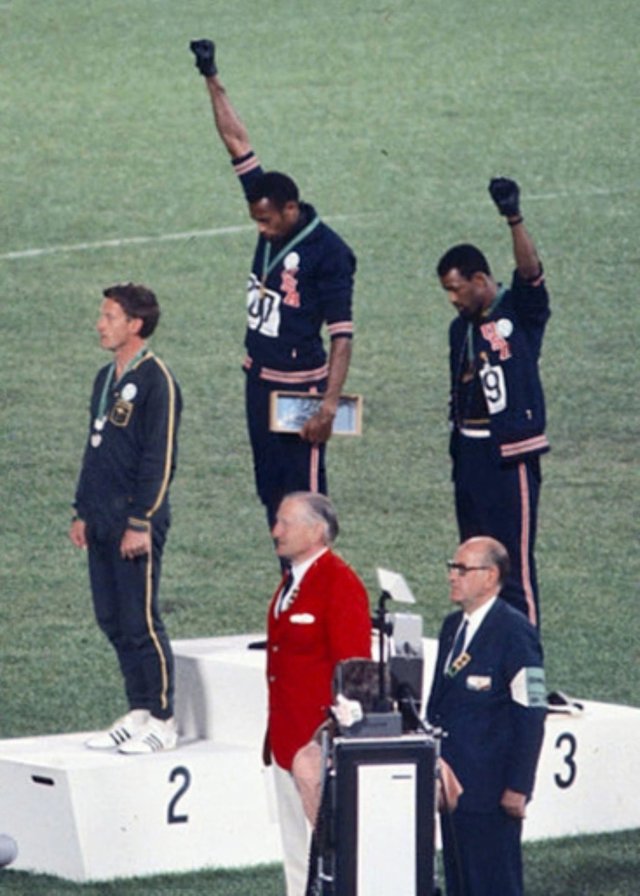
Whatever other stories I might have found, writing about the XIII Winter Games at Lake Placid without covering the Miracle on Ice would have been an egregious oversight. It would be similarly egregious to write about the Games of México City without first discussing US track stars Tommie Smith and John Carlos and their famous (infamous to some) gestures.
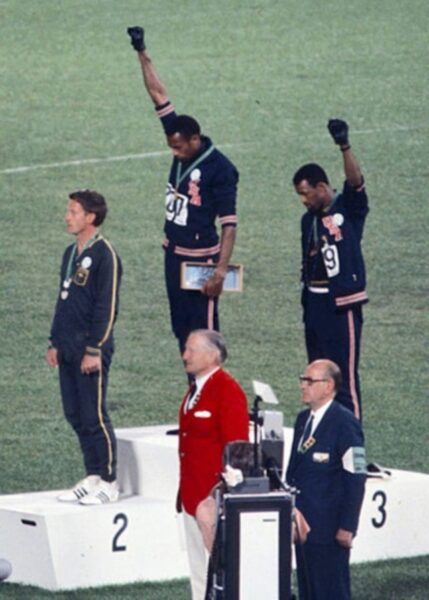
[From Wikipedia – Public Domain By Angelo Cozzi (Mondadori Publishers)]
1968 – For What it’s Worth
Writing this in 2026, I’m 71 years old and still think that the year between my 13th and 14th birthdays leading up to the Summer Games that began on 12 October in México City remains the most tumultuous year of my lifetime. (That may change given the global circumstances at the time I publish this. It’s probable the resulting global political shift will be greater than anything prompted by the events in 1968.) What follows is necessary because some, perhaps many, readers lack the context to understand the significance of the gestures by Carlos and Smith.
And it’s 1, 2, 3, what are we fighting for?
Opposition to US involvement in the war in Vietnam had been growing steadily since the first large SDS led protest on 17 April 1965. On 25 and 26 March 1966, the “Days of International Protest,” organized large anti-war demonstrations in New York, Boston, Philadelphia, Washington, Chicago, Detroit, San Francisco, and Oklahoma City in the US with global protests in Ottawa, London, Oslo, Stockholm, and Tokyo.
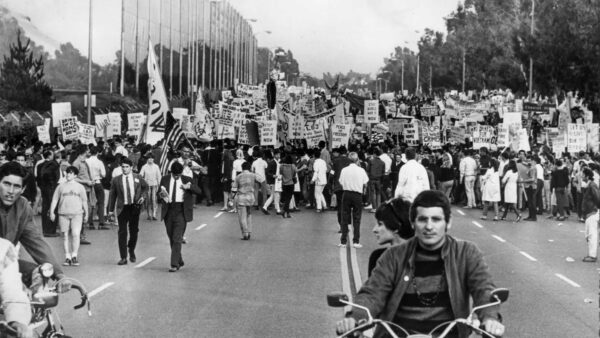
[1967 Protest from LA Times – Ray Graham]
On 4 April 1967, Martin Luther King Junior delivered the Riverside Church Speech – “Beyond Vietnam – A Time to Break the Silence.” On 15 April more than 400,000 people marched from Central Park to the UN in New York and less than two weeks after that, on 28 April in Houston, Texas, Muhammad Ali refused induction into the US Armed Forces citing his religious objection and saying he had “no quarrel with the Viet Cong” and “no Viet Cong ever called me nigger.” Ali also said he would not go “10,000 miles to help murder, kill, and burn other people to simply help continue the domination of white slave masters over dark people.” (He was immediately stripped of his heavyweight title, banned from boxing, and later that year sentenced to five years in federal prison for draft evasion. A unanimous US Supreme Court decision on 28 June 1971 overturned his conviction.)
A year to the day after his Riverside Church Speech, Martin Luther King Junior was murdered on the balcony of the Lorraine Motel in Memphis, Tennessee. (You can read about my visit to the Lorraine here.) King’s assassination sparked riots in more than 100 American cities.
In my home state of Maryland, a pair of Catholic priests – Philip and Daniel Berrigan – led seven others into a draft board office in Catonsville on 17 May. They became known as the Catonsville Nine and
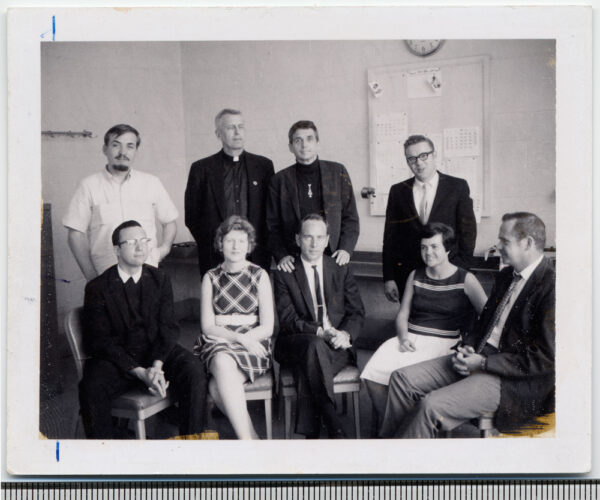
[From Wikipedia By Jean Walsh – Friends of the Catonsville Library]
their action helped end the US Military draft.
But the political assassinations weren’t quite done. On 5 June, one night after Robert Kennedy won the California Democratic Primary, Sirhan Sirhan shot and killed him at the Ambassador Hotel in Los Angeles.
Things boiled over at the end of August at the Democratic National Convention in Chicago. There was chaos within the convention center over delegate credential fights (Several southern states sent both all-white and racially mixed delegates.) and platform positions particularly concerning Vietnam, the draft, and reducing the voting age to 18. There was greater chaos outside where mass protests met with a violent police crackdown.
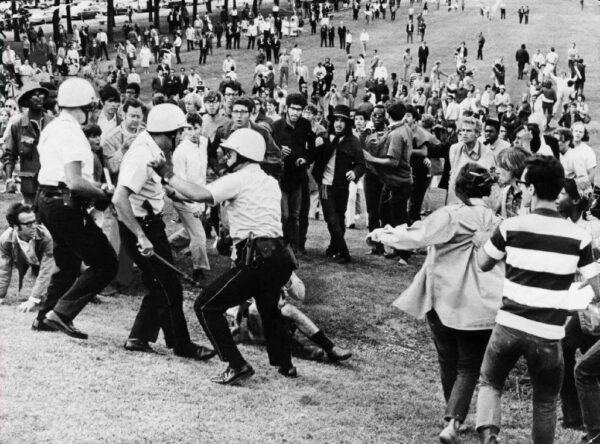
[From Chicago Tribune – File Photo]
Say it loud
Saying the mood of the country in 1968 was tense – whether the focus was civil rights or the Vietnam War – is an understatement. I felt it and I wasn’t Sixteen Going on Seventeen. I was only 13 going on 14.
In September 1967, Carlos and Smith joined the United Black Students for Action founded at San Jose State University (SJSU) by Doctor Harry Edwards. Over the next year, they established the Olympic Project for Human Rights (OPHR). OPHR initially floated the idea of black athletes boycotting the games but, over time, Carlos felt that the punishment of losing their Olympic dreams was asking them to sacrifice too much. They stepped away from that idea.
In the 2003 book Race, Culture and the Revolt of the Black Athlete: The 1968 Olympic Protests and Their Aftermath, Smith was cited as having said, “There have been a lot of marches, protests, and sit-ins on the situation of Negro ostracism in the US. I don’t think this boycott of the Olympics will stop the problem, but I think people will see that we will not sit on our haunches and take this sort of stuff. Our goal would not be just to improve conditions for ourselves and our teammates but to improve things for the entire Negro community.”
Among OPHR’s stated goals were:
- improving the welfare of black people globally.
- ending apartheid in South Africa and banning the country from the Olympics.
- adding more black coaches to the United States Olympic team.
- removing International Olympic Committee (IOC) chairman Avery Brundage.
- restoration of conscientious objector Muhammad Ali’s boxing title.
The South African ban was their lone achievement before the Games.
As noted above, human rights and anti-war protests had occurred worldwide. Ten days before the Opening Ceremony that would be overseen by Mexican president Gustavo Díaz Ordaz, Ordaz ordered Mexican military troops, snipers, and police officers to fire at a crowd of students protesting his authoritarian regime. They reportedly killed 300 people. This reinforced the three sprinters’ resolve to make a political statement at the Olympics. (Lee Evans had joined Carlos and Smith in OPHR.)
On 15 October 1968, thirteen days after the students were shot down in México City, another shot began the 200-meter dash. Smith won the gold medal in world record time. Australian Peter Norman took the silver. Carlos captured the bronze.
At the medal ceremony, Smith and Carlos stepped onto the podium shoeless wearing black socks to symbolize black poverty in the United States. They wore OPHR buttons on their USA track uniforms. Earlier, Smith and Carlos had told Norman about their plan and Norman – who was raised in a Salvation Army family and had criticized the “White Australia” movement in his home country – stood with them in support also wearing an OPHR button.
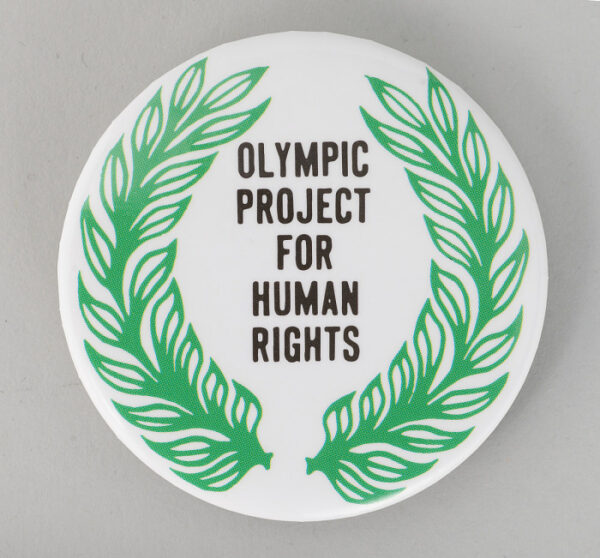
[From NMAAHC – OPHR]
(US rowing coxswain, Paul Hoffman gave Norman the button he wore. All eight rowers on the US team also wore the button.)
When the US National Anthem began to play, Smith and Carlos bowed their heads and raised their black-gloved fists toward the sky. Smith’s raised right fist represented Black Power. Carlos, wearing a bead necklace to symbolize the lynching of black Americans, raised his left fist as a gesture of black unity.
The reaction was vitriolic and swift. Avery Brundage called the “Black Power” salute “a deliberate and violent breach of Olympic principles” and demanded that the USOC remove Smith and Carlos. When the USOC resisted, he sent a letter threatening to suspend the entire US team. Facing that threat, the USOC complied, suspended Smith and Carlos, and gave them 48 hours to leave the Olympic Village.
(For the record, Avery Brundage is generally viewed as an anti-Semite and white supremacist. Among his “signature” achievements as President of the USOC, was leading the fight to prevent the US from boycotting the 1936 Olympics in Berlin. There’s good evidence that Brundage’s motivation was at least partially driven by a business deal with the Nazi party – specifically regarding a contract to build a German embassy. Brundage later pulled two Jewish-American athletes, Marty Glickman and Sam Stoller, from the 4x100m relay team at the last minute to avoid embarrassing Hitler.
Brundage was comfortable with the Germans using the Nazi salute during the Berlin Olympics calling it a “national gesture.” He argued that the 1968 protest was a political gesture and echoed his argument from three decades prior that “politics has no place in sport.”)
The media in the US was equally unkind. The Los Angeles Times accused Smith and Carlos of a Nazi-like salute. Time Magazine put a distorted version of the Olympic logo on its cover with the motto “Angrier, Nastier, Uglier.” The Chicago Tribune called their gesture “an embarrassment visited upon the country, an act contemptuous of the United States, and an insult to their countrymen.” A young reporter for the Chicago American named Brent Musberger called them “a pair of black-skinned storm troopers.”
Once they reached home in the US, they were subjected to death threats and many Americans considered them traitors. Employment opportunities and commercial endorsements vanished. The USOC banned Smith from national and international competitions. By 1972, instead of preparing for the Munich Olympics, Smith was training schoolchildren in Wakefield in northern England to earn a living.
But the moral arc of the universe is long. By 2003, Smith, Carlos, and Evans had all been inducted into the USA Track and Field Hall of Fame. In 2005, SJSU erected a statue honoring Smith and Carlos and the pair were honored with the Arthur Ashe Award for Courage in 2008.
-
Photos and their stories – Lisbon – Summer 2026 part two – plus an egg-straordinary bonus
August 21, 2026 -
Photos and their stories – Lisbon – Summer 2026 – part one
August 21, 2026 -

The indigenous people of Da?ow?aga? (Olympic Valley and me supplement three)
August 19, 2026 -
The indigenous people of Da?ow?aga? (Olympic Valley and me Supplement two)
August 17, 2026 -
Olympic Valley in the time before humans (Olympic Valley and Me Supplement one)
August 14, 2026