Y no te puedo hallar
I covered our trip to Teotihuacán in a previous post so today I’ll report on our group’s final day and my return to the US. For much of the week, our group leader C had reminded us that today would be our main shopping day because we’d be going to Bazar el Sábado – the Saturday Bazaar. The good news for us was that this was a relatively leisurely morning. The bad news for you is that the ride from our hotel to our destination requires between 45 minutes and an hour. This means, of course, you get a lesson in the history of
San Ángel and Bazar el Sábado.
Before the Spanish arrived, the CDMX neighborhood we now call San Ángel was called Tenanitla from the Nahuatl word meaning “walled in place.” The walls in question describe a natural enclosure formed by solidified lava flows from an eruption of the Xitle Volcano around 2,000 years ago.
The residents of this modest community likely maximized their position within Lake Texcoco’s ecosystem. They lived in small hamlets amid orchards, gardens, and chinampas and, in addition to providing their own subsistence, would have likely been providing crops, fruit, wood, charcoal, and water for the Mexica in Tenochtitlan.
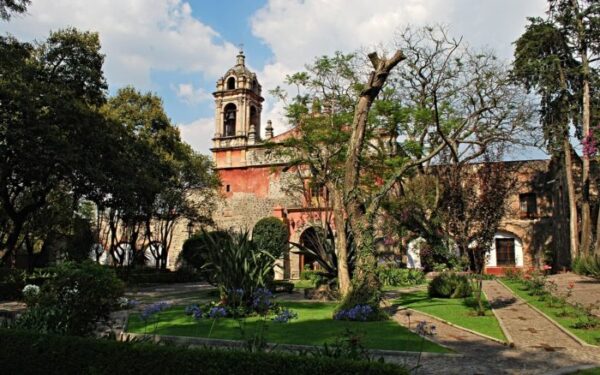
The character of the community began changing less than a century after the Spanish conquest of Tenochtitlan. By 1529, the Dominicans had established a small chapel in the area that, by 1580, evolved into the Parish of San Jacinto with its own monastery.
[From Magical Towns]
Carmelites established the Monastery del Carmen in the late 1580s. (At present, this is a museum that some of us will visit before our shopping and lunch excursions.) Much of the land on which these Catholic orders built their monasteries was donated by local hereditary chieftains or caciques (a term the Spanish brought from the Caribbean) such as Felipe de Guzmán Itzolinque who had converted to Catholicism.
The Carmelite and Dominican friars used and expanded the orchards that previously existed thereby underpinning and supporting the local economy and cementing San Ángel’s identity as an agricultural and flower-growing region.
By the 18th and 19th centuries, wealthy families from México City built country houses and haciendas here, turning the town into a summer retreat. Although San Ángel was formally incorporated into the Federal District during a period of major expansion between 1903 and 1928, it remained physically separate from full urbanization into CDMX until the mid‑20th century, when Avenida Insurgentes and Ciudad Universitaria created a physical link with the previously autonomous community.
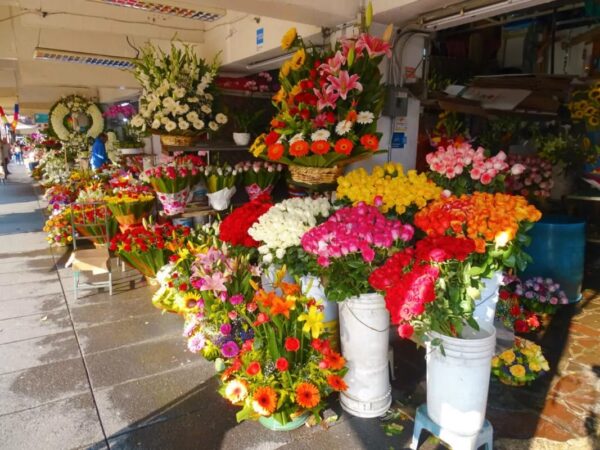
On our way, we rode past the San Ángel Flower Market
[From My Mexico Trip]
that traces its roots to the gardens cultivated by the Carmelites around their church and monastery. The flower and produce markets present since the sixteenth century formed a backdrop for the Bazar and other craft and art markets that now define weekends in the barrio.
Formally established in 1960 and centered on the Plaza San Jacinto, the original concept was reportedly the brainchild of Jim Tillet – an American artist. He thought a regular, organized open-air market would help local artists sell their work. By the late 20th century, the Saturday art market had become a well‑known gathering place for middle‑class chilangos and tourists, with both indoor stalls found in a large colonial house by the Plaza and an outdoor plaza full of painters, printmakers, and craftspeople.
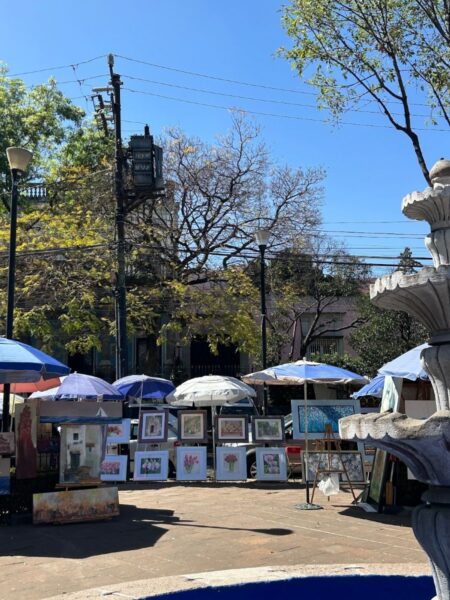
Today, the Bazar el Sábado is often described as one of the city’s most beloved artisan bazaars. It’s a place where the combination of historic buildings and colonial‑era town plan, the 19th century flower and hacienda traditions, and the 1960s artist‑driven bazaar intersect in a weekly ritual of art, crafts, and food.
What I did and didn’t do Saturday
Shortly before our arrival at San Ángel, one of our guides offered to lead a tour of the Museo del Carmen for anyone interested and, because we’d been joking earlier that he was disappointed that I never went with one of his groups, I suppressed my disinclination to visit places religious and decided to tag along. Unsurprisingly, I was uninspired. If you’re interested, you can visit this site for an in depth look at the museum and photos you may enjoy more than my indifferent efforts.
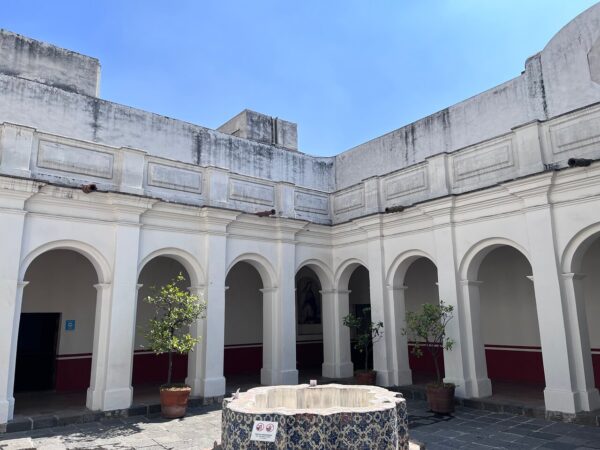
One advantage of the walk to the museum was that it allowed me to get a sense of the artists who had paintings for sale and even to spot some that I wanted to look at again. One of the few things I try to regularly bring back from my trips is a piece of art. (To give you an idea, this folder has some of the “Art from my Travels.”)
I spent the remainder of the morning looking at paintings and other creative works that I liked. And there were many. (Out of consideration to the artists, however, I didn’t take any photographs.) My dilemma was that all but two were too large to fit into my carry-on. Several of the artists offered to pack their work in a way that I could safely check them as luggage.
Lunch, we were told, was more family style than our previous meals had been. We were presented with warm tortillas and a table with eight or ten different potential fillings that we used to build our own meals. It was interesting and enjoyable. During this lunch at La Jacinta,
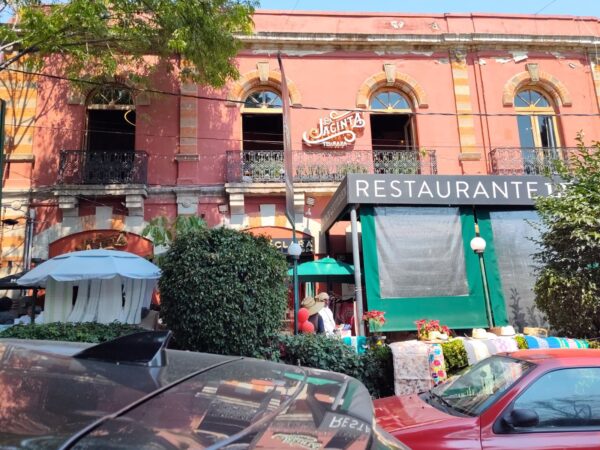
[Photo from the WhatsApp Group]
I vacillated between buying them and holding fast to my no checked baggage rule. By the end of lunch I realized that I’m a stubborn old man who couldn’t forgo re-entering the US with only my carry-on. Perhaps with regard to carry-on, I’m just a wayward son.
As for the two that could have fit, I returned several times to that artist’s display. The issue with these was that they would only fit if removed from their frame so I could roll the canvas. Since the artist was clearly not interested in doing that for me, since I had no tools to remove the thick staples, and since I was leaving for the airport at an unconscionably early hour Sunday, they, like the others, remained in CDMX.
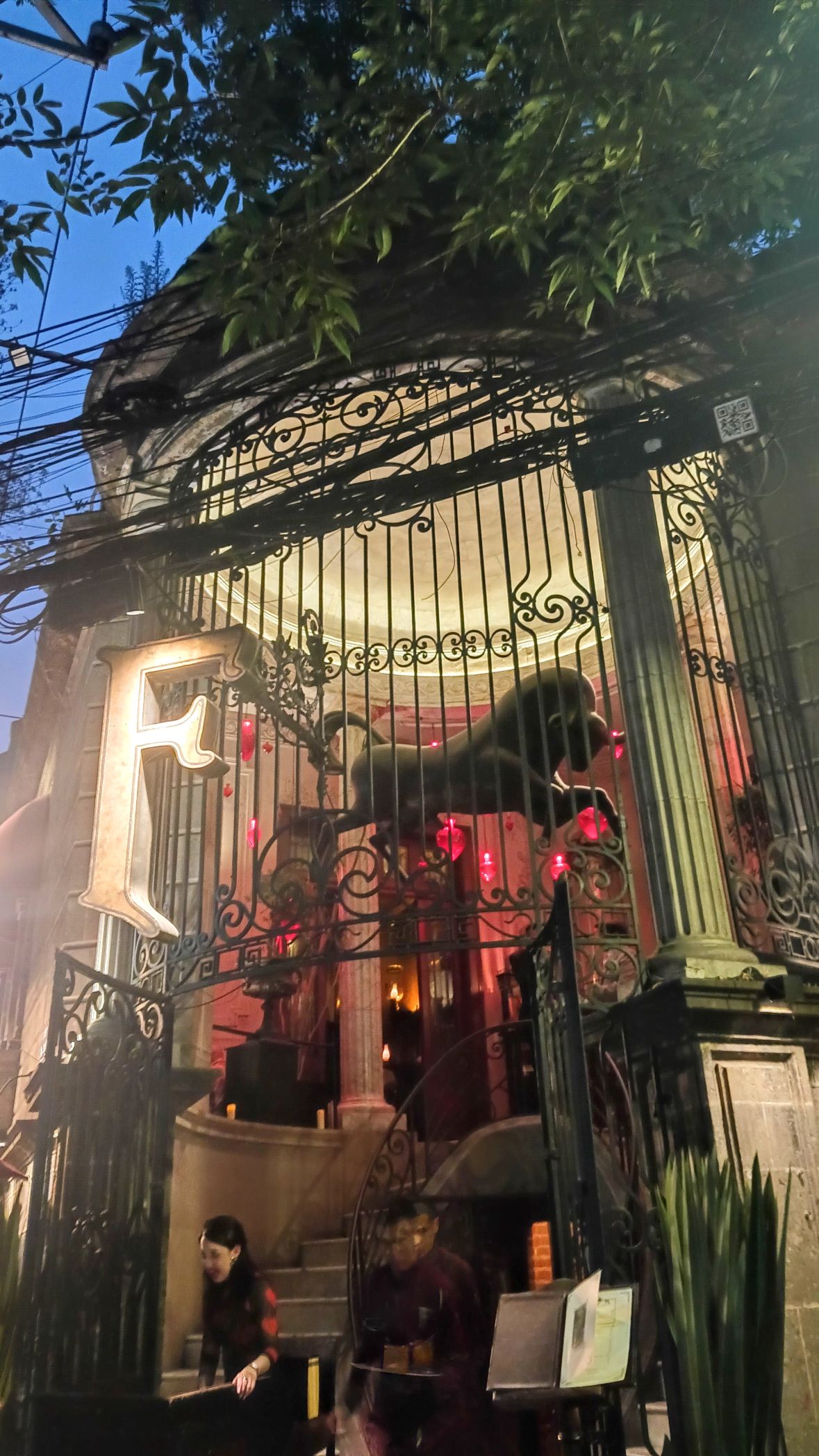
Saturday night we gathered for a final supper at Gran Cantina Filomeno a restaurant with some drama at its entrance (at least I think the bull suspended from the ceiling is rather dramatic).
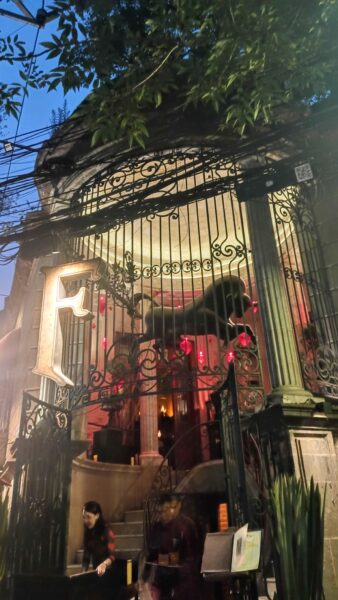
I’ll simply say in this, a “gran” time was had by all.
Travel troubles?
Actually, no. Or the minor travails were largely of my own making. By a certain perspective, one might say that my departure from CDMX mirrored my arrival but with only an hour time difference. In their trip materials, Earthbound noted that they would provide airport transfers for those in the group who were departing Sunday. What I learned Saturday was that there would be three shifts and the time of my departure meant I’d be leaving the hotel with the first group.
However, my flight was several hours later than theirs and for the others to arrive at the airport within the recommended pre-departure time window, meant we had to leave the hotel at 04:30. Now, I could have scheduled my own transportation and left a few hours later but, I’m a stubborn old man and I paid for this transfer so I’m going to use it! And, I thought, I can always spend that extra time in the lounge. I was flying on Aeroméxico after all.
It was probably after 22:00 by the time we reached the hotel from dinner and considerably later by the time we finished all our farewells so I simply decided I’d stay up all night – which I did. Everything went smoothly until I passed through airport security and learned that Aeroméxico’s lounge was closed for renovations and there was no alternative. I was there so early, my flight hadn’t been assigned a departure gate. Let’s just say I managed a lot of steps waiting for that to happen. I managed a few catnaps both at the gate and on the flight.
I reached home late Sunday afternoon to temperatures lower than I’d experienced in the previous two months and a house more devoid of food than it had been after my last trip to Europe. Fortunately, Super Chicken and a pollo a la brasa meal was just a few minutes away. Both supper and bedtime arrived early that Sunday.
I didn’t take many photos Saturday and one or two are from the WhatsApp group. But here’s the link if you want to see them.
You’re now up to date on my travels but please stay tuned. I have three posts with a history lesson plus many interesting stories and tidbits about the 1968 Summer Olympic Games upcoming followed, of course, by the summation of México’s music references. I promise, this hold a few surprises.
-
Photos and their stories – Lisbon – Summer 2026 part two – plus an egg-straordinary bonus
August 21, 2026 -
Photos and their stories – Lisbon – Summer 2026 – part one
August 21, 2026 -
The indigenous people of Da?ow?aga? (Olympic Valley and me supplement three)
August 19, 2026 -
The indigenous people of Da?ow?aga? (Olympic Valley and me Supplement two)
August 17, 2026 -
Olympic Valley in the time before humans (Olympic Valley and Me Supplement one)
August 14, 2026
2 responses to “Y no te puedo hallar”
“Add more than just a carry-on, my son
And you’d have a new piece of art when you’re done”
Brilliant!