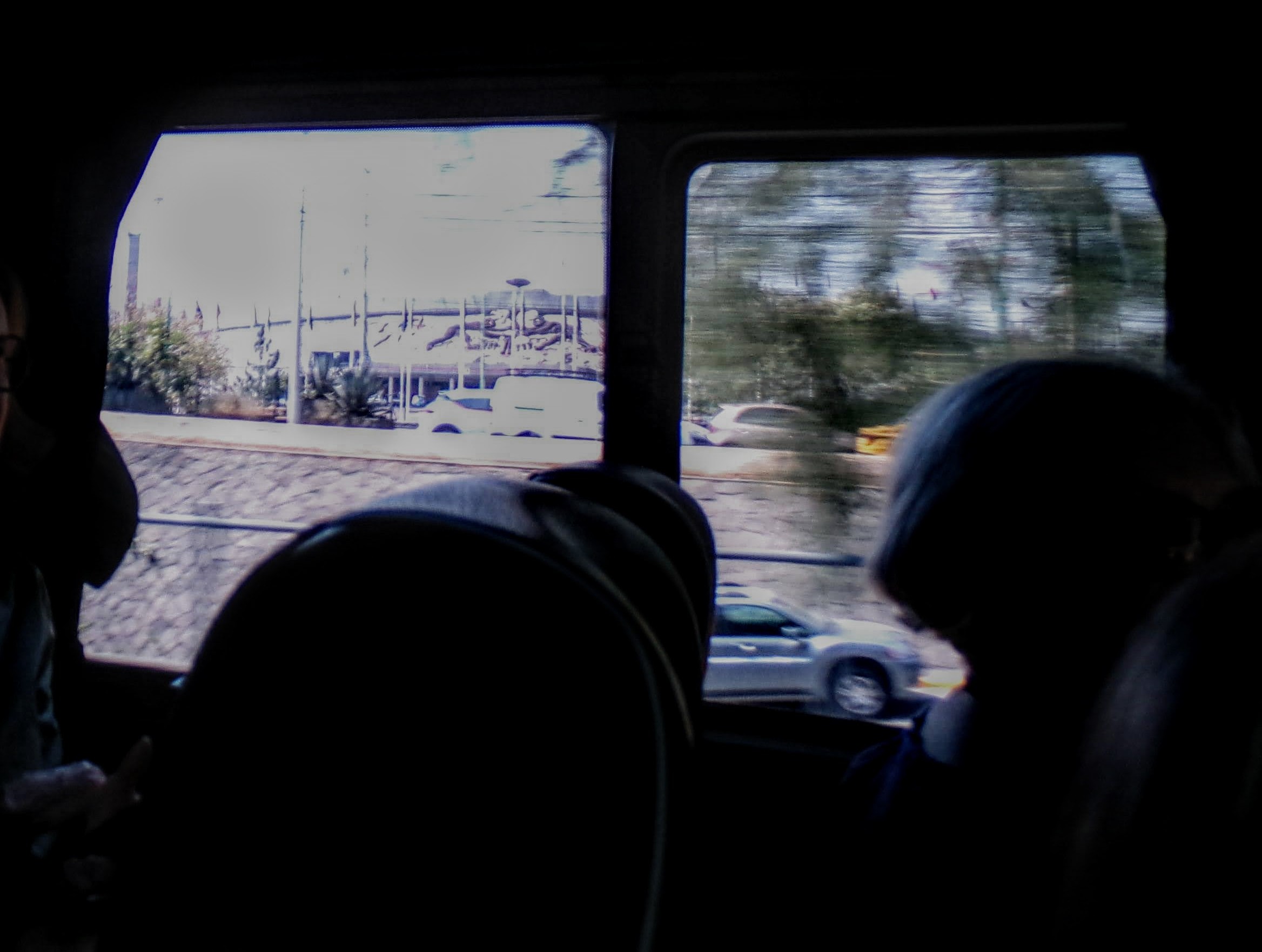
Y me pongo a placticar
After our time on the Xochimilco canals, we boarded our vans for the ride to Coyoacán where we’d have lunch followed by a visit to La Casa Azul – the museum that was once the home of Frida Kahlo.
Those of you who looked at the photos in this album might have wondered at this curiously blurry shot that also serves as the featured image for this post.
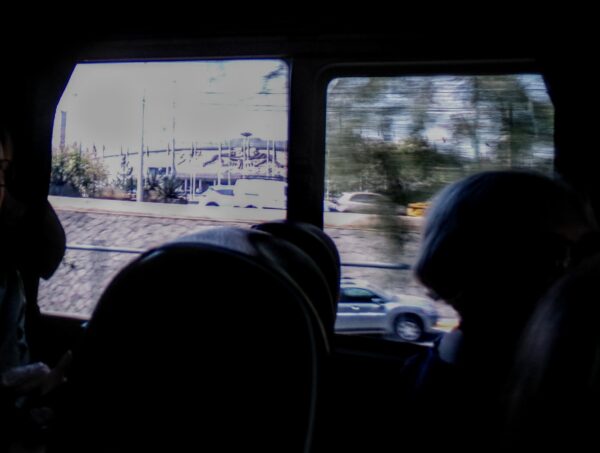
This was my lone glimpse of the Estadio Olimpico Universitario that was the central venue for the 1968 Olympic Games as we barreled past it on our way to Coyoacán.
But before Frida, a few words about mezcal, lunch, and Coyoacán
We went directly to our lunch at Corazón de Maguey. Its menu is quite interesting but it’s probably as much a mezcalería as a restaurant. So let’s talk a little about mezcal.
For many centuries, the indigenous people of México used the agave plant – also called maguey – to produce pulque. This milk-colored, viscous drink was known as the “drink of the gods.”
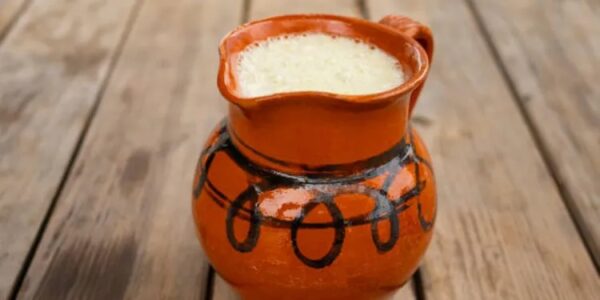
[From Cultura Collectiva]
Its alcohol content is typically between 4 and 6 percent putting it on a par with most beers.
Fermentation from the agave plant was widespread throughout Mesoamerica. In 1579 Phillip II of Spain ordered a series of surveys of “New Spain” called Relaciones Geográficas. One document in that survey, the Relacion de Zapotitlán (that likely covered a province in modern Guatemala or a Mexican region like Zapotitlán in Jalisco) reports,
There is in this province a tree named mexcatl which the Spaniards named maguey. They produced with it wine, vinegar, syrup, rope, fabric, timber, needles, nails, and a very proven balsam for injuries.
In the late sixteenth and early seventeenth centuries, Filipinos arriving via the Manila galleons that docked in Colima and Jalisco, brought distillation equipment with them initially intended to produce coconut wine. (It’s likely they brought and transplanted the coconut palm as well.) Filipino stills used local materials
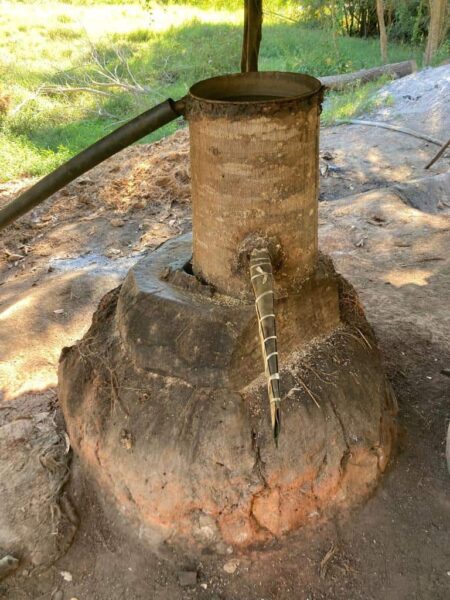
[From Mezcalistas.com]
and the indigenous people adapted it to use with the agave plant.
The process began its migration inland from the coast and, by 1601, historical records note “mexcales” being distilled in the Sierra de Nayarit. In 1621, Domingo Lázaro de Arrequi sent reports of a drink he described as being made when “the hearts of roasted mezcal which are crushed by a stone wheel to extract the mosto for fermentation in the alquitarra, creating a liquid clearer than water, stronger than moonshine.”
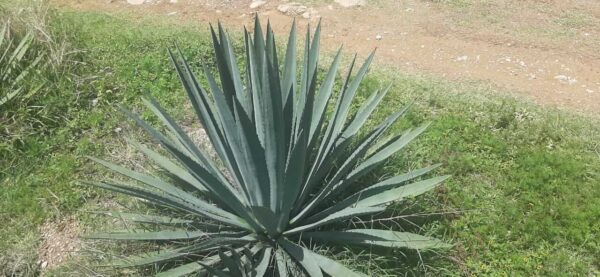
By 1638, the government was regulating and taxing sales in Nueva Galicia (including Guadalajara). However, these modest taxes prompted a forceful reaction from colonial authorities who, in order to protect imports of Spanish brandy and wines, banned its production. Of course, the solution was relatively simple. By the early 1700s, the production of mezcal shifted farther inland to ravines in western states thus evading bans on indigenous spirits. They switched to using local agaves like A. angustifolia – one of 30 or so species used to distill mezcal.
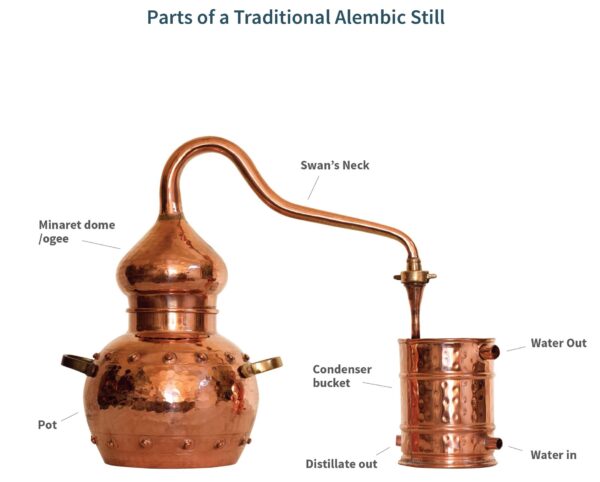
In the early seventeenth century, the Spanish, who regularly consumed various types of alcoholic beverages with their meals, imported Arab alembic stills made of copper.
[From The Alembics Lab]
(Given their Islamic beliefs together with the religion’s prohibition against imbibing spirits, it’s perhaps a bit ironic that invention of this still is generally credited to Jabir ibn Hayyan and it dates from sometime before 800 AD. Of course, across Europe and the Middle East, non-Muslims had long been fermenting grapes to make wine. It wasn’t long before they realized that distillation produced a high alcohol content beverage that appealed to their palates.)
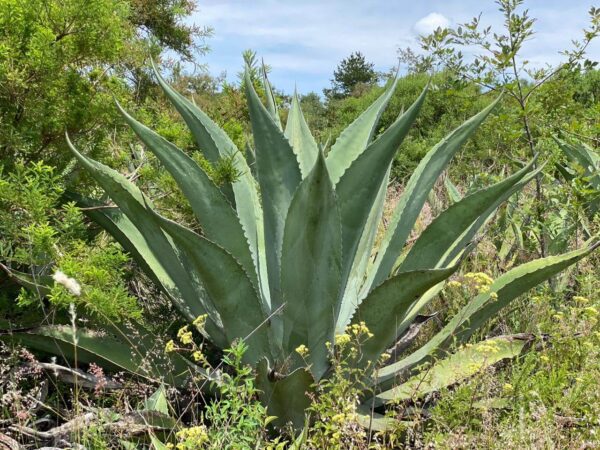
While it’s probable that the Spanish began using it mainly to distill sugar cane for rum production, they began experimental distillations of a mash from the maguey plant. In and around CDMX, they were likely using the agave salmiana that had long been commonly used to produce pulque in the VM.
[From La Luna Mezcal]
After a time, the presence of these stills gave birth to broader production of mezcal. Initially, this strong, rustic liquor was associated with rural and indigenous or mixed communities and generally avoided by the elites. That changed over time and, by the eighteenth century, mezcal was common enough among colonial populations that the Crown taxed and regulated it but it also continued threatening Spanish imports so in 1785, King Carlos III instituted a comprehensive prohibition. It lasted a decade and was repealed by Carlos IV in 1795 but he also implemented new taxes.
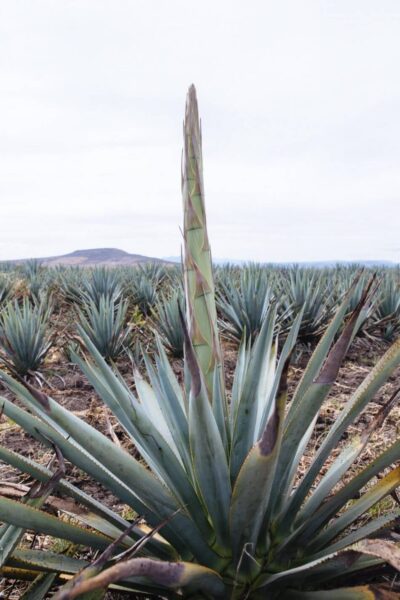
It was in this year that the King granted the Cuervo family (specifically José María Guadalupe de Cuervo) the first official license to produce a very specific type of mezcal using the local blue or Weber’s agave
[From La Luna Mezcal]
from their hacienda in the Tequila Valley. By 1805, José Cuervo was producing approximately 800,000 liters of its tequila annually. After the end of prohibition in the US in late 1933, tequila production exploded passing 10,000,000 liters during the Second World War and 200,000,000 liters by the late twentieth century.
Conversely, despite a recent boom in popularity and demand, traditional mezcal and its artisanal production methods, produced under 1,000,000 liters until 2011. In the last decade and a half, that increased to 8,000,000 liters in 2020.
Sometimes you don’t need the music
Although I took you on a brief detour into the history of mezcal, our vans did not pass GO!, did not collect $200, and went directly to Corazón de Maguey. The name translates as “Heart of the Maguey” and you know now that maguey and agave are interchangeable and that agave is the source of mezcal. As I noted above, this is both a restaurante and a mezcalería. I’ll start with the restaurant story since I fear I will disappoint you when I reach the mezcal chapter.
We were a group of more than 20 so they sat us on the patio at the front of the establishment. This was fine. The day wasn’t too hot, the patio was shaded, and it faced Coyoacán’s central park. The park had moderate foot traffic and there was a fellow sitting on a nearby bench with a puppet dog reading a book. However, we also had to share the space with two pairs of itinerant buskers both of whom stopped to serenade the restaurant’s patrons. Normally, I appreciate the efforts of street musicians but, in this instance, when you have a group of this size trying to communicate along and across tables, the additional sonic input becomes less welcome. At least for me.
Our meal started with guacamole accompanied by several small dishes of chapulines –
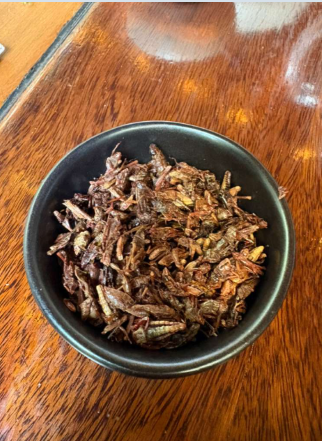
toasted grasshoppers that the menu describes as “collected in Oaxaca and seasoned with anise-scented hoja santa herb and smoky pasilla mixe chili.” I don’t know that I’d choose to make a career of eating them but they were fine once I adjusted to the texture.
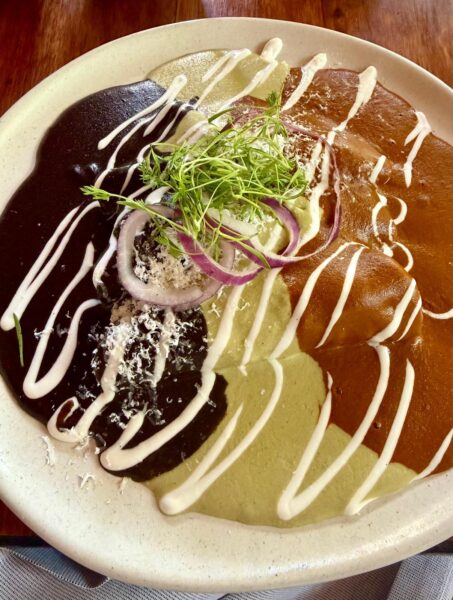
For my main course, I had the Enchiladas with Three Moles, or in my case, two moles since the traditional dark mole is made with lard and Earthbound wanted to accommodate my dietary preferences. The traditional dish looked like this.
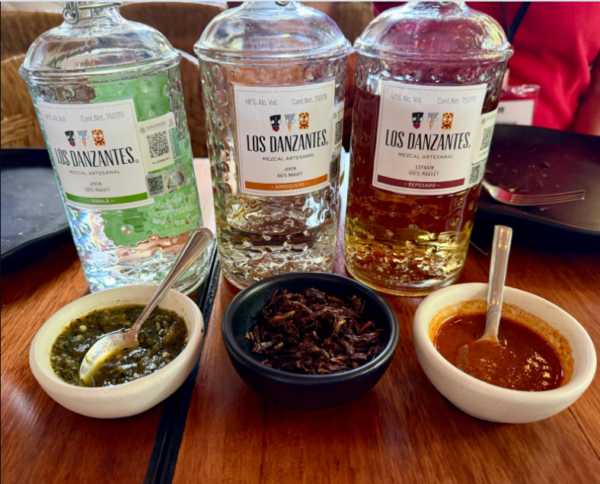
After lunch, we were offered the chance to sample some of the artisan mezcals. Many in our group did. I did not.
As many of you know, I usually limit my alcohol consumption to beer but when traveling will, if the social situation demands it, drink something more potent. (GËZUAR!) In this instance the situation didn’t require me to participate and, since I’d had a beer earlier in the morning and had a museum visit and a trip to the theatre remaining as part of the day, I eschewed the booze. Tasting a sampler was suggested as this photo shows.
(Thanks to C & M for all the lunch photos.)
El Corazón de Coyoacán
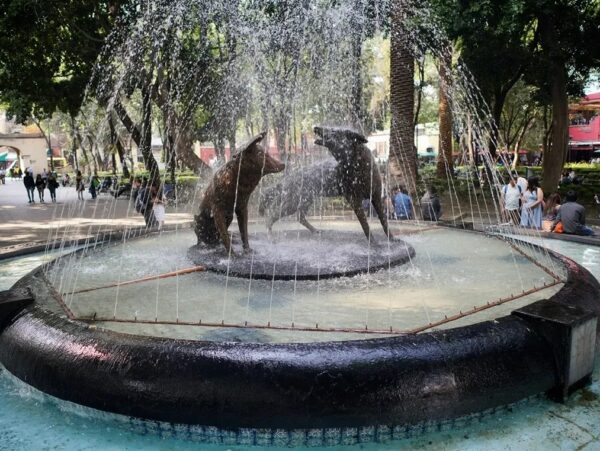
La Casa Azul is among the most in demand museums in CDMX and you need to have a timed entry ticket. Despite dawdling at lunch, we still had some time to explore what some promotional materials call “México City’s oldest neighborhood.” The name, derived from Nahuatl, means “place of the coyotes” and is celebrated by this fountain in the park adjacent to Corazón de Maguey.
Coyoacán was more than an important pre-Hispanic settlement. After the fall of Tenochtitlan in 1521, Hernán Cortés withdrew to the lakeshore village of Coyoacán and set up his first major Spanish base there. It served as the first capital of New Spain until 1523.
I’ll move on to La Casa Azul in the next post.
-
Photos and their stories – Lisbon – Summer 2026 part two – plus an egg-straordinary bonus
August 21, 2026 -
Photos and their stories – Lisbon – Summer 2026 – part one
August 21, 2026 -
The indigenous people of Da?ow?aga? (Olympic Valley and me supplement three)
August 19, 2026 -
The indigenous people of Da?ow?aga? (Olympic Valley and me Supplement two)
August 17, 2026 -
Olympic Valley in the time before humans (Olympic Valley and Me Supplement one)
August 14, 2026