Fires are burning inside but how can I show them
It probably seems like a cliché to call Frida Kahlo’s life story one of tragedy and triumph but phrases become clichés for a reason and, if you’re unfamiliar with her biography, I think by the end you’ll agree with my use of this particular phrase.
Setting the scene
This
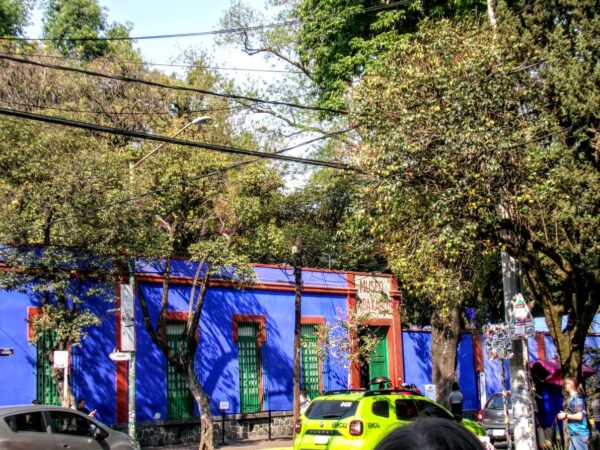
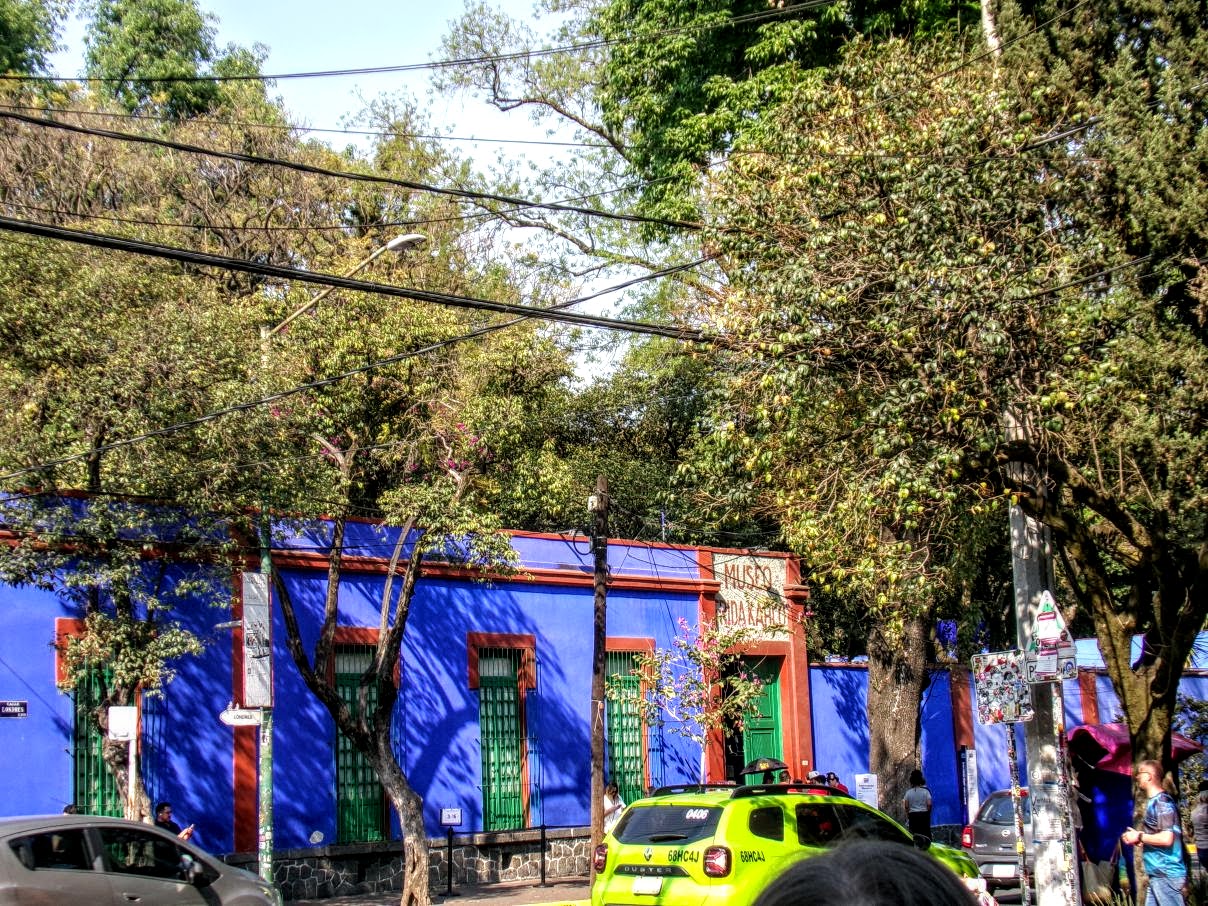
is La Casa Azul – the Blue House where most accounts say Frida Kahlo was born – though there’s some dispute regarding the accuracy of that assertion. Without question, it’s the place she thought of as home, spent much of her life, and died in 1954 at age 47.
We’ve already met Frida’s father Guillermo who was an official photographer of the Presidency of the Republic of México during the later years of the rule of Porfirio Diaz. He purchased land from the Hacienda del Carmen in 1904 in Coyoacán – a place I wrote briefly about in the previous post. Although the village had officially been a part of the Federal District since 1857, it retained much of its semi rural character at that time.
The neighborhood in which Kahlo built his house was called Colonia del Carmen (named for the President’s wife). Seeing the capital city’s expansion, it was still in the nascent stages of becoming a planned urban development that had begun in 1890. By the time Kahlo purchased the land and began construction of the house that would become known for its cobalt blue exterior, the neighborhood had attracted professionals, artists, intellectuals, and government officials seeking tranquility away from central México City’s urban core. This was the environment that would nurture the young Frida.
[From Daily Art Magazine]
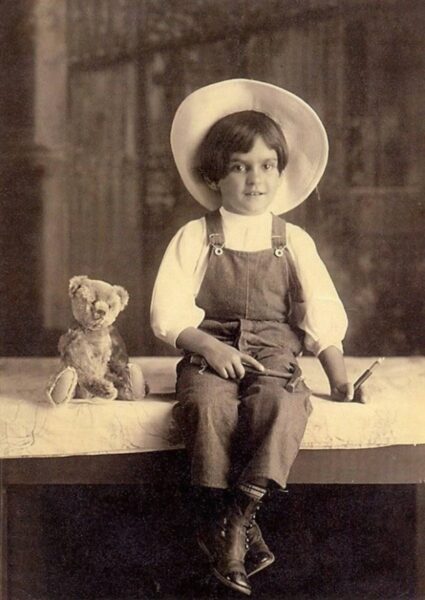
Guillermo took the photo above in 1913 and, judging from her apparent good health it was likely before she contracted polio sometime that year – an illness that would be the first of several serious medical challenges Frida would face in her lifetime. The immediate result of the infection caused her to be bedridden for nine months but, despite her father’s unusual encouragement that she play soccer, go swimming, and even wrestle to help aid in her recovery, consequent muscle atrophy and poor circulation created chronic pain and kept her right leg thinner, shorter, and weaker than the left.
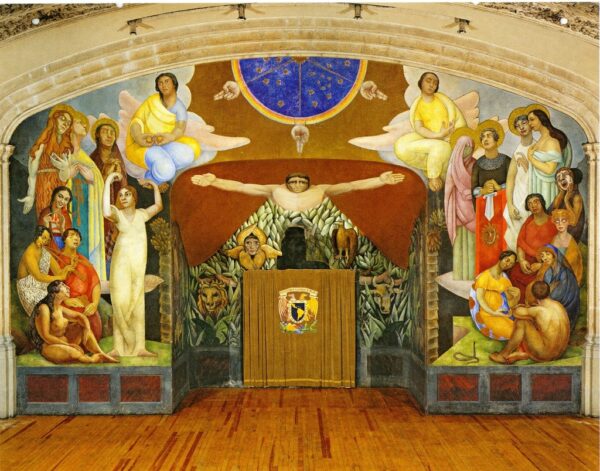
The disease delayed her school enrollment but by age 15 she was able to enroll in México’s most prestigious school – the renowned National Preparatory School – and it was here that she had her first, albeit brief, encounter with Diego Rivera – whom she would eventually marry – while he was painting his landmark mural Creation in the Bolívar Auditorium.
[From DiegoRivera.org]
Just one of 35 female students attending the school, Frida hoped to combine her love of medicine and sketching to become a medical illustrator. It was here that she began associating with a group of politically and intellectually like-minded leftist students gradually becoming more politically active and joining the Young Communist League and the Mexican Communist Party.
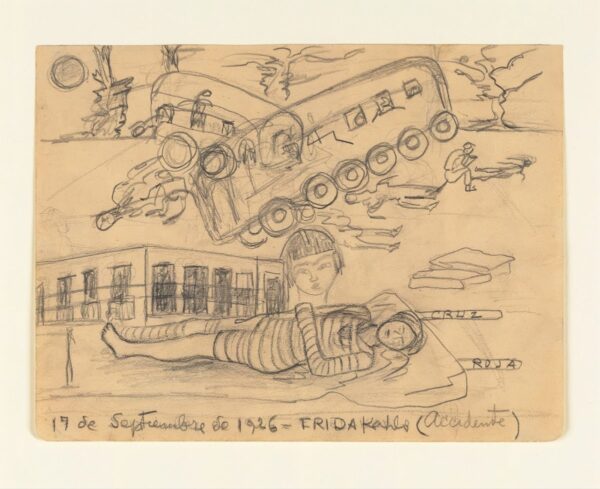
Everything changed for her on 17 September 1925. Frida and her friend Alejandro Gómez Arias were traveling home from school when they got off the bus they had initially boarded to look for an umbrella Kahlo realized she had left behind. The second bus they boarded collided with a streetcar. Several passengers were killed instantly, and others later died from their injuries.
Kahlo survived but was gravely injured. An iron handrail had impaled her through her pelvis, as, she would later say, piercing “the way a sword pierces a bull.” Arias and others removed the handrail, causing Kahlo immense pain.
After undergoing a series of surgeries and spending a month in hospital, Kahlo returned home where, in an echo from her childhood, she endured several bedridden months.
She turned to painting as a form of therapy at first using a specially made lap easel that allowed her to paint while prone in bed. At some point in her recovery period her mother, Maria Calderon, installed an overhead mirror in her bed’s canopy.
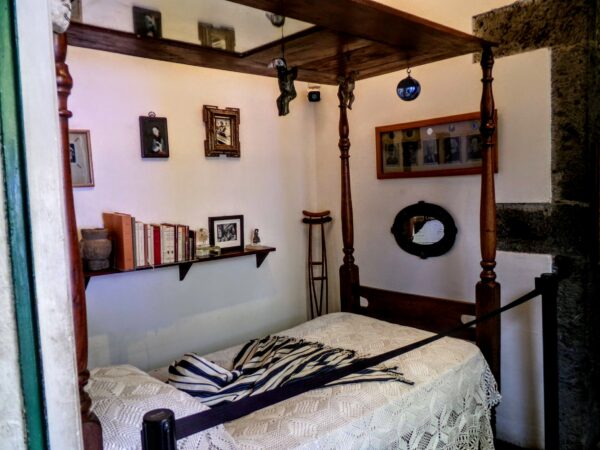
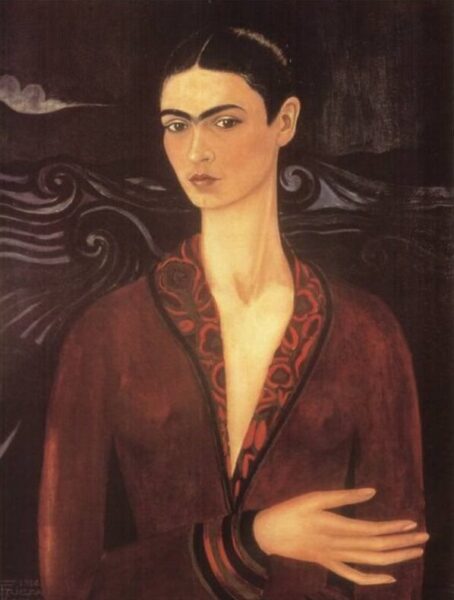
Frida used it to begin painting the first in a long series of self-portraits – the first of which was Self-portrait in a Velvet Dress.
A year after the accident, Frida produced her only work directly depicting that day. She called the sketch Accidente.
[From Google Arts and Culture ©2021 Banco de México Diego Rivera & Frida Kahlo Museums Trust]
Return to Diego
In 1928, 41 year-old Diego Rivera was completing his five-year-long project of murals at the Secretariat of Public Education (SEP) in México City. Among the last of those works was one
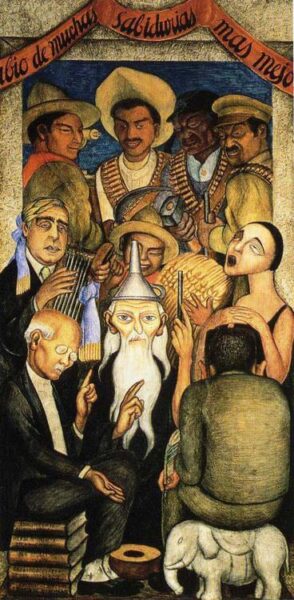
called Los Sabios and he might have been painting it when he was approached by a now healed 21-year-old Frida Kahlo seeking his professional opinion about her paintings. (Some reports place this second meeting at a party hosted by photographer Tina Modotti in México City but the former seems to carry the most credence.)
Kahlo’s work impressed Rivera and he both encouraged and supported her. Their shared political activism in the Mexican Communist Party and their mutual passion for Mexican identity sparked an immediate, more intimate connection and she became his third wife on 21 August 1929.
The medical bills the family had incurred during Frida’s recovery from her bus accident had placed the Kahlos under considerable financial strain. Within the first years of their marriage, Rivera purchased La Casa Azul
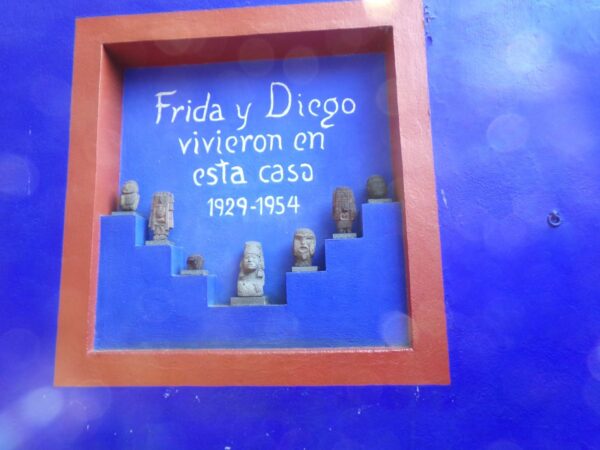
securing it for himself and his new bride while simultaneously relieving the burden her family had incurred.
The next decade would be tumultuous. Extramarital liaisons, such as Rivera’s affair with Frida’s younger sister Christina in 1934, prompted the first of their many separations.
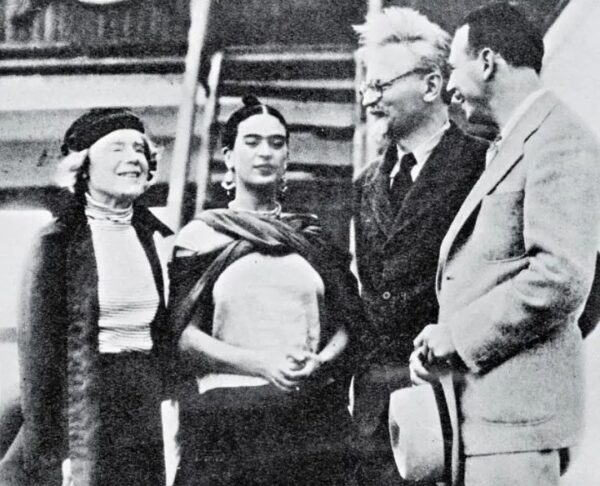
Kahlo herself was certainly not wed to conventional notions of marital fidelity. She was bisexual and a 1933 letter lamenting not “making love” with Georgia O’Keeffe hints at that attraction. Rivera was certainly tolerant of Frida’s bisexual inclinations but when the couple hosted Leon Trotsky and his wife Natalia Sedova in January 1937 after helping them secure asylum from President Lázaro Cárdenas,
[From Medium]
it ignited a months long affair between Frida and the Russian revolutionary that didn’t please either Rivera or Sedova when they discovered it in June.
Eventually, these extramarital “diversions” as they called them led to the couple’s divorce in 1939. Frida became his fourth wife when the pair remarried in 1940.
Meanwhile, Kahlo accompanied Rivera on two trips to the United States. They first traveled to San Francisco in late 1930 where they lived in the studio of sculptor Ralph Stackpole while Rivera worked on frescoes for the San Francisco Stock Exchange Luncheon Club (January–February 1931) and the California School of Fine Arts (finished 3 June, 1931). Stackpole was a classmate of Rivera’s and he introduced the couple to an eclectic group of writers, painters, and photographers many of whom helped energize Frida’s creative process.
But it was Dr Leo Eloesser, the chief of thoracic surgery at San Francisco General and who was treating Frida for the leg pain she suffered from her accident and from having had polio who provided many avenues of inspiration. Eloesser took them on trips around northern California and a trip to Santa Rosa when they visited Luther Burbank’s garden provided a critical moment of inspiration for Frida. Burbank’s method of fusing together two organisms to create a new third organism lit a spark that would be her first major breakthrough creatively. Death would be a common theme for Kahlo and she painted a portrait of Burbank portraying him as part human and part tree trunk with roots connecting to his buried corpse.
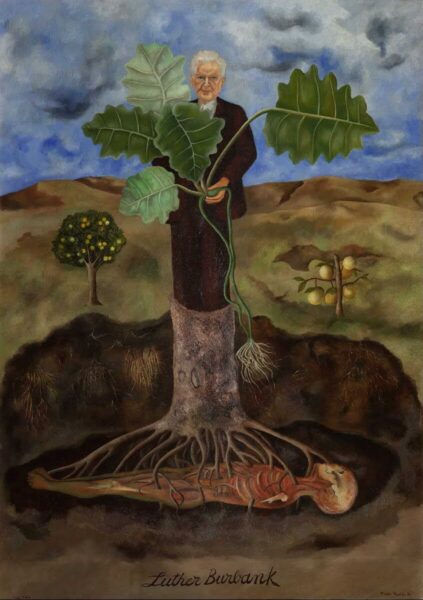
[From FridaKahlo.org]
The couple returned to México on 8 June 1931 but in November traveled to
New York and then Detroit.
Kahlo accompanied Rivera on the trip to New York as he prepared for a retrospective at the Museum of Modern Art (MoMA). The Henri Matisse Retrospective – MoMA’s first to feature a single artist – would close on 6 December 1931. Rivera’s show, featuring 149 works including portable murals Rivera created on-site at the museum, opened just more than two weeks later on the twenty-second.
Carl Van Vechten took this photographic portrait of the couple during their New York stay.
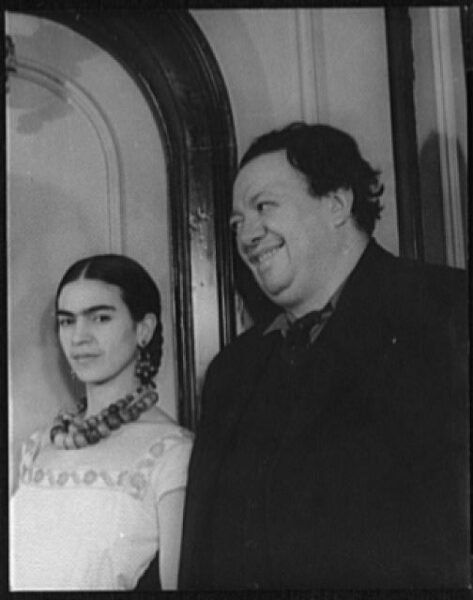
[Library of Congress – Public Domain]
She was able to expose herself to major European art but, perhaps more importantly, she became ever more acutely aware of the contrasts between wealth and Depression poverty and between industrial power and human suffering. This became part of her political and symbolic language. Although she’s not known to have produced any paintings during this time, it did inform her artistic vision and development.
The lone possible exception is that Kahlo started the painting titled Display Window in a Street of Detroit soon after their arrival because it bears the date 1931. They left New York for Detroit in April 1932.
Once in Detroit, one event in particular would dramatically change Kahlo’s life. You can read about that and much that followed in the next post.
-
Photos and their stories – Lisbon – Summer 2026 part two – plus an egg-straordinary bonus
August 21, 2026 -
Photos and their stories – Lisbon – Summer 2026 – part one
August 21, 2026 -

The indigenous people of Da?ow?aga? (Olympic Valley and me supplement three)
August 19, 2026 -
The indigenous people of Da?ow?aga? (Olympic Valley and me Supplement two)
August 17, 2026 -
Olympic Valley in the time before humans (Olympic Valley and Me Supplement one)
August 14, 2026
2 responses to “Fires are burning inside but how can I show them”
The original Unibrow
Maybe the original famous unibrow but there’s no doubt that was a defining feature. More to say about her in Friday’s post.