Notes on the VIII Winter Olympiad – (Squaw Valley and Me Addendum one)
In the previous post outlining how Alexander Cushing finagled his way into coaxing the IOC to Award the VIII Winter Games to his Squaw Valley resort, I noted a connection to the 1932 Games in Lake Placid – the first Winter Games in the US. In that instance bringing the Games to the US also happened principally through the efforts of a single man – Godfrey Dewey. As we proceed on our journey through the 1960 Games, we’ll unearth other ties between the two locations and we’ll do so without having to dig too deeply into any sediment of sentimentality. However, we can state rather conclusively that the Olympic Organizing Committee displayed no sentiment in brushing Cushing aside. They replaced him with Prentis Hale who, as President of the OOC, delivered the speech of welcome at the opening ceremony.
Ups and Downs
In the post How the III Winter Games came to the United States, I described how fewer countries (17 down from 25) and athletes (252 versus 464) participated in the first Lake Placid Olympics than had competed in St. Moritz four years earlier. Despite the first appearances of Argentina, Denmark, New Zealand and the Republic of South Africa, the 1960 Games in Squaw Valley also experienced a drop in NOC participation compared to the 1956 Games. (Belgium, Bolivia, Greece, Ireland, Romania, and Yugoslavia sent athletes to Cortina d’Ampezzo but not to Squaw Valley.) The onset of the Great Depression was the principal reason in 1932. It’s likely that the decision not to build a bobsled run combined with broader resistance to the venue and its facilities were prime factors that diminished participation in the 1960 Games.
Speaking of bobsled, Lake Placid, like Squaw Valley, didn’t have a bobsled run at the time it secured its position as the host.
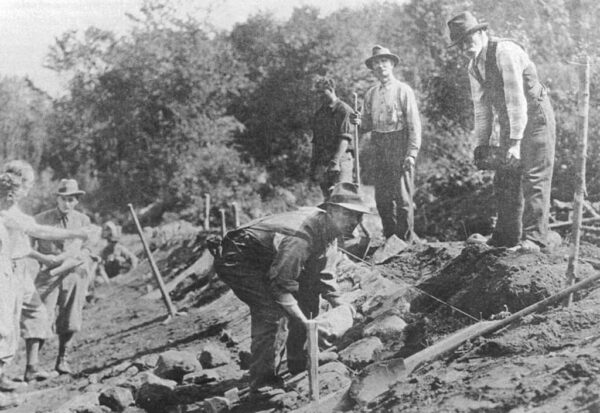
[From Lake Placid Olympic Museum]
Although Squaw Valley had the promise of $1,000,000 in state support that had helped Cushing secure the bid, Lake Placid had even stronger backing from then New York Governor Franklin D Roosevelt to provide all (or most) of the necessary construction funds.
Cushing’s bid promised the inclusion of the four major winter disciplines – bobsledding, hockey, skating (figure and speed), and skiing (Nordic and Alpine). In fact, On 4 October 1955, Cushing reported to IOC President Brundage that preliminary plans for the bobsled track had already been approved by the Fédération Internationale de Bobsleigh et Tobagganing (FIBT).
In early 1957, Alan Bartholemy, Secretary of the SVOC, wrote to Marc Hodler of the International Ski Federation (FIS), that starting the Games in late February 1960 would be better for the proposed refrigerated bob track. As of 13 August 1957, a tentative program for Squaw Valley included the dates for bobsled racing.
Then the controversy began. The Squaw Valley Organizing Committee learned that only nine NOCs planned to send bobsledding teams and decided the construction cost of a bobsled run constituted too great an expense. So in early September 1957, Alan Bartholemy, Secretary of the SVOC, petitioned the IOC for permission to abandon its planned construction. The IOC announced their acquiescence at their late September meeting in Sofia, Bulgaria.
The infuriated international bobsledding community actively lobbied the IOC to force the SVOC to reinstate the sport.
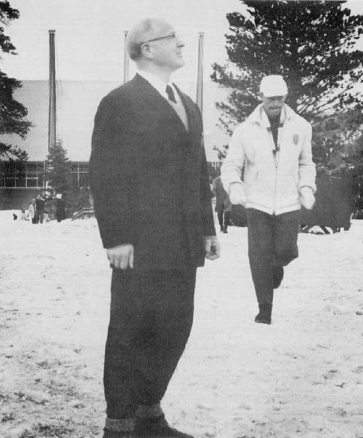
[Avery Brundage at Squaw Valley – From Wikipedia – Author Unknown]
When that failed, the FIBT backed the offer by the village of Lake Placid to use their 1932 course. Rather unsurprisingly, the IOC, using the previously unenforced Rule 30 that required a minimum of 12 participants (and applying it to countries rather than teams), asserted its amateur sport political dominance and rejected the idea that would have tied the two American host cities to the Olympics in an unprecedented manner. Although it wasn’t known – or even suspected at the time – fate would step in two decades later to further connect the two sites in a way that almost defies belief.
But before I tell that tale,
let me tell you the tale of the tape or, as we might call it in 21st century lingo, report on some of the metrics.
Total participating National Olympic Committees (NOCs): 30 (Down from 32 at Cortina d’Apezzo in 1956.)
Total participating athletes: 665 (521 Men; 144 Women. Down from 822 at Cortina d’Apezzo in 1956.)
Total competitive disciplines: 8.
Total medal events: 27 (Alpine skiing {6}, biathlon {1}, cross-country skiing{6}, figure skating {3}, ice hockey {1}, Nordic combined {1}, ski jumping {1}, and speed skating {8}.)
Top of the Medal Table.:
USSR – 7 gold / 21 total.
Germany – 4 gold / 8 total.
USA – 3 gold / 10 total.
Norway – 3 gold / 6 total.
Sweden – 3 gold / 8 total.
Finland – 2 gold / 10 total.
All Others – 5 gold / 18 total.
Multiple gold medal winning athletes: 2 – Lidiya Skoblikova and Yevgeny Grishin both in speed skating and both from the Soviet Union.
The Games were officially opened by Vice President Richard Nixon on 18 February 1960 with the first day of competition on the 19th and closed on 28 February.
The historic first
In addition to being the only Olympic Games hosted by a resort, the VIII Games at Squaw Valley gave Americans another first. This came courtesy of CBS which, in addition to a nightly recap, aired live coverage in the United States for the first time in the history of the Games. (These were not the first games to receive any televised coverage. Those distinctions belong to the 1936 Games in Berlin that were shown via closed circuit and a BBC broadcast {perhaps better called a narrowcast} for the 1948 Summer Games that could be seen by a small segment of London’s population {about 500,000} living within range of Wembley Stadium.)
A pair of former Olympians Dick Button (figure skating) and Art Devlin (ski jumping) and CBS News anchor Walter Cronkite joined sportscasters Chris Schenkel and Bud Palmer in providing the coverage. Looking at the schedule provided on the website Television Obscurities, it appears that the network aired 13.5 hours of live coverage that was supplemented by a half dozen late night recaps. The site also reproduces portions of a review by Jack Gould who wrote the following for The New York Times,
The formality of opening the games admittedly was not conducive to exciting TV: even Vice President Nixon was allotted only one sentence. But C.B.S. missed what could have been a story of more than passing interest. Some close-ups of the sports representatives of the world, as well as a better description of the setting at Squaw Valley, Calif., could have been informative.
Instead there was the familiar manifestation of television’s preoccupation with television’s role in reporting the news. Walt Disney was presented before the cameras; Lowell Thomas and Art Linkletter were there and the C.B.S. reporters were painstakingly introduced. Even Mrs. Andrea Mead Lawrence, the last skier to carry the Olympic torch, was revealed as a C.B.S. aide.
In the next post, we’ll look at some of the highlights of the competition and that fateful connection between Squaw Valley and Lake Placid. Meanwhile, if you’re interested in seeing a mix of archival footage both with and without sound, you can find it here from the archive of the Center for Sacramento History.
-
Photos and their stories – Lisbon – Summer 2026 part two – plus an egg-straordinary bonus
August 21, 2026 -
Photos and their stories – Lisbon – Summer 2026 – part one
August 21, 2026 -
The indigenous people of Da?ow?aga? (Olympic Valley and me supplement three)
August 19, 2026 -
The indigenous people of Da?ow?aga? (Olympic Valley and me Supplement two)
August 17, 2026 -
Olympic Valley in the time before humans (Olympic Valley and Me Supplement one)
August 14, 2026