Notes on the VIII Winter Olympiad – The first Miracle on Ice (Squaw Valley and Me Addendum two)
First, some other firsts
In previous posts, I’ve noted that the Squaw Valley Olympics were the first Winter Games to have a dedicated Olympic Village for the athletes, the first to have live television broadcasts in the United States, were the first (and, to date, only) Winter Games without a bobsled competition, and were the first (and, to date, only) Olympic Games not hosted by a municipality. But there were a few other noteworthy firsts at these California Games.
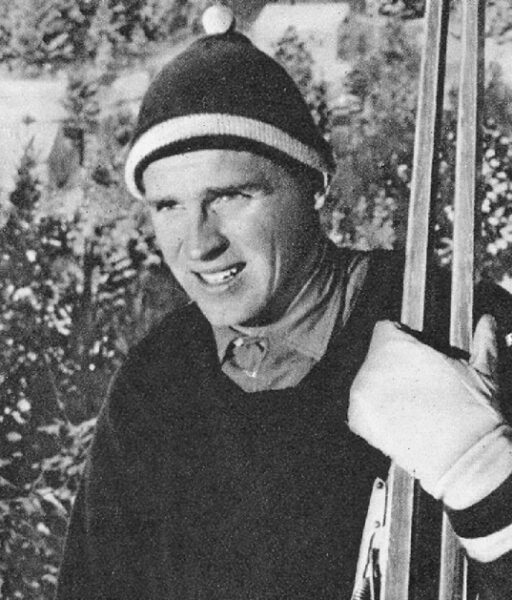
Biathlon was introduced as a sport for the first time. The first Winter Games at Chamonix in 1924, held a competition called Military Ski Patrol that was similar to biathlon and the sport appeared as a demonstration sport in 1928, 1936, and 1948. The main difference between the two is that the former was a team competition while biathlon was introduced as an individual sport. (Men’s team relays were added in 1968 and women’s in 1992.) The race in 1960 covered 20 kilometers combined with 20 shots fired at a stationary target from 250m, 200m, 150m and 100m with the first three series fired from a prone position and the last standing. Klas Lestander from Sweden
[From Wikipedia – Photographer Unknown]
was the sport’s first gold medalist.
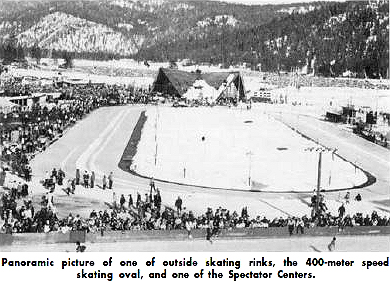
Another sport that made its first Olympics appearance was women’s speed skating. On 20 February 1960, at an unrecorded time in front of an unknown number of people 23 competitors from 10 countries stepped to the Squaw Valley Speed Skating Oval
[From Wikipedia – Photographer Unknown]
for the first ever women’s speed skating event – a 500 meter sprint. The race favorite was Tamara Rylove from the USSR but she would finish ninth. The gold medalist, Helga Hasse from the GDR (East Germany), came to Squaw Valley without her coach or husband because US authorities refused to grant them visas. (In a related first, the speed skating events were contested on artificial ice, rather than a natural lake or pond.) The ultimate star of the show was the USSR’s Lidiya Skoblikova who won gold medals in both the 1500 meters and 3000 meters races.
And a brotherly reunion
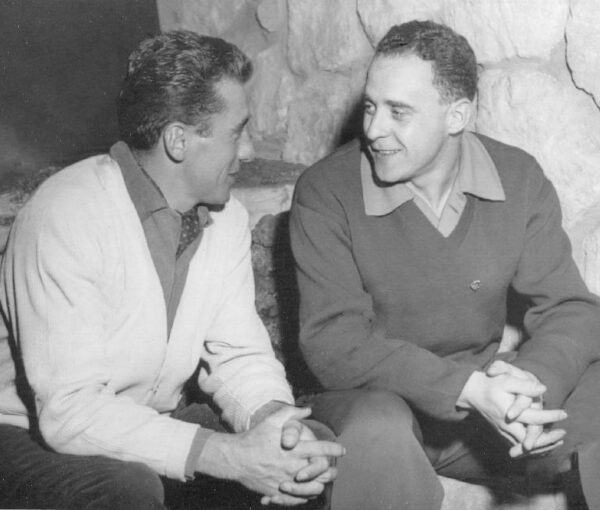
This particular reunion qualifies as both a first and a rarity. On 20 February 1960, for the first (and, to date, only) time, an Australian hockey team took to the ice at Blyth Arena where they would face a team from Czechoslovakia that had lost 7-5 to the US the previous day. One of the Australian players was a chap named Steve Tikal. However, Steve wasn’t his birth name. When he was born in Czechoslovakia, he was given the name Zdenêk. He’d only adopted the name Steve after he and his father had fled to Australia in 1948. His brother František wore the Czech uniform. Not only would this be the first time brothers faced one another playing the same sport but for different countries, their meeting in Squaw Valley was the first time these brothers had seen the other in a dozen years.
As might be expected, the Czech team skated to an easy 18-1 win but the game’s real drama stemmed from the approach of the Czechoslovakian players toward Steve. One of Steve’s teammates, Basil Hansen said, “We had two Czech players in our team, the other was Ivo Veseley. They were naturalized Australians but it was a big deal as far as the Czechs were concerned because they were classed as traitors to their country, and they wanted to kill.” Sometime during the game, Steve suffered either a broken collarbone or a separated shoulder (reports differ). Perhaps in a bit of irony, Seamus O’Coughlin’s book Squaw Valley Gold reported that it was a collision with František that sent Steve to the ice and ended his Olympic career.
The photo below shows that, despite the best efforts of the Czechoslovak security detail, the brothers did meet – at least briefly.
[From UPI – Public Domain]
The first Miracle on Ice
On 7 May 1945 in Reims, France, German Colonel General. Alfred Jodl signed Germany’s surrender on all fronts but that was insufficient for one leader among the victorious Allied forces. For Josef Stalin this seemed too much like a separate Western peace so he insisted on a second signing in Berlin. Thus, the official end to the Second World War in Europe is recognized as 8 May when German Field Marshal Wilhelm Keitel signed the final German surrender.
This reflected months of tension between the United States, Britain, and the Soviet Union because these “Big Three” allies didn’t share the same political goals. Disagreements over Poland, Eastern Europe, and the future of Germany further strained the alliance. Stalin was suspicious of Churchill and Roosevelt, while the Western Allies were wary of Soviet expansion.
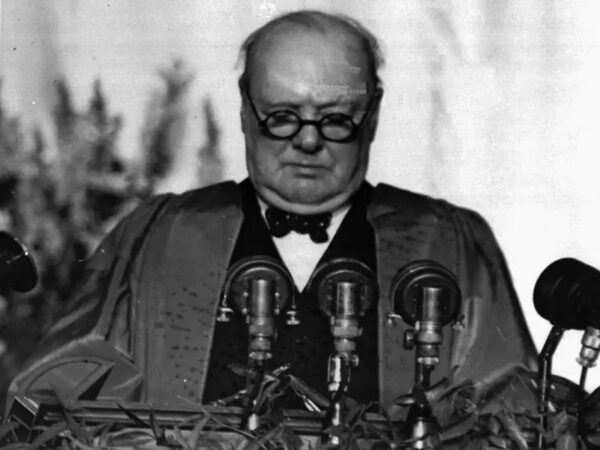
Less than a year later Winston Churchill traveled to Westminster College in Fulton, MO and delivered a speech he called, “Sinews of Peace.”
[AP – Public Domain]
This, is perhaps the most famous sentence from that oration.
From Stettin in the Baltic, to Trieste in the Adriatic, an iron curtain has descended across the continent.
It wouldn’t be unreasonable to mark this as the day the Cold War began. And tensions from this cold war predictably spilled into athletic competition as athletes from each side became the exemplars of the supposed superiority of the economic and political systems they represented. With respect to ice hockey, Canadian Olympic officials, in particular, objected to the use of what they called “professional amateurs” by Eastern Bloc countries – especially the Soviet Union. They alleged that the Soviets gave their elite hockey players phantom jobs in the military that allowed them to play hockey full-time creating a distinct advantage.
The U S held its preliminary tryout camps at Williams Arena, on the University of Minnesota campus and Jack Riley,
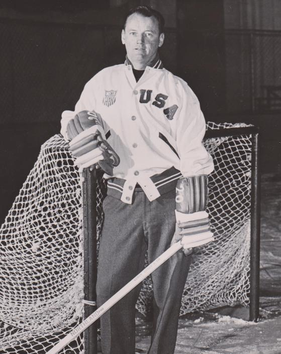
[By USA Hockey – Original publication: USA Hockey Immediate source: https://www.ushockeyhall.com/page/show/3003287-john-jack-riley-jr, Fair use, https://en.wikipedia.org/w/index.php?curid=78610322]
then the head coach at Army had the responsibility of building the roster and, in December 1959, would take the team on a demanding 18 game pre-Olympics tour before moving to West Point to complete its training.
One player missing from that group was Harvard’s Bill Cleary who was widely considered the country’s best amateur player. Coach Riley was finally able to coax Cleary to join the squad by agreeing to Cleary’s demand that his brother Bob also make the roster. When Riley also added John Mayasich just days before the Games began, he had to cut two players who had trained with the team. This infuriated the other players who held a secret meeting in Denver and threatened to boycott the Games. Riley stood his ground saying, “I’d rather have an unhappy ship than a bunch of guys that love each other and play like horseshit.”
For the first time in Olympic history (Where have you read this phrase before?) the ice hockey tournament had a clear group stage. Six teams – Canada, Czechoslovakia, Germany, Sweden, Soviet Union, and United States – from the three preliminary groups advanced to the round‑robin medal round. The Canadians and the Soviet Union were the heavy gold medal favorites when the 1960 Games opened and, though the U S team had played well, this remained the case at the outset of the medal round.
Team USA easily won its first two games over Sweden and Germany and, bolstered by goalie Jack McCartan’s 39 saves, shocked the Canadian team 2-1 and put the U S in a strong position heading into their semifinal game against the USSR.
On 27 February, in front of an estimated 10,000 spectators in Blyth Arena, the US team took the ice against the Soviet team. Just over four minutes into the game, Bill Cleary scored with an assist from his brother Bob to put the US in front 1-0. The lead was short lived as Veniamin Alexandrov tied the game less than a minute later. Mikhail Bychkov also found the back of the net and the USSR led 2-1 at the end of the first period.
The game was a taut physical affair with neither team able to gain a real advantage until Billy Christian scored with about nine minutes to play in the second period. The teams went into the break tied at two all.
With five minutes left to play in regulation, Christian scored again putting the US on top 3-2. The US held on completing their semifinal win and presaging their accomplishment in the same round in Lake Placid 20 years later. (The Soviets would suffer only a single preliminary round loss while sweeping the four subsequent Olympic gold medals.)
But the job wasn’t quite done. To earn the gold medal, the US would have to take down the Czech team they’d defeated 7-5 in the preliminary round. They did just that in a dominant 6-o third period turning a 4-3 deficit into a 9-4 win.
Some tell their story in this 11-minute video.
In one final connection to the later Miracle on Ice, the last player Jack Riley cut from his team was a University of Minnesota senior named Herb Brooks.
-
Photos and their stories – Lisbon – Summer 2026 part two – plus an egg-straordinary bonus
August 21, 2026 -
Photos and their stories – Lisbon – Summer 2026 – part one
August 21, 2026 -
The indigenous people of Da?ow?aga? (Olympic Valley and me supplement three)
August 19, 2026 -
The indigenous people of Da?ow?aga? (Olympic Valley and me Supplement two)
August 17, 2026 -
Olympic Valley in the time before humans (Olympic Valley and Me Supplement one)
August 14, 2026
2 responses to “Notes on the VIII Winter Olympiad – The first Miracle on Ice (Squaw Valley and Me Addendum two)”
Good read Todd. Thanks for sharing this. I found it entertaining.
Always happy to have you stop by, Shell.