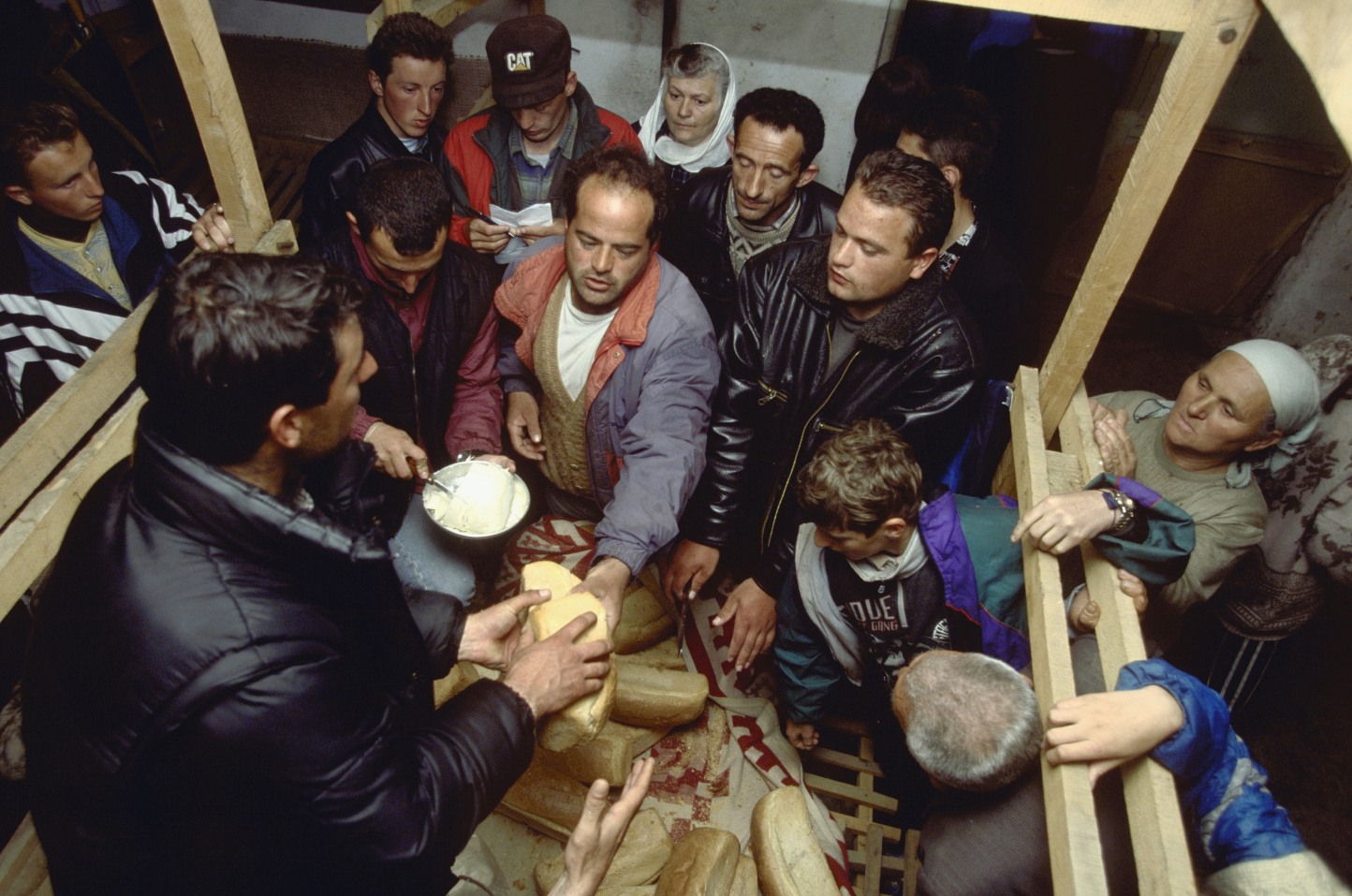
Here, where the sky is falling – Kukës
Today begins the second solo stretch of this trip and, while I’ll be based in Tirana for the next two days, I’m going to use the compact international structure of the Balkan Peninsula to take a pair of quick day trips to two of Albania’s neighbors. I begin today with Kosovo. (I was told that Kosovars prefer their country’s name to be pronounced Kuh-SO-vuh as opposed to the internationally recognized Kosovo.) But on our way, we’ll make an all too brief stop in Kukës – the only city ever nominated for the Nobel Peace Prize.
How it came to pass
The route from Tirana to Kukës and thence to Pristina as the Google Maps screenshot shows
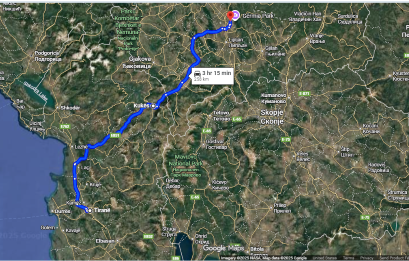
is relatively direct with only a few twists and turns along the way. The same can’t be said for the history of Kosovo and its connection to the Albanian city of Kukës but I’ll try to make it seem so. Under Ottoman rule, Kosovo was one of the four vilayets the League of Prizren sought to consolidate into a single autonomous Albanian province in the late 19th century. However, the Great Powers of the time blocked these efforts first with the Treaty of San Stefano and later with the 1878 Treaty of Berlin.
In the First Balkan War (1912-1913), the combined forces of Serbia and Montenegro defeated the Ottomans and annexed most of Kosovo. Throughout World War I, Austria‑Hungary in the west and Bulgaria in the east occupied Kosovo. At the end of that war and Based on its previous incorporation into Serbia and Montenegro, Kosovo became part of the new Kingdom of Serbs, Croats and Slovenes, created in December 1918 and that was renamed the Kingdom of Yugoslavia in 1929.
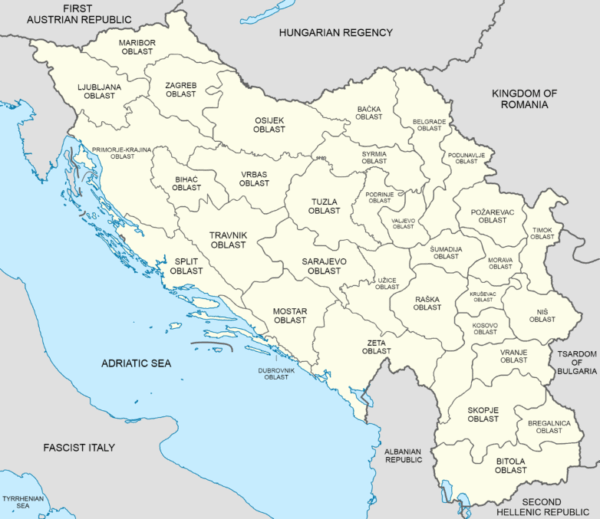
[From Wikipedia by NordNordWest]
In the interwar period, Kosovo remained part of the Kingdom of Yugoslavia as a region within the Serbian part of the kingdom. At the outset of WWI, an estimated 75 – 80% of Kosovo’s population was ethnically Albanian. Aggressive policies of expulsion and forced Serbian migration reduced that to approximately 65% by the time Kosovo became part of the Kingdom of Yugoslavia. They continued these policies between the First and Second World Wars and this resulted in another slight decline to roughly 61 percent. (By the end of the twentieth century, the proportion of ethnic Albanians in Kosovo had rebounded to an even higher proportion.)
During World War II, Axis powers detached most of Kosovo from Yugoslavia incorporating it within Italian‑controlled Albania – an arrangement that ended with the Axis defeat. After the war, Tito’s new Socialist Federal Republic of Yugoslavia re‑established Yugoslav control and, in 1946, it made Kosovo an autonomous region within the republic of Serbia.
Although the 1974 Yugoslav constitution expanded Kosovo’s autonomy, giving it many of the powers of a republic, it formally remained an autonomous province within the Yugoslav Socialist Republic of Serbia.
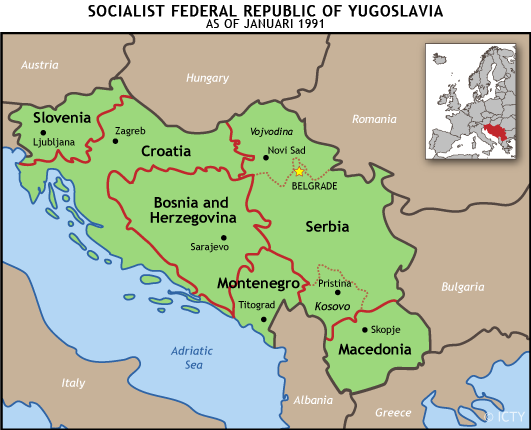
[From University of Central Arkansas]
However, Yugoslavia was largely a single nation in name only. It had been held together largely by Tito’s iron rule and his force of personality. Barely more than a decade after the dictator’s death, the Republics began to secede – led by Slovenia in June 1991 and followed shortly thereafter by Croatia. By 1992 only Serbia and Montenegro remained unified in what was colloquially called rump Yugoslavia.
As Yugoslavia dissolved and the region devolved into the interethnic and religious wars of the early nineties, Serbia under Slobodan Milošević revoked Kosovo’s wide autonomy, dissolved its assembly, and brought the province under tight Serbian control. In response, Kosovan Albanian leaders proclaimed a Republic of Kosovo, organized underground elections, and built parallel systems for schooling, health, and taxation while largely boycotting Serbian state structures.
In April 1996, a previously unknown organization – the Kosovo Liberation Army (KLA) – coordinated four simultaneous attacks on Serbian security forces in different parts of the country. This armed resistance against Serbian and Yugoslav forces ran counter to the policy of passive resistance espoused by the Republic’s first President – Ibrahim Rugova.
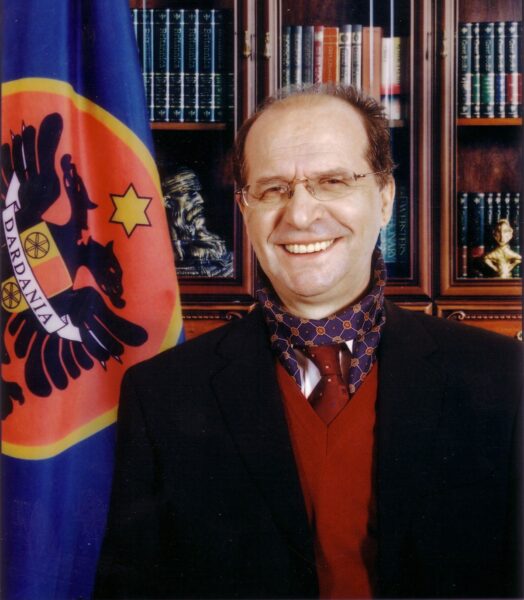
[Wikipedia – Public Domain]
The conflicts escalated over the following 18 months – a period that coincided with a financial collapse in Albania that, together with funding from the Kosovar Albanian diaspora, opened the floodgates for arms flowing to the KLA.
Kosovo’s shadow prime minister in exile further fueled the conflict when he oversaw the creation of the Armed Forces of the Republic of Kosova or FARK. (The KLA and FARK began as rivals but eventually merged into a single force.) Then a misstep by the United States Special Envoy to the Balkans, Robert Gelbard, inadvertently worsened an already deteriorating situation. According to a BBC article, on a visit to Pristina in February 1988, Gelbard, referring to the KLA, said, “I know a terrorist when I see one and these men are terrorists.” Although he later walked that back when he testified in front of the House Committee on International Relations saying, “while the KLA had committed ‘terrorist acts,’ it had ‘not been classified legally by the US Government as a terrorist organization.'”
However, the Yugoslav government, which did see the KLA as a terrorist organization, needed just days to use Gelbard’s February statement to launch a crackdown that, rather than breaking the KLA, increased their support and numbers. The situation escalated into the Kosovo War in 1998–1999.
Western Europe, the US, and NATO had been entangled in the various Balkan conflicts since the early nineties. You might recall that the Dayton Accords, that I wrote about here, were signed in Paris in December 1995, ended the war in Bosnia and Herzegovina.
In March 1999, NATO launched a campaign of air strikes they labeled a “Humanitarian War.” Its stated aim was stopping the Serbian efforts to “ethnically cleanse” the area by displacing or killing the ethnic Albanians who had always constituted the majority of Kosovo’s population. From one perspective, the bombing campaign that would last until June temporarily achieved, perhaps inadvertently, the Serbian effort to change the ethnic balance, as hundreds of thousands of Albanians fled Kosovo to neighboring countries. Albania opened its borders immediately.
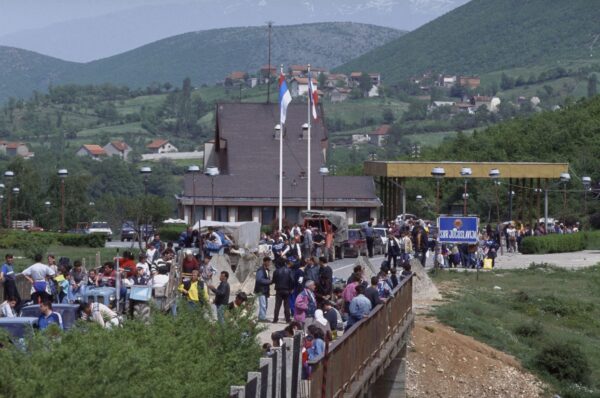
[Archives of the ICRC – By Boris Heger]
And this brings us to the role of Kukës.
Although the first known written mention of the town dates only to 1571, the history of human habitation in the area of Kukës dates to the neolithic period, and the small city was historically an important cultural and strategic crossroads, it escaped widespread international notice until March 1999. This is when the refugees began pouring in.
The first day saw a manageable 187 people seeking refuge. When 13,ooo arrived on the second day, it effectively doubled the city’s population of about 16,000. Within a week, the area pullulated with refugees. Before the crisis ended, more than 450,000 people would cross the border into Kukës with more than 150,000 remaining in the town and nearby internationally supported camps.
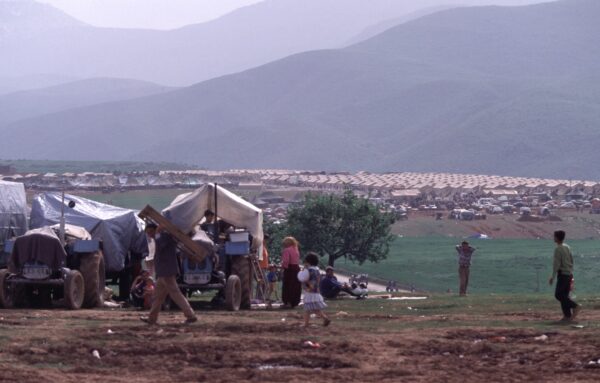
[Archives of the ICRC – By Boris Heger]
Recall that in 1997-98, Albania’s economy was crushed by the collapse of massive pyramid schemes that had built the illusion of wealth and Kukës was no exception. Despite limited resources that could barely support its own population, the people of Kukës became exemplars of the Albanian traditions of Kanun and besa. Such a sudden influx of refugees would likely overwhelm even a large, wealthy community let alone a small, impoverished one. But the city became a sanctuary for the displaced, sharing its limited resources to ensure the safety and survival of those fleeing war. Yes, there was international aid including a camp set up by the UAE but beyond the camps, families in Kukës took their Kosovar neighbors into their homes while town officials repurposed schools and government buildings to provide safety, food, and shelter.
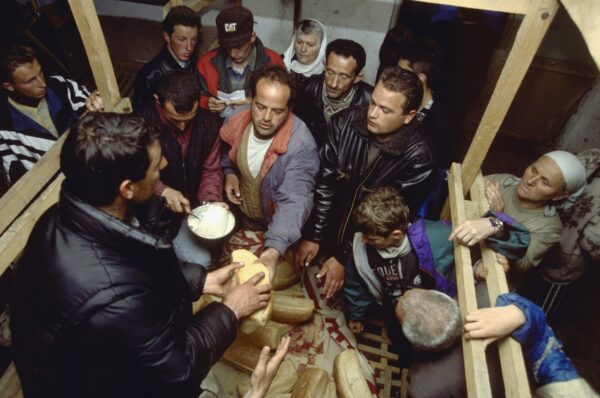
[Archives of the ICRC – By Boris Heger]
And the world noticed. In 2000, in recognition of its role in sheltering almost half a million refugees, Kukës was nominated for the Nobel Peace Prize – the first, and only, time a city has been so honored. There are no public records or reports that name a particular organization, individual, or entity that submitted the nomination.
Regular readers of this blog know that I treat every trip as an opportunity to broaden my worldview and expand my knowledge. Sometimes, though, I’m dogged by a sense of dystoria. Before we stopped in Kukës, my knowledge of the city – even to its existence – had the same content as a hole in a bagel. It required merely a brief stop to fill the hole and generate an entire post devoted to the city.
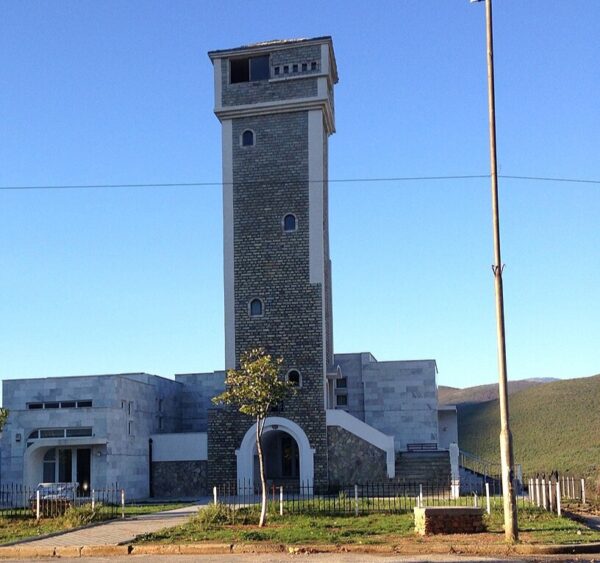
Our stop here was barely long enough to take a photo of the exterior of the Kulla Monument (also called the Exodus Monument) that’s part of the Ethnographic Museum but is mainly a tribute to the 450,000 Kosovars who passed through here. A quarter century later, this might be the sole representation of the wave of refugees that engulfed the town of Kukës as its people showed the world their Albanian hearts.
-
Photos and their stories – Lisbon – Summer 2026 part two – plus an egg-straordinary bonus
August 21, 2026 -
Photos and their stories – Lisbon – Summer 2026 – part one
August 21, 2026 -
The indigenous people of Da?ow?aga? (Olympic Valley and me supplement three)
August 19, 2026 -
The indigenous people of Da?ow?aga? (Olympic Valley and me Supplement two)
August 17, 2026 -
Olympic Valley in the time before humans (Olympic Valley and Me Supplement one)
August 14, 2026
2 responses to “Here, where the sky is falling – Kukës”
The first map shows “Fascist Italy”. Hhhmmmm…
Is that not appropriate for the time frame of the text?