En la zona rosa fue, En donde yo la conoci
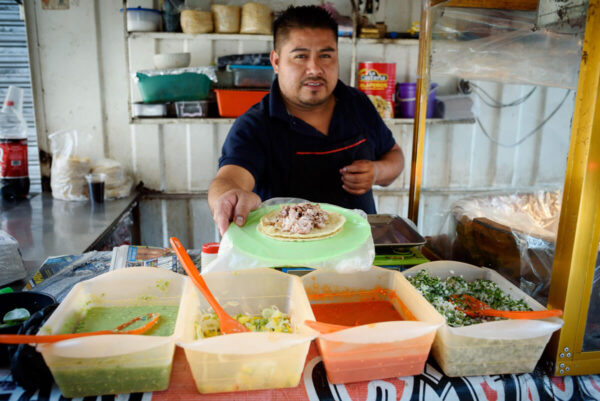
Some among you might recall the Culinary Backstreets tour I took when my friends K & P visited me in Lisbon in January 2024 that inspired seven posts beginning with the one called Side by Side by Side. Culinary Backstreets operates internationally and CDMX is one of their locations. Since I believe that one can begin to establish a basis of cultural understanding through food and since I’d obviously enjoyed the Lisbon tour (as well as my walking food tour in Tirana with Ariola) when I saw this Culinary Backstreets tour
[From Culinary Backstreets]
had space available Monday morning before I’d meet the Earthbound Expeditions group, it was quite the temptation. Sadly, for me, it proved impractical.
As I noted in the introductory post, I arrived at the hotel in the Zona Rosa at about 23:00 and I received firm advice from the receptionist that, if I didn’t know the route, I shouldn’t use a Mèxico City metered cab to take me the four kilometers or so to the tour’s meeting point at the Zócalo – the central square in CDMX. Rather I should take an Uber (whose app had been recently inactivated due to lack of use) or, alternatively, allow the concierge to book me a ride in the morning. And then I’d still be faced with finding my way back to the hotel. After 23 hours of travel, the thought of arranging all that seemed a bit overwhelming. Perhaps another time.
Atlas Obscura to the rescue?
Our hotel stay included daily breakfast so, before I curled under the bedclothes late Sunday, I laid out my list of Atlas Obscura’s CDMX sites and considered that would be the day’s primary activity before meeting the Earthbound group Monday evening. But when I reached the breakfast room, my plans would change.
Breakfast was included daily as part of our tour package and, when the hostess seated me at a corner table I recognized the person sitting to my right as our KFHM host T, because her photo was included in the pre-trip package Earthbound had sent. Repressing my tendency toward shyness, I immediately introduced myself to her and her partner A – who had joined her on the trip. I learned during the course of our broad breakfast conversation that he had a tie to my hometown of Baltimore because he’d attended the Maryland Institute College of Art or, as he called it MICA. Since we had no fixed plans for the day and since the tour didn’t officially begin until just before supper Monday evening, we made an arrangement to meet in the hotel lobby
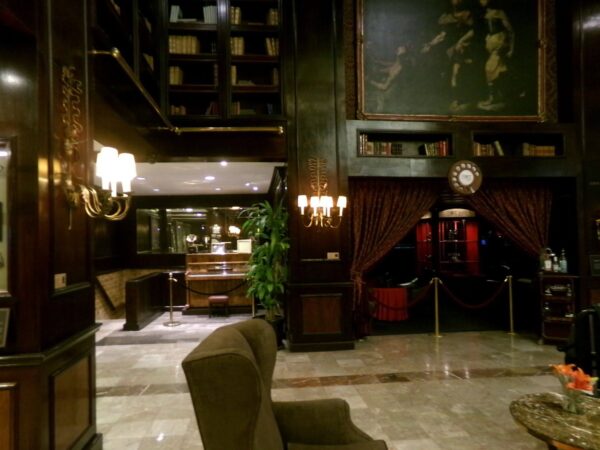
later in the morning. Our plan was to explore the neighborhood in the general direction of Chapultepec Park hoping to see a few of its many attractions.
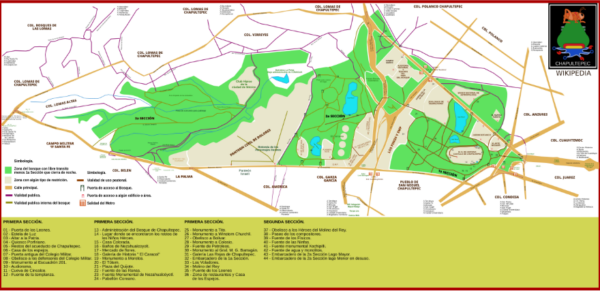
(Chapultepec Park is the largest park in CDMX and is twice the size of Manhattan’s Central Park. It’s divided into three main sections with a smaller fourth section.
The oldest section of the park dates to 1460 when it was designed by Nezahualcóyotl for Emperor Moctezuma as a garden and aqueduct that served as the source of water for the city. Then, in 1530, Holy Roman Emperor Charles V decreed that the forest of Chapultepec was property of Mêxico City to be used as a park, changing its use from a royal retreat to a civic park.
[From Wikipedia By Sarumo74 – Own work, CC BY 3.0.]
On 16 August 1785, Viceroy Bernardo de Gálvez began constructing Chapultepec Castle which sits atop a hill looming over the first section of the park. It was once the site of a Franciscan hermitage that was razed for the castle. After México achieved independence in 1821, the castle became the official residence of the head of state. The hill was the site of the Battle of Chapultpec on 13 September 1847 when 2000 American troops led by General Winfield Scott defeated a Mexican force of approximately 832 men led by General Nicholas Bravo in one of the most decisive battles of the Mexican-American War.
Later, Maximilian of Hapsburg established his residence in Chapultepec Castle (that we’ll visit later in the tour) and expanded it in the 1860s. Although the Castle would remain the principal residence of Mexican presidents until 1940 and thus off-limits to the public, the first section of the park was redesigned in 1907 and reopened in 1910.
The second section was added in 1964, the third in 1974, and the fourth and westernmost section in 2021. This land was donated by the Mexican Secretariat of National Defense.)
The strange story of La flechadora de las estrellas del norte
We three met at the appointed hour and, with GPSs in hands, set off in search of the park. We weren’t entirely focused on our maps – perhaps more attentive to our conversation – but were gaining a sense of the neighborhood when we reached the Mother’s Monument and the second of a pair of Korea – México Friendship Bells in CDMX.
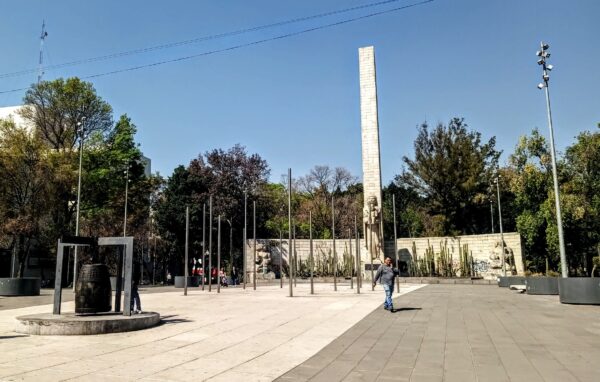
The Monumento a la Madre honors Mexican mothers and the ideals of maternal love, sacrifice, and fertility. It’s a “tribute of love and tenderness” to mothers and includes inscriptions and sculptures – such as a mother holding her child and an indigenous woman with corn – that symbolize motherhood’s nurturing and life‑giving role in Mexican society. The original monument was completed in 1949 but destroyed in the 2017 earthquake. It reopened a bit more than a year later.
One might wonder why the reproduction of the bell of King Seongdeok of Silla has a place near the Mother’s Monument. The bell is one of South Korea’s National Treasures and its reproductions are given as gifts of goodwill to other nations. The two given to México were to celebrate the centennial of the start of the Mexican Revolution and the bicentennial of the start of the War of Independence. Silla was an ancient Korean kingdom and it’s also called the Emile Bell. In Silla, emile means mother making this placement more than appropriate.
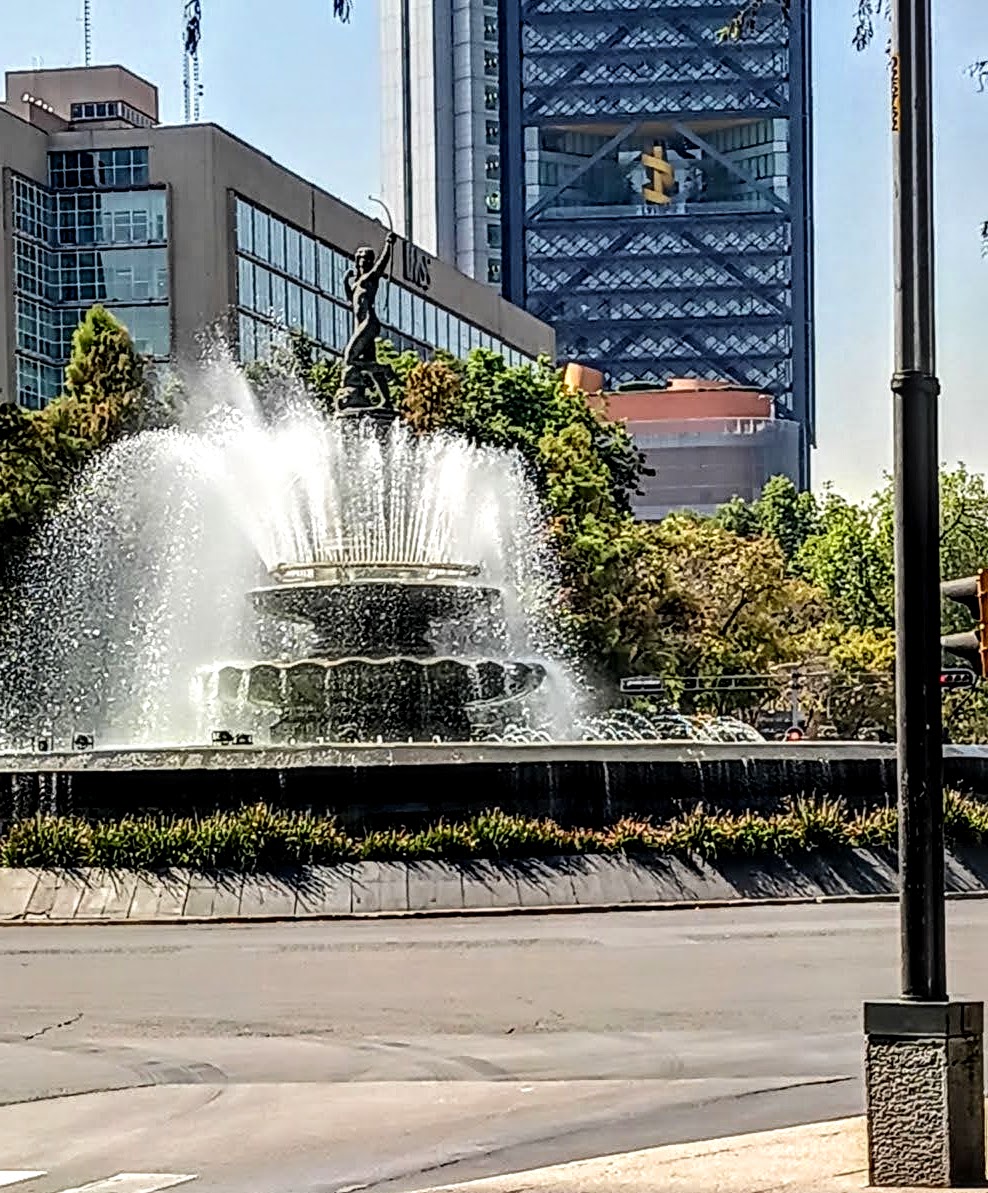
We continued along the Avenida Paseo de la Reforma admiring some of the architecture when we reached the large roundabout at the intersection with Sevilla and faced this impressive fountain
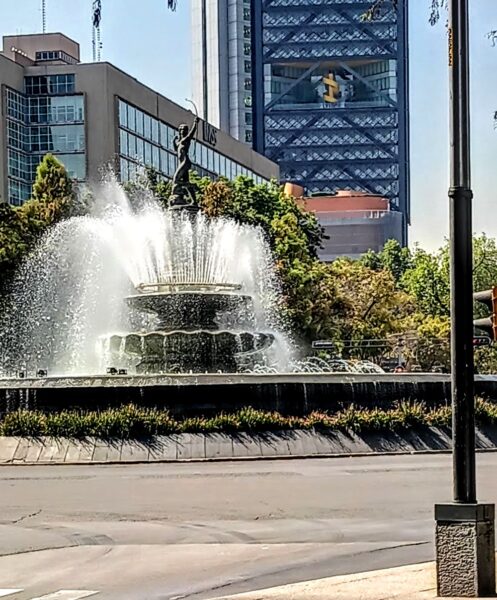
and statue that’s known not by its original name – La flechadora de las estrellas del norte (The archer of the northern stars) but as La Diana Cazadora or Diana the Huntress.
In the 1940s, an effort began to beautify CDMX. Likely prompted by Javier Rojo Gómez, the head of the Federal District Department, it included the construction and installation of public art and large fountains at roundabouts such as the one we now faced.
The design for this fountain was awarded to the architect Vicente Mendiola and the sculptor Juan Olaguibel. Mendiola asked Helvia Martínez Verdayes, a teenager he knew who was working as a secretary for Pemex to pose for the statue. The teenager agreed but, since the work was a nude archer, she required her identity remain a secret which it did until the early 1990s when she published a book titled El Secreto de la Diana Cazadora.
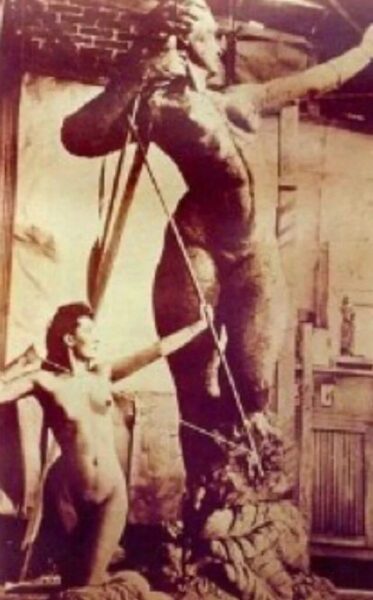
[From La Palomilla]
When the work opened on 10 October 1942, some elements in Mexican society found the fullness of its nudity scandalous. A year later, as a result of protests led by the League of Decency, Olaguibel agreed to add a bronze “loincloth” that he affixed with three small welds hoping that he might restore the work to its original form at a later time.
That later time came when México City was selected to host the 1968 Summer Olympics. In 1967, Alfonso Corona del Rosal agreed to the sculptor’s request to restore the work. However, it didn’t work out as well as Olaguibel had hoped as the statue was damaged during the removal process. As a result, a new statue was cast
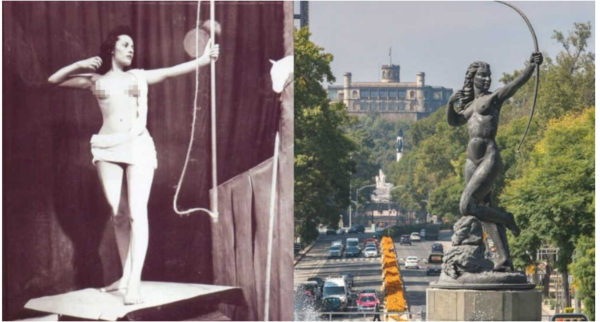
[From Proyeto Puente]
and this is the one we see today. Several other replicas were cast at this time including this smaller version
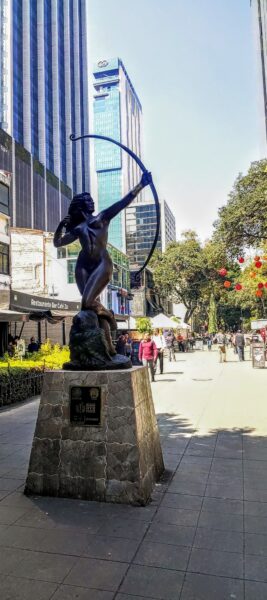
on Calle Génova just a few blocks from our hotel.
The original statue can be seen in Olaguibel’s hometown of Ixmiquilpan, Hidalgo some 143 km north of CDMX.
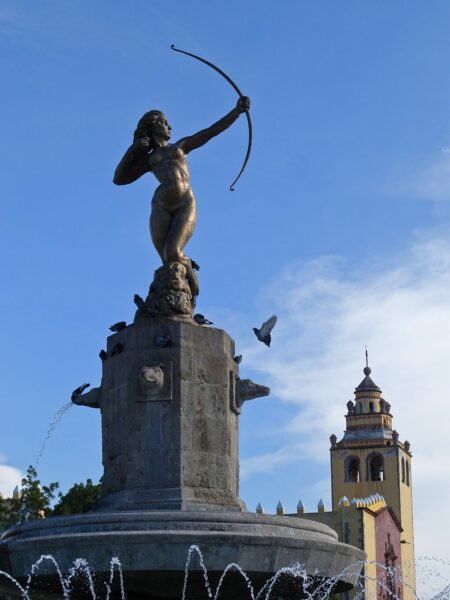
[From Wikimedia Commons by Ismael Villafranco, CC BY 2.0.]

We somehow found our way to the park but, when we arrived, discovered that Section One is closed for maintenance every Monday. So it was that we made our way back to the hotel and took our leave until later in the evening.
In the next post, I’ll wrap up my first full day in CDMX with a tour of the historic hotel where we’re staying and meet the rest of the group and our guides for the week. So stay tuned. Meanwhile, entertain yourselves with a few photos.
-
Photos and their stories – Lisbon – Summer 2026 part two – plus an egg-straordinary bonus
August 21, 2026 -
Photos and their stories – Lisbon – Summer 2026 – part one
August 21, 2026 -
The indigenous people of Da?ow?aga? (Olympic Valley and me supplement three)
August 19, 2026 -
The indigenous people of Da?ow?aga? (Olympic Valley and me Supplement two)
August 17, 2026 -
Olympic Valley in the time before humans (Olympic Valley and Me Supplement one)
August 14, 2026
2 responses to “En la zona rosa fue, En donde yo la conoci”
“Repressing my tendency towards shyness”. That’s not the Todd I know…😜
Exactly the response I hoped for.