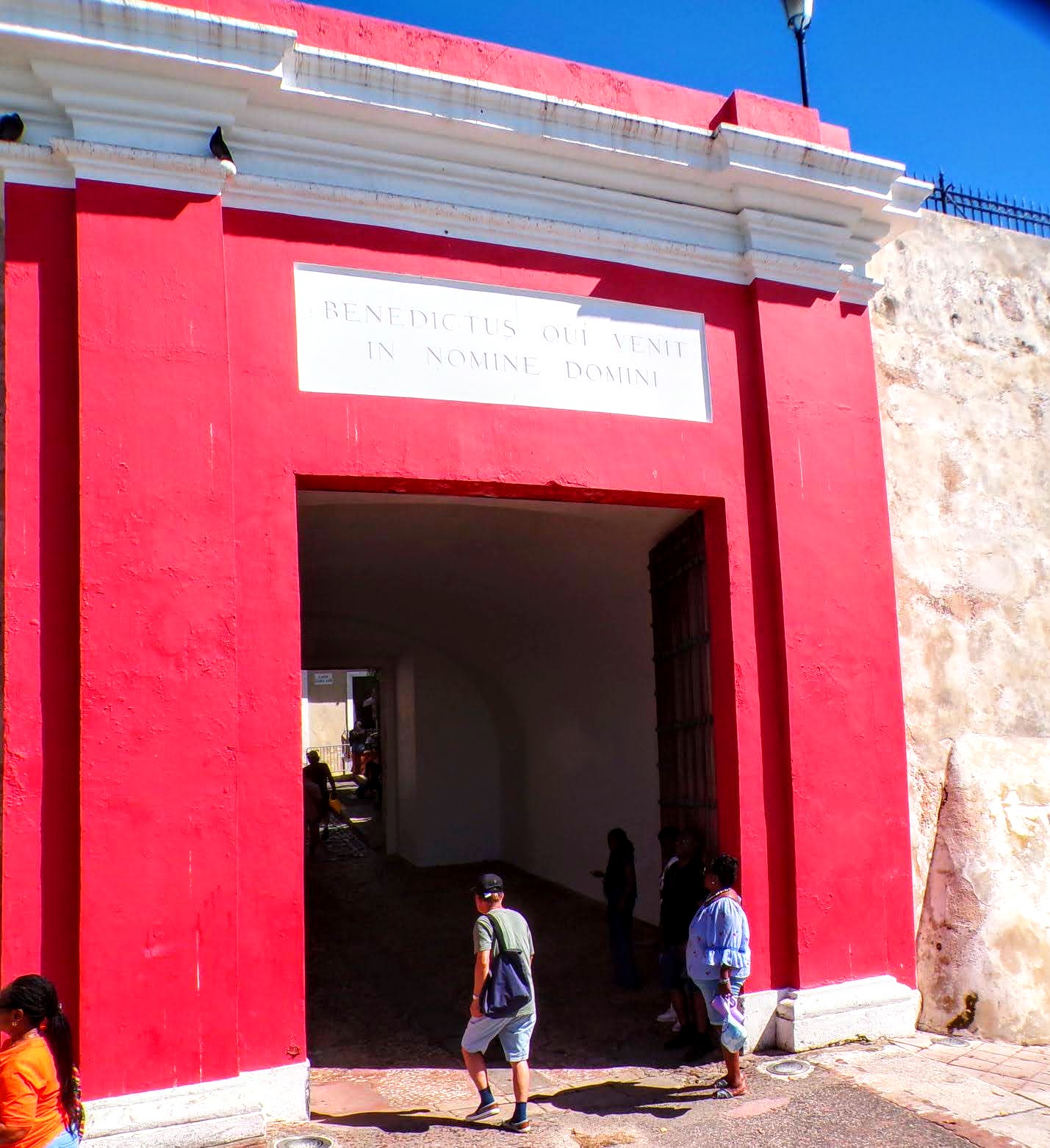
A walk through Old San Juan
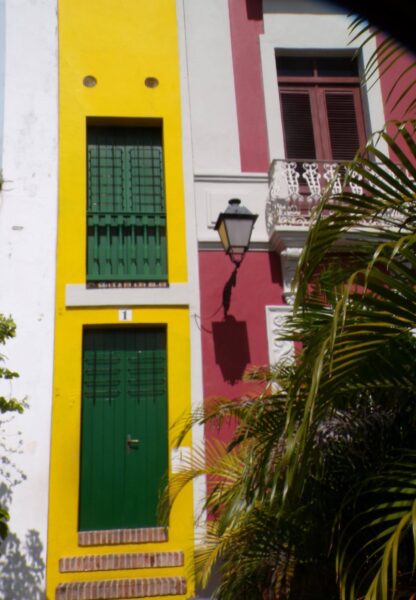
The taxi dropped me off near Plaza Arturo Somohano and the first place I wanted to visit was El Parque de las Palomas or The Pigeon Park. Fortunately, it was only a walk of about 600 meters (.4 mile) and along the way I thought I’d be able to stop into La Casa Estrecha – a suggestion I’d found on Atlas Obscura that describes it as, “an extraordinarily slim, two-story house” – an apt description for its 5’3″ or 160 cm width. Rescued from oblivion and made habitable by architect Antonio Álvarez, he uses it today as a gallery to showcase local artwork. Unfortunately, I’d neglected to note that tours need to be scheduled in advance so all I managed was an exterior photo.
Soon after I passed the skinny house, I entered the San Juan National Historic Site – at least some of which is also a UNESCO World Heritage site. I’m uncertain of the exact makeup of either but I’d guess I spent most of my time within or adjacent to them. And I started with Parque de las Palomas.
In the previous post I wrote about the century long Spanish construction of a defensive wall to surround the city. Although there was a significant French incursion in 1797, the need for these fortifications had waned by the mid eighteenth century. Cannons were gradually removed from the wall sockets and, over time, this created a fertile and bustling nesting spot for the local pigeons.
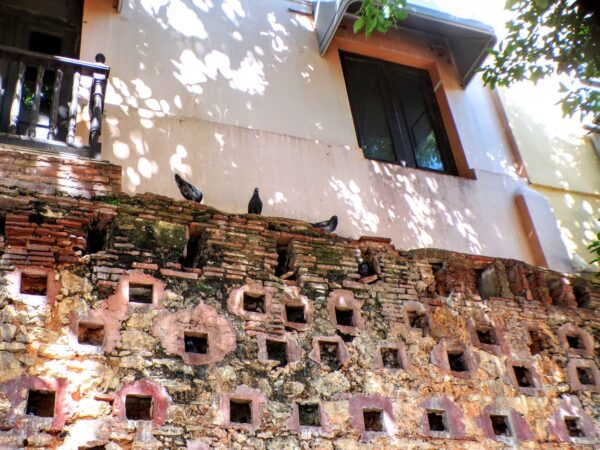
According to my cursory research (mostly Atlas Obscura) families soon began bringing their children to the park and began feeding them. The pigeons hung around because the food was free and easy. This created a feedback loop. The more the pigeons stayed, the more people came to feed them. And so on. Today, you can enter the park and, for a nominal fee,
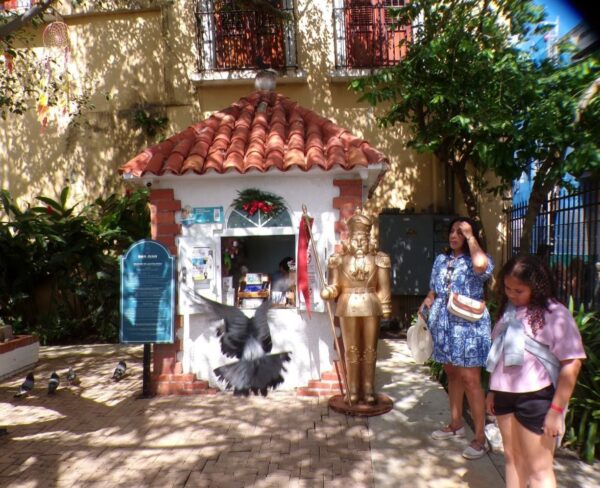
purchase a small bag of food at this stand. Then, if you’re interested in developing a closer connection with the birds, you can put some of the seed in your hand and
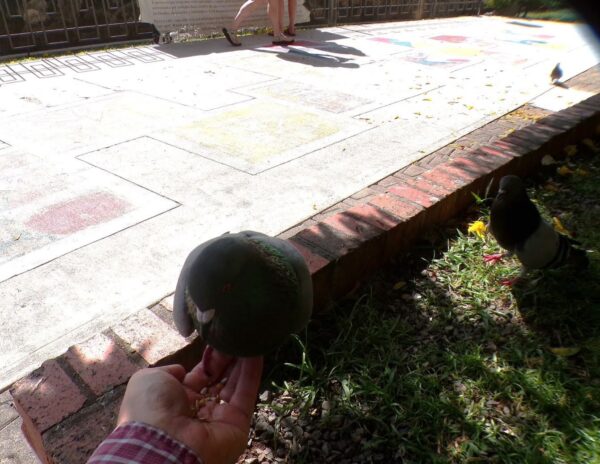
they won’t hesitate to hop aboard. They only want to eat, though. If you try to make any other contact, they’ll fly off.
Time to get Limber
I’m sure most of you know the name Charles Lindbergh – the first aviator to complete a solo transatlantic flight in his plane The Spirit of St Louis. On 13 December 1927, Lindbergh and The Spirit of St Louis left Washington, DC for a 16 country Goodwill Tour of Latin America and the Caribbean. The goal of the tour was promoting aviation and fostering US relations in the region while showcasing a shift by the American government from interventionist policies to diplomacy.
On 4 February, 1928, coincidentally his 26th birthaversary, Lindbergh landed at Escambrón Flying Field near San Juan. It was the thirteenth stop on his 16 stop tour and, as he had been throughout, he was greeted by a massive crowd. The Puerto Ricans offered him a frozen fruit juice treat as an antidote to the tropical heat. Lindbergh must have expressed some measure of delight because afterward, people began calling it “limber” after the Spanish pronunciation of his last name.
The fellow in the booth who sold me my bird feed told me about this in a rather extended conversation. He talked about how every family seems to have their own recipe and how it’s exceedingly nostalgic for most Puerto Ricans. Conveniently, there was a kiosk in the park that sold Limbers.
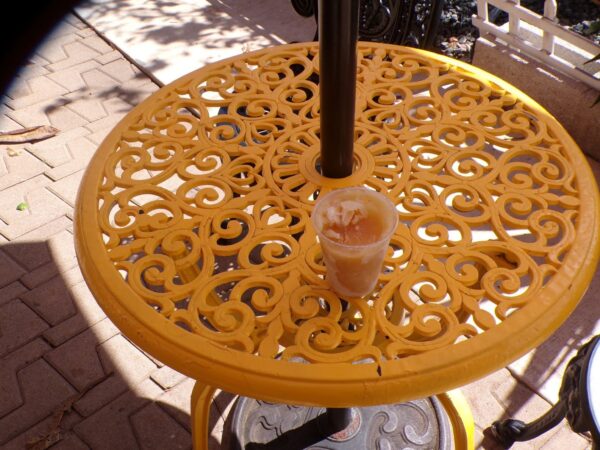
Although some recipes will add milk, coconut, spices, or even Nutella, I went the conservative route and chose a very traditional piña (pineapple).
Abriendo puertas
In the previous post I noted that beginning in about 1520 and continuing for a little more than a century, the Spanish built a massive stone wall up to 40 feet (12 meters) high with its 3 miles (5km) encircling San Juan to protect it from invaders. And these fortified walls were very effective in keeping people out. However, a wall can also keep people in so in order to allow the city to function, the wall had to have gates and La Muralla, as it’s called, had five. These were the only way into the city.
Coming from the east people had to pass through the Puerta de Tierra. On the north, the Puerta de San José was used principally for commerce. The Puerta de San Antonio on the city’s south side was the main gate used by the military while fishermen and other laborers entered and exited through the Puerta de San Francisco. None of these gates exist in the 21st century.
However, the Puerta de San Juan that was the main gate to the city and is the oldest of the five does.
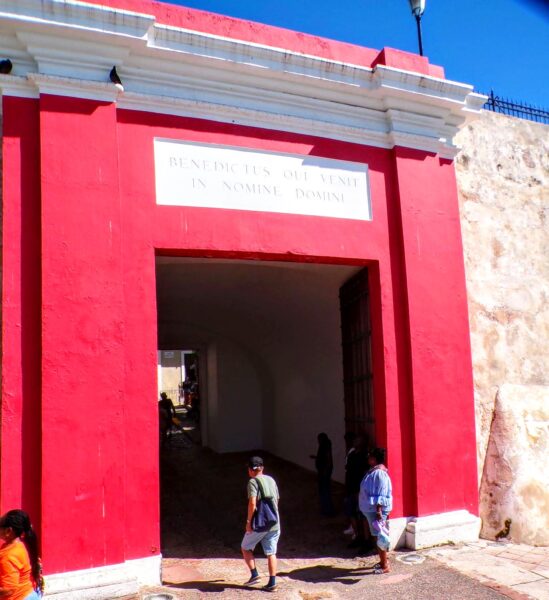
Built in 1635, it was always considered the main entrance to San Juan. New governors and bishops passed through the gate as part of their traditional inaugurations and it was the one used to receive important visitors from Spain. Today it’s preserved as a tourist attraction at the end of Paseo de la Princesa.
Another city cemetery
Longtime readers know of my affinity for visiting cemeteries but I didn’t have to go out of my way to at least get a look at the Cimenterio Santa Maria Magdalena de Pazzis (also called Old San Juan Cemetery) since it was on my route to Castillo del Morro – my final planned tourist stop for the day. Its opening in 1863 makes it a decade older then Vienna’s Zentralfriedhof but it’s tiny by any comparison. Vienna’s main cemetery is approximately 245 hectares (600 acres) with more than 3,000,000 people buried in 330,000 graves. The Old San Juan Cemetery is a mere 1.6 hectares (4 acres) and holds the remains of about 1,500 people. However,
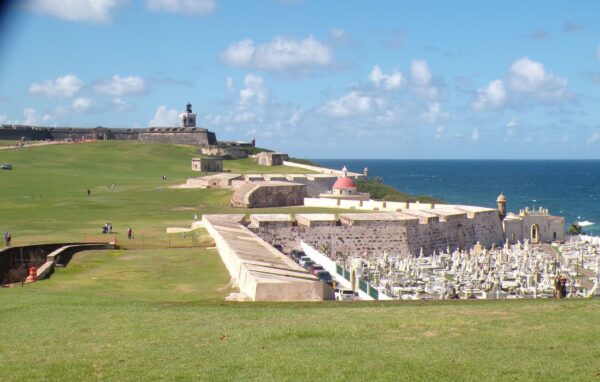
nestled outside the walls of Castillo San Felipe del Morro, its stark white tombstones and ocean view certainly make it unique. The seaside placement was deliberately chosen by Spanish authorities as a symbolic representation of the soul’s journey into the afterlife. The cemetery is accessible via the tunnel on the left side of the photo above but, because the day was latening and my time in Viejo San Juan was limited, I chose not to enter it.
Del Morro
The previous post briefly mentioned this castle that the locals simply call Del Morro. In its initial construction that began in 1539 it was a simple tower and water battery to protect against seafaring threats. By 1587, engineers Juan de Tejeda and Bautista Antonelli finalized its hornwork design, adding bastions named Tejeda and Austria, a moat, drawbridge, and ravelin.
The fort became a critical element in thwarting naval attacks beginning in 1595 when Sir Francis Drake launched an attack seeking to seize about five tons of gold and silver from the damaged Spanish ship Begoña that was anchored in the harbor for repairs. El Morro’s 27 cannons forced his withdrawal. It successfully staved off further assaults, including George Clifford’s 1598 land attack and one by Dutch forces in 1625.
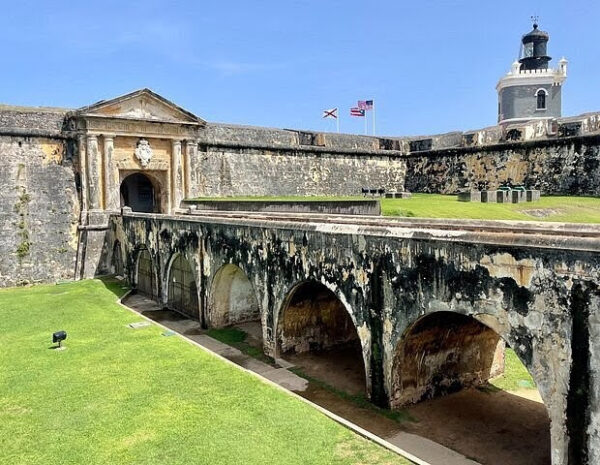
The US Army decommissioned it in 1961, transferring it to the National Park Service as part of the San Juan National Historic Site.
The only place I could stop for lunch
Don’t infer from this section header, that there was only a single restaurant available in Old San Juan. Recall that my motive for coming to Puerto Rico was to watch the Maryland women’s basketball team play a pair of nonconference games. The mascot for Maryland’s sports teams is the terrapin and regular readers know that my travels are filled with turtles of various descriptions . Thus, when I walked by this restaurant on my way to Del Morro,
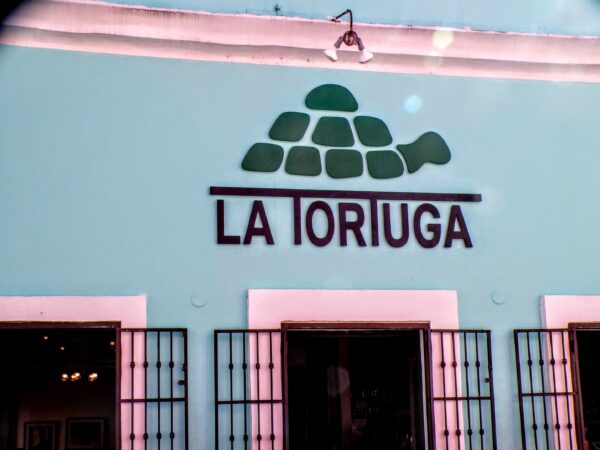
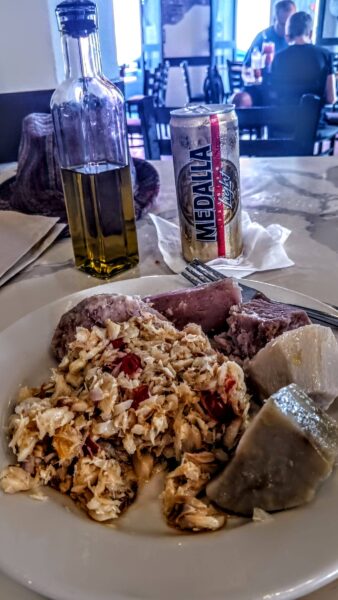
it effectively predetermined my lunch destination. And it turned out to be a good choice. I was surprised to find a dish called Bacalao con viandas on the menu. Salted cod (bacalhau) is a staple of Portuguese cuisine and I knew nothing of Portuguese involvement with this Spanish colony but a bit of post-trip research revealed that Don Cristóbal de Sotomayor, a Portuguese nobleman, arrived on the island in 1509. Then, in 1593, Portuguese soldiers were part of the first garrison sent to Del Morro. It’s likely that bacalhau came with them.
Culinary cross cultural pollination often seems inevitable and that was the case here. Combining Taíno viandas (root vegetables such as yuca, batata, and ñame) with European salted cod and African cooking influences from enslaved people it evolved into a comfort food symbolizing Puerto Rican resourcefulness.
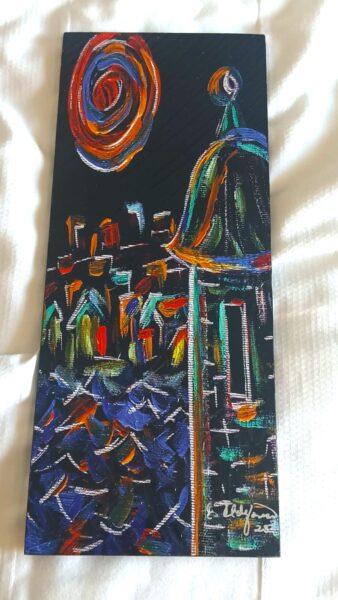
After lunch I wandered back toward Plaza Arturo Somohano where I picked up, as I often do, a small piece of art to add to my home collection.
I returned to the hotel where I met a few other Terps fans and with whom I’d share rides to and from the arena and a rather meager Thanksgiving dinner. Thursday’s earlier game left insufficient time to return to the old city so I spent my morning walking around the area near the hotel enjoying the warm weather, ocean views, and snapping some photos of things I found eye-catching. You can see all the photos from my two day excursion here.
-
Photos and their stories – Lisbon – Summer 2026 part two – plus an egg-straordinary bonus
August 21, 2026 -
Photos and their stories – Lisbon – Summer 2026 – part one
August 21, 2026 -
The indigenous people of Da?ow?aga? (Olympic Valley and me supplement three)
August 19, 2026 -
The indigenous people of Da?ow?aga? (Olympic Valley and me Supplement two)
August 17, 2026 -
Olympic Valley in the time before humans (Olympic Valley and Me Supplement one)
August 14, 2026
2 responses to “A walk through Old San Juan”
Thanks to the ever alert Double D for spotting a typo and a missing word. I have corrected both.
My pleasure….