Y canta la cucaracha
On the canals of Xochimilco
I don’t know how many visitors to CDMX have the opportunity to take a boat ride along the canals of Xochimilco but, according to our guides, it’s a common activity not only for the tourists who come here but for chilangos and chilanguas residents of CDMX) as well. For me, it was a delightful start to a very full day. However, as we ride the calm waters of these canals, we need to keep in mind that Xochimilco was once a part of a large lacustrine system whose remnants now underlie CDMX.
This video shows the changes wrought in the five lake system through the slightly more than five centuries since the Spanish reached the México basin.
(Xochimilco is one of the pair of southernmost lakes.)
Chinampas and the Mexica presence
Because its waters were relatively shallow and fed by freshwater springs, the first chinampas were constructed at Lake Xochimilco long before the Mexica settled Tenochtitlan. Once they settled the area they transformed it into a major center of this style of raised‑field agriculture.
Chinampas are artificial floating gardens built by weaving reed rafts, piling on lake-bottom mud, planting trees at the corners that then create fixed rectangular islands separated by canals.
The finished chinampa was a long, raised, extremely fertile bed surrounded by canals, capable of several harvests per year thanks to constant moisture and nutrient cycling. By repeating this process over large areas of shallow lakebed, the Mexica created extensive networks of artificial islands that could reliably feed dense urban populations.
(This video overview of chinampas is in Spanish. Non-Spanish speakers can either enjoy the pictures or turn on closed-captions and use settings to generate them in their native language.)
The principal crops grown on the chinampas were maize, beans, squash, chili peppers, tomatoes, and amaranth. Additionally, they grew a mix of herbs, edible flowers (like marigolds), and other vegetables such as purslane (verdolagas), radishes, and lettuce. This provided year-round harvests.
Fewer than 20% of the original chinampas – that once numbered in excess of 20,000 – remain active today. Some still produce crops – primarily lettuce, broccoli, radishes, onions, celery, and eggplant together with herbs such as epazote, mint, parsley, chamomile, and rosemary. However, the area is better known for being one of the main sources of flowers in CDMX.
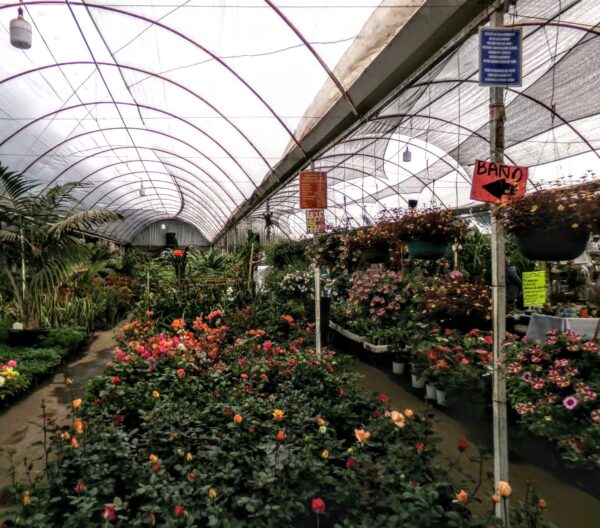
(Our tour stopped at what seemed to me to be more of a greenhouse but it might have been built on one of the floating islands.)
Since 1519
When the Spanish arrived, the lake system covered about 1500 km² (with Lake Texcoco comprising a bit less than half the total) and it was likely little changed from its size when the Mexica first settled Tenochtitlan in the early 14th century. As you can see from the first video, it was a different story after 1519.
The Spanish conquered the Triple Alliance in 1521. In addition to decimating the population through war and disease, they destroyed many of the dams and sluice gates that had regulated the valley’s lakes.
The early stages of Spanish dominion saw some continued use of the lakes and canals for transport and agriculture. However, the following decades saw repeated flooding throughout the new Spanish city. Much of the flooding resulted from the destruction of indigenous management methods and the abandonment of many of the chinampas (due largely to the demographic collapse).
This regular flooding prompted the 1607 beginning of the construction of the Gran Canal del Desagüe
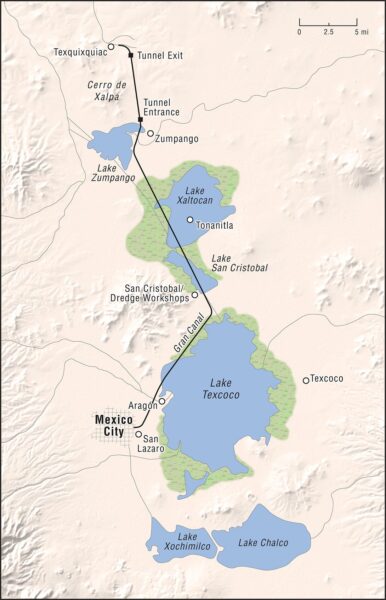
[From UNL By James Garza]
led by engineer Enrico Martínez and using forced indigenous labor compelled through colonial repartimiento systems. This didn’t prevent continued catastrophic flooding in 1609, 1615, and 1623. Much of this flooding stemmed from the valley’s hydrology prompting additional large‑scale drainage projects that, like the construction of the Gran Canal, lasted centuries, but lowered lake levels and progressively shrank Xochimilco and the interconnected lakes.
These ongoing projects and continued urban growth have effectively rendered the five lakes that were 1500 km² just 400 years ago to the 170 km² of canals on which our boat ride would occur. Today, Lake Xochimilco, refers not so much to a single open body of water but more to a mosaic of canals, wetlands, and chinampas within southern CDMX.
THE KHFM Trajineras
We drove through a bit of CDMX traffic for a bit over an hour and, despite it being relatively early in the morning and not too hot, it was on this ride that I got my first good look at the smog overhanging the city when we rode along a stretch of elevated highway. I’m not particularly sensitive to these conditions but it’s always a bit of a shock to think that I must be inhaling some of these contaminants.
University of Nebraska-Lincoln historian James Garza, who created the map above, describes Lake Xochilmilco today as, “basically a lagoon and wetland where tourists go for boat rides.” And this is precisely how we experienced it.
We arrived at our embarcadero that, much to my quiet delight, is called Belem. (The historic district at the western edge of Lisbon is Belém.) As we walked to our boats we were entertained (?) by sporadic but persistent blasts of fireworks.
(Fireworks, we were told, are a daily or near daily ritual in this CDMX barrio. The cohetes (rockets) and bombas (large firecrackers) signal the start of masses, honor patron saints, and mark feast days such as La Candelaria. As is often the case, this tradition also has a pre-Catholic connection. The loud explosions are said to scare away evil spirits. They now serve to call the faithful to worship or give thanks.)
The walls along our walk and in the immediate port area were also adorned with interesting art. I was particularly taken with this image.
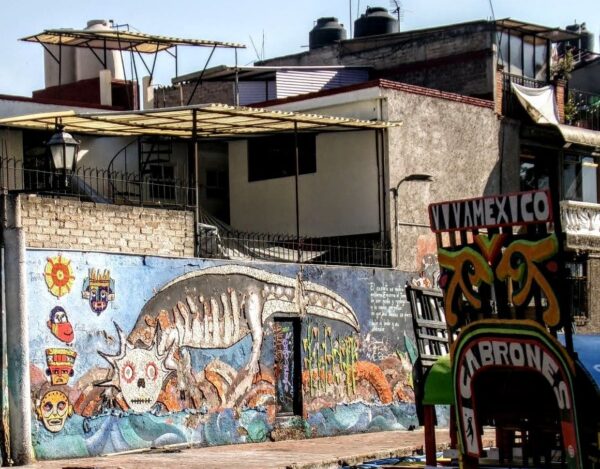
As it turns out, the central figure is an axolotl. This critically endangered salamander is native to the ancient lake systems of central México. Among the few places it can still be found in its native habitat are the canals and chinampas of Xochimilco. They are unlike most of their amphibian relatives because they retain juvenile features like external gills and aquatic lifestyles into adulthood.
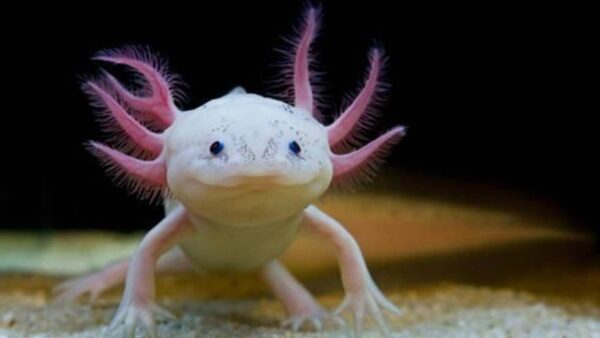
[From Trajineras Xochimilco]
The name axolotl means water monster in Nahuatl and these tiny creatures were once sacred to the Mexica as a symbol of water and renewal. In what I would consider a miracle of evolution, they can regenerate not only lost limbs but spinal cords, and even parts of their heart and brain.
The boats on which we rode are called trajineras and they’re steered by trajineros. Our group was large enough that the trajineros tied two boats together but, from this photo that A posted in our group chat,
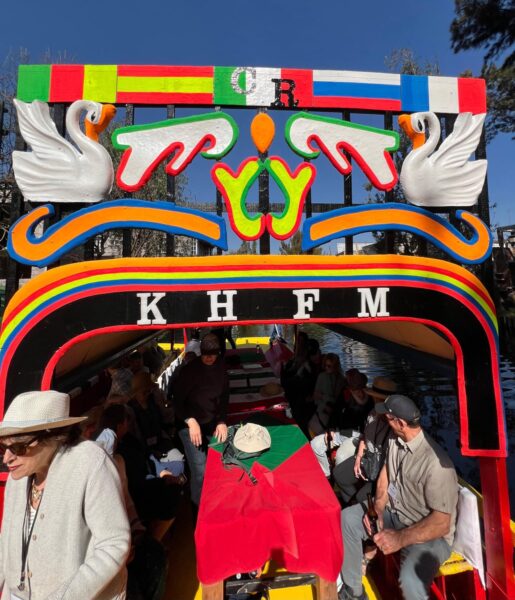
they were well prepared for us (or had worked with KHFM before).
Perhaps because we arrived relatively early on a Tuesday morning, the canal wasn’t crowded with other boats as it has the potential to be.
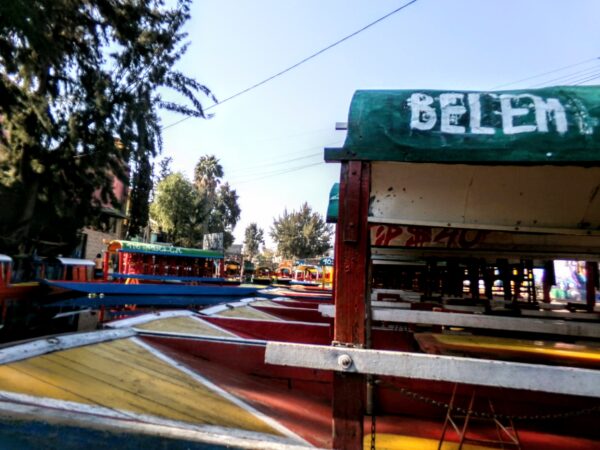
The ride included beverages of our choice (I had another Vicky) and other boats plied the canal offering snacks and additional beverages including, I believe, some mescal – though I don’t recall anyone taking advantage of the latter. I think one of the highlights of this outing for all of us was the appearance of a mariachi band
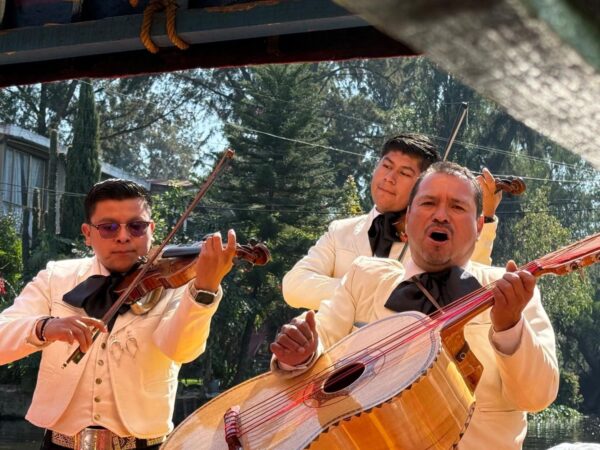
[Pic from L in the KHFM Group]
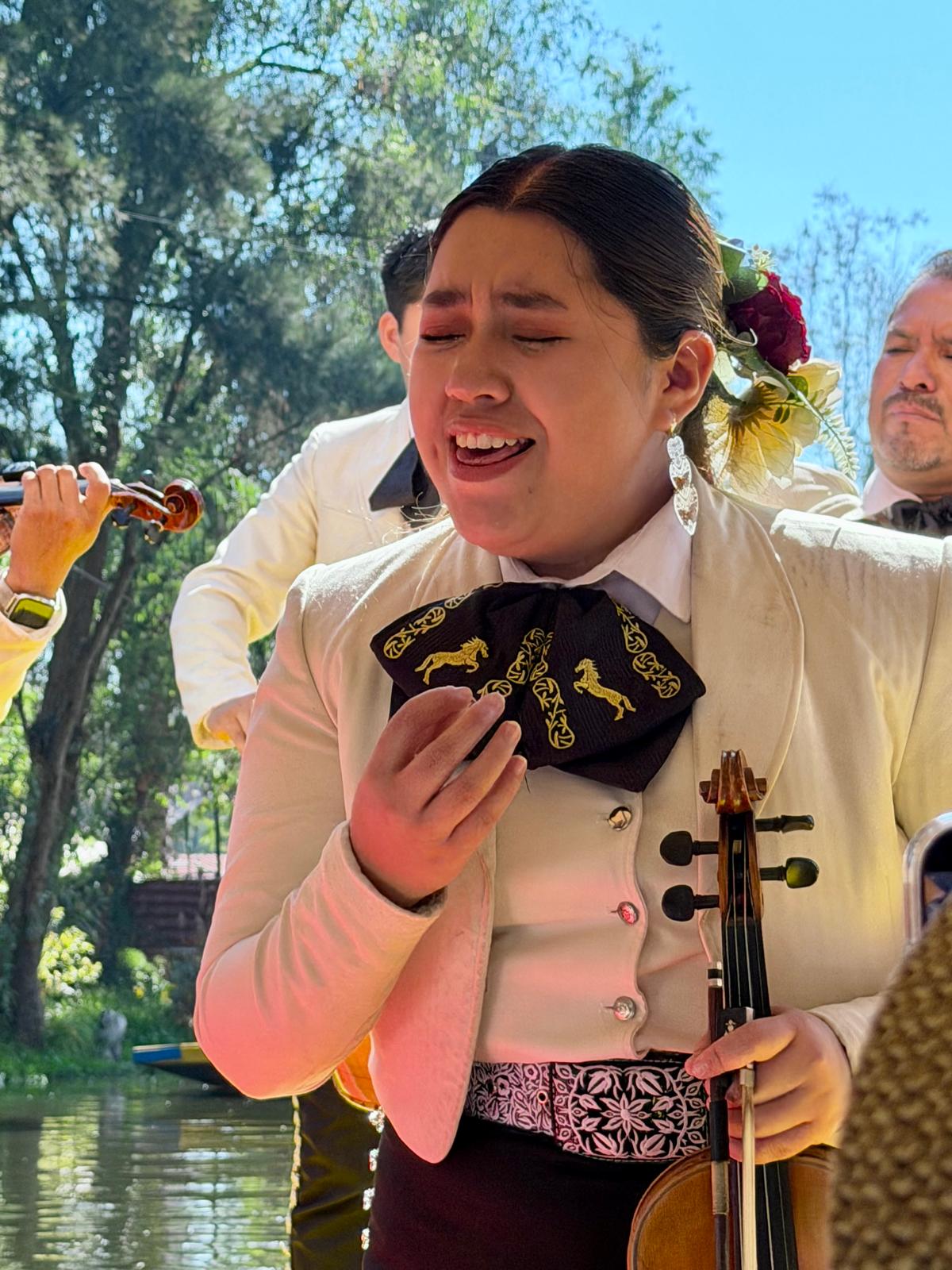
that, at one point did play La Cucaracha. Their presence inspired one of our guides to sing
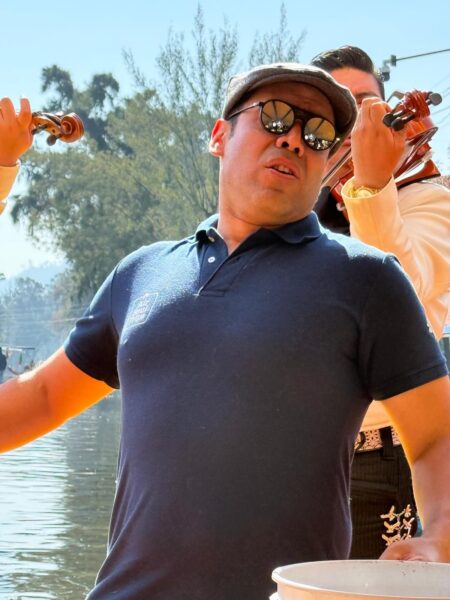
and our group to dance.
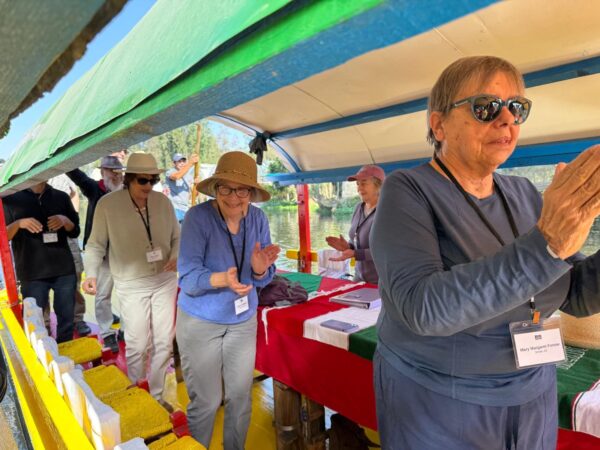
(Thanks again to B for sharing these pictures.)
I made a song request I think the band found surprising and I thought it inspired a highlight performance. (I hope the group agreed.) I requested the song La Cigarra and it allowed the lone female in the band to step out front. (Thanks to M for this photo.)
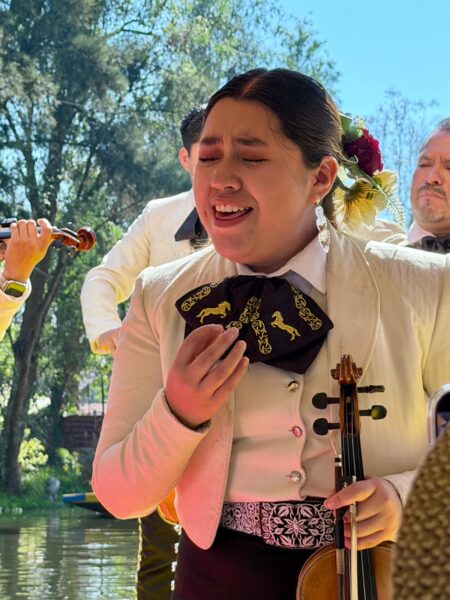
It’s a heart wrenching song that demands not only great vocal dexterity but intense emotion. Here’s an English translation of the first verse.:
-
Photos and their stories – Lisbon – Summer 2026 part two – plus an egg-straordinary bonus
August 21, 2026 -
Photos and their stories – Lisbon – Summer 2026 – part one
August 21, 2026 -
The indigenous people of Da?ow?aga? (Olympic Valley and me supplement three)
August 19, 2026 -
The indigenous people of Da?ow?aga? (Olympic Valley and me Supplement two)
August 17, 2026 -
Olympic Valley in the time before humans (Olympic Valley and Me Supplement one)
August 14, 2026