Se va perdiendo la calma
The official name of México City’s main square is Plaza de la Constitución but is more commonly called Zócalo and it was toward this location that our group walked after we left the Palacio de Bellas Artes. The intent of the preceding post was to provide a general basis for you to understand the archaeology we’d discover there but, as often happens, my research diverted me into an unanticipated bit of history so I’ll begin by looking at how it acquired both its official and common names.
None of the five (or six)
Many large cities in the Spanish speaking world have a large central square such as this one in Madrid
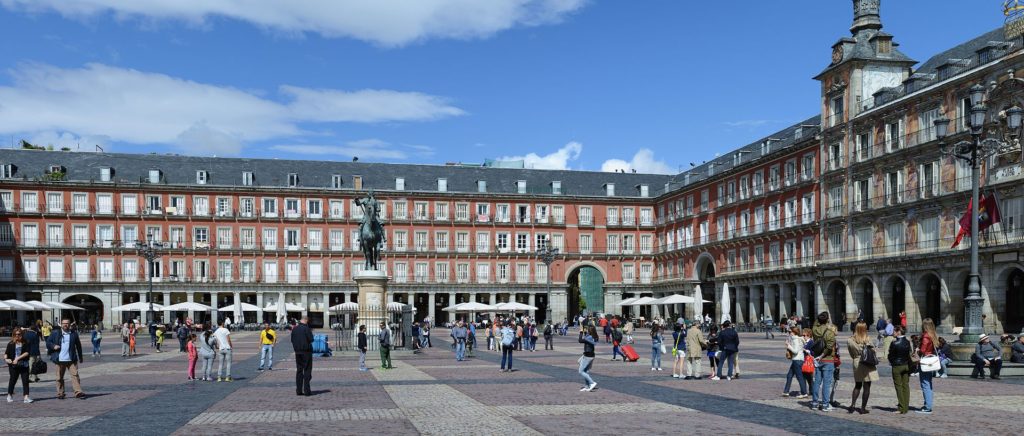
and nearly everywhere they are called simply and clearly, Plaza Mayor. In other large colonial cities such as Cuzco the central plaza may also be called Plaza de Armas
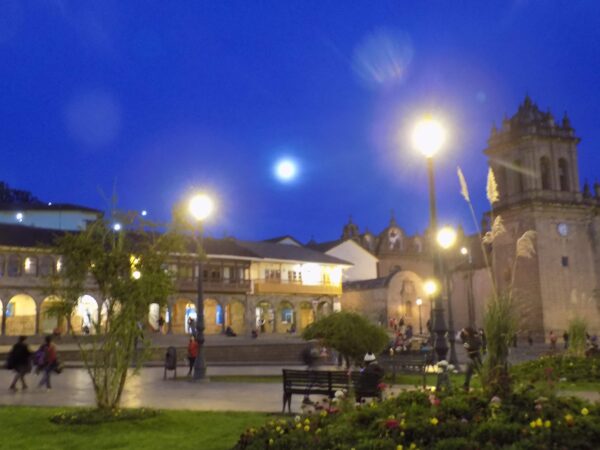
and both were used informally when one of Hernán Cortés’ soldiers, Alonso García Bravo, completed redesigning the city’s layout.
We don’t know what the indigenous residents called it but in post-Colonial México, it has always had one of the names above. When the Spanish arrived in Tenochtitlan, they came to a large open area bounded by structures on three sides. The palace of Axayacatl, the previous tlatoani and Emperor of the Triple Alliance stood on the west while that of his son and current Emperor Moctezuma II rose on the east. The northern side of the plaza housed the city’s sacred precinct.
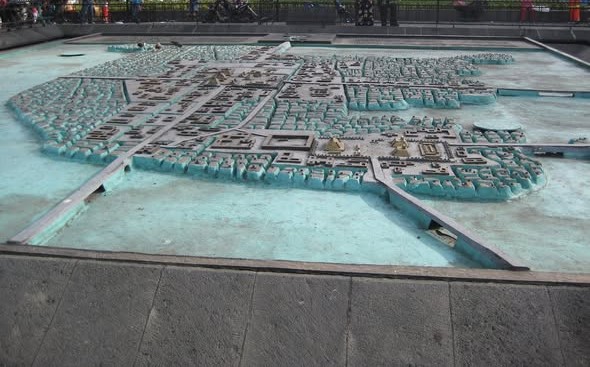
Even though Garcia Bravo had largely completed his work by 1524, and the Spanish would largely dismantle Tenochtitlan over the following years, the plaza wouldn’t receive a formal name until 1812. Over those intervening centuries, in addition to being called Plaza de Armas, Plaza Mayor, or even Plaza Principal, it was also sometimes called Plaza de Palacio, because of the presence of the Viceroy’s (now National) Palace the square. For reasons unknown, people also occasionally called it the Plaza de las Ánimas, or the Plaza of Souls.
The Mexican War for Independence from Spain that began with the Grito de Dolores under the Banner of Hidalgo
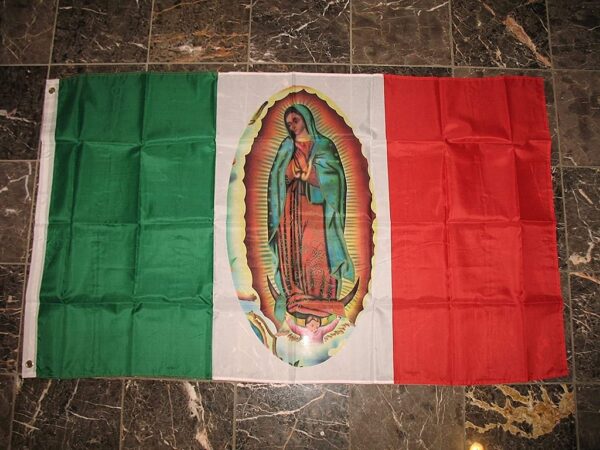
[From Wikimedia Commons Guadalupe el Tricolor, CC BY-SA 4.0.]
on 16 September 1810 didn’t officially end until 27 September 1821. Though never adopted, México’s first constitution – the Constitution of Apatzingán – was drafted in the midst of that war in 1814. The newly independent country adopted its first constitution – the Federal Constitution of the United Mexican States of 1824 a bit more than three years after it won its sovereignty. It would be followed by the Seven Constitutional Laws (1835), the Organic Bases of the Mexican Republic (1843), the Federal Constitution of the United Mexican States of 1857, and most recently, the Political Constitution of the United Mexican States in 1917.
The question I hope you’re asking yourselves is, “If México didn’t adopt its first constitution until 1824, what prompted them to grant the name Plaza de la Constitución in 1812?” The document celebrated in the plaza’s now official name was the Spanish Constitution of 1812 – a seemingly odd choice given that what was then called Nueva España was engaged in a war seeking independence from its parent.
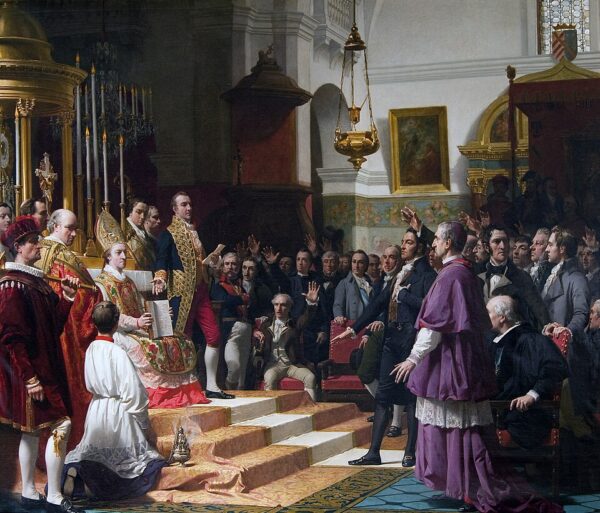
[From Wikipedia – Public Domain]
Although repealed by Ferdinand VII in 1814, it replaced absolute monarchy with a constitutional monarchy based on national sovereignty rather than royal sovereignty while defining the Spanish Nation as including citizens in both hemispheres and this seemed a cause for celebration.
However, even with its original promise of rights and representation, it failed to resolve colonial demands and catalyzed the political processes that led to the dissolution of the Spanish empire. Still, it served as the model for México’s 1824 Constitution.
Whence Zócalo?
Throughout the colonial period and into the 19th century, the Plaza Mayor was home to México City’s central marketplace. With the National Palace abutting one side of the square, it was a natural place for the city’s residents to express their discontent and riots were not uncommon.
The final iteration of the Plaza Mayor market, called the Parián,
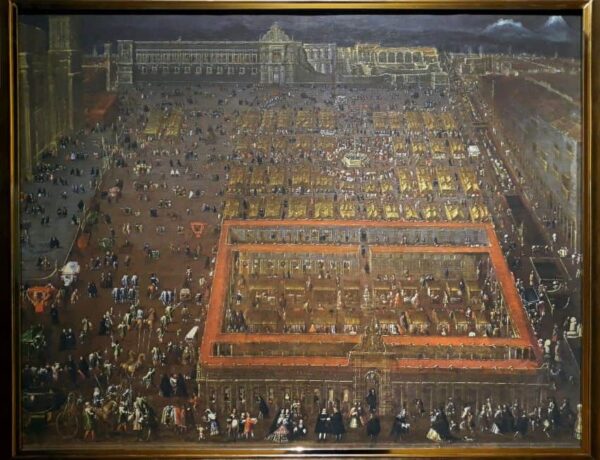
[Cristóbal de Villalpando, View of the Plaza Mayor of Mexico City from Smart History.]
lasted from the end of the 17th-century until a major uprising took place in the aftermath of the September 1828 presidential election – the country’s second as a republic. In this instance, rather than direct suffrage, the votes of state legislatures elected a conservative president Manuel Gómez Pedraza rather than the liberal independence hero Vicente Guerrero.
Soon after the election another leader in the fight for independence, Antonio López de Santa Anna, began an insurrection in Veracruz demanding not only the annulment of the election but for the concurrent expulsion of all Spaniards. Later that fall, on 4 December, rioters ransacked and burned the Parián, Gómez Pedraza fled the city, and Guerrero was sworn in as president the next year.
In 1830, López de Santa Anna, who was not above entering into politics himself, allowed conservatives to oust Guerrero from the presidency. The man whom Heritage History calls, “a real-life caricature of an unstable, unprincipled, military despot of Latin American politics” would serve 11 short-lived terms as México’s president. (Yes, this is the same Santa Anna who defeated the Republic of Texas at the Battle of the Alamo.)
He was in the midst of one of those terms when he announced a competition to design a monument that would stand in the Plaza and commemorate the heroes of Mexican independence. Ironically, the winning design came from Spanish architect Lorenzo de la Hidalga.
Hidalga proposed a column with an octagonal base with an independence hero represented on each angle. It was to be crowned with a statue representing the republic.
On 16 September 1843 (Mexican Independence Day) Santa Anna laid the cornerstone for the monument’s base but political turmoil and an absence of funds prevented the project from progressing beyond the completion of the plinth or, as the locals would call it, el zócalo.
The plinth remained visible for several decades but over time was buried under layers of construction. An archaeological excavation in 2017 uncovered it.
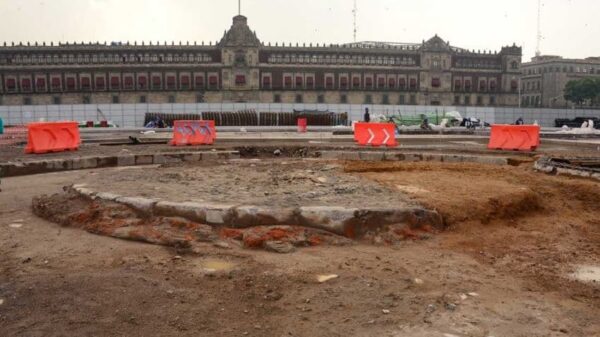
[From Mexico News Daily]
And now you know the stories of the names.
And a little more digging
Archaeologists didn’t have to dig very far to uncover the plinth for Santa Anna’s unfinished column. And, while the Zócalo may not have as many layers as a Smith Island Cake,

[From The Spruce Eats by Jessie Sheehan]
it is a layered space. The modern plaza sits atop the colonial Plaza Mayor this, in turn, sits upon conquest era demolition with some reuse, and under that are the remains of the Mexica ceremonial center and palaces. So accurate are the sixteenth century historical texts such as Cortés’ letters and the writing of friar Bernardino de Sahagún that 21st-century archaeologists are entwined with them in a tight quebradita-like hold.
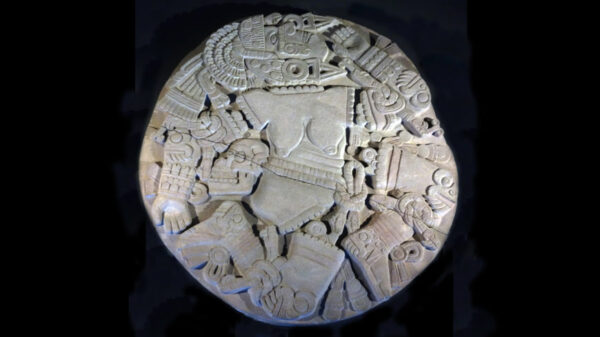
But despite the availability of these texts, all of this history remained buried until workers laying electrical cables accidentally discovered a finely carved stone monolith featuring a dismembered and decapitated woman. This was the Coyolxauhqui Stone.
[From Smart History by Steven Zucker, CC BY-NC-SA 2.0.]
(Coyolxauhqui was the Aztec goddess of the Moon or Milky Way. She was butchered by her brother Huitzilopochtli, the sun god and god of war. For the Mexica, this was among their foundational beliefs of conflict and cosmic order.)
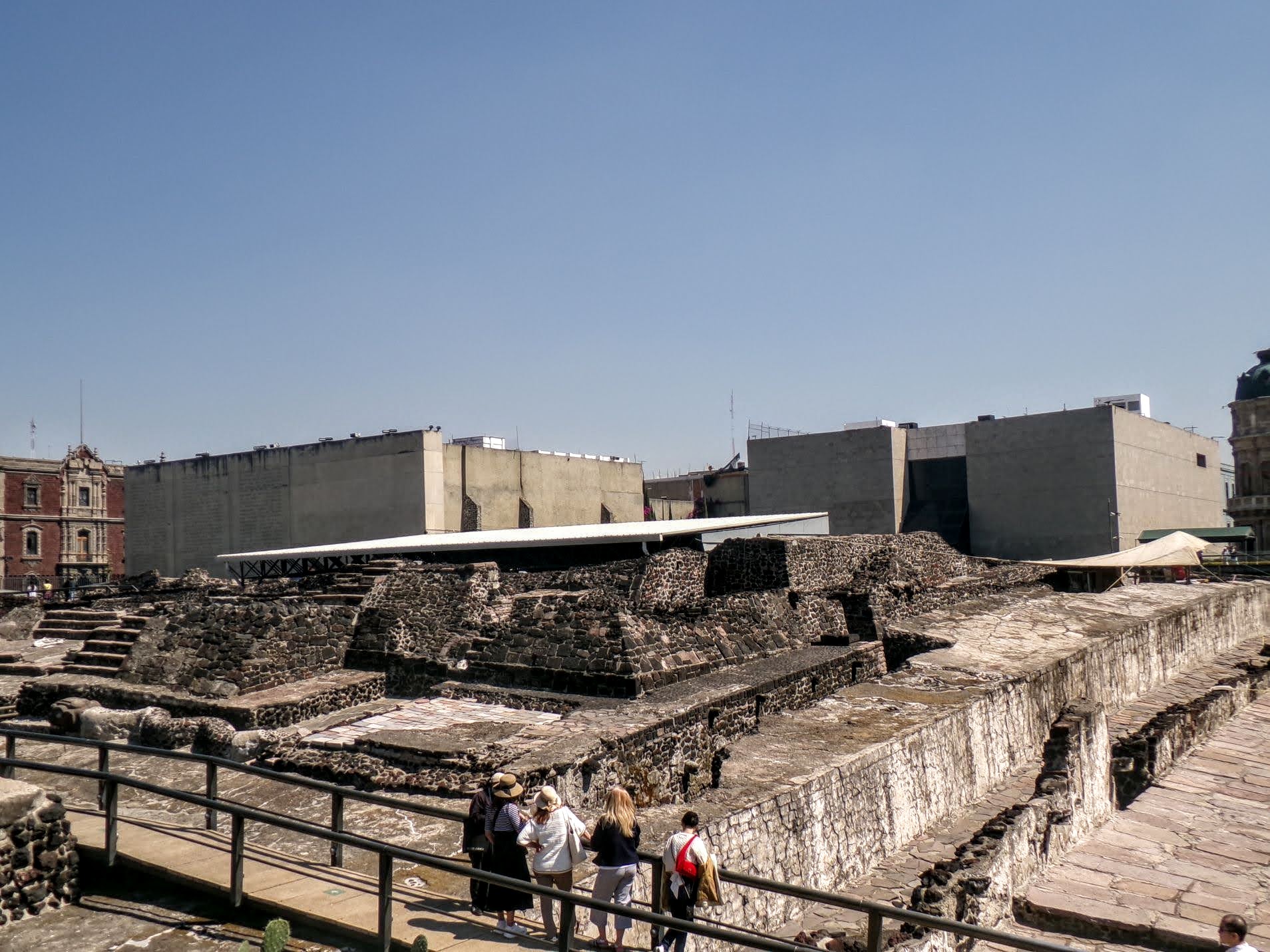
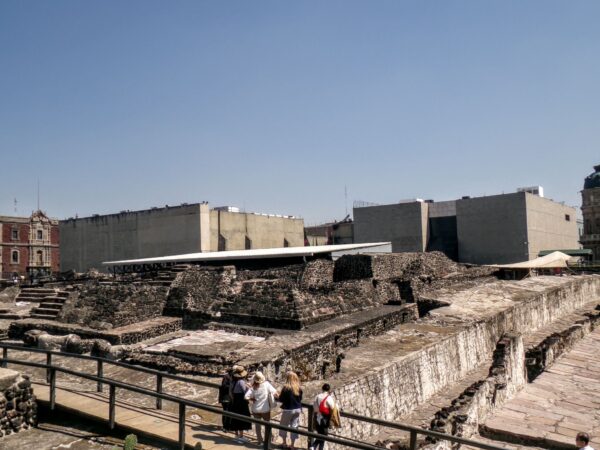
This accidental discovery began a period of archaeological activity that continues to this day with the entirety of the Historic Center protected by México’s Federal Law on Archaeological, Artistic, and Historic Monuments and Zones. Thus it is that visitors like me (and the rest of the group) can get a sense of the scale of the Templo Mayor
by visiting the area near the square. There are more photos here.
Tomorrow, we’ll have a boat ride along the canals that are remnants of Lake Xochimilco – one of the five interconnected lakes (Zumpango, Xaltocan, Texcoco, Xochimilco, and Chalco) that once covered 1,500 square kilometers in the Valley of México.
-
Photos and their stories – Lisbon – Summer 2026 part two – plus an egg-straordinary bonus
August 21, 2026 -
Photos and their stories – Lisbon – Summer 2026 – part one
August 21, 2026 -
The indigenous people of Da?ow?aga? (Olympic Valley and me supplement three)
August 19, 2026 -
The indigenous people of Da?ow?aga? (Olympic Valley and me Supplement two)
August 17, 2026 -
Olympic Valley in the time before humans (Olympic Valley and Me Supplement one)
August 14, 2026