I’m eatin’ right and I’m livin’ good
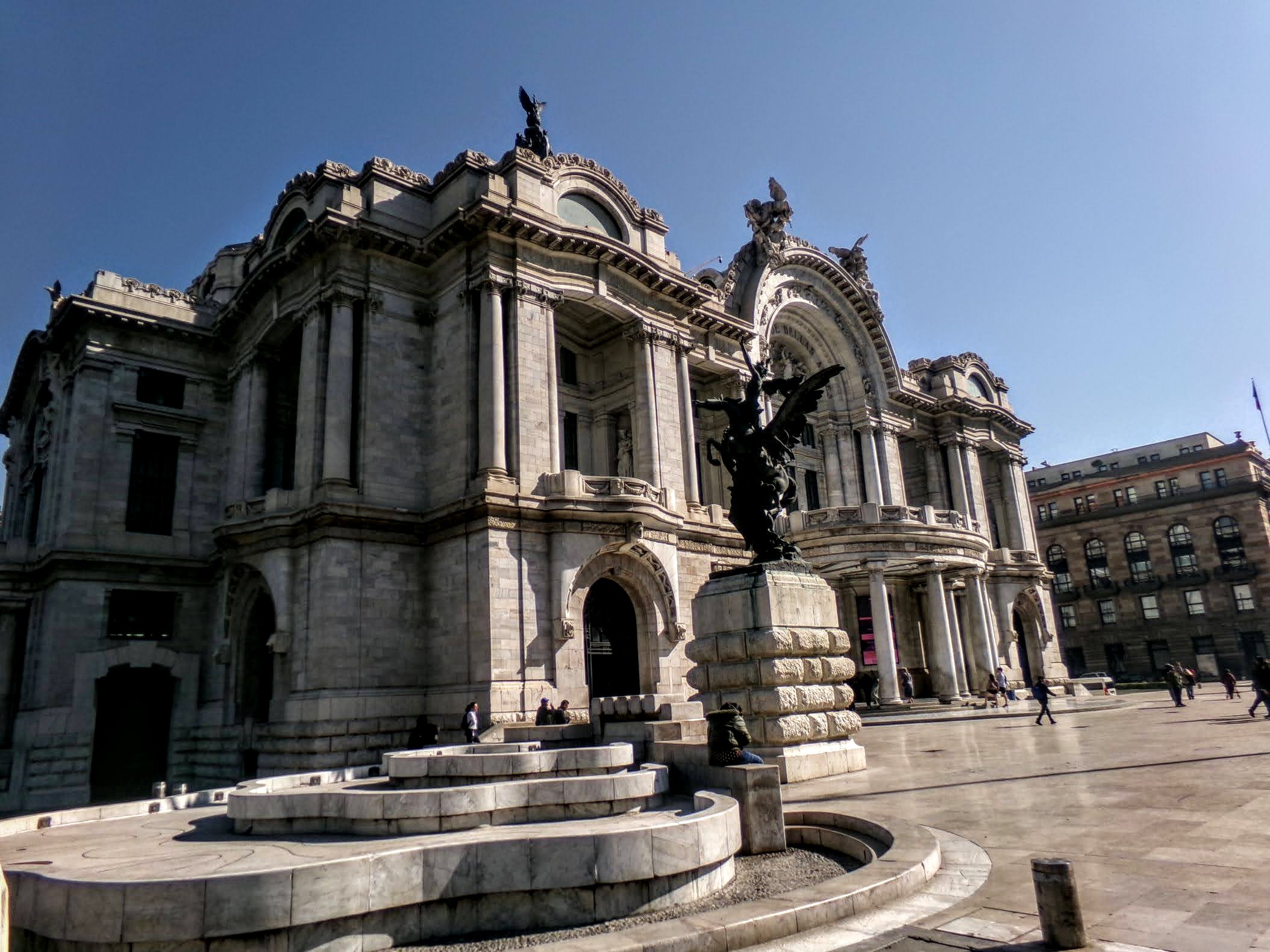
Tuesday morning it was time to experience what Earthbound Expeditions and Air Soul Trips, our local hosts and guide, had in store for us. We’d gotten a broad outline after supper Monday evening and knew we’d start with the first of our two visits to the Palacio de Bellas Artes or Palace of Fine Arts (PFA).
As part of his vision to “Europeanize” México, President Porfirio Díaz commissioned Italian architect Adamo Boari to design a new Gran Teatro de Ópera to be built on the site of the recently razed National Theater. Combining Art Nouveau and Neoclassical styles, Boari added sculptural decorations expressing both European and pre‑Hispanic motifs to his white marble exterior.
Construction began in 1904 with a planned completion date coinciding with the 1910 centennial celebrations of Mexican independence. Unfortunately, México City’s soft, water‑saturated subsoil couldn’t support the building’s weight and it began to sink. The building was unfinished when the 1910 revolution began and, by 1913, all construction halted.
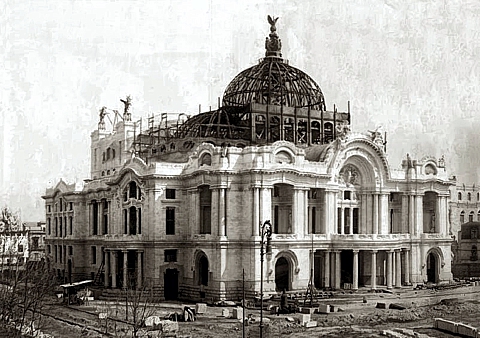
[From Wikipedia – Public Domain]
Although much of the exterior had been finished the same could not be said for the interior and the structure remained an incomplete shell for nearly two decades. Boari had long since returned to Italy and Mexican architect Federico Mariscal took over the project in 1932 redesigning the interior in the Art Deco style.
Marical’s changes brought the building a more public‑oriented interior layout, with expanded foyers, museum spaces, a conference room, library, and areas for temporary exhibitions. He modified the main performance hall (where we’ll have our second visit Wednesday night) by reconfiguring the floors and adopting amphitheater seating that increased its capacity. He carried over his Art Deco aesthetic in a way that incorporated Mexican motifs and material. The Palacio de Bellas Artes was inaugurated on 29 November 1934.
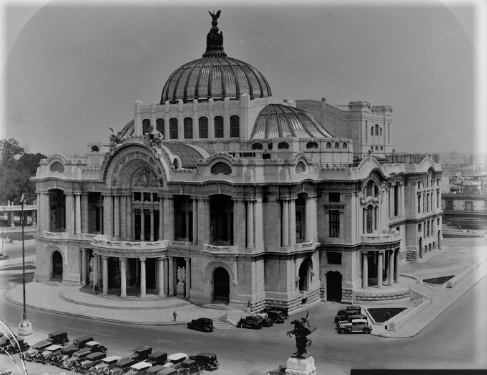
[From Research Gate by Guillermo Kahlo, Fototeca Nacional INAH]
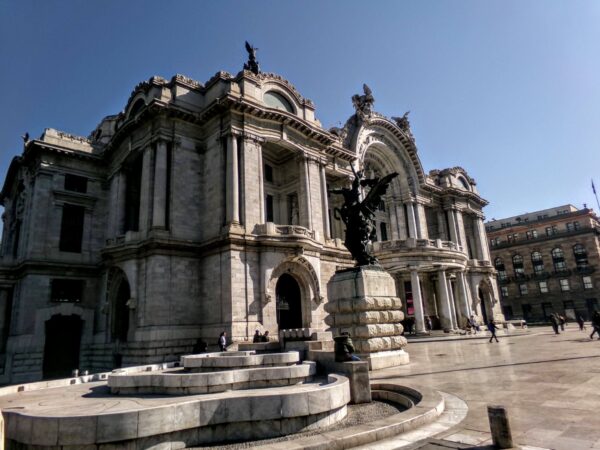
From a different angle in 2026, it looks like this.:
Mexican Muralism
Before entering the PFA our 24 person group split into three smaller groups so my report is based on the focus of the group I chose to walk with and that focus was principally on the murals installed throughout the building. And this made sense given their prominent place within, and the importance of the Mexican Muralism movement.
Technically, Mexican muralism refers specifically to an art project initially funded by the Mexican government in the years following the Mexican Revolution. Its stated purpose was portraying visions of México’s past, present, and future through imagery by transforming the walls of many public buildings into didactic scenes intended to transform Mexicans’ understanding of the nation’s history. The murals bore historical, social, and political messages. Diego Rivera, José Clemente Orozco, and David Alfaro Siqueiros – the group of artists who became known as Los Tres Grandes (The Three Greats) – led the project beginning in the 1920s.
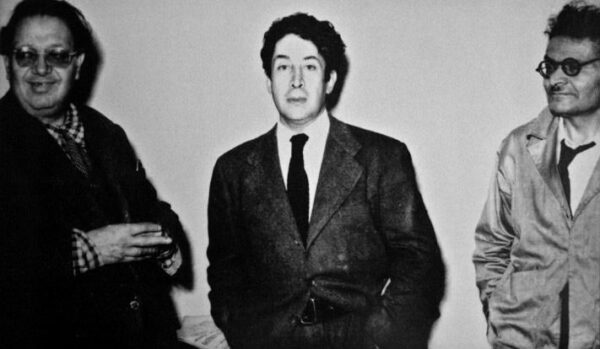
[From Google Arts and Culture by Hermanos Mayo]
It wasn’t by accident that José Vasconcelos, Minister of Public Education under President Álvaro Obregón commissioned murals from these three artists. Mural painting is a Mexican tradition that dates at least as far back as the Olmec culture (1200-400 BCE) such as this one of the Battle of Cacaxtla
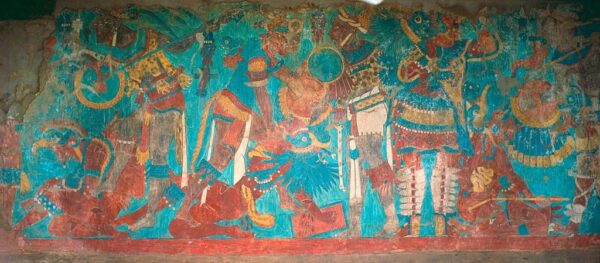
[From Atlas Obscura by HJPD/cc by 3.0.]
that can be seen at an archaeological site just 100km east of CDMX. That form of expression and communication continued into the colonial period.
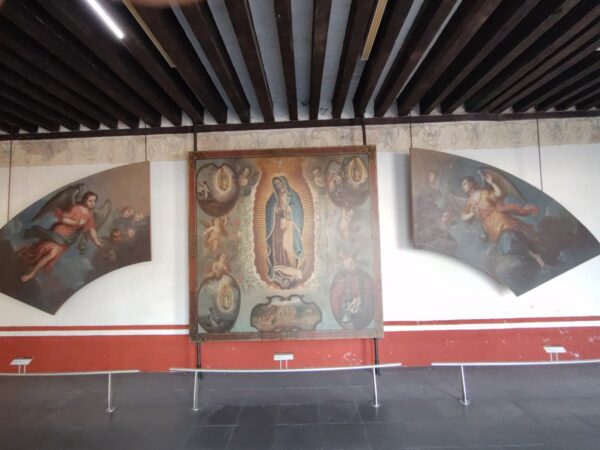
[Taken by LC on a Saturday visit to the Museo de El Carmen]
While the former focused on ritual and elite imagery tied to Olmec cosmology and the latter were often intended to evangelize the indigenous people and reinforce Christian doctrine, the notion of communicating ideas through murals was a long established tradition in México. Vasconcelos envisioned these modern murals as tools for education and creating national unity that would form a new Mexican identity.
We spent most of our time inside discussing several of the murals in detail and I’ll review a few of them though not in our guided sequence. I’ll start with Diego Rivera’s
Man, controller of the Universe
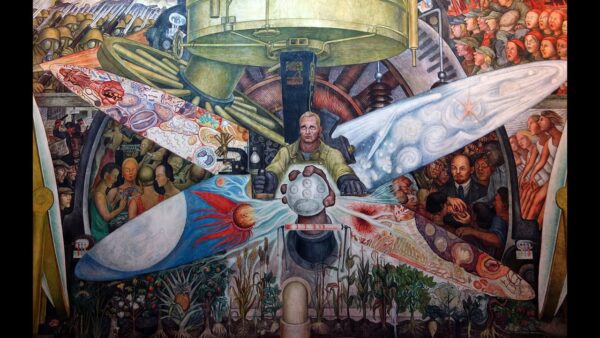
This is a re-creation of the mural Man at the Crossroads that Rivera painted for the lobby of the RCA Building at Rockefeller Center in New York. As work on that mural progressed, the New York World-Telegram published an editorial calling it “anti-capitalist propaganda” and an ever defiant Rivera then added a portrait of Lenin and an image of a Soviet May Day Parade. John Rockefeller’s response was to order it plastered over effectively destroying it before Rivera completed it. Rivera completed this new version the following year (1934) for its installation in the PFA. The mural expresses Rivera’s Marxist vision of technology’s dual potential – either utopian progress or dystopian war. Choose wisely, he seems to say.
Carnival of Mexican Life
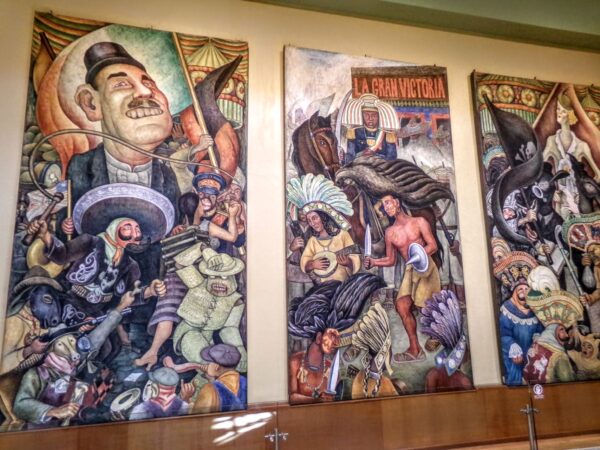
Alberto Pani commissioned this four panel work for the Hotel Reforma in 1936. Like Rockefeller, Pani took offense at the socialist critiques, including unflattering tourist depictions, that Rivera embedded. Rather than destroy the work, however, Pani put the panels in storage and the government acquired them and, in 1963, installed them in the PFA. The allegorical panels blend Mexican history, revolution, and global politics while critiquing dictatorship, imperialism, and social inequality from Rivera’s Marxist perspective.
The Torment of Cuauhtémoc
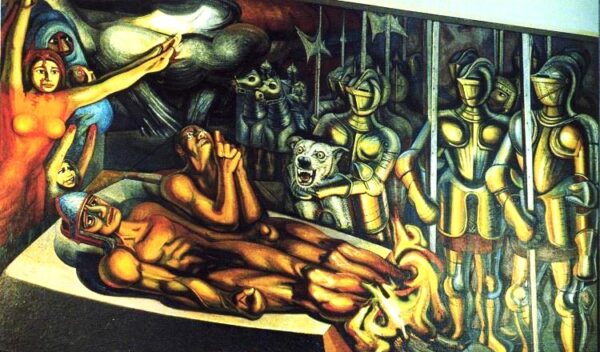
Cuauhtémoc was the last emperor of the people conquered by Spanish conquistadors after the 1521 fall of Tenochtitlan. This painting, by David Alfaro Siqueiros, is explicit in its condemnation of colonial brutality and imperialism and requires no further comment from me.
New Democracy
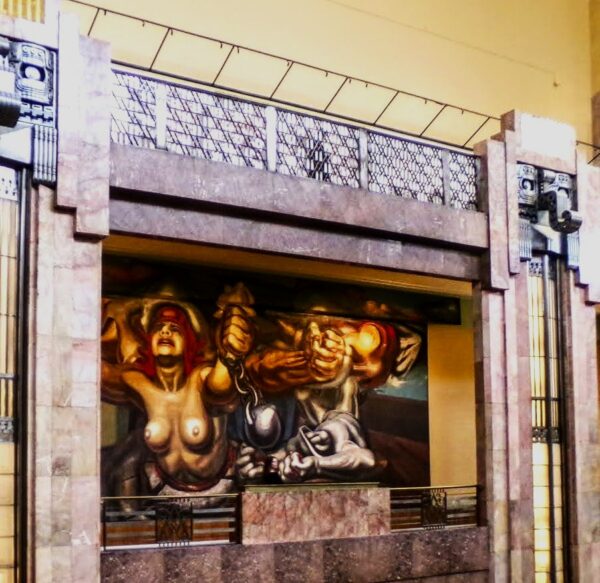
Siqueiros painted this toward the end of World War II to celebrate the Allied victory over fascism. It also serves as a warning of ongoing struggles. While representing democracy, the female figure remains partially chained – implying incomplete liberation.
Katharsis
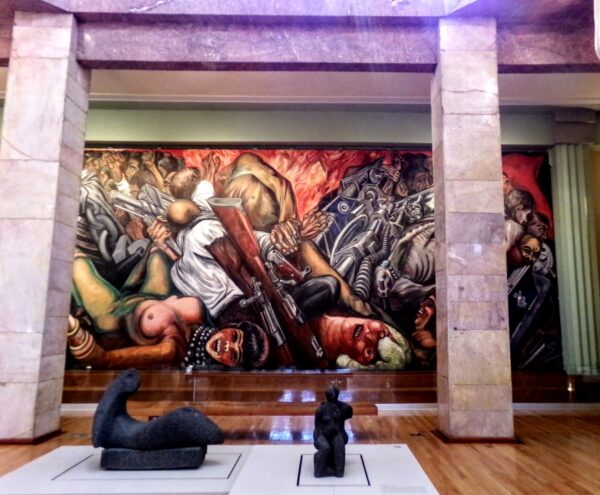
This painting by José Clemente Orozco – the last of Los Tres Grandes I’ll discuss – is, perhaps, the most chaotic with its nightmarish tangle of distorted human bodies, machinery, weapons, and flames. Painted just prior to the outbreak of the Second World War, it’s Orozco’s first major fresco following a seven year stay in the United States. I found its rather bleak representation of individuality within mass destruction quite unsettling despite it supposedly holding out the possibility of redemption.
Eatin’ right
The next stop on our day’s itinerary is the central square of CDMX also called Constitution Square and Zócalo. Had we walked directly there I doubt it would have taken more than 20 minutes for even the slowest walkers among us. Our group made a few photo op stops of the sort I might make on my own even if I could find none of these on Atlas Obscura.
I’ll return to the Zócalo and its importance in a later post. For now, I want to jump ahead to our lunch at the second location of Restaurante El Cardenal on calle Palma. Founded in 1969 by Olivia Garizurieta and Jesús Briz, on a site once occupied by Jesús’ taco stand, it would likely have remained in its original location but archaeological excavations forced the move.
Earthbound had named this tour “Flavors of Mexico City” so it included a daily focus on typical Mexican food and dining style. By the latter, I mean eating a large lunch, usually beginning 13:30 or later and a light cena or evening meal. Air Soul called this stop, “A classic introduction to traditional Mexican cuisine.”
Producing many of their own ingredients on their ranch using artisanal methods they also use traditional nixtamalization to make the masa for their tortillas. (Nixtamalization is a process in which dried corn is boiled and then steeped in an alkaline solution for at least six hours. Washing the corn then removes the loosened outer hull (pericarp). The alkaline bath increases the bioavailability of vitamin B3 (niacin), adds calcium, improves protein quality, breaks down mycotoxins, and increases resistant starch making it more like soluble fiber that’s fermented by gut bacteria. Many modern corn tortillas use masa harina which is a dehydrated product more akin to corn flour and is somewhat removed from the process that some call an integral part of the fabric of Mexican cultural identity.)
Here’s a video explainer.:
I thoroughly enjoyed my bowl of Verdolagas con pollo and my main course of Lomo de robalo al gusto Al epazote accompanied by my first Victoria – an amber Vienna-style lager – that’s the country’s oldest beer. I thoroughly enjoyed that, too.
A mid-trip course change
Because I’m integrating my report on my time in CDMX as both a trip and an Olympics host city, the next posts will break with the usual chronology of simple trip reports because I think it makes sense to do so. I’ll return to our time in the Zócalo and the adjacent archaeological sites of Tenochtitlan once you have the sound foundation I hope these next posts will provide. Until then, here are some other photos from the PFA.
-
Photos and their stories – Lisbon – Summer 2026 part two – plus an egg-straordinary bonus
August 21, 2026 -
Photos and their stories – Lisbon – Summer 2026 – part one
August 21, 2026 -
The indigenous people of Da?ow?aga? (Olympic Valley and me supplement three)
August 19, 2026 -
The indigenous people of Da?ow?aga? (Olympic Valley and me Supplement two)
August 17, 2026 -
Olympic Valley in the time before humans (Olympic Valley and Me Supplement one)
August 14, 2026