México City – Early migration and indigenous civilizations – (México City and Me supplement two)
Since I’ve explored the arrival of First People in many locations in the Americas for other posts in the Olympic Host Cities category, I’ll begin this post with only a brief review before moving on to the early settlements and civilizations of the Valley of México (VM).
A land bridge too far
I’ve made it clear elsewhere in these anthropological posts that I think the best current evidence for human origin is a modified Out of Africa hypothesis sometimes called the Recent African Origin with admixture. It posits that human global migration began in Africa approximately 60,000 years ago and modern Homo sapiens interbred modestly with Neanderthals, Denisovans, and other archaic groups. The overall pattern might have looked like this.
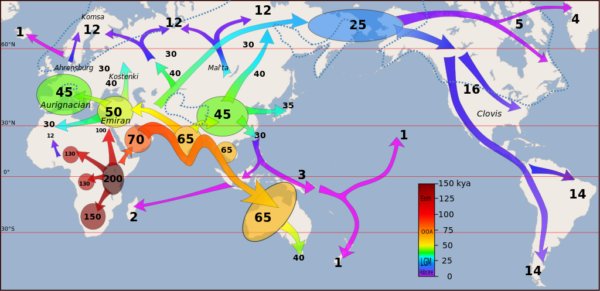
[From User:Dbachmann, CC BY-SA 4.0, via Wikimedia Commons.]

This model shows the earliest humans crossing the Bering Land Bridge about 25,000 years ago and reaching the American southwest and Central America over a 9,000 year period. Here’s one idea of how that happened.
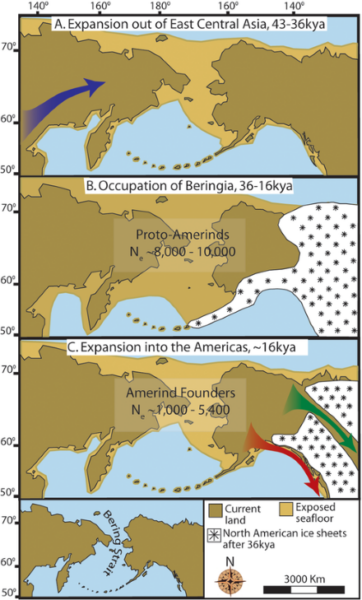
[From Buzzzsherman, CC BY-SA 3.0, via Wikimedia Commons.]

Pre-Classic – the early days
The two main pre-Columbian urban centers of the VM were the cities of Teotihuacán and Tenochtitlán. The former was established around the year 250 CE and was the first great urban area of the MV. It predates the latter by at least a millennium. I’ll look at three main periods of human activity in the VM – pre-Classic, Classic, and post-Classic. (Don’t confuse these with the Baroque, Classical, and Romantic periods of western instrumental music. Seriously, these rather standard archaeological eras, together with the term Mesoamerica were largely developed by the German archaeologist Paul Kirchhoff in the 1940s.)
The pre-Classic period begins about 14,000 years BP with early hunter-gatherers settling on islets and near the shores of the valley’s major lakes such as Texcoco. Until about 11,000 years BP they hunted large game like mammoths in a semi-arid landscape and likely relied on nomadic foraging. As the glaciers retreated, they would have adapted to hunting small game and moved to seasonal camps near lakes like Chalco. These early people began a gradual transition to agriculture and a more settled lifestyle by 5000 BCE. Sites like Tlapacoya and nearby Zohapilco show year-round habitation with domesticated maize, amaranth, beans, and gourds.
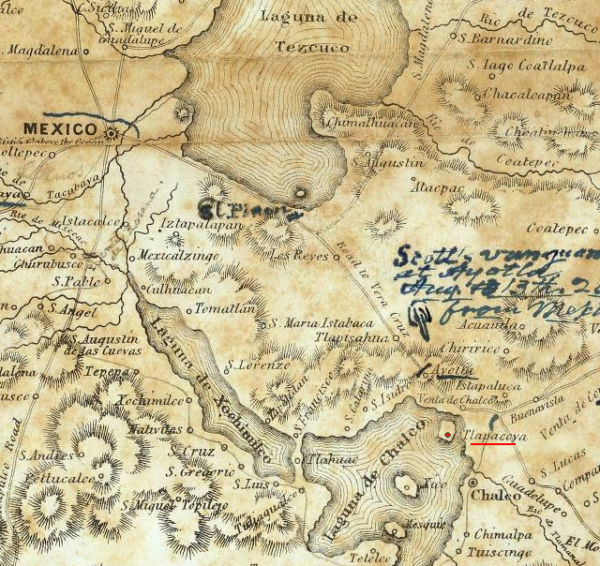
[From Wikipedia – Public Domain]
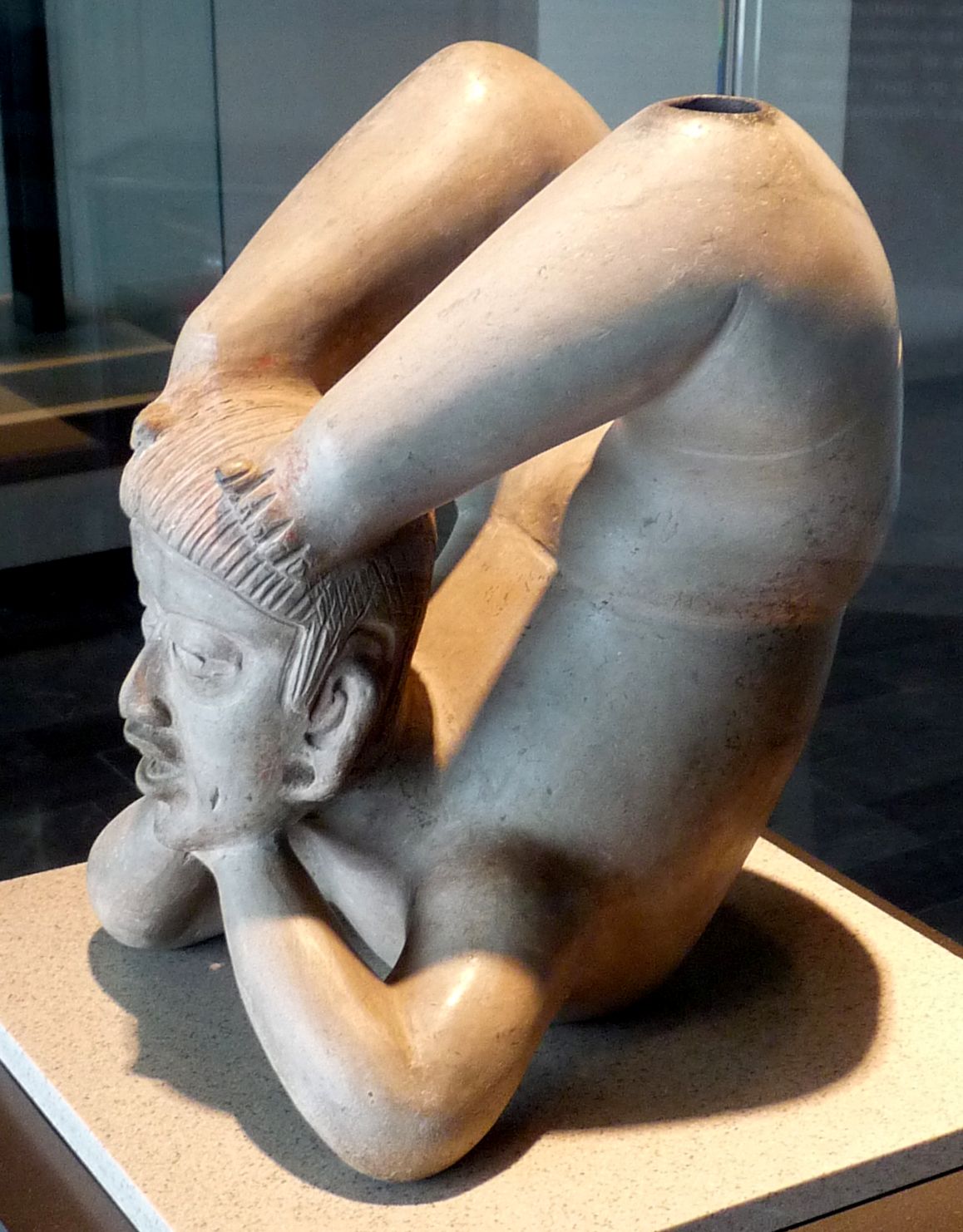
Increased volcanic activity laid down thick ash layers around 3000 BCE. This propelled the pace of agricultural development and, toward the Late pre-Classic (1200–200 BCE), larger settlements such as Tlatilco that was one of the first chiefdom centers to arise in the VM. This sort of chiefdom center could mark the onset of an Olmec presence in the VM because it’s here that archaeologists have found some of the earliest Olmec-influenced ceramics such as the one called “The Acrobat.”
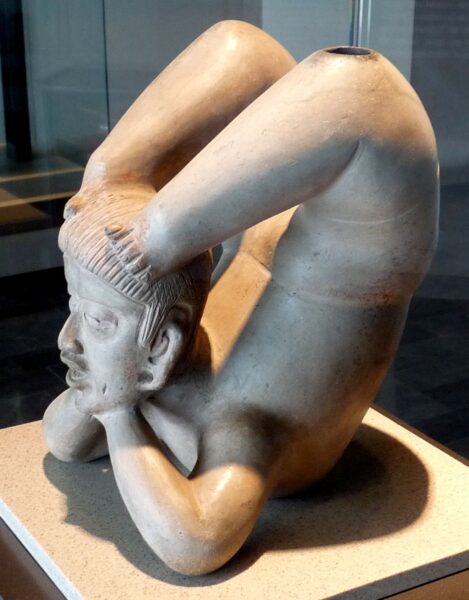
[From Wikipedia – By El Comandante – Own work, CC BY-SA 4.0.]
The presence of the Olmec nurtured economic integration and social stratification. Shared ritual practices and monumental expression provide further evidence for the region’s transition from villages to complex chiefdoms. (The Olmec people formed the first major civilization in Mesoamerica in the Gulf Coast lowlands of modern-day Veracruz and Tabasco, México thriving from around 1200 to 400 BCE . Often called the “mother culture” they influenced later societies by bringing innovations in art, religion, and urban planning.)
Cities rise and fall
Olmec dominance in the region began waning in the fourth century BCE thereby allowing the emergence of local cultures and cities like Tlatilco and Cuicuilco. Tlatilco arose on the western shores of Lake Texcoco and was one of the valley’s first major population centers and it remained prominent until about 800 BCE.
Sited on the western shore of Lake Texcoco a mere 10km north of the center of present day México City, the urbanization of this modern city – particularly in the 1970s – destroyed most of Tlatilco’s remains. Much of its art, in the form of stylized human and animal figurines, ritual ceramics, and clay masks, has survived and can be found in several museums globally. Olmec-style motifs, like “baby-face” figurines and others depicting dancers, ballgame players, conjoined figures, and women with exaggerated features show the influence of that coastal culture.
Tlatilco, the city’s name, comes from the Nahuatl language – a language that’s central to the identities of many VM cultures. In perhaps an odd coincidence for a place where so much of its history has been lost, the name translates to English as meaning either “the place of hidden things” or “the place where things are hidden.” As Tlatilco’s culture and influence declined, another city’s was rising.
Travel 20km south of México City’s Museum of Anthropology to reach Cuicuilco – a site Boston University archaeologist David Carballo calls “central México’s first true city” and it’s the first major archaeological-architectural site in the VM.
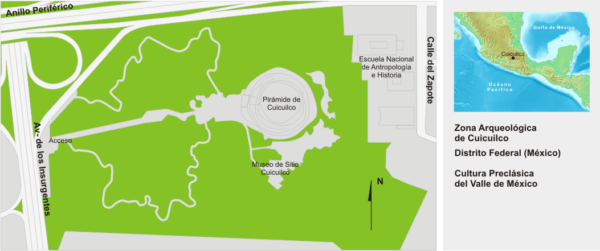
[From Wikipedia – Public Domain]
The distinctive semi-circular shape of its elevated structures present an architecture unlike any other in the valley.
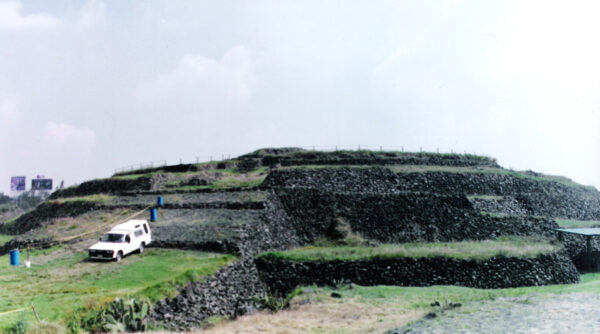
[From Wikipedia – Public Domain]
Settled between 1500 and 1200 BCE, Cuicuilco’s zenith likely spanned more than four centuries from 250 BCE to 200 CE when it’s estimated to have supported a population of 20,000 over an area spanning 405 hectares. Its urban center would have concentrated housing for the chiefs encircled by quarters for the commoners who supported them, ritual buildings, and probably some agricultural land use. The town’s chief would have exercised dominion over local resources while also controlling access to the trade routes to the valleys of Morelos and Toluca.
There is some degree of speculation with regard to the overall size and importance of Cuicuilco because of a nearby volcano called Xitle. To date, Xitle is a monogenetic volcano. Its only known eruption occurred between 245 and 315 CE. As you can see from this map,
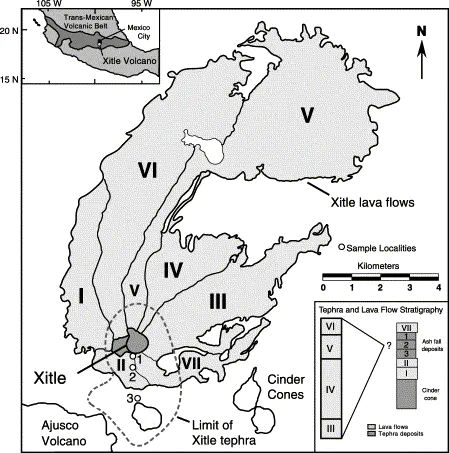
[From Oregon State University]
its lava flow inundated and buried most of Cuicuilco. The surviving residents abandoned the city and it quickly shifted from zenith to nadir.
What follows Pre-Classic?
If you guessed Classic, pat yourself on the back. (And if you guessed something else, well…) As they do with the Pre-Classic, most archaeologists trisect the Classic era into three timelines defined as Early Classic (200–400 CE), Late Classic (400–650 CE), and Terminal Classic (650-900 CE).
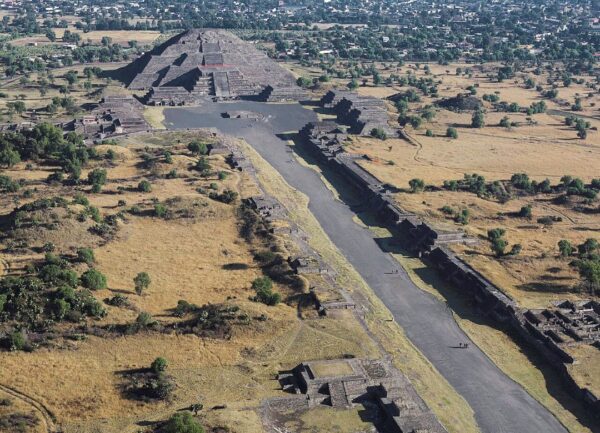
Travel about 50km north from the heart of México City to reach one of the most famous archaeological sites in the VM – the city of Teotihuacán. With the first villages in the area appearing circa 800 BCE, the earliest urban appearing settlements appeared in the Late Pre-Classic around 200 BCE or at about the time Cuicuilco was reaching the apex of its success.
It’s often said that when one door closes another opens. When Xitle’s eruption effectively closed the door on nearby Cuicuilco, it opened space for Teotihuacán to rise and many of the survivors from Cuicuilco migrated north. This influx of migrants together with a pullulating obsidian trade increased the power and population of this new and burgeoning urban center that had already completed such monumental structures as the Pyramid of the Sun. (A visit to and a more detailed discussion is forthcoming when I return to exclusively recounting my trip to CDMX.)
[From Wikipedia – By Ricardo David Sánchez – Own work, CC BY-SA 3.0.]
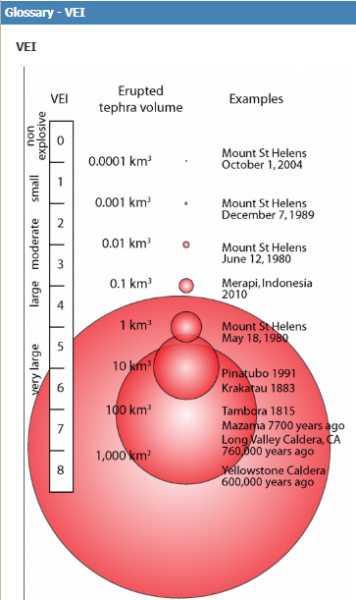
Over time, Teotihuacán’s success proved unsustainable. Near the end of the first third of the fifth century another volcanic eruption – this one at Ilopango might have been the beginning of Teotihuacán’s decline. The eruption, called the Tierra Blanca Joven (TBJ) event, happened in present day El Salvador nearly 1,700km from Teotihuacán but it was a magnitude VEI 6 (Volcanic Explosivity Index) eruption. With some estimates placing it as high as 7.3,
[FROM USGS]
it had far reaching geographic and temporal impact.
In the sixth century, the area near Teotihuacán experienced prolonged droughts when climate change – possibly attributable in part to the TBJ – began putting stress on the city. An increase in malnutrition seen in juvenile skeletons points to sustained periods of famine. Resource depletion from overpopulation and deforestation further weakened agricultural sustainability.
When segments of the economy become unsustainable and combine with rising social inequality, unequal distribution of and access to survival resources among a population, civil unrest is likely to occur. There’s evidence, such as burn marks on elite structures along the Avenue of the Dead that’s suggestive of civil unrest or a class-based revolt. Whatever the cause of its decline, Teotihuacán had effectively been abandoned by the year 750.
Our group would visit Teotihuacán on the trip’s penultimate day. However, since the civilization that built the city we call Teotihuacán antedates the Mexica construction of the next great city of the VM – Tenochtitlan by nearly 14 centuries, I’ll break the chronology of the trip and jump ahead to that visit – complete with balloon ride.
-
Photos and their stories – Lisbon – Summer 2026 part two – plus an egg-straordinary bonus
August 21, 2026 -
Photos and their stories – Lisbon – Summer 2026 – part one
August 21, 2026 -
The indigenous people of Da?ow?aga? (Olympic Valley and me supplement three)
August 19, 2026 -
The indigenous people of Da?ow?aga? (Olympic Valley and me Supplement two)
August 17, 2026 -
Olympic Valley in the time before humans (Olympic Valley and Me Supplement one)
August 14, 2026