How the VIII Winter Games came to Squaw Valley
The impossible dream.
Those who read my post about the III Winter Olympiad that included this post describing how those games reached the small, relatively isolated upstate New York village of Lake Placid might recall that the effort was largely driven by the personality and determination of Godfrey Dewey who served as President of the Organizing Committee. Much the same can be said for the efforts of Alexander Cushing
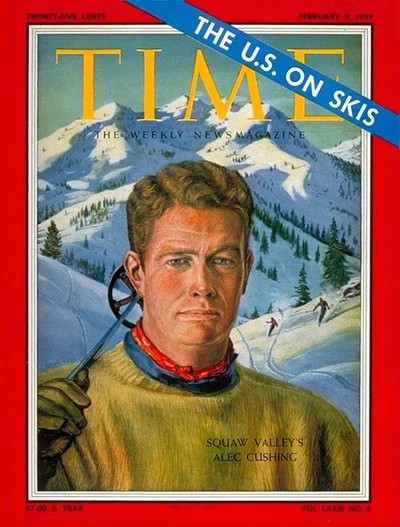
[From California Outdoors Hall of Fame]
to bring the Games to the community located just seven miles from the north shore of Lake Tahoe.
The story begins in 1938 or 1939 when Wayne Poulsen, who had been a collegiate skier at the University of Nevada, purchased 2,000 acres of land where he planned to both reside and develop a ski resort. By the mid 1940s he had achieved the first goal and, in 1946, he met Cushing, a New York attorney and businessman, who was vacationing there. Like Poulsen, Cushing saw the area’s potential and, by 1940, the pair formed a short lived partnership – the Squaw Valley Ski Corporation. Cushing provided substantial capital – including $275,000 from Laurence Rockefeller and other investors and $145,000 of his own money. According to the Palisades Tahoe website, the partnership dissolved – with Cushing and his group seeming to force Poulsen out prior to the resort’s opening.
On 24 November 1949 the first customers of the Squaw Valley Ski Resort rode either two rope tows or what was, at the time, the longest double chairlift in the world or up the mountain that Sandy and Wayne Poulsen had named KT-22 for the 22 kick turns Sandy made on the couple’s first ski trip down the famously steep slope.
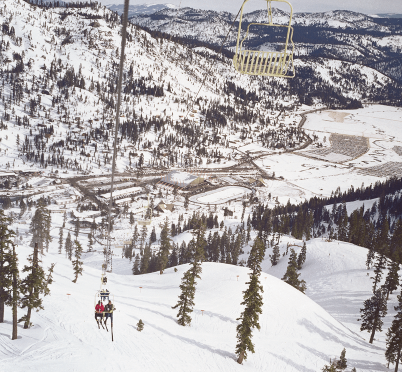
[From Palisades-Tahoe]
What those first visitors didn’t know on that Thanksgiving Day was that Cushing and his group were on the verge of bankruptcy. The resort teetered on the edge of financial ruin for the coming five years struggling to overcome not only a lack of name recognition but a series of cataclysmic events including three avalanches that flattened its limited lift towers, a flood that washed away the access bridge, and a fire that severely damaged the lodge.
In 1955, Cushing had an idea. The International Olympic Committee (IOC) would soon be meeting to determine the location of the 1960 Winter Olympics. So, to gain some publicity by having his resort associated with the other US contenders that included Lake Placid and Aspen, he announced his resort’s bid to host the Games of the VIII Winter Olympiad. Although people generally scoffed at the idea that this fledgling resort could host the Olympic Games, and rendering then USOC Chairman Avery Brundage aghast at his lack of facilities, Cushing somehow outmaneuvered his competition and managed to secure the American bid that would be presented to the IOC.
Encouraged by this success and by the enthusiastic reaction of the sparse local population, he approached the project with greater determination. Initially, his European competition was St Moritz, Garmisch-Partenkirchen, and Innsbruck. After visiting Brundage in Chicago, Cushing reached out to George Weller – a foreign correspondent for the Chicago Daily News. He and Weller traveled the continent to secure individual meetings with as many of the IOC’s 64 members as possible.
When the committee met in Paris for the final vote, Cushing had an architect build a scale model of his proposed Olympic site that was so large that IOC delegates had to walk to the U S Embassy lobby in Paris to see it.
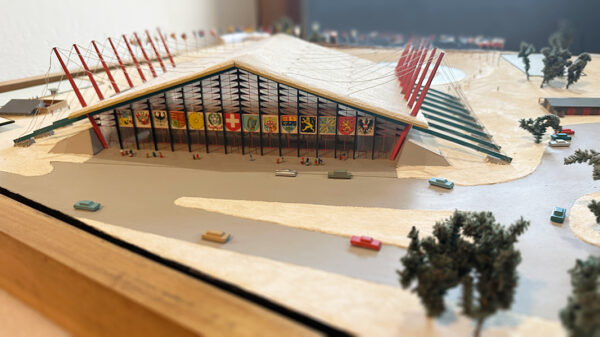
[From MoonshineInk]
Scorned and covered with scars.
It took more than simply charm, determination, and chutzpah for Cushing to secure his bid. He was ably assisted by his state senator Harold T Johnson. Johnson was apparently well aware of Cushing’s initial success – that of getting some free publicity. He used this to persuade his fellow lawmakers to pass a bill promising $1,000,000 (about $12,500,000 in 2026) in state support if Squaw Valley won the Olympic bid.
Governor Goodwin Knight signed the bill just six weeks before Cushing pitched his proposal to the USOC. The money talked and Cushing moved on to begin his charm offensive with the IOC beginning with the trips he made with Weller and continuing through the streets of Paris as the committee walked to the U S Embassy to see his model. Cushing’s plans featured several innovations including the construction of permanent facilities such as Blyth Memorial Arena (pictured above), temporary venues like the Olympic Speed Skating Oval
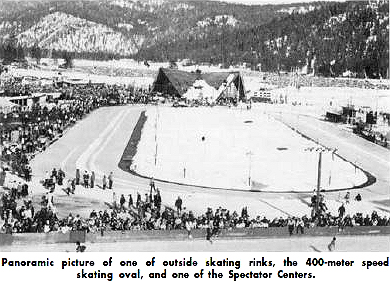
[From Wikipedia]
that would be dismantled after the Games, and the first purpose built athlete’s village for a Winter Games. (Unlike Lake Placid’s 1980 Olympic Village, Squaw Valley’s would be converted to hotel rooms rather than prison cells.)
Apparently, his charm offensive worked because to almost everyone’s surprise, the IOC awarded the 1960 Games to the Squaw Valley Resort.
(This prompted an interesting change at the closing ceremony of the 1956 Olympics in Cortina d’Ampezzo, Italy. Traditionally, the ceremony begins with the mayor of the host city handing the Olympic Flag to the IOC president who then hands it to the mayor of the next host city. Squaw Valley was a ski resort and the village it occupied was unincorporated and had no mayor. Thus it was that either state senator Harold T Johnson or Cushing himself {sources differ}, who received the flag from former Italian bobsledder Renzo Menardi, the deputy mayor of Cortina.)
And still he torments me.
The Europeans weren’t happy when the IOC awarded the Games to Squaw Valley. The howls of protest began almost immediately. Complaint number one: The altitude of 6,650 feet would be too stressful for the Nordic racers. Complaint number 2: The ski courses didn’t meet International Ski Federation standards. A bit more than a month after the IOC award, IOC Chancellor Otto Mayer wrote Cushing a letter, “Remember Mr Cushing that you will never get the games for 1960 as I may understand that you are not ready at all to take the great responsibility of organizing them.”
When only nine of the 30 NOCs indicated they would send bobsled teams, Cushing chose not to build a bobsled run. The furious International Bobsleigh Federation petitioned the IOC to change the ruling, but the Squaw Valley organizers refused to change their position. So, for the first, and only time, the Winter Olympics would have no bobsled competition.
With your heart striving upward.
In the end, Cushing had the last laugh. The games were well run with few problems. In those days before the institution of layers of security, the athletes could walk to most of their events in the remote, rural, and rustic setting. In the evening, they could socialize with others from outside their own NOCs in the village while enjoying nightly entertainment featuring stars like Bing Crosby, Danny Kaye, Jack Benny, Roy Rogers, and Marlene Dietrich courtesy of the chairman of the pageantry committee – Walt Disney. Disney also programmed the opening and closing ceremonies and designed victory ceremonies for each event – in ways that brought lasting change to the Games.
Now that we know how the Games came to Squaw Valley, we can take a look at some of the competition and stories in the next post.
But first, a musical detour
Yes, four of the section headers in this post are from Man of La Mancha. Three are from The Impossible Dream Reprise.
The line “And still he torments me” is from the confrontation between Don Quixote and Aldonza – the woman he calls Dulcinea.
Here’s hoping you find my stories about the games as this classic musical.
-
Photos and their stories – Lisbon – Summer 2026 part two – plus an egg-straordinary bonus
August 21, 2026 -
Photos and their stories – Lisbon – Summer 2026 – part one
August 21, 2026 -
The indigenous people of Da?ow?aga? (Olympic Valley and me supplement three)
August 19, 2026 -
The indigenous people of Da?ow?aga? (Olympic Valley and me Supplement two)
August 17, 2026 -
Olympic Valley in the time before humans (Olympic Valley and Me Supplement one)
August 14, 2026