Para bailar la bamba
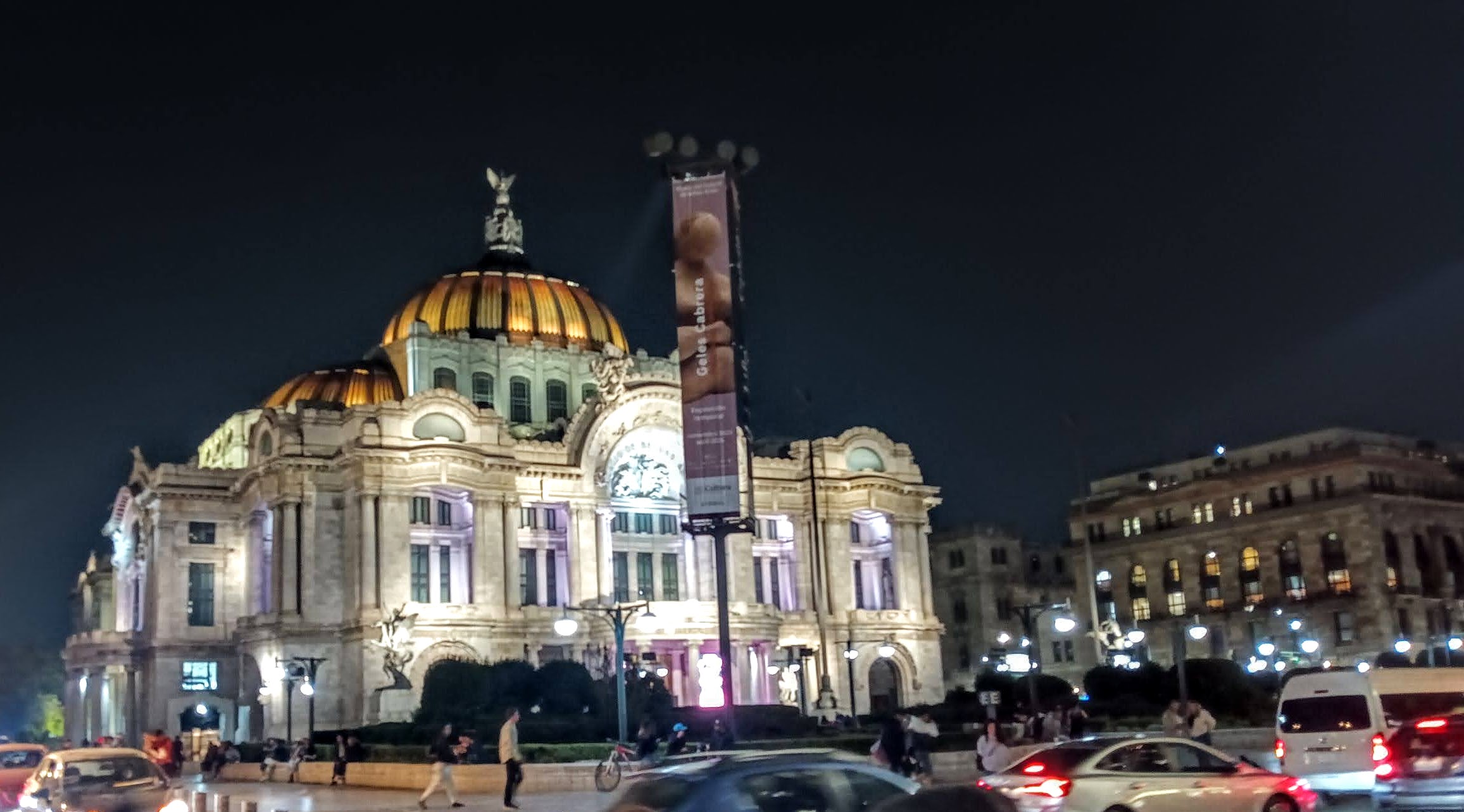
Wednesday had one final treat in store for us. On tonight’s schedule was an evening performance by Ballet Folklórico de México in the central auditorium of the Palacio de Bellas Artes. If not more impressive, the building certainly had a more dramatic appearance at night
than it had been when we’d seen it Tuesday afternoon. After some bureaucratic confusion regarding our tickets, we gained entry to the splendid theater
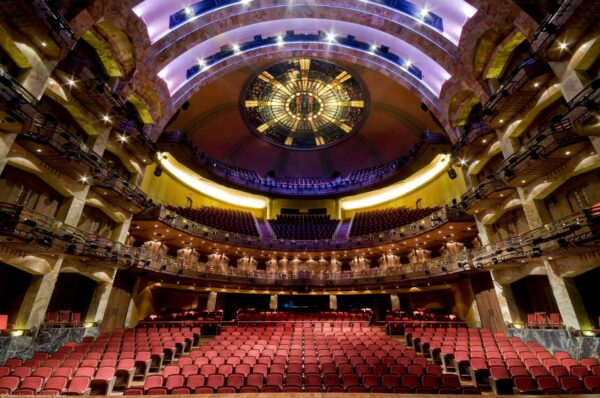
[From The Vendry]
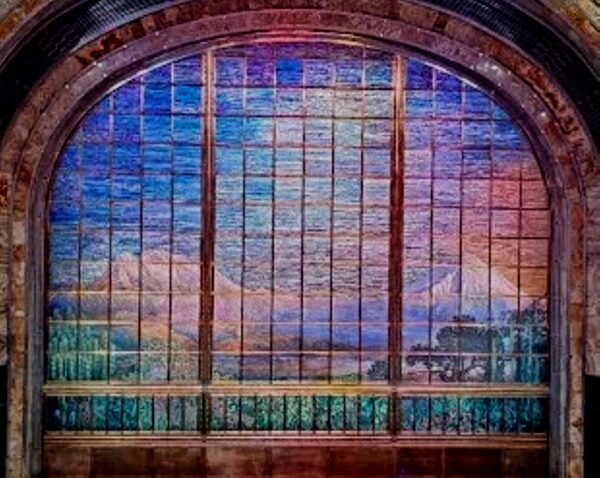
and its equally – or perhaps more- splendid Tiffany Glass stage curtain
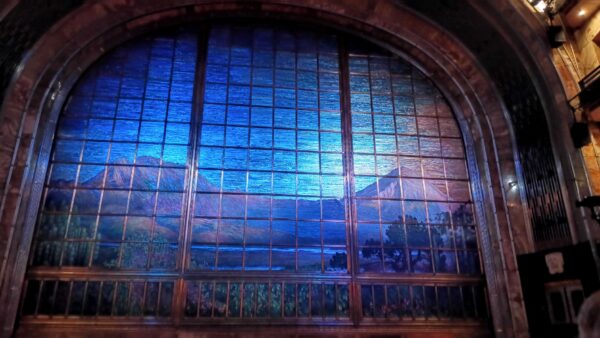
that isn’t a curtain at all.
In his design process, Italian architect Adama Boari wanted a non-flammable alternative to a textile main curtain. He chose the submission of Favrile glass from Tiffany. It took Tiffany & Company nearly two years to complete their work and they put it on display in their New York showrooms before shipping it by steamer to Veracruz then by land to CDMX.
The Mexican Revolution had begun a year or two earlier but the curtain was installed before construction halted for nearly two decades. Thus, the curtain was in situ before the building was finished.
While debated, most archival information indicates that Hungarian artist Géza Maróti created the mosaic’s depiction of the Valle de México with Popocatépetl and Iztaccíhuatl prominently identifiable. Maróti had previously designed the proscenium mosaic arch, the dome sculpture, and the ceiling rosette.
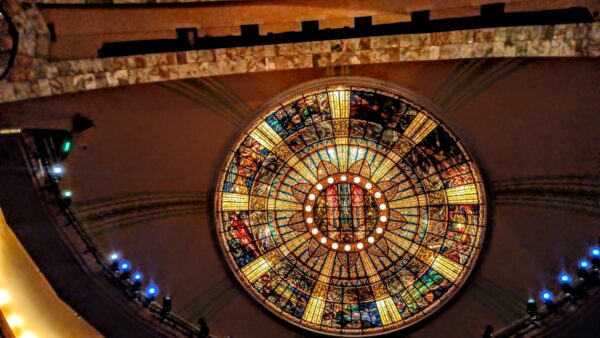
Nearly one million pieces of iridescent Favrile glass are mounted in a metal framework covering approximately 230 m² and weighing between 24 and 27 tons. And it doesn’t bend or fold.
Many in our group were keen to speculate about how the curtain would rise. When the time came, it lifted vertically and disappeared into the ceiling. Integrating the hydraulic lift system with other stage machinery was one of the necessary technical innovations to accommodate this dramatic design.
Another innovation was the lighting scheme. It was designed in tandem with the mechanism allowing different color and intensity combinations to animate the landscape. It is, as some described it at the time, a poem in glass.
A Company is born
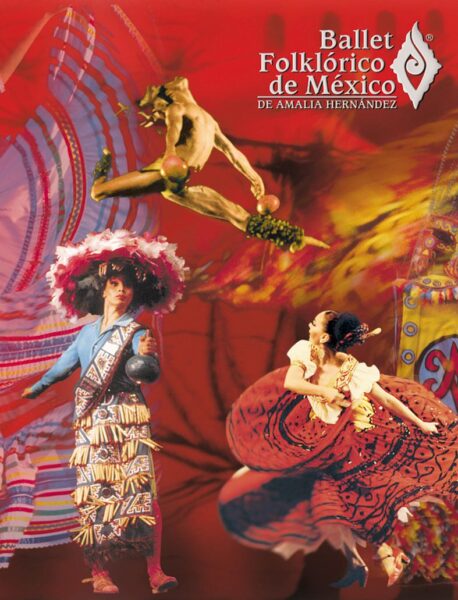
In 1952, choreographer Amalia Hernández brought together a small troupe of eight dancers to stage a theatrical, nationalist vision of Mexican folk dance by blending concert dance technique with Mexican folk themes. Beginning in CDMX at small venues like Sala Chopin, her mix of classical music, ballet vocabulary, and regional costumes quickly attracted public and critical interest.
The increasing popularity of her company’s folk-based works prompted Hernández to draw on more folkloric material. By 1958 the company had grown both its size and its repertory and was not only touring México but had begun a series of US tours and in 1959 it began receiving financial support from México’s National Institute of Fine Arts. With their first regular program on 11 October 1959, the company officially became the Ballet Folklórico de México.
With her company well-established, Hernández enthusiastically adopted the country’s efforts to create a unified national identity representing the mix of Indigenous, European, and African heritages that they called mestizaje. She created stage works that synthesized regional dances, Indigenous imagery, and Spanish‑derived forms into a single, theatrical narrative expressing Mexican identity.
[From Emilo Garcia]
Hernández approached the project with the notion of using living danzas, mestizos, and bailes regionales – such as sones and jarabes – as the foundation on which she layered ballet and modern dance techniques adapted for large ensembles within a framework of dramatic staging and lighting.
-
- Danza is the original Mexican folk-dance form performed by indigenous people before the Spanish arrived.
- Mestizo mixes the influences of Spanish fandangos, French ballet, and German polkas, with indigenous dance.
- Bailes regionales arose as different communities across the regions of México created their own dance interpretations and idiosyncrasies.
Those of you who read the Music and songs of Puerto Rico post know that many of the musical styles of the eastern Caribbean are closely tied to dance styles. It should thus be unsurprising that, whether in steps broad or narrow, each of the dance styles above exists symbiotically with a musical style.
Let’s Dance!
We’ll start our journey on México’s west coast in the state of Jalisco with what many consider the country’s national dance, the jarabe tapatío – more commonly called the Mexican Hat Dance. The earliest records trace its origin to the late eighteenth century. When it was banned for a time by colonial authorities, it gained popularity as a symbol of Mexican identity post-independence. Composer Jesús González Rubio standardized the very familiar melody in the nineteenth century.
For our next regional dance, let’s cross the country to the east coast state of Veracruz. We’ll stay in the 18th century to find the origins of son jarocho. The music fuses Spanish guitar traditions like fandango with African rhythms brought by enslaved people, and Indigenous elements from local Nahua and Popoluca cultures. The term “jarocho” was originally a derogatory term that referred to vaqueros of mixed Afro-Spanish or Afro-Indigenous descent. Over time, however, it became linked to Afro-Mexican resistance against colonial oppression and has become a term of empowerment and local pride.
The Son Jarocho involves a lot of zapateados and sees a dancer try to tie a ribbon on their partner. These are the basic zapateado steps or pasos.:
-
- Golpe – the basic stomping of a foot to the ground.
- Sencillo, doble sencillo, paso de tres zapateado – One, two, and three consecutive foot stomps respectively.
- Remate – a series of foot stomps.
- Sequidos – continuous steps.
- Sequencia – combining these zapateado steps with the music.
For us, it looked rather like this.
If you can’t quite hear or recognize the music, this version from 1958 might be more familiar.
To show that the bailes regionales aren’t all rooted in the past, one need merely travel west from Veracruz to the state of Oaxaca and Tuxtepec in the Papaloapan Basin to discover the dance called flor de piña.
Created in 1958 by choreographer Paulina Solís Ocampo at the behest of Oaxaca’s governor, it aimed to forge a distinct Oaxacan style separate from Veracruz’s jarocho style. Amalia Hernández died in the year 2ooo and although her grandson Salvador López López is the company’s general director and her daughter Viviana Basanta Hernández has assumed the role of artistic director, the show we saw didn’t include this dance because I think I would have taken photos if pineapples had appeared on stage. Still, here’s a look at Oaxaca’s Flor de Piña.
A few other highlights from our night at the Ballet
The show we saw began with a suite representing the Indigenous people of México with the troupe’s imagining of Mexica ceremonial dances. This is among the first images we saw when the curtain rose
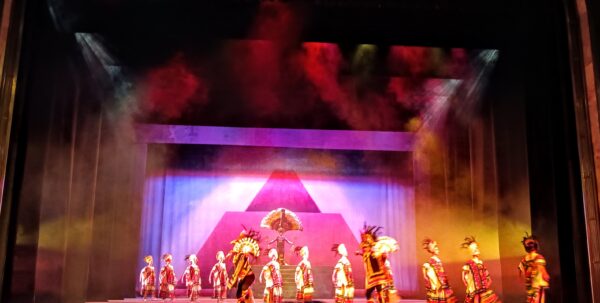
and one dance in this episode almost certainly looked like this.:
An interpretation of the Danza de los Concheros followed. Once again, the choreography began by depicting Indigenous motifs that presented a tangible manifestation of the survival of Nahuatl tradition then combined that with modern and balletic elements.
Using seamless transitions it flowed temporally forward through the Suite called La Conquista taking us through the clash with conquistadors in armor into the creation of a new identity. However, rather than emphasizing the violent aspects of this cultural takeover, it stresses cultural fusion and uses music that mixes Nahuatl chants with Spanish colonial melodies.
The dance of the Adelas highlighted the role of women in the Mexican revolution.
Another highlight (at least for me) was La Danza del Venado or the Deer Dance –
a traditional ritual dance originating from the Yaqui and Mayo indigenous peoples in Sonora and Sinaloa. It had me so mesmerized that I took no photos.
And the closing moments of the show provided one of the highlights for L – one of our guides. He’d seen the show before and knew what was coming so when the dancers left the stage and entered the auditorium to invite patrons to dance with them,
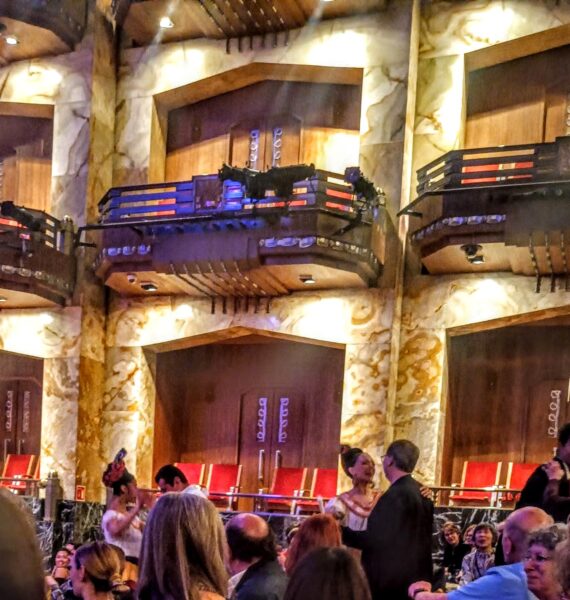
he was among the first to reach the aisle. (He’s not in this picture or the other similar one in the photo album.)
Thus ended a long, but exhilarating day but not my stay in CDMX. I hope you’ll return for the continuation of my report.
-
Photos and their stories – Lisbon – Summer 2026 part two – plus an egg-straordinary bonus
August 21, 2026 -
Photos and their stories – Lisbon – Summer 2026 – part one
August 21, 2026 -

The indigenous people of Da?ow?aga? (Olympic Valley and me supplement three)
August 19, 2026 -
The indigenous people of Da?ow?aga? (Olympic Valley and me Supplement two)
August 17, 2026 -
Olympic Valley in the time before humans (Olympic Valley and Me Supplement one)
August 14, 2026