I see all I never knew
What happened in Detroit
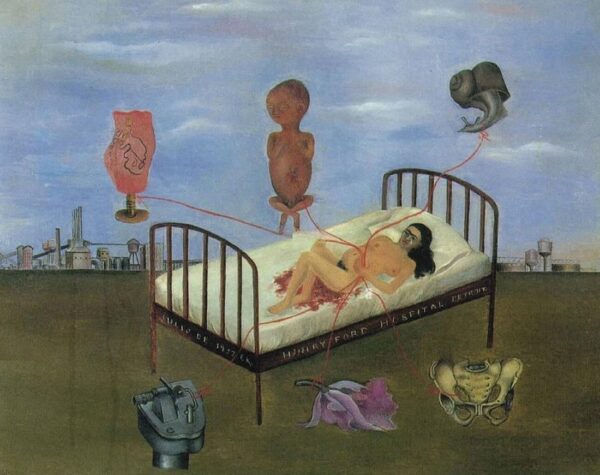
Soon after the couple arrived in Detroit for Rivera to begin painting a mural commission at the Detroit Institute of Arts Kahlo became pregnant. It’s likely she was delighted to learn this because she had long wanted to have children. But she began bleeding on the night of 4 July and was admitted to Henry Ford Hospital the following day to stop the hemorrhage and treat the miscarriage. Unsurprisingly, as she had done in the past, this time with Rivera’s encouragement, Frida turned her pain into art beginning with the painting depicting her in Henry Ford Hospital. That painting is now part of the collection at the Museo Dolores Olmedo in Xochimilco.
[From FridaKahlo.org]
Perhaps with a new vision inspired at least in part by Rivera’s advice to “paint the years of her life” she went on to produce My Birth and Self-Portrait on the Borderline Between Mexico and the United States. She also completed the aforementioned Display Window in a Street of Detroit.
Kahlo and Rivera’s marriage was in one of its states of reconciliation when the American actor Edward G Robinson traveled to CDMX. Rivera introduced the actor and his wife Gladys to Kahlo at her studio and Robinson purchased four of her paintings for $200 each – the equivalent of about $4,500 each in 2026.
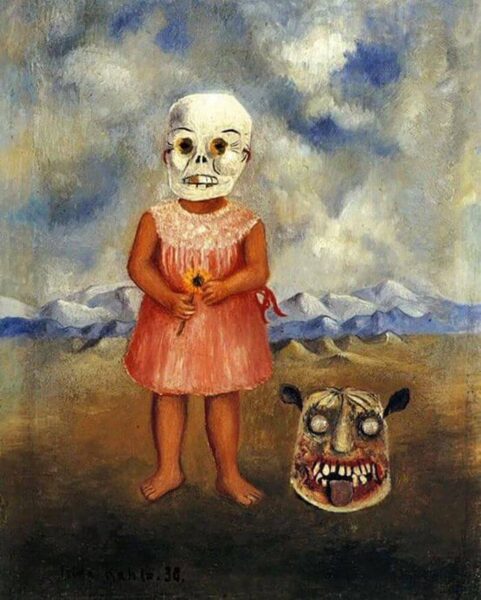
Another visitor to CDMX, surrealist painter André Breton saw Kahlo’s recently completed painting What Water Gave Me and declared her a “natural surrealist.” Word of this reached Julien Levy whose New York gallery specialized in surrealism. Breton’s endorsement, enthusiastically supported by Rivera, resulted in Kahlo’s first solo show in November 1938. It’s possible that the painting that impressed Breton was one of the 25 or so paintings included in the show but the only piece that can be definitively placed there was She Plays Alone that’s also called Girl with Death Mask.
[From FridaKahlo.org]
Records indicate that 12 of the exhibited paintings were sold but, perhaps more importantly these two events helped bring Frida and her work to the wider attention of the American public and earned her a commission from Clare Booth Luce.
Luce requested that Kahlo create a memorial “recuerdo” portrait as a gift for her friend Emma Donovan whose daughter Dorothy Hale had committed suicide earlier that year. What Luce expected was a conventional portrait. What she received was a graphic ex-voto-style depiction of Hale’s leap from the Hampshire House. Although Luce didn’t destroy the painting as John Rockefeller had done to Diego Rivera’s mural a few years earlier, she did have her name as commissioner overpainted and placed it in storage until she donated it anonymously to the Phoenix Art Museum in 1960.
A visit to Paris and the last years
Before she finalized her divorce from Rivera in November 1939 Frida spent some time in Paris. Her motivation for this came largely from Breton who invited her to participate in the exhibition he was organizing called Mexique. Eighteen of Kahlo’s paintings were included among the Mexican folk art, pre-Columbian objects, and modern works on view at the Galerie Renou et Colle for a week in late March.
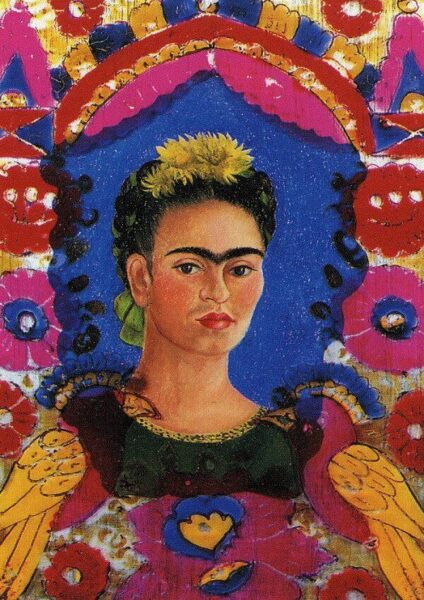
Although she sold only a single painting, the sale was quite noteworthy. Her painting The Frame
[From FridaKahlo.org]
was the first painting purchased by the French state (for exhibit in the Jeu de Paume) by a 20th-century Mexican artist.
During this time, she socialized with the elite of the Parisian art scene including Pablo Picasso, Joan Miró, Wassily Kandinsky, Marcel Duchamp, and Yves Tanguy. However, despite Breton’s support, she chafed at being classified as a surrealist and wrote to Nickolas Muray, with whom she was having an affair, complaining about the French “bitches” and “rotten intellectuals,” and calling Europe “false.” She left Paris the day the show ended and returned to Coyoacán and La Casa Azul
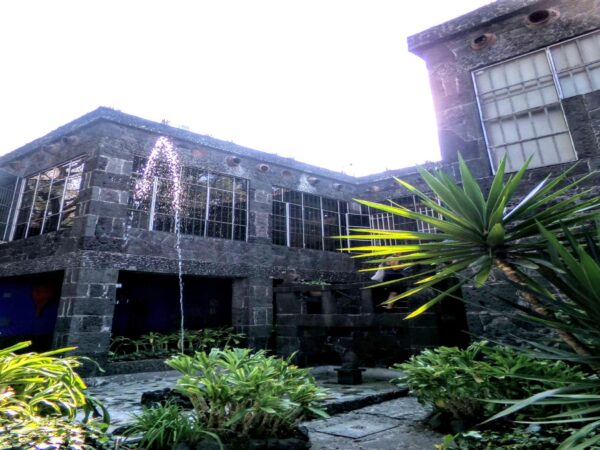
where she would remain for much of the remainder of her short life.
After her remarriage to Rivera in December 1940, Frida was chosen by the Ministry of Education to be among the 25 founders of the Seminar for Mexican Culture – a group of intellectuals and artists with a mission to develop and promote Mexican culture.
In 1946, at the Palacio de Bellas Artes, México’s Ministry of Public Education presented Frida Kahlo with its National Prize of Arts specifically for her 1945 painting Moses.
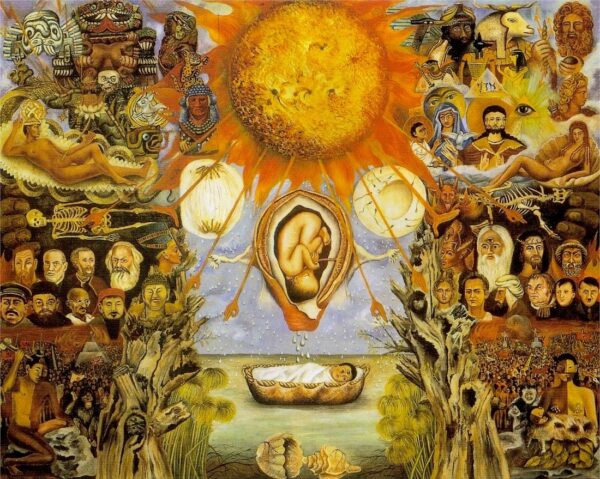
[From FridaKahlo.org]
Despite this rare official honor in her home country, despite her international recognition, and despite this award providing recognition that she was a leading national artist and not merely the famous muralist’s wife, it would be another seven years before Frida Kahlo would have her lone solo show in México.
Between 1949 and 1950, she had seven separate back surgeries and spent a total of nine months in the hospital. Even these efforts failed to fully ameliorate her pain and her health continued to decline. When, in April 1953, her friend Lola Álvarez Bravo organized what would be her lone solo show in México at the Galería de Arte Contemporáneo, Frida was transported to the grand opening by ambulance and attended it in a hospital bed.
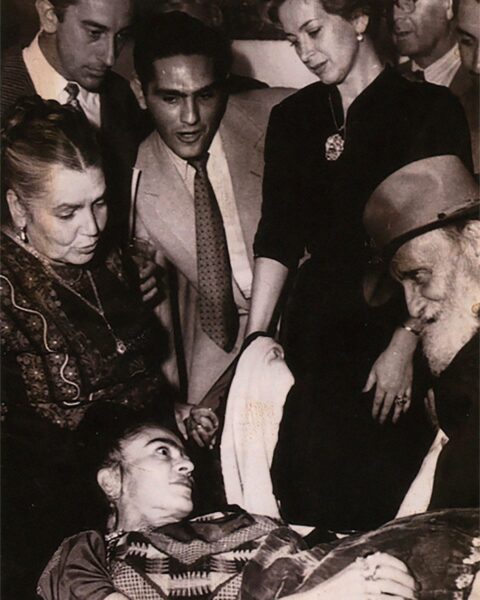
[From Frida Kahlo Corporation Facebook]
In August of that year, doctors amputated her right leg below the knee to stop the spread of gangrene. She contracted pneumonia in June 1954 and died at La Casa Azul on 13 July of that year.
A moderately successful life becomes posthumously iconic
Unlike Vincent van Gogh, Frida Kahlo was respected as a serious painter by artists, critics, and patrons even if her husband’s fame overshadowed hers. She had at least two solo shows and had public sales and private commissions.
Her public persona, dress, and politics often attracted attention and her inclusion in exhibitions in key institutions such as the MoMA portrait show and surrealist exhibitions in New York, ICA Boston, and the Philadelphia Museum of Art certainly demonstrate moderate success if not major fame.
Shortly before his death in 1957, Rivera established the Fideicomiso de los Museos Diego Rivera y Frida Kahlo trust to preserve and manage La Casa Azul and its contents – including pre-Hispanic artifacts –
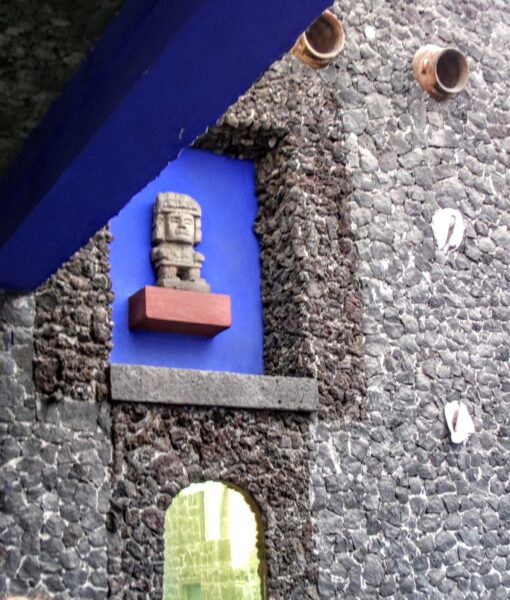
as a cultural gift to the people of México. The house opened as a museum in 1958.
However, decades would pass before it became the location that today attracts more than 25,000 monthly visitors.
(Establishing this foundation might have been Rivera’s last grand gesture demonstrating not only love of his country but his love for Frida. Although he’d expressed a desire to be cremated and have his ashes mixed with hers, his surviving family {or the Mexican government}denied him that reunion and had him buried in the Rotonda de las Personas Ilustres at the Panteón Civil de Dolores in CDMX. The opera El Último Sueño de Frida y Diego by Gabriela Lena Frank and Nilo Cruz provides that fictional reunion.)
NOTE: I added this short trailer for the Metropolitan Opera production after initially publishing this entry.
Kahlo’s art began drawing more attention with the emergence of the feminist art movement in the 1970s. Interest in her work continued to grow with its inclusion in a 1982 show with the work of Tina Modotti at London’s Whitechapel Gallery but the pivotal moment for triggering what many term Fridamania was the 1983 publication of Hayden Herrera’s Frida: A Biography of Frida Kahlo.
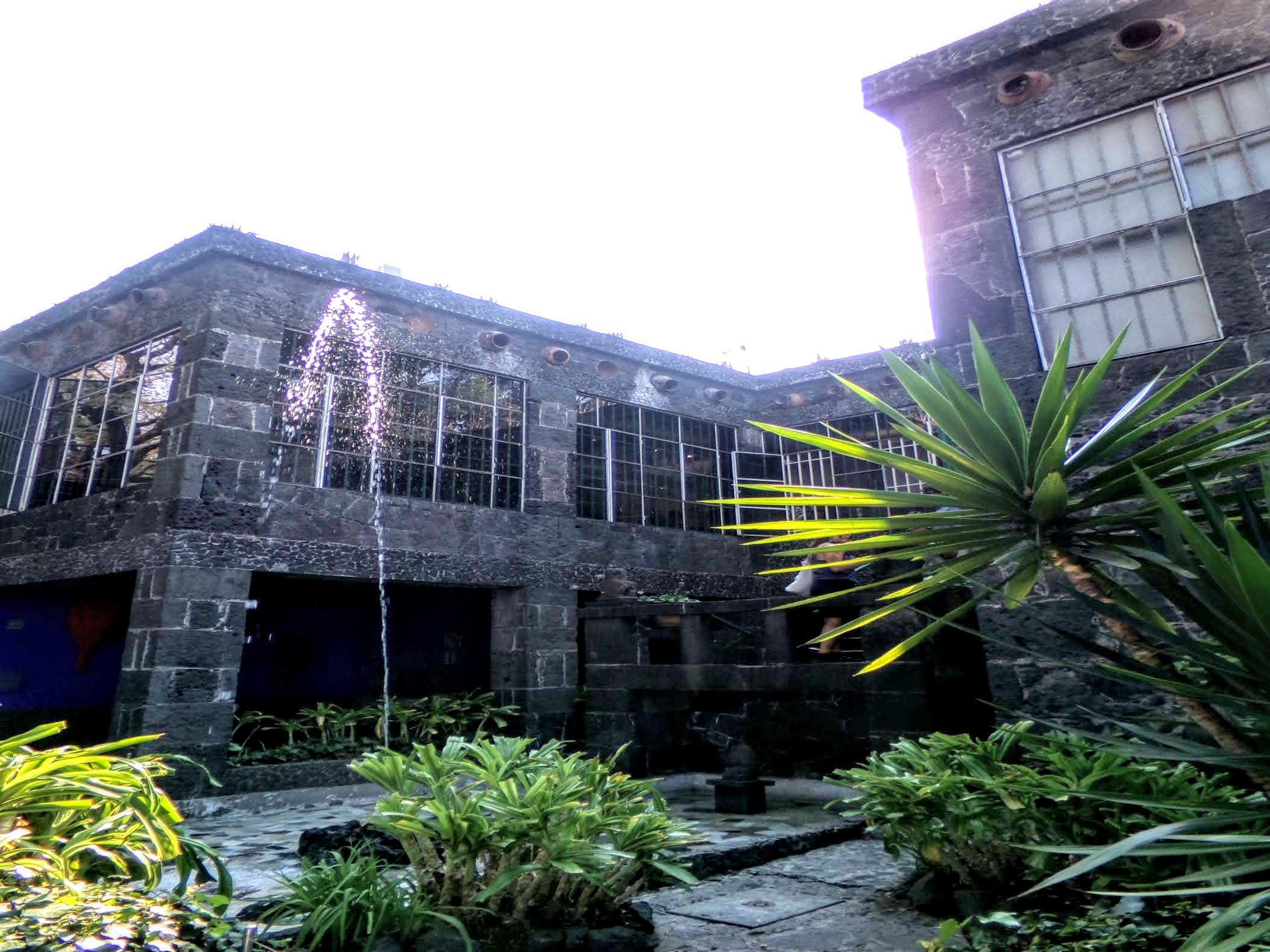
Prior to its publication, Kahlo had largely lingered in Diego Rivera’s shadow with limited recognition outside México. Herrera’s portrayal of her pain, sensuality, politics, and description of herself-portraits as “visual diaries” meshed perfectly with the time. Here are the photos from La Casa Azul.
A tribute of a different kind
By another artist, Frida Kahlo’s last known painting might have been called “Still Life with Watermelons.” Her title was Viva la Vida, Watermelons (Long Live Life, Watermelons) and it’s displayed in La Casa Azul.
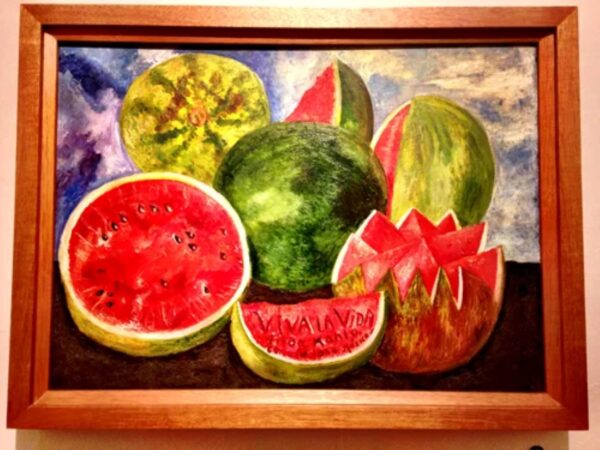
When the band Coldplay toured México in 2005-2006, Chris Martin visited the museum and, when he saw the painting, knowing that Kahlo had experienced great physical and emotional pain, later said that he loved the boldness of it and her insistence on celebrating life while enduring chronic illness, pain, and depression. It not only inspired a song with that title but carried the theme of resilience and redemption through a stylistic change on the album titled Viva la Vida or Death and All His Friends that most believe is the band’s most unique and cohesive effort. Although there are no songs specifically about Frida, Martin has been clear in stating that the album is an homage to Frida Kahlo and to México. For those of you who are unfamiliar with it, here’s the title song.
From contracting polio, to her bus accident, to her tumultuous marriage, or her miscarriages, Frida Kahlo seemed to rise above every physical and emotional challenge to continue producing the art that has become iconic. Time Magazine interviewed Frida in conjunction with her México City show and published their story on 27 April 1953. In a statement that seems to summarize her triumph and her tragedy she told them, “I am not sick. I am broken. But I am happy to be alive as long as I can paint.”
-
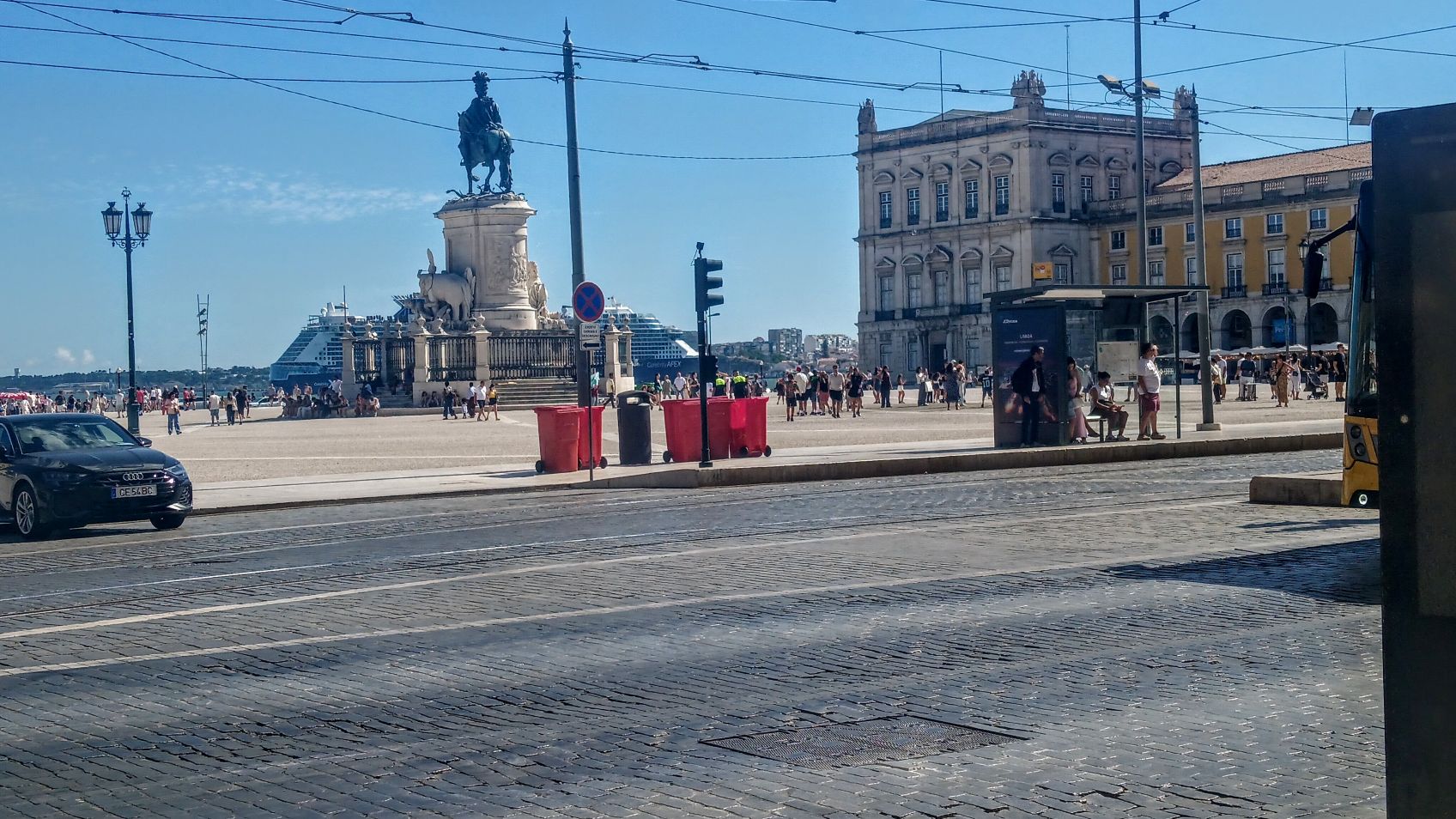
Photos and their stories – Lisbon – Summer 2026 part two – plus an egg-straordinary bonus
August 21, 2026 -
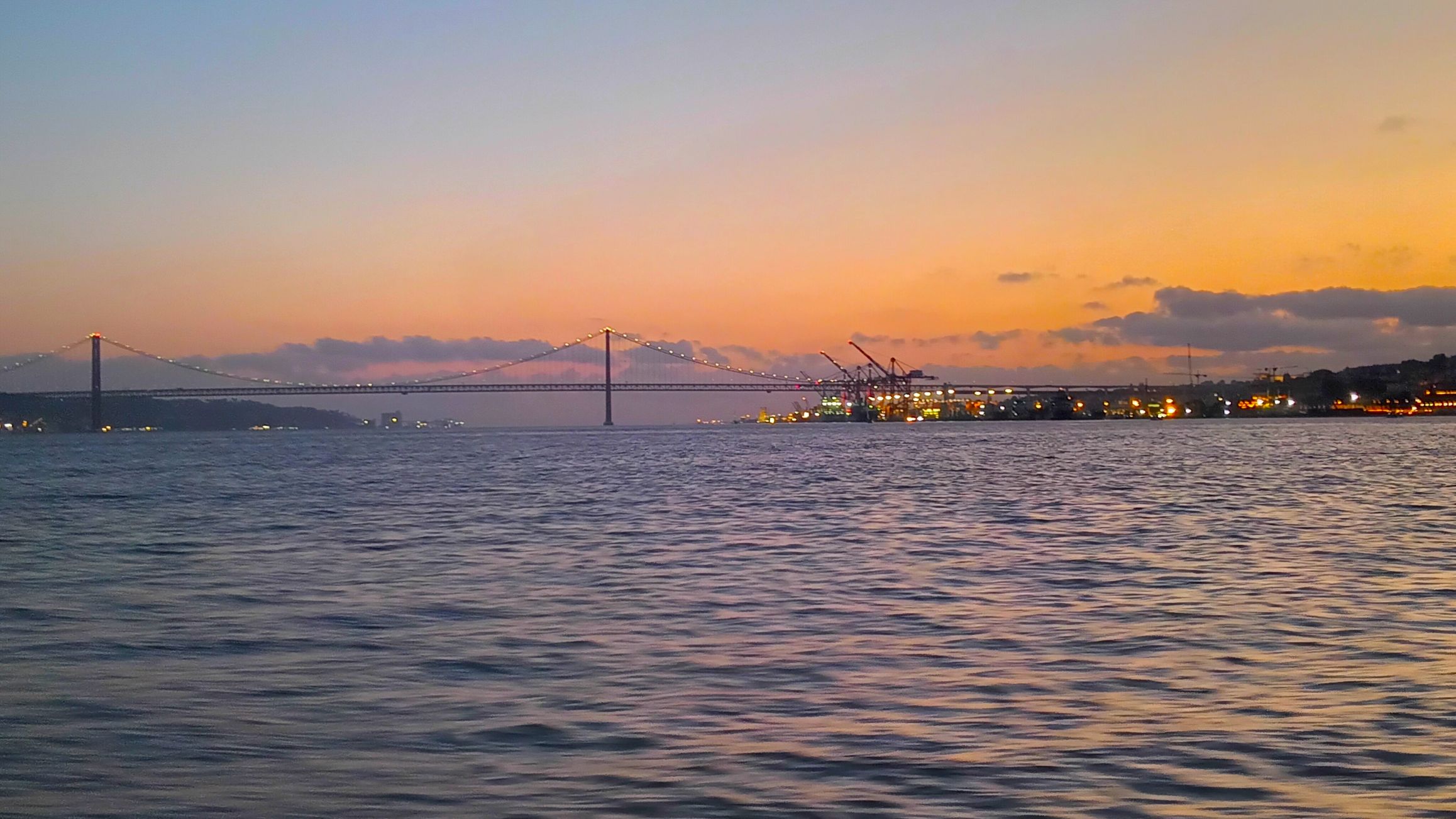
Photos and their stories – Lisbon – Summer 2026 – part one
August 21, 2026 -

The indigenous people of Da?ow?aga? (Olympic Valley and me supplement three)
August 19, 2026 -
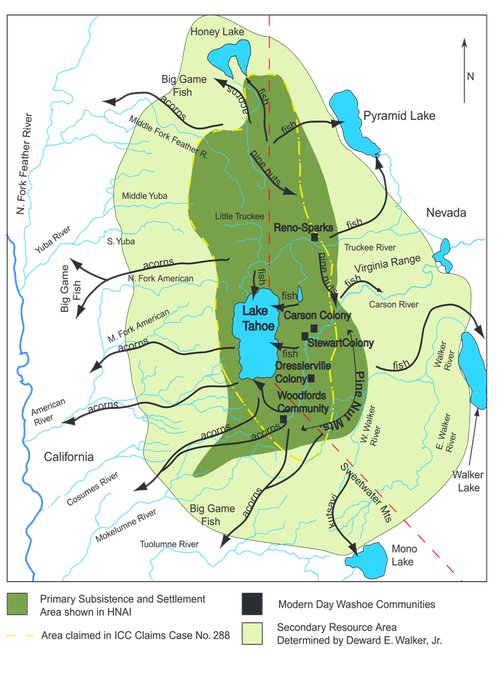
The indigenous people of Da?ow?aga? (Olympic Valley and me Supplement two)
August 17, 2026 -

Olympic Valley in the time before humans (Olympic Valley and Me Supplement one)
August 14, 2026