Mexico is different, like the travel folder says
With few exceptions, I usually take you through my trips in a linear temporal sequence. But, as I noted previously, Earthbound Expeditions didn’t take us on a historical timeline. For my purposes, however, I see México’s archaeology as essential both to reporting about this trip and, of course, as a part of the Olympic Host Cities category. As I noted in the previous post, our group visited Teotihuacán on our penultimate day but since that post looked at its settlement, I think the logical step is to break the timeline and jump ahead to that visit. As we make the hour long journey from central CDMX, I’ll treat you to a little overview of some of the attributes applied by the archaeological scholars who have studied the city.
Who were they?
Midway through the epic swordfight between Wesley and Inigo Montoya, Inigo asks, “Who are you?” and Wesley responds, “No one of consequence.”
Although we may know relatively little about them, we cannot reduce the builders of the great city at Teotihuacán to, “No one of consequence.” As we learned in the previous post, the earliest urban-like settlements appeared in the Late Pre-Classic around 200 BCE and Teotihuacán became a major urban center within a few centuries.
Most likely the settlers and builders were from Nahua-speaking groups such as Otomi, Totonac, or other VM cultures but none have been definitively proven. Archaeologists have pinpointed distinct barrios they have associated with migrants from Oaxaca, the Gulf Coast, and Mayan regions, suggesting resident communities of Zapotec, Mixtec, Maya, and other groups. In fact, evidence from apartment compounds,
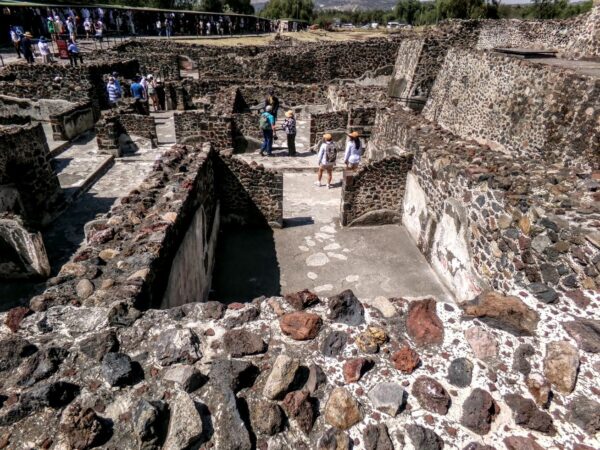
pottery, murals, and burials indicates that Teotihuacán was a multiethnic city. Recall that lava flow from the eruption of Xitle inundated and buried most of Cuicuilco and that the surviving residents abandoned the city. If similar conditions prompted other groups to migrate, it adds credence to the multiethnic hypothesis. These diverse groups may have coalesced into a new urban society rather than extending an older ethnic kingdom.
It appears that residents lived largely in large, stone-and-adobe apartment compounds that often-housed multiple related families and craft specialists who might have been artisans working in obsidian,
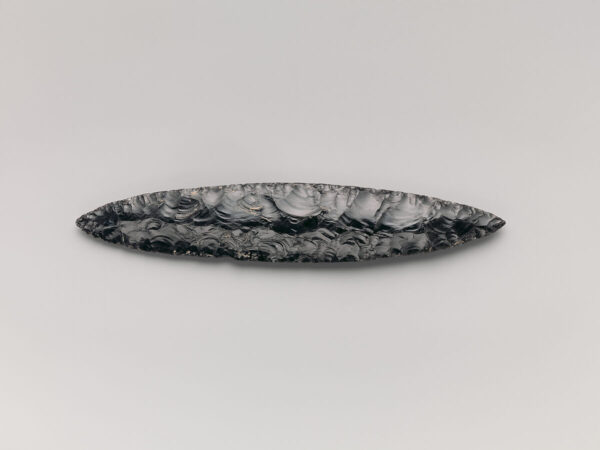
[From Metropolitan Museum of Art]
ceramics, textiles and painting.
Since some estimates say the city’s population grew to more than 100,000, agriculture would have been a crucial element to maintain the residents. With evidence supporting the use of intensive chinampa-like methods, it’s possible that some of these farmers also dwelled in the city. (I’ll discuss chinampa farming when our group visits Xochimilco later in this journey.)
Governance in the city is another point of debate. Some scholars interpret the monumental standardized architecture of the Pyramids of the Sun (on the left below) and Moon respectively
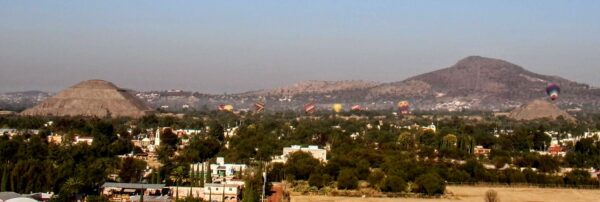
as evidence of a centralized, powerful administration capable of organizing massive labor forces. Others point to the absence of explicit royal portraits and texts as evidence supporting a more collective style of governance.
How did they build it?
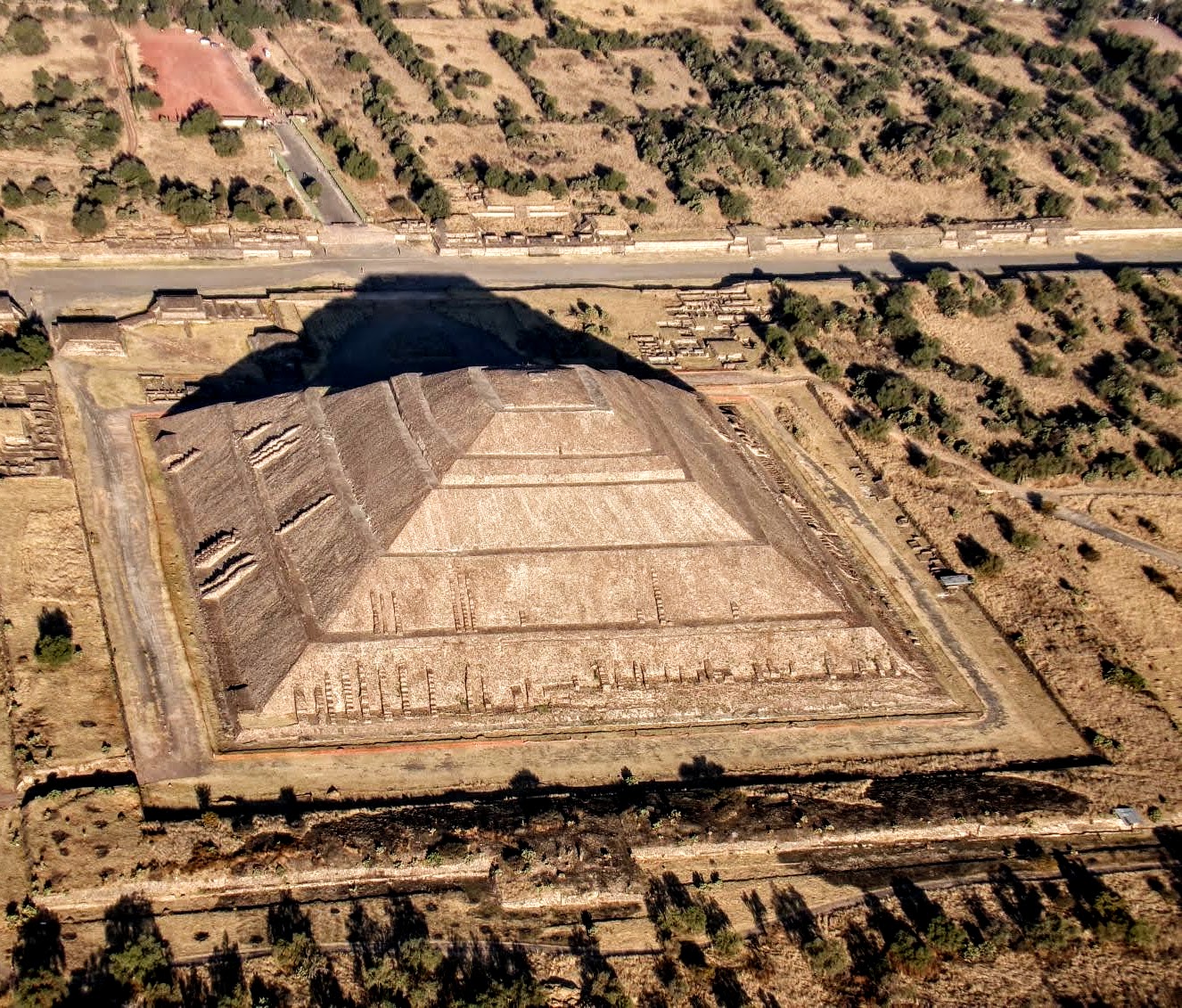
Let’s take a look at the largest structure in Teotihuacán – the Pyramid of the Sun – that sits on a square 225 meter base and rises 65 meters above it.
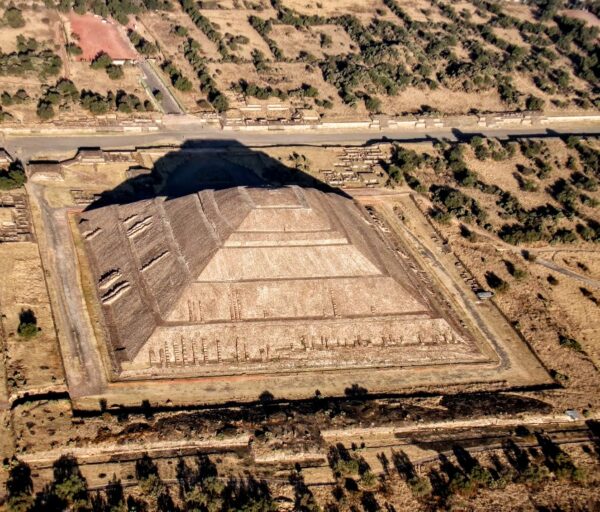
We don’t know with any certainty how the people who lived in here used this structure. The Mexica, who visited the site centuries after it was abandoned, gave it this name. The Mexica called the city, “the birthplace of the gods” and made regular pilgrimages there. They associated it with sun worship because of its massive size, central location along the Avenue of the Dead, and precise astronomical alignments to sunrises, sunsets, and to the nearby Cerro Gordo mountain.
Although differently shaped than the Pyramids at Giza, archaeologists consider this (and its companion the Pyramid of the Moon) as examples of Mesoamerican pyramids.
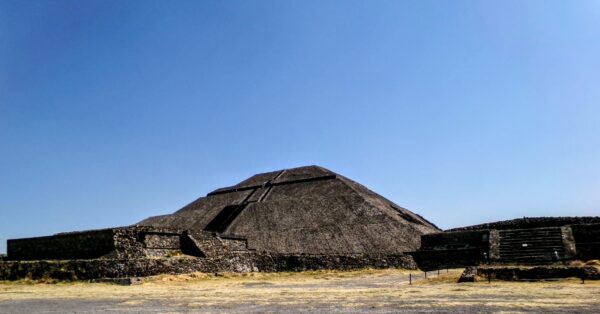
The Pyramids of Teotihuacán were built in multiple phases likely over decades or perhaps centuries. The initial phase started with bedrock excavation for stability and, in the case of the Sun, over a natural cave aligned to axes. The foundations integrated drainage systems and incrementally added massive fill – up to 35 million cubic feet for the Sun – primarily tezontle (porous red volcanic scoria).
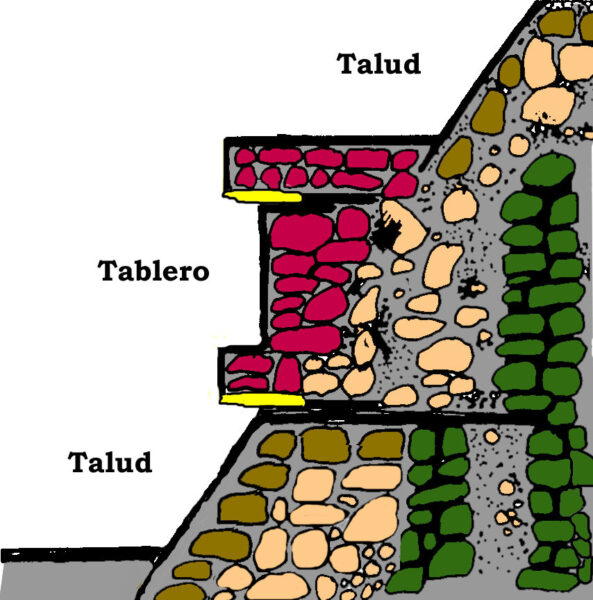
Unlike their Egyptian counterparts, the pyramids at Teotihuacán faced a threat from earthquakes. The ingenious indigenous stability solution was to build in the Talud-tablero method. A battered sloping base of stone or plaster called talud supported rectangular tablero panels. They repeated this pattern for both structural strength and visual aesthetics.
[From Wikipedia – By HJPD – Own work, CC BY-SA 3.0.]
Labor was organized communally, likely by rotating work parties from the city’s 100,000 plus residents. Workers quarried stone locally, shaped slabs with stone tools, and transported them using ramps, levers, and rollers.
Construction cells with retaining walls of adobe or tepetate (a hard cemented volcanic ash material common to the area) contained rubble fill. This prevented collapse during buildup. Basalt and andesite blocks were used for facings and stairs, with adobe bricks, mud mortar, and lime plaster added for smooth veneers. Volcanic tuff formed flooring bases that were then layered with crushed tepetate, clay, and plaster. Finally, wooden timbers reinforced interiors.
The Avenue of the Dead
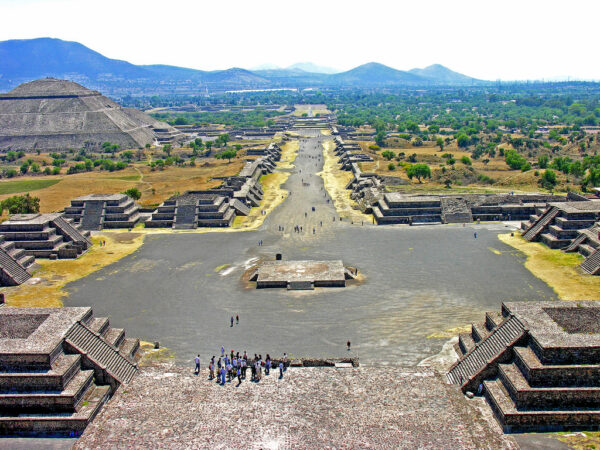
This is the central thoroughfare of Teotihuacán seen from the top of the Pyramid of the Moon.
[From World History Encyclopedia]
Once again it is the Mexica who provide us this name. As it was with the Pyramids, the name of the road emanates from their spiritual mythology that envisioned the abandoned city as the “birthplace of the gods.” Though no archaeological evidence confirms burials under the street, it was in this place that they believed certain deities sacrificed themselves to create the sun and moon. They viewed it as a sacred path imagining its platforms and temples possibly serving as tombs or leading to divine realms.
The Fifth Sun and the story of the gods
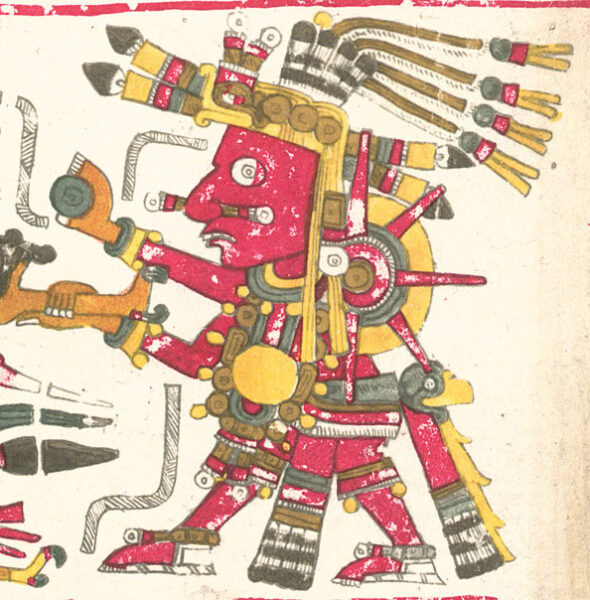
The Mexica viewed themselves as living in the Fifth Sun. After the destruction of four previous suns (worlds), the gods convened in darkness at Teotihuacán to form a new era. But this act of creation required and act of sacrifice. At first, none of the gods volunteered because it required leaping into a massive hearth fire.
In time, the god Nanahuatzin – whose name means covered with sores – and who is admired for his bravery and poverty and is closely associated with humility and self-sacrifice – jumped into the flames and emerged as the radian sun called Tonatiuh.
[From World History Encyclopedia]
His sacrifice shamed the proud god Tecuciztecatl who followed him and became a second equally bright celestial body. The other gods threw a rabbit at Tecuciztecatl’s face dimming his light and transforming him into the moon. They then sacrificed their blood or hearts to propel the sun’s motion while mandating human offerings to sustain the Fifth Sun against earthquakes.
Understanding this Mexica story of creation is a way to unlock our understanding of their practice of human sacrifice that so shocked the Spanish when they encountered it at the Templo Mayor in Tenochtitlan. Rather than being a form of public punishment as the Spaniards thought, these were reenactments of their creation story and a form of protection from earthquakes.
Stone carvings excavated at Tenochtitlan depict these violent stories. Some feature people being dismembered or thrown from great heights. Subsequent discoveries of human remains show similar wounds suggesting a reenactment of these stories.
The Mexica believed that the fate of the world rested on what happened on the towering heights of their temples. According to Raúl Barrera, director of the National Institute of Anthropology and History’s Urban Archaeology Program they, “materialized their beliefs about creation, performing them at the Templo Mayor.” (We’ll have the opportunity to see some of the remains of the Templo Mayor when I return these posts to Monday’s visit to the Zócalo in CDMX.)
Before we had the opportunity to walk through the site and I took the ground level shots seen in this photo album, we were able to view it from above. As promised, here’s a bit of our hot air balloon ride.
As I’ve noted, the Mexica visited this city centuries after it had been abandoned. However, in the Valley of México, when one city fell, another would eventually rise. And I’ll take a look at that in the next post.
-
Photos and their stories – Lisbon – Summer 2026 part two – plus an egg-straordinary bonus
August 21, 2026 -
Photos and their stories – Lisbon – Summer 2026 – part one
August 21, 2026 -
The indigenous people of Da?ow?aga? (Olympic Valley and me supplement three)
August 19, 2026 -
The indigenous people of Da?ow?aga? (Olympic Valley and me Supplement two)
August 17, 2026 -
Olympic Valley in the time before humans (Olympic Valley and Me Supplement one)
August 14, 2026
2 responses to “Mexico is different, like the travel folder says”
Entertaining as always Todd.
Up Up and Away in my BIG, beautiful balloon ride.
Your video won!
First time I’ve won something in years, amigo.
It was cool, though.