Notes on the XIX Olympiad – the quiet protest – (México City and Me addendum three)
Most Americans who followed the México City Olympics or the news at the time have visceral memories of Carlos and Smith’s silent Black Power protest and that I covered in the first of the “Notes” posts. Those same Americans likely have little or no memory of another silent protest made nine days later at the medal ceremonies for women’s gymnastics. It was subtler than that of Smith and Carlos but neither less dramatic nor less personally risky. The athlete who made her protest was Věra Čáslavská.
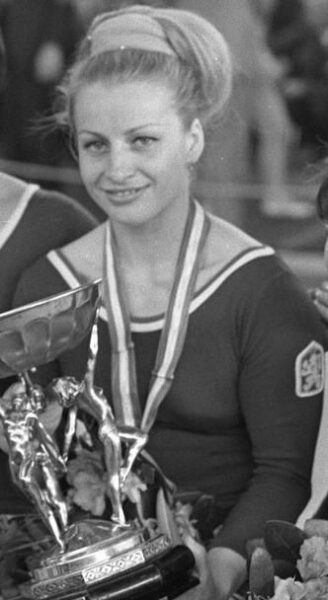
[From Czech Wikipedia By Nizozemský archiv, CC BY-SA 3.0.]
Why she did it
In January 1968, Alexander Dubček became the First Secretary of the Communist Party in Czechoslovakia effectively making him the country’s leader. Dubček assumed his leadership with a plan to govern through a policy he called “socialism with a human face” in a period known as the Prague Spring that I lightly covered in the post Turn around, bright eyes.
Čáslavská was among those who not only supported Dubček’s reforms, she was among those who signed the Two Thousand Words Manifesto that was published on 17 June. The document is alleged to have infuriated Soviet leader Leonid Brezhnev and was denounced by many Warsaw Pact hard-liners as counter-revolutionary. Despite increasing pressure, the Czechs refused to buckle. Then, on 20 August between 200,000 and 600,000 Soviet led Warsaw Pact troops accompanied by 20,000 tanks entered the country and occupied Prague within a day.
Simply the best
Like Tommie Smith, Věra Čáslavská was a superior athlete in her discipline. She won the gold medal in the floor exercise at the 1959 European Championships at age 17. It was the first of 14 individual gold medals she would win in World and European Championship competition before she “retired” after the 1968 Olympics.
She competed in two Olympic Games winning three gold medals in Tokyo in 1964 and added four to that in 1968 for a total of seven Olympic Gold medals for her career. (Her seven individual gold medals stood as the record for the most individual gold medals among all female athletes in Olympic history for 56 years. Swimmer Katie Ledecky surpassed her in 2024.) She’s one of only three female gymnasts, Soviet Larisa Latynina and American Simone Biles are the others, to win the all-around gold medal at two Olympics and, she remains the only gymnast, male or female, to have won an Olympic gold medal in each individual event.
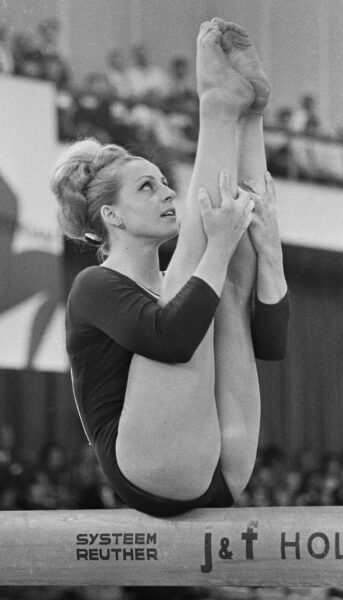
[From Wikipedia – By Kroon, Ron / Anefo – [1] Dutch National Archives, The Hague, Fotocollectie Algemeen Nederlands Persbureau CC BY-SA 3.0 nl.]
Before.
Čáslavská felt the ramifications of her political activism and support for the reforms of Alexander Dubček before the México City Games. It didn’t seem to matter that she was already a world renowned athlete with three Olympic and four World Championship gold medals to her name. It didn’t seem to matter that she was only one among tens or perhaps hundreds of thousands of Czechoslovaks who signed the Two Thousand Words Manifesto.
Sometime before the Soviet invasion, Čáslavská participated in an exchange program and one of the gymnasts who trained with her was Great Britain’s Mary Prestige (seen here watching her GB teammate Margaret Bell).
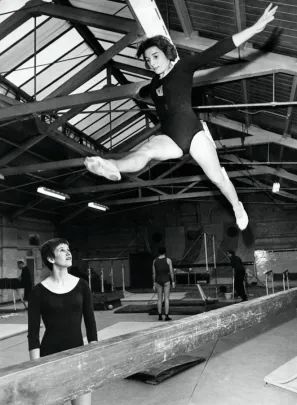
[From British Gymnewstics]
When the ‘Prague Spring’ reforms were halted by the Soviet led Warsaw Pact invasion at the end of August 1968, Čáslavská retreated to a remote forest hideout in the Šumperk mountain area nearly 250km from Prague because she feared arrest.
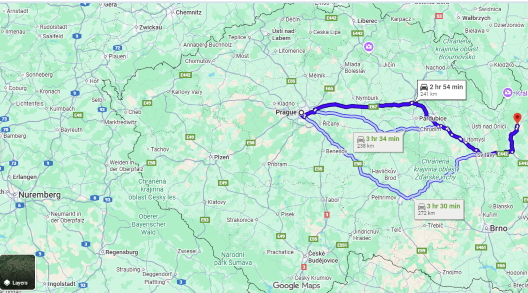
[From Google Maps]
Prestige later told the BBC, “Vera had to go into hiding. She was someone who had signed charters and been very active underground towards liberating the country, so she and others had to disappear for a while.” Note that her need to disappear happened less than two months prior to the scheduled start of the Games.
Čáslavská’s practices largely consisted of using a log as a makeshift balance beam, potato sacks in lieu of weight training, and shoveling coal to toughen up her hands for the stress of the uneven bars. She was also working on a strategic change to her floor exercise. Just a few weeks before the Games began on 12 October 1968, the Czech authorities granted her permission to rejoin the team.
During.
Despite (or perhaps because of) her Rocky IV style training,
the 26-year-old Čáslavská was ready to face down the Soviets. She stated her goal for the Games was to “sweat blood to defeat the invaders’ representatives.” And defeat them she did. At least in part.
In 1968, gymnastics, like figure skating, had a compulsory phase and an optional stage. In the compulsory phase, all the gymnasts performed the exact same routine with the judges focused on technical perfection, precision, and mastery of fundamental movements with a maximum score of 10.00. The all-around competition began with the compulsories on 21 October. At day’s end, Čáslavská had scored 38.85 and had a half-point lead on her two nearest competitors both from the USSR. Two days later in the optional phase, she scored 39.40 and her total score of 78.25 was 1.40 points better than that of silver medalist Zinaida Voronina.
Of course, her scores qualified her to compete for an individual medal on each apparatus.
The individual medal competition followed the standard Olympic order of vault, uneven bars, balance beam, and floor exercise. With a score of 19.775 on the vault, Čáslavská stood at the top of the podium – her gold medal draped around her neck as she listened to her country’s national anthem. She repeated her triumph on the uneven bars giving her a perfect three gold medals in three individual events. Then the controversies began.
When the judges posted her initial balance beam score of 9.65, the crowd in the arena erupted in howls of protest that continued for more than 10 minutes. The issue surrounded a deduction from her performance of a walkover forward to a needle scale that she finished with her hand underneath the beam. Two judges deducted one-tenth of a point and two deducted three-tenths. Eventually after the intervention of Superior Judge Valerie Nagy of Hungary, Čáslavská received a score of 9.80 but it was still only enough to earn her the silver medal with the gold going to Soviet gymnast Nataliya Kuchinskaya. At the medal ceremony, Čáslavská turned her head down and to the right during the Soviet national anthem. She told someone, “I longed to humiliate the Soviet flag and raise my humble nation, at least for a moment.”
She avoided the bold gestures of Smith and Carlos because the IOC had been so forceful in disciplining the Americans. “I didn’t want to lose the medal, our nation needed it,” she said.
The floor exercise concluded the competition and another judging controversy followed. Čáslavská had whipped the crowd into a frenzy by rechoreographing her floor routine and performing it to the Mexican Hat Dance and it initially appeared that she had won the gold outright. But that was not quite to be. This time, it was a Soviet gymnast who had her scores upgraded and Larisa Petrik received enough benefit that she tied Čáslavská for the gold medal. During the playing of the Soviet anthem, Čáslavská repeated her gesture from earlier that day.
After the Soviet anthem finished, the first bars of the Czechoslovak anthem began. The Soviet gymnasts turned their backs. The international press paid very little attention.
And after.
Čáslavská married Czech runner Josef Odlozil in México City and opted to retire from competition. So rather than the Czechoslovak NOC doling out the punishment, much as the USOC had delivered its ban of Tommie Smith, the task of punishing Čáslavská fell to the government. Despite her status as a seven-time Olympic gold medalist, the recently installed pro-Soviet Czech authorities wanting to quash any anti-government sentiment needed to make an example of her. Thus, on her return to Czechoslovakia, the government denied her access to training facilities, work opportunities, and travel rights and barred her from coaching or attending events. Through the seventies and eighties, she worked mainly as a cleaning woman.
The long moral arc of the universe once again bent toward justice when another political upheaval in 1989 brought a new government to power and lifted Vaclav Havel to the Czech presidency. Vera Čáslavská became one of his advisors and the rehabilitation of her reputation continued when she became head of the Czech Olympic Committee, and joined the IOC as a member until 2001.
In that same year (1989) IOC President Juan Antonio Samaranch presented her with the Olympic Order – an award honoring those who exemplify Olympic ideals through exceptional achievements in sport or significant service to the Olympic Movement. The United Nations presented her its Pierre de Coubertin Prize for promoting fair play.
-
Photos and their stories – Lisbon – Summer 2026 part two – plus an egg-straordinary bonus
August 21, 2026 -
Photos and their stories – Lisbon – Summer 2026 – part one
August 21, 2026 -
The indigenous people of Da?ow?aga? (Olympic Valley and me supplement three)
August 19, 2026 -
The indigenous people of Da?ow?aga? (Olympic Valley and me Supplement two)
August 17, 2026 -
Olympic Valley in the time before humans (Olympic Valley and Me Supplement one)
August 14, 2026