Brussels – Go up far enough to come down
People occasionally ask me how I deal with the rapid time shift commonly called jet lag and my answer is simple. I power through. By this I mean I do nothing anticipatory – no melatonin or ashwagandha or making gradual changes to my normal sleep pattern. I might doze on the flight but rarely sleep deeply. Since the typical overnight flight to Europe arrives between 07:00 and 10:00 with a five to six hour time difference to the east coast of the US it means that on arrival my body is operating as though it’s early afternoon and supper at, say, 18:00 local time will feel like supper at 23:00. I disregard this and continue fighting the urge to sleep until the local time reaches 22:00 or later. This approach might not work for everyone and it’s gotten a bit harder as I’ve aged but it works for me and I’ll continue the practice until I no longer can.
Thus, after depositing my meager luggage in the Airstream, I took a deep breath, tried to set my mind into power through it mode, and set off to soodle through Brussels. I was armed with a tourist map provided by the hotel, the navigation apps on my phone, and my trusty list of Atlas Obscura’s odd and interesting sites.
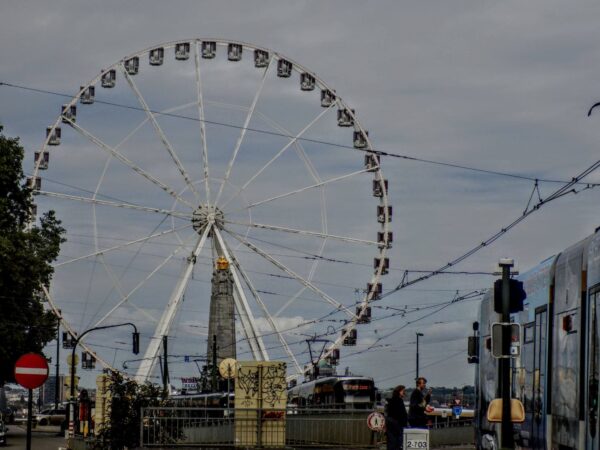
Mister Hat eschews The View
The Ferris Wheel made its debut in 1893 at Chicago’s World’s Columbian Exhibition.
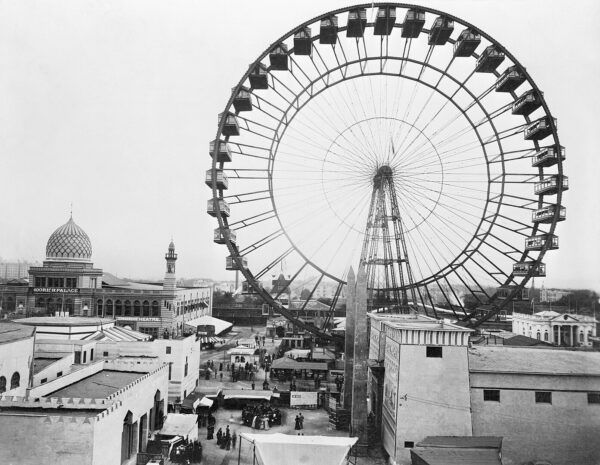
[From Wikipedia – Public Domain]
At just over 70 meters tall it was considered an engineering marvel. Two cities soon erected wheels that exceeded the original’s height. In 1895, London had a wheel that rose to 84 meters. Not to be outdone, Paris built an 86 meter tall wheel for its 1900 Exposition Universelle that coincided with that year’s Olympic Games. But Paris dismantled its wheel in 1920 and, while Ferris Wheels remained a staple of carnivals and, to a lesser degree, amusement parks, for most of the 20th century it was a fading attraction.
But things changed on 31 December 1999 with the opening of the London Eye.
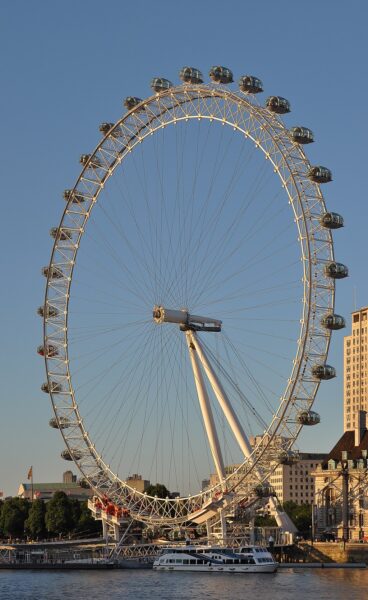
[From Wikimedia Commons by Bob Collowan, CC BY-SA 3.0]
It featured a cantilevered design supported only on one side by an A-frame structure, 32 egg-shaped capsules externally mounted on the wheel’s rim so views are never blocked, floors designed to rotate independently to keep the floor level as the wheel turns, and a then world-record height of 135 meters. It became a major tourist attraction for the city.
The success of the London Eye sparked a resurgence and Ferris Wheels began popping up all over the world beginning in 2001 with the 117 meter tall Diamond and Flower Ferris Wheel in Tokyo. In 2006, the Star of Nanchang bettered the London Eye by 25 meters. Its record didn’t last very long, though. Singapore opened a 165-meter tall wheel in 2008 called the Singapore Flyer. Then in 2014, in perhaps the world’s most flamboyant city, Las Vegas’ High Roller took the title as world’s tallest – a record it held until 2021 when the current record holder, the Ain Dubai
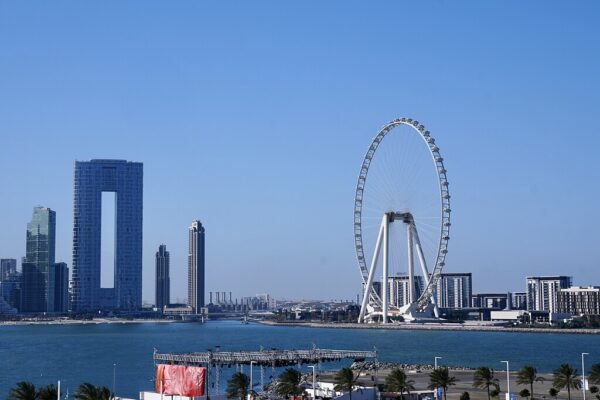
[From Wikimedia Commons By Richard N Horne, CC BY-SA 4.0]
opened to the public.
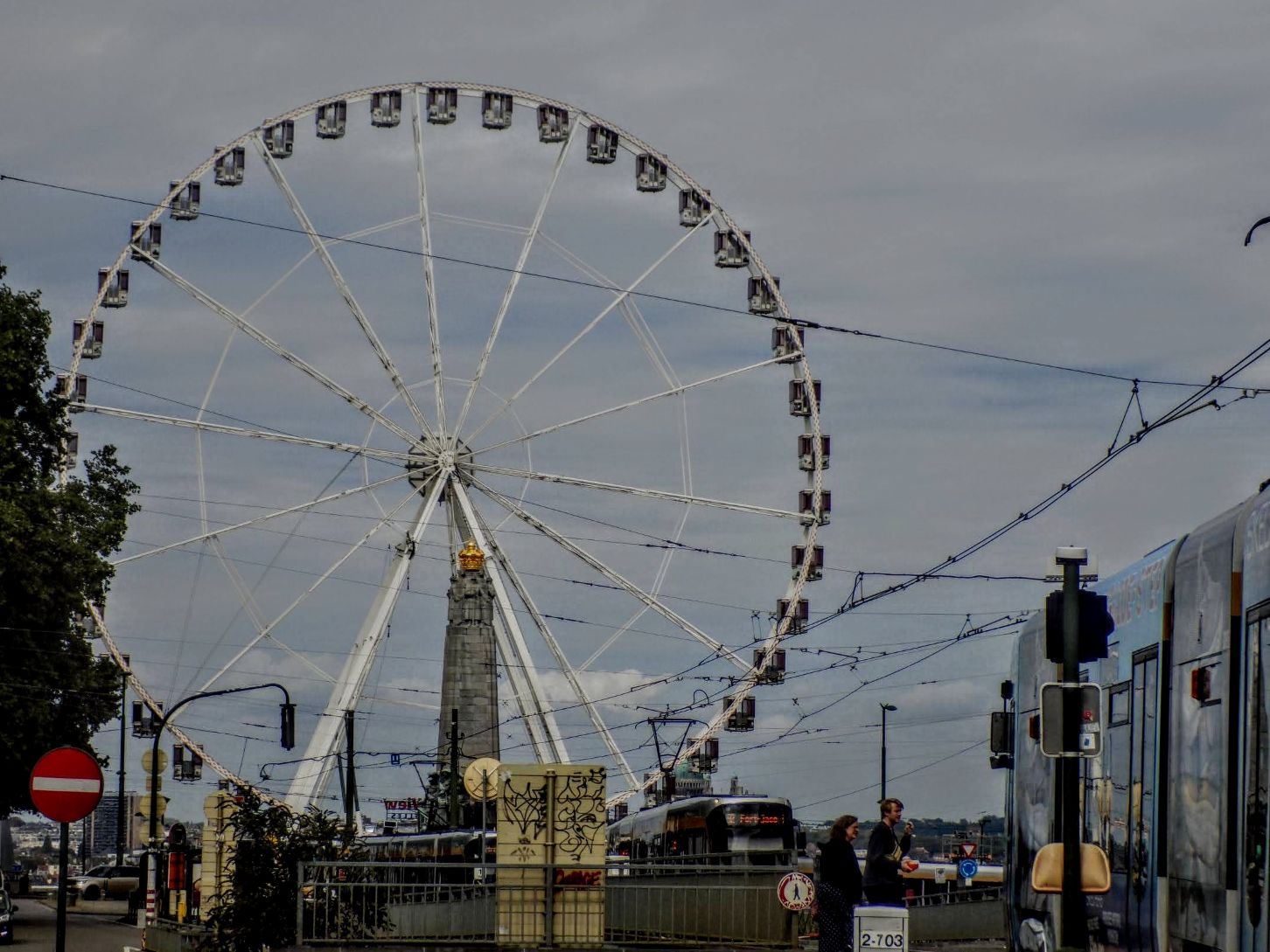
So why all this talk of Ferris Wheels? Although it’s not on this list, Brussels has a large wheel of its own. It’s called The View and, I set out for it because I misunderstood something L told me. Still, it’s located on the Grande Roue Place Poelaert and was a short 750 meter walk and a nice vantage point to look out to a part of the city I’d soon be traversing. With a height of 55 meters it’s about the same size as the Capital Wheel located a bit less than 20km from the center of Washington, DC.
Towers but no inferno
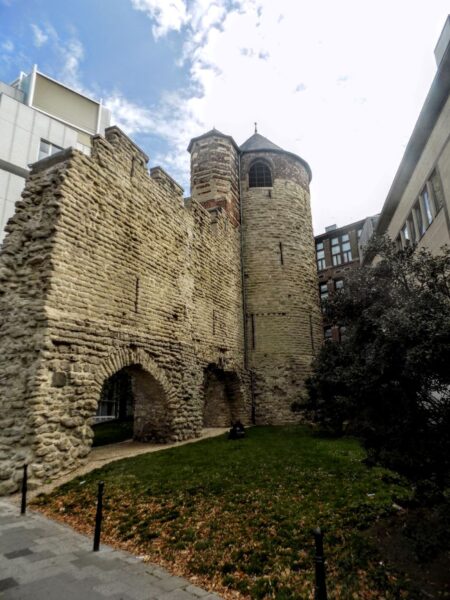
Brussels has made a curious choice to preserve certain elements of its history. Or, at least it seems curious to me. According to the website Visit Brussels, the city’s first wall, built early in the 13th century was more than 4km long and had more than 50 towers. At least three remain prominently visible in the city – the Black Tower, the Angle or Anneessens Tower, and the Villiers or Saint James Tower. I’d manage two of them on my walk. Closest to me was Anneessenstoren so I made that my next stop.
I’d visit the Black Tower
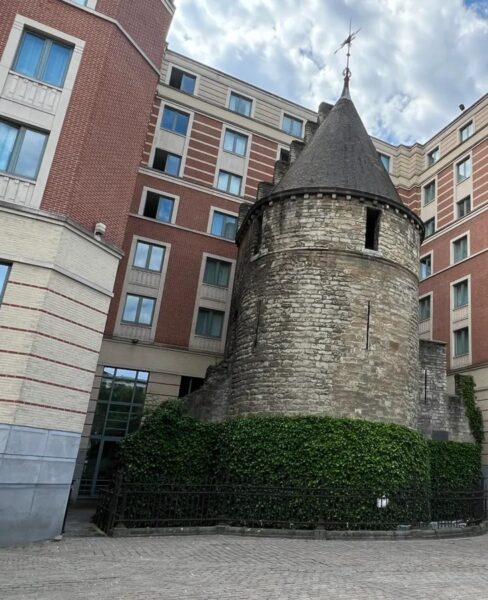
later in the day. The aspect I found curious was that unlike the fragments of the wall built in Paris by Philippe II where one needs to do more than merely gongoozle to notice them, the medieval towers in Brussels are prominent and hard to miss. On the other hand, looking at the Black Tower, one can see why Atlas Obscura describes it as, “an appealing antique oddity” and “a true hidden medieval treasure, right in the middle of the modern city.”
Men of La Mancha
Some of my readers might not know this but 16 January 1605 is one of the most important days in the history of Western literature. This was the date in Madrid that saw the publication of the first part of El Ingenioso Hildago Don Quixote de la Mancha or, as we refer to it today, Don Quixote. Most scholars cite the Miguel de Cervantes epic as the first modern novel and as recently as 2002, in a poll of international authors, it was cited as, “the best piece of fiction ever produced.” Notably, in 1607, Brussels became the location of the first publication of Don Quixote outside the Iberian Peninsula.
In 1989, Spain assumed the rotating presidency of the European Union. Since Brussels is considered the de facto capital of the EU, (it hosts several core EU institutions including the European Commission and the Council of the European Union), Spain’s capital Madrid, presented Brussels with a statue of Don Quixote and his squire Sancho Panza. (It’s a replica of Madrid’s monument that was created by the Spanish sculptor Lorenzo Coullaut Valera in 1929.) Brussels installed it in the Place d’Espagne.
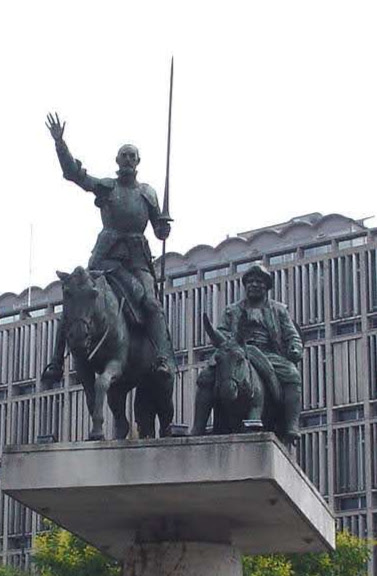
(Please don’t believe the oft cited report that Shakespeare and Cervantes died on the same day. It’s possible that they died on the same date – 23 April 1616 – though some reports note Cervantes’ death as happening on the 22nd. However, while Spain adopted the Gregorian calendar in 1582, it would take England nearly two centuries to move from the Julian to the Gregorian calendar. Had England been using the Gregorian calendar Shakespeare’s death would have been recorded as 4 May 1616.)
Pissing away the afternoon
While there’s certainly a lot to see and do in Brussels, I think it would be an egregious oversight for any first time tourist to not seek out at least two of the trio of ‘pis statues’ – Mannekin-Pis, Jeanneke-Pis and Zinneke-Pis. The first is the most prominent and sought after, the second is a little more remote but serves a higher purpose, and the third is the only one not passing water. No one is certain why this particular statue has gained such renown among the plethora of European pissing statues but this particular little peeing boy is nearly perpetually surrounded by tourists.
According to Atlas Obscura,
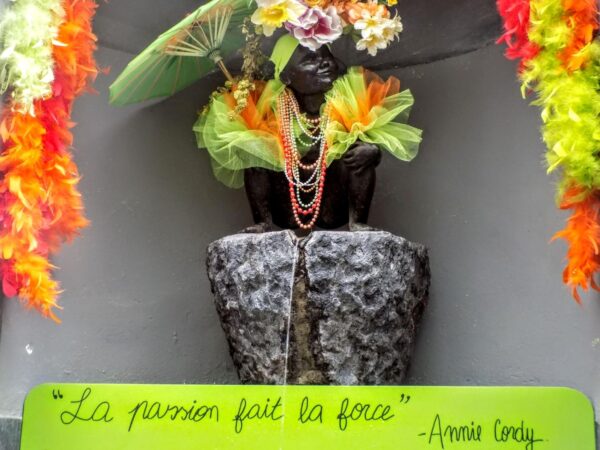
The statue gets dressed in tiny costumes several times each week in one of around 1,000 different costumes. A society called Friends of Manneken Pis takes care of the costumes.
And nearby, there is, in fact, the Garderobe Mannekin Pis – sadly closed the day I visited. AO describes it as follows:
The statue’s wardrobe now contains around 1,000 outfits, with about 20 new costumes donated to the statue each year. This small museum near the fountain features a selection of this vast and varied wardrobe in a rotating display.
The day I visited the boy was dressed as a pediatric oncologist for Childhood Cancer Awareness Month.
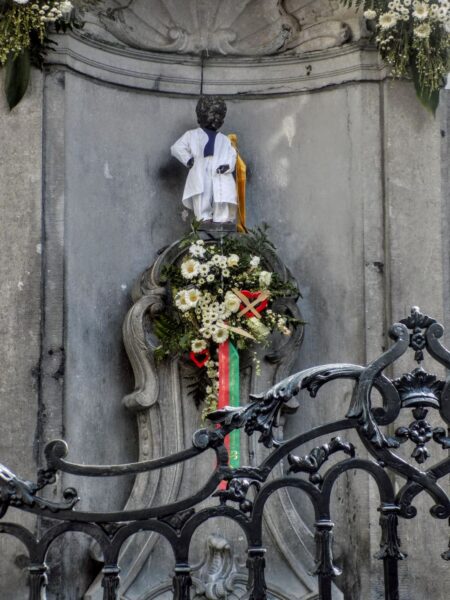
Coins tossed into the fountain where Jeanneke-Pis is relieving herself are used for medical research and to help the needy in Belgium.
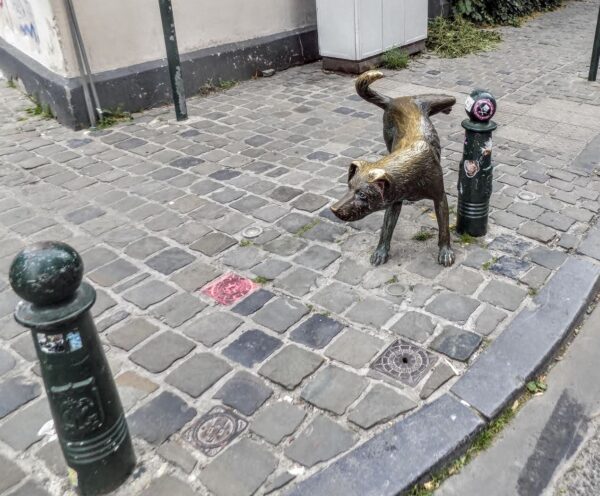
As for Zinneke, well, his unclothed and dry statue takes a little effort to find but I needed to complete the trifecta.
Mr Hat meets Mrs Hat
My final mission for the day was finding the statue of Mrs Hat. Here’s her AO description:
Amélie Van Beneden, nicknamed Madame Chapeau or “Mrs. Hat,” is a supporting character in the play Bossemans et Coppenolle, which was written by Joris d’Hanswyck and Paul Van Stalleand, and first staged in 1938. Traditionally portrayed by a male actor, the elderly lady is written as a representation of zwanze, the self-deprecative sense of humor typical in the Brusselian way of life, and speaks in the near-extinct, Francizied dialect of Dutch known as Brusseleer.
I’ve long been known in the environs of Maryland athletics as The Hat, but adopted the moniker Mr Hat after receiving a lovely note from a Maryland softball player addressed to Mr Hat. Once I learned that the somewhat anachronistic Mrs Hat had a statue in Brussels, getting a photo with her became mandatory.
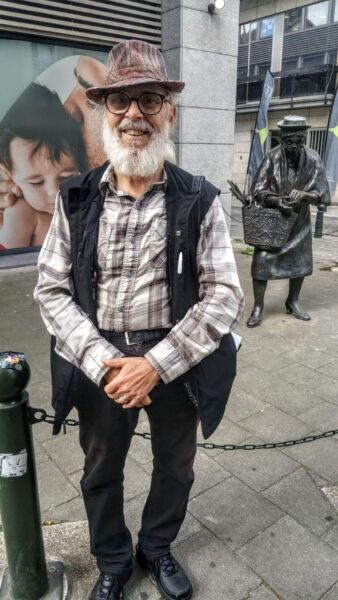
You can see the rest of the day’s photos including some from Brussels’ famous comic strip murals and my moules frites supper by clicking here.
Tomorrow, I’ll visit Antwerp.
-
Photos and their stories – Lisbon – Summer 2026 part two – plus an egg-straordinary bonus
August 21, 2026 -
Photos and their stories – Lisbon – Summer 2026 – part one
August 21, 2026 -

The indigenous people of Da?ow?aga? (Olympic Valley and me supplement three)
August 19, 2026 -
The indigenous people of Da?ow?aga? (Olympic Valley and me Supplement two)
August 17, 2026 -
Olympic Valley in the time before humans (Olympic Valley and Me Supplement one)
August 14, 2026
4 responses to “Brussels – Go up far enough to come down”
Mrs. Hat appears to be giving you the cold shoulder…..😟
Well, there was the small matter of a restraining order 🤷
Jeez man, that thing even follows you when you go across the pond? 😜😘
Are you not familiar with Interpol? 🤨