Notes on the XVI Olympiad (Melbourne and Me addendum one)
The unique Games.
Helsinki, Finland, the host city for the 15th Olympiad in 1952 is the northernmost city to host the Summer Games. Three years earlier in 1949, on the fourth round of balloting, the International Olympic Committee (IOC) awarded the 1956 games to Melbourne, Australia by a single vote over Buenos Aires. Melbourne became the first host city in the Southern Hemisphere where it remains the southernmost Olympics host city.
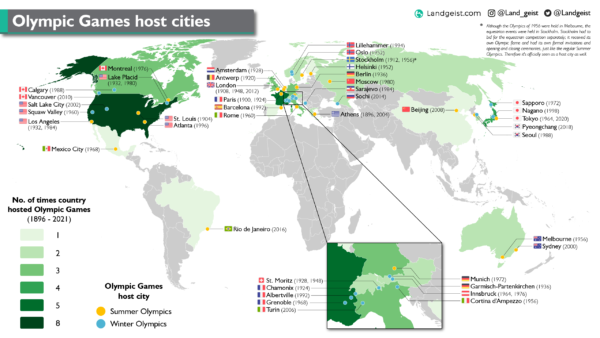
[Map from Landgeist].
These Games hold another unique distinction: They are the only Olympic Games held on different continents and in different seasons. As I noted in my post about the Stockholm Games, “At the time, Australia had a strict six-month pre-shipment quarantine on horses and as early as 1953 Australian federal authorities ruled that they wouldn’t change the quarantine laws for the Olympic horses… in 1954, the IOC selected Stockholm as the alternate venue for the equestrian competition.” That competition which, ironically enough, included a team from Australia, was held from 10 to 17 June 1956. Because the Southern Hemisphere’s summer begins in December, the rest of the competition took place between the 21st of November and the 8th of December.
By the numbers.
The Olympic Torch relay began its Australian journey in the northern city of Cairns – where it is celebrated by this monument. It traveled 4,600 kilometers along a somewhat circuitous route with each torchbearer carrying it a single kilometer in less than seven minutes on a non-stop two-week journey.
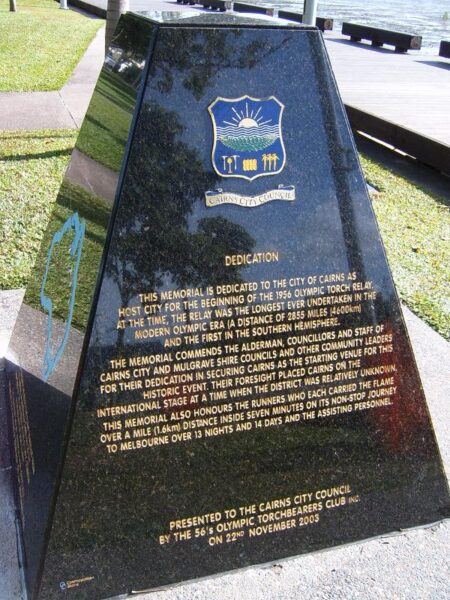
[From Wikipedia By Peter Ellis at the English language Wikipedia, CC BY-SA 3.0].
Ron Clarke, who would win the bronze medal in the 10,000 meter race in Tokyo in 1964, lit the flame at the Melbourne Cricket Ground.
Seventy-two countries sent a total of 3,314 athletes (376 women and 2938 men) who competed in 151 events. The Federal Republic of Germany (West) and German Democratic Republic (East) competed as the United Team of Germany under a single black, red, and yellow flag bearing the Olympic Rings
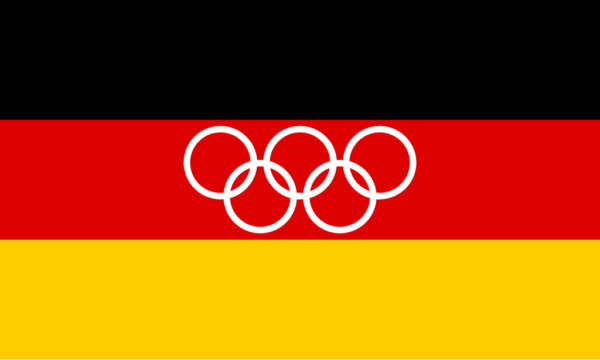
[Image from Wikipedia – Public Domain.]
and used Beethoven’s Ode to Joy in lieu of a national anthem. They continued this practice until 1968.
Seven countries boycotted the games. Three – Spain, Switzerland, and the Netherlands – did so in protest of the Soviet invasion of Hungary. Three others – Egypt, Lebanon, and Iraq – withdrew to protest Franco-British intervention in the Suez Canal crisis. Lastly, the People’s Republic of China refused to participate because it disapproved of the presence of the Republic of China (Taiwan).
The Soviet Union led all countries with 98 total medals 37 Gold / 29 Silver / 32 Bronze. The United States won 32 Gold / 25 Silver / 17 Bronze to finish second with 74 total medals. The host country Australia finished with the third highest total capturing 35 comprised of 13 Gold / 8 Silver / 14 Bronze.
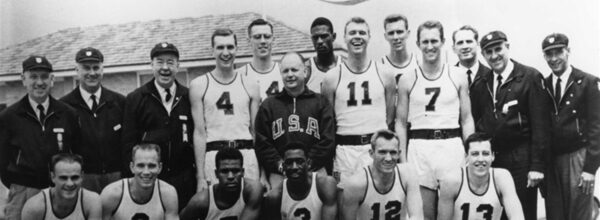
The United States basketball team coached by Gerald Tucker and comprised of all college players and led by Bill Russell and KC Jones won its eight games by a collective score of 793-365.
[From FIBA Basketball]
Its closest game was an 85-55 win over the USSR in the quarterfinal round.
Other notable performances.
Texan Bobby Morrow became the first Olympian since Jesse Owens in 1936 to complete the sprint triple by winning gold in the 100 meters, 2oo meters and 4×100 relay.
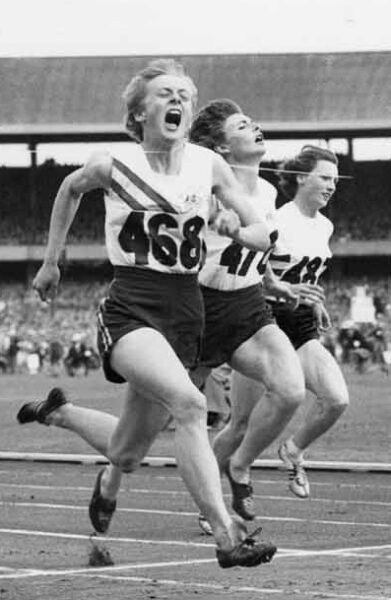
Nicknamed the Golden Girl, Betty Cuthbert, an 18-year old Australian from Sydney matched Morrow’s sprint triple overtaking the relay team from Great Britain on the anchor leg.
[From Wikipedia By Tidningarnas Telegrambyrå]
With a throw of 56.36 meters, Al Oerter set an Olympic record in leading the U S to a podium sweep. Oerter would go on to win the event in 1960, 1964, and 1968 thereby becoming the first, and to date only, man to win gold in the same event across four consecutive Olympic Games.
Dawn Fraser started a streak of her own in the pool when she won the first of three consecutive gold medals in the 100 meters. She also claimed gold in the 4×100 meter freestyle relay and silver in the 400 meter freestyle.
Alain Mimoun of France won the marathon in the unremarkable time of 2:25:00. However, he stood at the finish line to greet his friend, longtime rival, and defending Olympic champion Emil Zatopek who finished sixth. The gesture is noteworthy because Mimoun had finished second to Zatopek in the 10,000 meter races in the two previous Olympics as well as finishing second in the 5,000 meters in Helsinki.
The survivor.
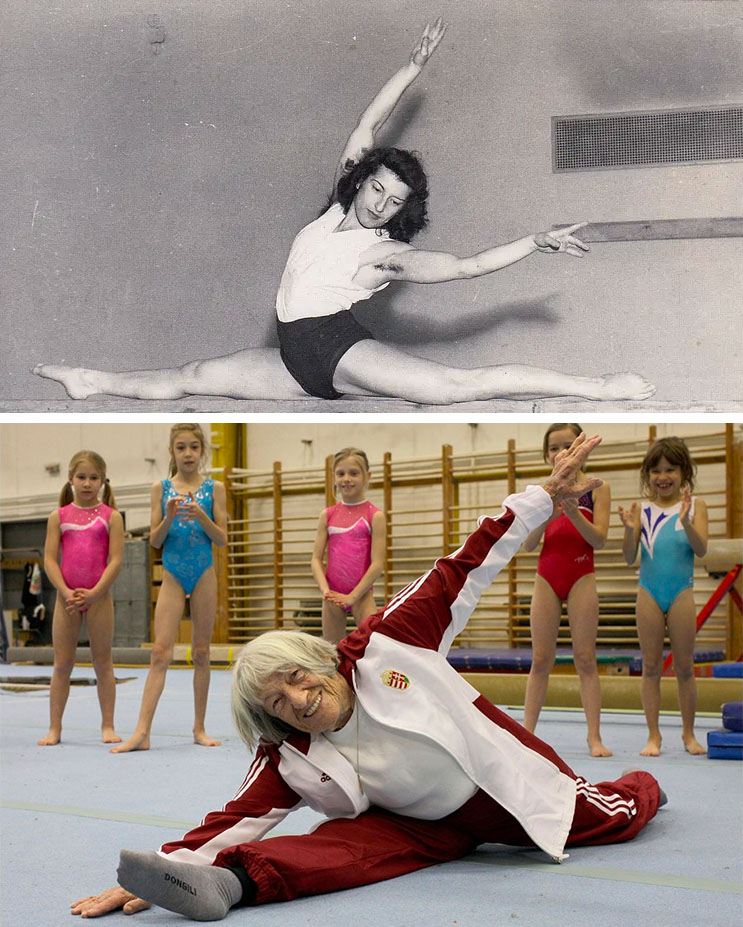
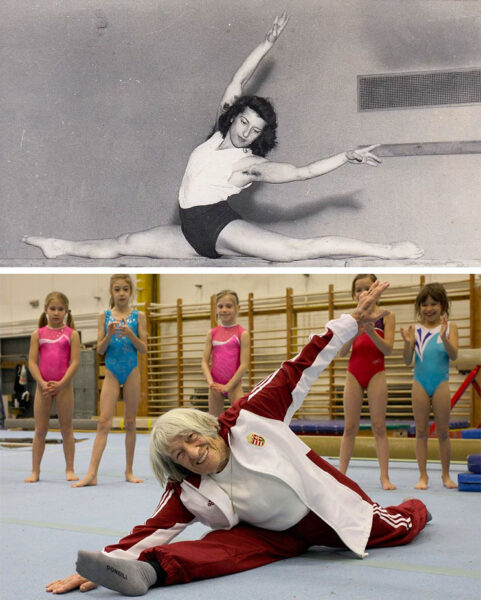
In Hungary her name would be Keleti Ágnes. In the west she’s known as Ágnes Keleti. She was born in Hungary in January 1921 and won a national championship in gymnastics in 1937 when she was 16 years old. She seemed a likely candidate to represent Hungary at the 1940 Olympics in Tokyo but World War II scuttled those plans and dreams. Keleti faced yet another challenge when she was expelled from her gymnastics club because she was Jewish.
In an interview some years later, she explained that she was able to buy the identity papers of a Christian girl and flee to the countryside where she found work as a maid and was able to survive the war. The famed Swedish diplomat Raoul Wallenberg was able to save her mother and sister but not her father and other family members who were among the 550,000 Hungarians murdered in one of the extermination camps.
She and her surviving family returned to Budapest and Ágnes began training again for the 1948 London Games but once she reached London, a ligament injury derailed her plans once again. But Ágnes loved gymnastics and, at age 31 represented Hungary at the Helsinki Games in 1952.
[From The Guardian]
But she did more than merely represent her homeland, she won four medals – one silver, two bronze, and a gold medal on the floor exercise.
But this wasn’t enough for her. Now 35, she returned to the games in Melbourne where, in the shadow of the Soviet invasion of Hungary barely a month earlier and competing against Larisa Latynina who would go on to win 18 medals, she surpassed her performance in Helsinki. Ágnes won four gold medals (three individual and one team) and two silver medals. Among Jewish athletes, only Mark Spitz with 11 has more Olympic medals than Keleti Ágnes. As I write this, Ágnes remains active at 103 years old.
-
Photos and their stories – Lisbon – Summer 2026 part two – plus an egg-straordinary bonus
August 21, 2026 -
Photos and their stories – Lisbon – Summer 2026 – part one
August 21, 2026 -
The indigenous people of Da?ow?aga? (Olympic Valley and me supplement three)
August 19, 2026 -
The indigenous people of Da?ow?aga? (Olympic Valley and me Supplement two)
August 17, 2026 -
Olympic Valley in the time before humans (Olympic Valley and Me Supplement one)
August 14, 2026