And then I’ll fly, so high across the sky – Tirana to Frankfurt
One unintended consequence of my transition to exclusively flying first class on long flights is that I’m inclined to arrive at my departing airport considerably earlier than is necessary. If I pass through security with sufficient ease, I can customarily spend the additional time in the airline’s lounge and that’s typically a pleasant experience.
I opted to return to the airport using the same bus company I’d used on my arrival.
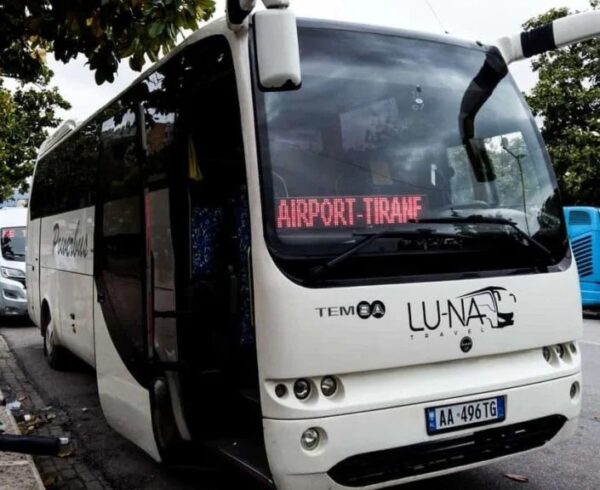
However, with my limited experience of Tirana traffic (twice jammed and once flowing), no experience of departing from Tirana International Airport Nënë Tereza, and adding a check-in line to the usual security and immigration lines, I made the very cautious choice of planning to arrive at the airport early – nearly four hours before my scheduled departure as it turned out. (I couldn’t check-in online – likely because my flight was on Lufthansa – an airline that’s not a Delta partner – and because my flight wasfrom outside Schengen to inside it.)
The traffic was manageable so I didn’t encounter the first congestion point until I reached the check-in desk. There, I learned that Lufthansa wouldn’t allow check-in until three hours before departure and there was already a small crowd milling about. When the time came, they initially only opened one position. Of course, there was no real line but whatever line I thought I might be in I was behind a woman – obviously a group tour leader – who was checking in a group of travelers. After about 15 minutes of chaos, Lufthansa opened a second position. For some incomprehensible reason, the man who slid in front of me somehow needed more than six minutes to complete his check-in – a process that took me two minutes.
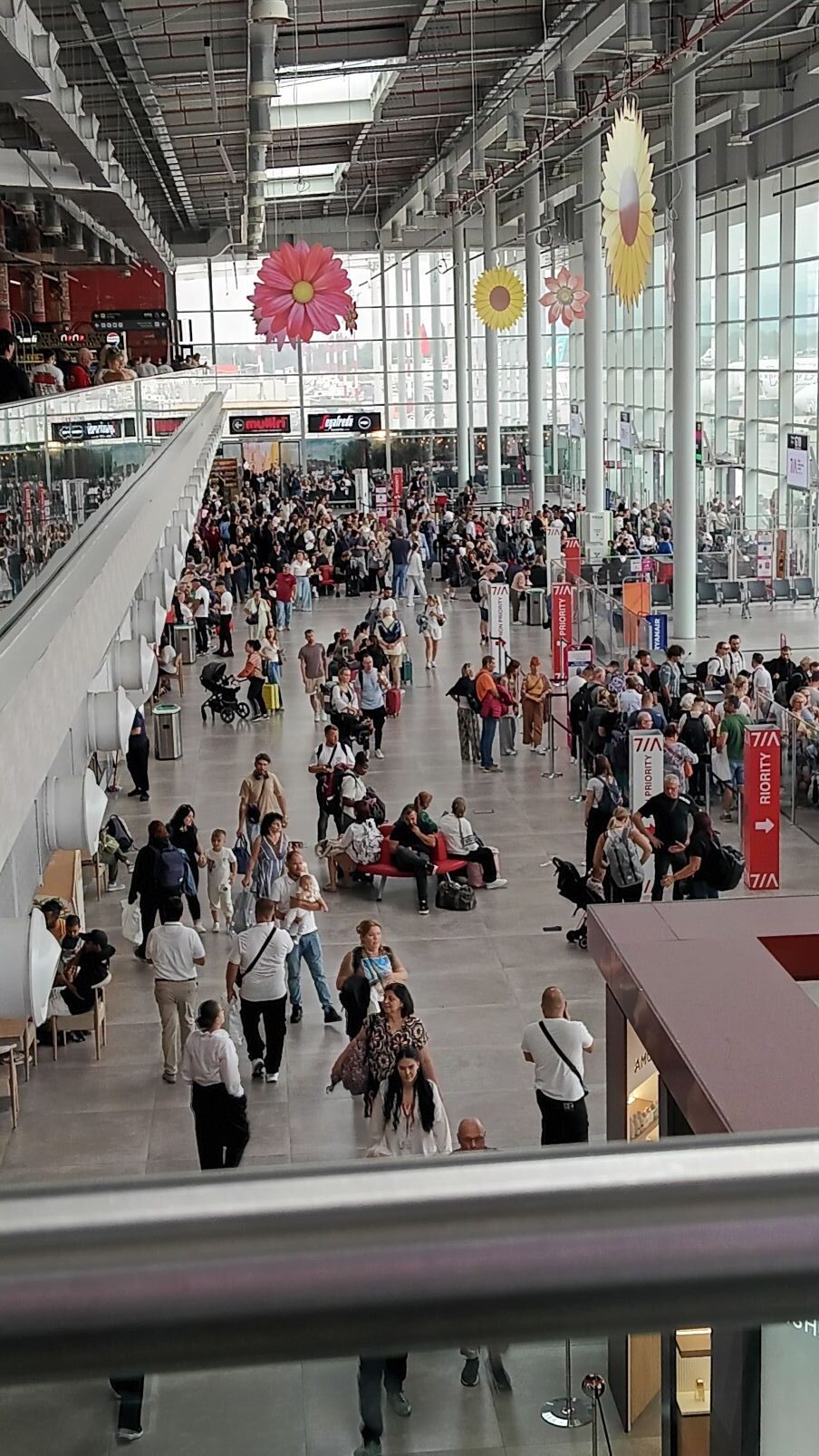
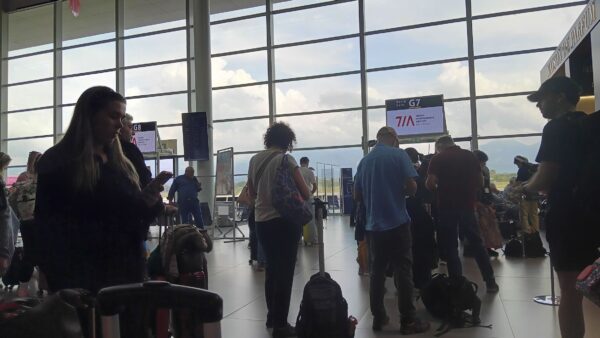
Fortunately (or perhaps unfortunately), after the check-in confusion, Murphy’s Law operated in reverse and clearing security and immigration couldn’t have proceeded more smoothly. This left me with lots of time to kill. Looking at this scene once I reached the terminal,
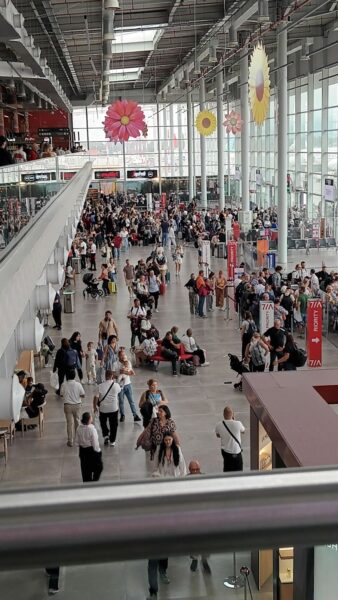
made the chaos at check-in more understandable.
I paced the terminal for about half an hour (gotta get those steps in!) and decided it was time for lunch. I’d had a nice breakfast at the hotel in Tirana. The hotel restaurant was across the street from the hotel itself but they prepared me a freshly made omelet. However, assuming my flight would be on time it would be well after 16:00 when I arrived in Frankfurt and, adding time to find my way into the city from the airport made having another meal important. The food definitely had “airport pricing.” I don’t recall the cost of my sandwich and fries but I did note that the same can of soda that I could buy for 100 lek in Tirana cost 330 lek at the airport.
Tirana Airport doesn’t use jetways
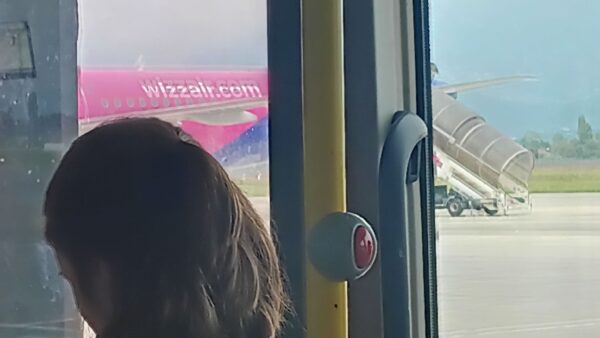
(Sorry for the blur. When I saw this I thought this company should be registered as “Wizzair dot oz.”)
and in most instances passengers ride buses to their planes. Still, that doesn’t prevent a pre-boarding infestation of “gate lice.”
What I know about Frankfurt
Although I’d ridden a train across a few hundred kilometers of German countryside and spent a night in a hotel near the airport, I couldn’t bring myself to count that as having visited Germany even by my rather loose definition of visiting a country or a state for that matter. Having scheduled my return to the US through Frankfurt-am-Main, I decided I should spend at least a day there.
Of course, ever the pedant, I did more than simply look for some sights on Atlas Obscura and determining where to stay. Before I get cooking on a short general history of the city, I’ll answer the question that I suspect is foremost in your mind. Yes, the sausage we Americans call a hot dog, or more to this point, a frankfurter, traces its roots to the city of Frankfurt.
Come to the city today and if you purchase a Frankfurter Würstchen,
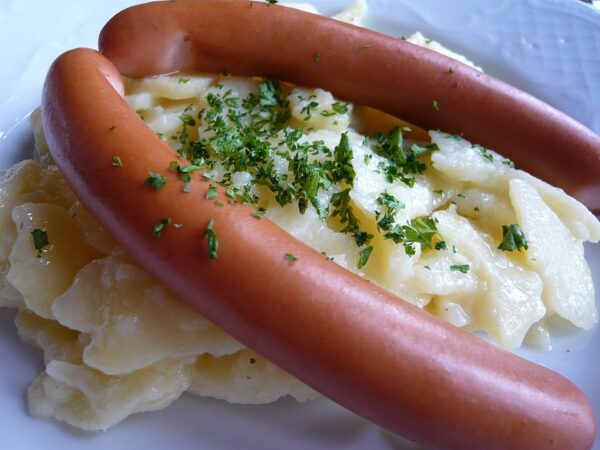
[From Wikipedia – By WordRidden / Jessica Spengler, CC BY 2.0]
you are guaranteed that it was produced, if not in the city, then in Neu-Isenburg or Dreieich. And it’s been around for a long time. The first written reference to this boiled sausage appears in the mid-fifteenth century. It’s held protected geographical status in Germany since 1860 and, since 1929, the term can only be used to apply to sausages produced in the area.
German immigrants brought this boiled sausage to the United States in the 19th century. By the late 1800s vendors were serving them in buns at places like Coney Island and at baseball games. In the US, people applied nicknames such as dachshund sausages, hot dog, and frankfurter to the sausage. The last two stuck and became interchangeable although there are slight differences between them. Traditional frankfurters use pork in a natural (usually lamb) casing, while American hot dogs often mix meats and use artificial casings.
It was advertising that helped keep the nickname around. Brands like Ball Park and Hebrew National used “franks” in their marketing in the mid-20th century. This cemented the term in everyday use. If your tailgate is the right size, it might feature seven dozen franks and a firkin or homerkin of beer.
Flumadiddle Frankfurt facts? You decide.
There’s a small hill in the area near Domplatz (marked by the pin on the Bing Maps screenshot)
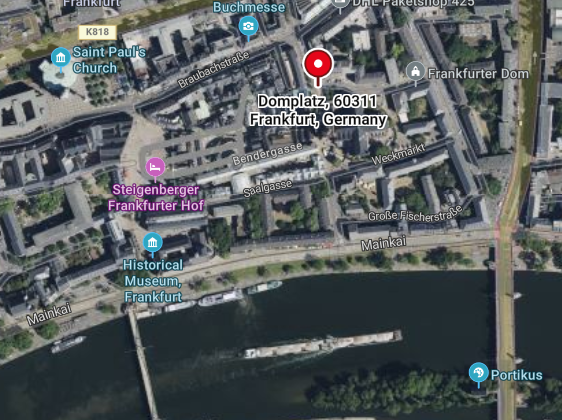
and archaeological evidence indicates that this is where the first humans settled and have had some sort of presence near this part of the Main River for about 5,000 years. Frankish tribes moved into the area in the middle of the third century after the fall of the Roman Empire. Their presence and use of the ford there provided the city its name – Ford of the Franks – that first appeared as Franconofurt in late 8th century Carolingian documents.
Under Charlemagne and his successors, Frankfurt became an important royal residence and assembly place, with a royal palace (Pfalz) and church councils held there. After the Treaty of Verdun in 843, it effectively served as a principal seat of East Francia. Louis the Pious and later Carolingian rulers expanded fortifications and palatial buildings thereby beginning its evolution from a fortified royal site into a more substantial town.
In the High and Late Middle Ages, Frankfurt became commercially prosperous and held the status of a free imperial city. Thus, it was subject directly to the Holy Roman Emperor rather than to territorial princes. The Golden Bull of 1356 designated Frankfurt as the permanent city for electing German kings (Holy Roman Emperors‑elect).
This ceremonial significance contributed to its growth and by the 14th century, Frankfurt had city walls protecting its imperial representatives as well as its expanding markets.
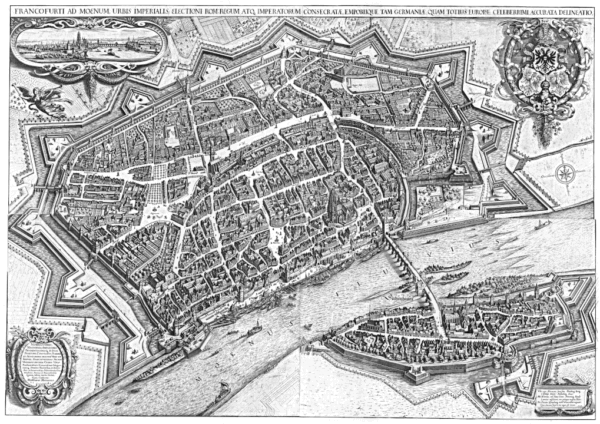
[From Wikipedia – Public Domain]
The walls didn’t protect against Napoleon’s expansion of his empire in the early 19th century, however, and he reduced Frankfurt’s status by making it part of the Grand Duchy of Frankfurt. After Napoleon’s fall, the Congress of Vienna restored Frankfurt as a free city in 1815 and made it the seat of the German Confederation’s federal institutions.
Prussia’s victory in the Austro‑Prussian War of 1866 led to the annexation of Frankfurt again ending its independence as a free city. It was incorporated into the Prussian province of Hesse‑Nassau and later became part of the unified German Empire proclaimed in 1871.
In the early 20th century, Frankfurt developed as a major banking and transport center making it a prime target in the Second World War. Wartime Allied bombing destroyed much of Frankfurt’s historic old town, including many medieval buildings
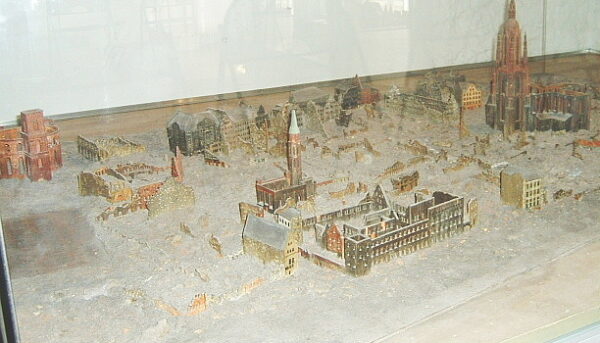
[From Wikipedia – Model in the Frankfurt History Museum CC BY-SA 3.0]
but post‑1945 reconstruction restored many key historic structures to their medieval appearance though often using modern architectural techniques. I expected Frankfurt to present an interesting combination of modern and medieval. Would it be so? I’ll find out tomorrow.
Now back to our regular programming
I made my way to the train station and after some confusion about which ticket to purchase and which train to ride (a downside to having everything automated with no people to help), I managed to board the right train to Frankfurt Central Station. From there it was less than a kilometer walk to the hotel that, although a part of the Marriott family, is, like the Ramel Hotel in Tirana, centrally located but on a quiet side street.
Perhaps I’d felt a little stress from the day or perhaps I was simply worn down by two days of travel but I opted to have supper at a Vietnamese restaurant called Sen that was barely 100m from the hotel. After supper, I went straight back to the hotel and collapsed into bed.
-
Olympic (Squaw) Valley and Me – part one
August 3, 2026 -
Here are the songs from the México City and México City Olympics posts
May 18, 2026 -
Notes on the XIX Olympiad – the quiet protest – (México City and Me addendum three)
May 18, 2026 -
Notes on the XIX Olympiad – Successes, failures, and a Flop – (México City and Me addendum two)
May 15, 2026 -
Notes on the XIX Olympiad – Understanding Carlos and Smith – (México City and Me addendum one)
May 13, 2026