Walking on the big stuff – a climb to Tragjas
We gathered at the hotel for a short bus ride to the path that would take us to the old village of Tragjas described in the itinerary as a place,
where time has stood still since the area was bombed during World War II. From the ruins of the old village, a family has created a farm that utilizes traditional and sustainable farming practices. Learn how they coexist alongside animals such as grey wolves, jackals, birds of prey and bee-eaters.
Our hike had, at least for me, a promising start.
It wouldn’t stay this way for long.
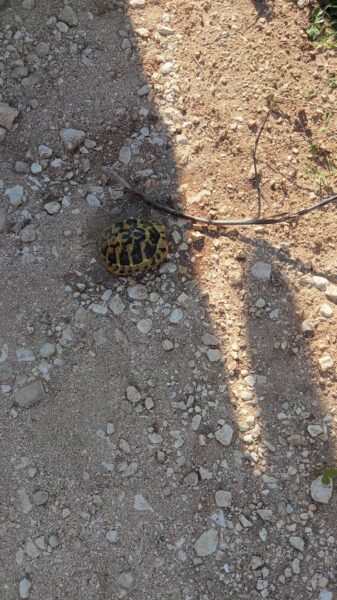
Still, I sensed it would be significantly more manageable than the Shala River hike. (This second video was shot within minutes of the first.) Even though the path was no longer paved, it did hold one additional – and pleasant surprise – my first live turtle of the trip.
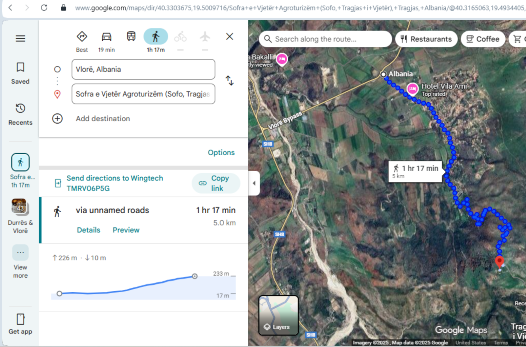
As nearly as I can judge this screenshot from Google Maps estimates our route. I know the end point is correct but am uncertain of the starting location.
We certainly skirted the main village where we could have seen the remnants of the castle built by Gjon Boçari in the 15th century – more or less concurrently with the resistance led by Skanderbeg. I didn’t mind because I’d seen enough of them and and was fairly certain still more awaited. It’s noteworthy, however, that the village had taken part in a revolt against Ottoman rule that began in 1432 and pre-dated Skanderbeg’s insurrection. On the other hand, since we know that the Ottomans controlled Albania for five centuries, we’ll skip ahead to the
Second World War.
First, you need to recall that Mussolini’s fascist Italian government established Albania as an Italian Protectorate when they deposed Zog 1 and he fled the country. For many Albanians, this is the point they consider the beginning of World War II.
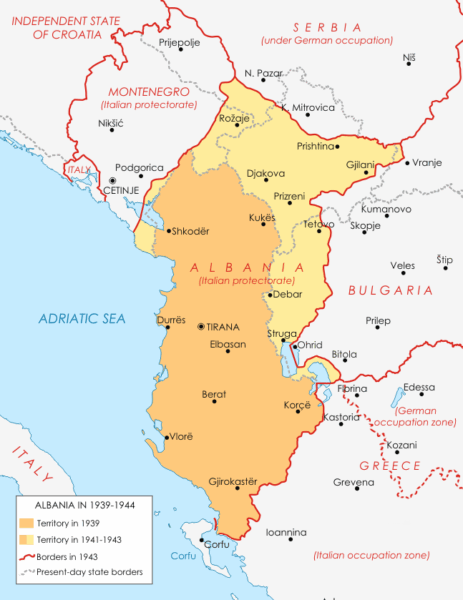
[From Wikipedia By Пакко – Greater albania.JPG;, CC BY-SA 3.0 .]
There were elements within Albanian society that resisted the Italians from the outset but the Albanian resistance became most active after a series of defeats suffered by Italian forces in their war with Greece. A series of skirmishes throughout the fall of 1942 eventually led to the Battle of Gjorm on 1 and 2 January 1943. Demonstrating the notion that the enemy of my enemy is my friend, the combined forces of the Balli Kombëttar (the militantly anti-communist Nationalist Front that would eventually ally itself with the Nazis) and the LANÇ (the Lëvizja Nacional-Çlirimtare – an Albanian communist resistance organization led by Mehmet Shehu and Enver Hoxha) inflicted a decisive defeat on the Italians killing 186, injuring thousands, and taking tenuous and temporary control of the area.
The Albanians had little time to savor the taste of their victory. Soon thereafter, the Italians began a series of reprisals against the civilians of the villages of Dukat, Gjorm, Trëbaç, Tragjas, and Vranisht. When they came to Tragjas, the Italians burned the village in August 1943. When the Germans arrived less than a year later, they must have been unsatisfied with the Italian job and subjected the town to another inferno.
We continued our ascent up the boscaresque hillside until we reached a unique semiustulate survivor of that pair of conflagrations.
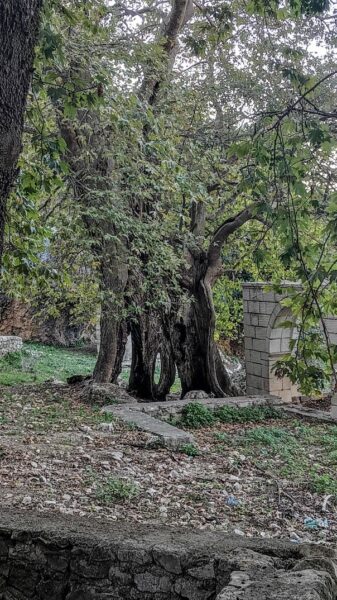
Before it met the Italians and the Nazis, the base of this tree wasn’t hollow. And yet it survives.
E shared some interesting facts about this burned village and the Albanian traditions of Kanun and besa. Kanun is a traditional Albanian customary law wherein their residence belongs to God and the guest. This places the guest’s welfare above all else. In fact, while it’s possible to pardon blood feuds between families, blood spilled against a guest is unpardonable. The concept of besa means “to keep one’s promise” or a vow of protection. It obligates the host to ensure the guest’s safety and well-being, even if the guest might be a sworn enemy. The tradition is so strong that historically, enemies have sought refuge under this pledge, knowing they would be safe.
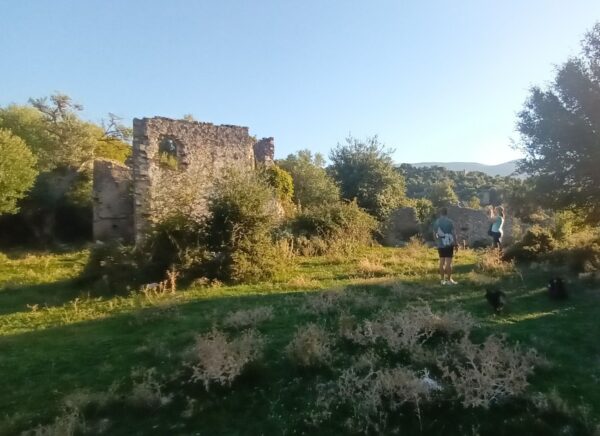
Thus it was that when Italians – some of whom might have participated in sacking the village – came seeking shelter, the residents were obligated to provide it. And they did.
There’s also some evidence that residents of Tragjas provided shelter to Jews fleeing the Nazis. Recall that, prior to being ousted by Mussolini, King Zog opened the border in 1939. The geography shows that it’s likely that few Jews would have been fortunate or hardy enough to survive such a journey but it’s also indisputable that Albania was the only country that had an increase in its Jewish population albeit from an estimate of merely 200 before the war to 600 after. Still, if this is accurate, it would have been closely tied to the concepts of Kanun and besa.
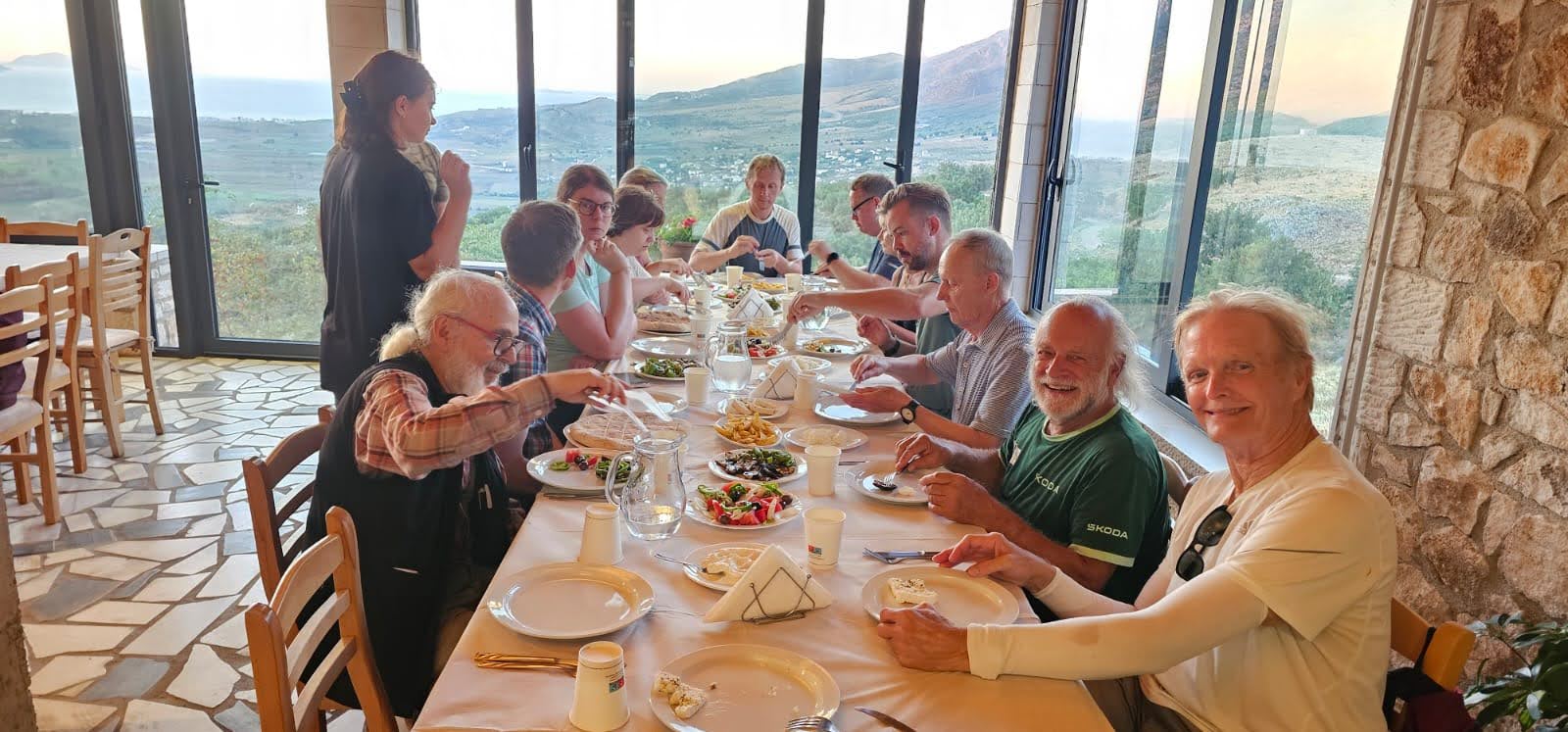
We reached the farm-hotel called Sofra e Vjeter and – what I thought was the climax of the hike – particularly when we began playing with the dogs and our host brought us glasses of raki.
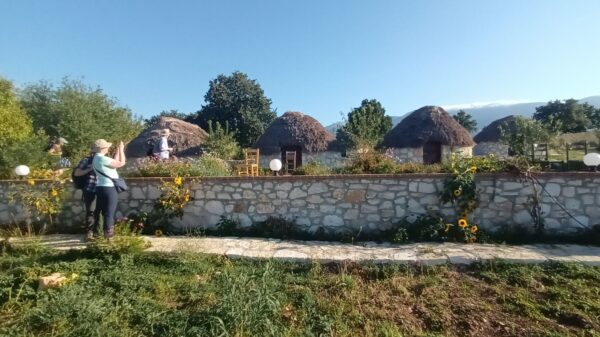
However, we’d apparently arrived a bit too early for supper so E took us on another walk farther up the hill.
I made the walk but must have been a bit quanked from the day’s exertions by this point because I have no notes, photos or recollection why we made this additional walk or what we saw there. By my estimation, J and I had walked perhaps 8 kilometers in Vlora and the walk up the hill to Tragjas had already clipped a further five onto that.
We returned to the restaurant where we encountered yet another meal after which the most comfortable choice was to diffibulate my jeans and believe my belt would provide sufficient support to maintain appropriate modesty.
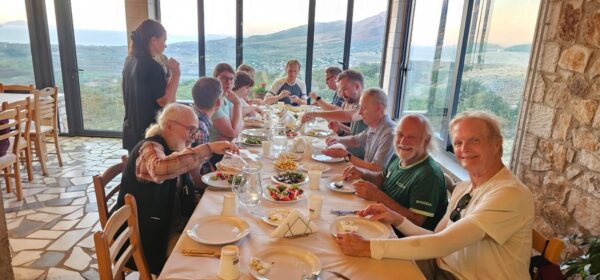
In fact I was so full that I decided to stay behind and play with the kittens who’d been circulating around the table throughout the meal. As it turned out, despite their groak expressions, it seemed they were as interested in affection as they were in panhandling food. Well, almost.
Are the stars out tonight?
E had told us that we should have our phones well charged because while we’d be descending the hill on a road and not by the path we’d climbed, we would need the light. Fortunately a few in the group – notably P – had brought along LED headbands and, without them, the walk would have been utterly murklins. As someone prone to tripping, I stayed with the slower group. (I think it was B who wanted to race down the hill to try to watch a rugby match.) I occasionally stumbled but didn’t fall once! While there was little light pollution, and, I’m sure there were some, I didn’t notice any noctilucous heavenly objects but that was likely because I was too focused on maintaining my balance.
Tomorrow is the last day of our group tour. We’ll visit Berat then return to Tirana where some of us will share a final dinner together before heading our separate ways. If you want a few more photos, I suggest using this link.
-
Photos and their stories – Lisbon – Summer 2026 part two – plus an egg-straordinary bonus
August 21, 2026 -
Photos and their stories – Lisbon – Summer 2026 – part one
August 21, 2026 -
The indigenous people of Da?ow?aga? (Olympic Valley and me supplement three)
August 19, 2026 -
The indigenous people of Da?ow?aga? (Olympic Valley and me Supplement two)
August 17, 2026 -
Olympic Valley in the time before humans (Olympic Valley and Me Supplement one)
August 14, 2026