Driving slow on Sunday morning – Goodbye for now to Tirana
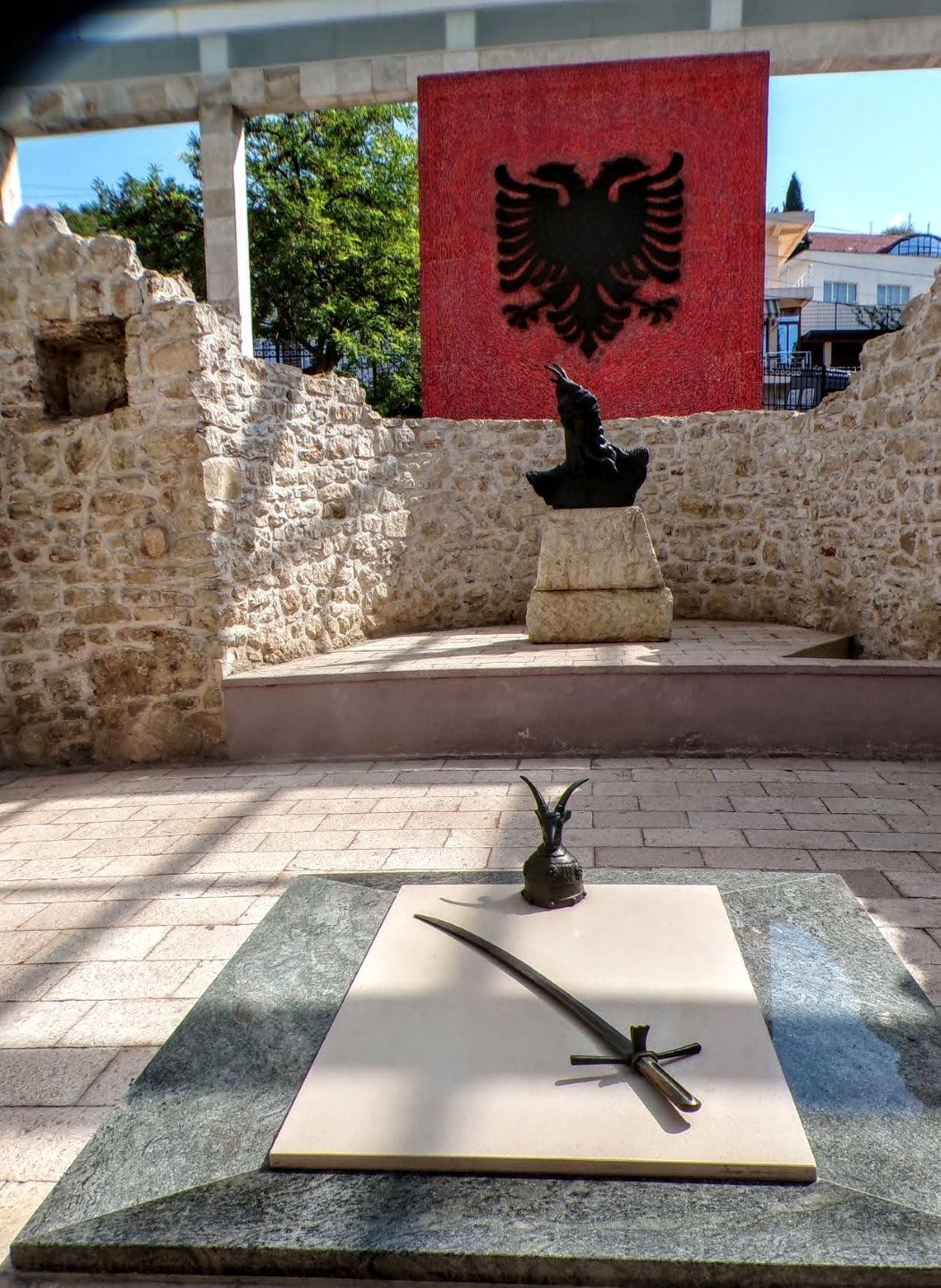
After straggling into the rather simple breakfast the hotel offered, the group continued their straggles into the lobby and courtyard – luggage in hand ready to take the short walk to the van that would transport us over the coming week. We’d make a brief stop in Lezhë to visit the burial site of Skanderbeg and end the day with a walk through a tunnel to board a boat that would take us across Lake Koman to our hotel on the Shala River where we’d spend the ensuing two nights. But I’m getting a bit ahead of myself.
I’ll be his and he’ll be mine
Sometime after arriving in Tirana Friday afternoon I learned that about one-third of the country’s population (2,700,000 or less than half of the DC metro area) live in Tirana County. On the overly long and congested ride from the airport to the city center, it seemed as though they were all in their cars at the same time. When our group set out for Lake Koman and the Shala River with a brief stop planned in Lezhë enroute encountering another traffic jam was certainly outside my expectations. These might have been different had I foreknowledge of Albanian dashmas (weddings).
Saying that Albanian dashmas are a major production is something of an understatement. The typical dashma will last at least four days and often as long as seven. The country is dotted with opulent wedding palaces such as this one
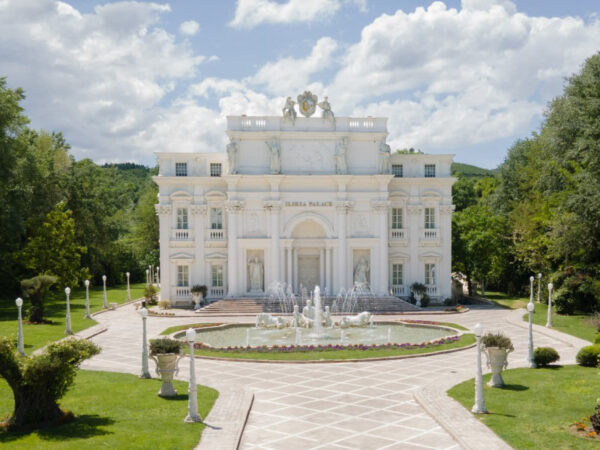
[From Wherewedding.co.uk]
near Tirana where there will be a communal banquet – often held on a Sunday – that serves as the ritual’s climax. Among the nine traditions is the krushqit when the groomsmen accompany the groom to take the bride from her family’s home. The ceremony itself is likely to be a small affair held on Thursday at or near the beginning of the bride’s celebrations. The groom’s celebrations begin a day or two later and the krushqit is an essential element of this custom. Traditionally, the groom, accompanied by family elders, and the other groomsmen would march in a procession on horseback or donkey carts from the groom’s house to the home of the bride’s father carrying gifts such as gold jewelry, necklaces, rings, bracelets, and watches. They might also bring perfumes and clothes for different seasons.
In modern Albania, this has been replaced by a flashy callithump of plastic flower and streamer covered cars. Most often Mercedes, these five-plus vehicle caravans obstruct and weave through traffic with horns blaring. It was just such a procession that we encountered soon after leaving Tirana.

And remaining in the cars isn’t obligatory.
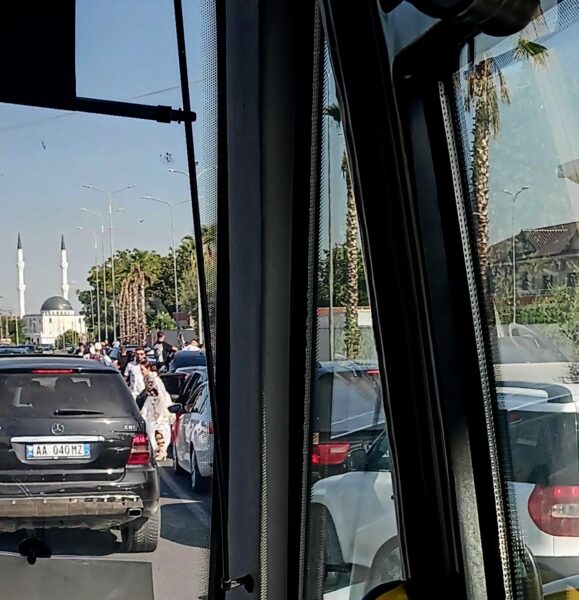
According to one source,
The lead car always has a sunroof with a young (perhaps raki saturated) male hanging out the top with a video camera in hand filming the entire spectacle. The next vehicle is the most lavishly decorated one as it carries the bride and groom. Other cars follow behind.
It was a nice bit of exposure to a sliver of Albanian culture. It would have been even more fun if we could have found a way to participate.
Lezhë fair
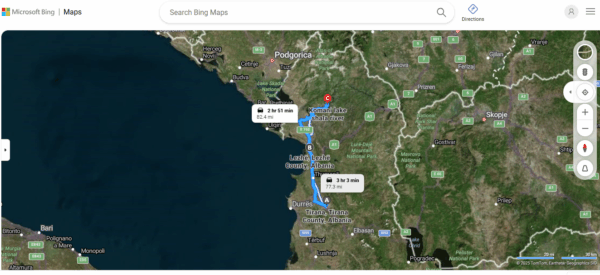
If you’re curious about today’s route covering a bit more than 200km and ending in the north of the country, I’ve mapped it for you on this screenshot from Bing Maps.
Why would the small city of Lezhë with a population of about 15,000 merit a stop? Like many small towns, its size belies its historical importance. I first mentioned Albania’s great national hero Gjergj Kastrioti or, as I’ll refer to him henceforth, Skanderbeg, in this post. Skanderbeg was born on 6 May 1405 – more than six centuries ago – yet his name is ubiquitous not only through Albania but, as we’ll learn later, in Kosovo as well.
Skanderbeg was born in Krujë some 50km south of Lezhë. His father Gjon was a local noble and considered a leader in the region. As I noted in the post All Things Must Pass, Albania was historically subjugated by various empires beginning with the Byzantines in the late fourth century. Their control of the territory began waning in the 13th century and, while the empire’s collapse culminated with the Ottoman conquest of Constantinople in 1453, they hadn’t controlled Albanian territory for nearly a century. By the middle of the fifteenth century, the main ruling power in the area was the Republic of Venice.
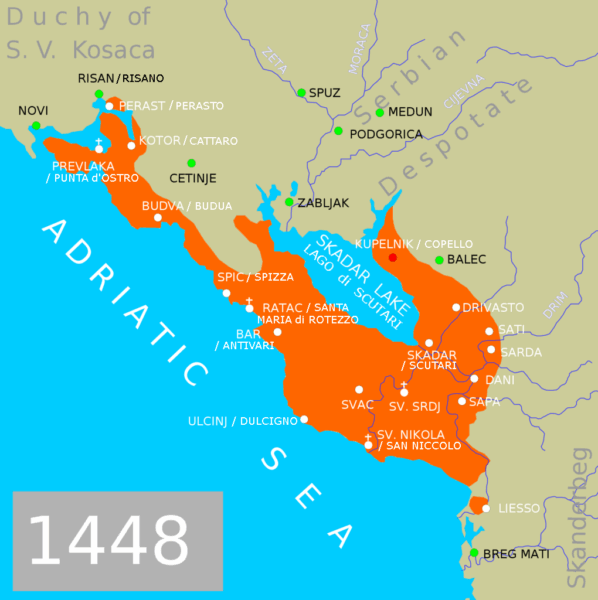
[From Wikipedia – By Bratislav Tabaš.]
Gjon Kastrioti, sensing the pressure from the Venetians on his north and west and the encroaching Ottomans from the east, sent his oldest son Stanisha as a hostage to the Sultan.
(Holding a child of a local leader was a common tactic the Ottomans used to maintain their control over conquered territory. Sometimes, such as appears to be the case with Stanisha, the child would be surrendered voluntarily. It’s generally thought that this was also the case with Gjergj {who became Skanderbeg} but some sources assert that he was abducted. Since there are indications that the boy was sent twice – once at age 10 and again at 18 – the weight of the evidence would indicate that he was voluntarily surrendered.
Once sent to the Sultan’s court, the hostage child would generally be conscripted into a system called Devşirme. The boys would be forcibly converted to Islam, have their names changed, serve the court of the Sultan, {In Skanderbeg’s case Murad II.}
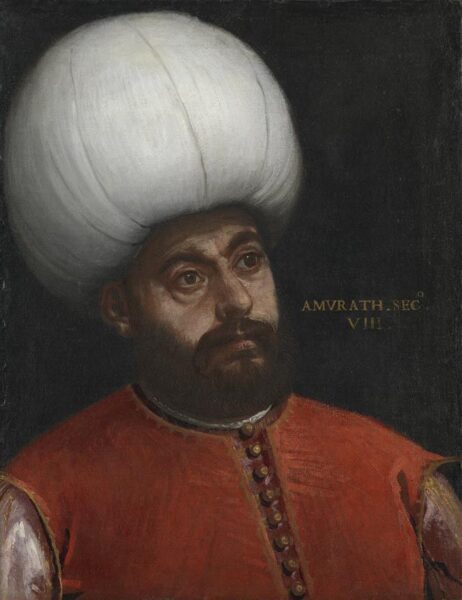
[From Wikipedia – Public Domain]
and be given military training. The Turks named Skanderbeg Iksander and he received his training at the Enderun School.)
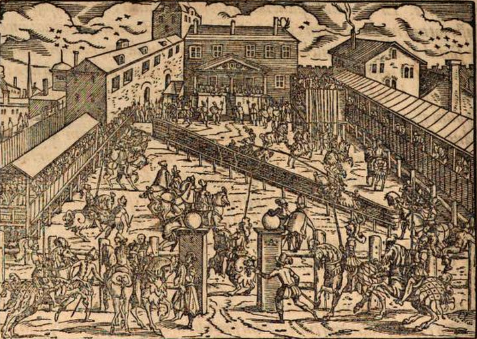
[From Wikipedia – Public Domain]
It’s possible that the process of Devşirme created many loyal janissaries and that might have been the case with Skanderbeg had his father and the Sultan each not made one crucial mistake. Following his graduation from Enderun in 1428, the Sultan granted Skanderbeg a land grant in or near his father’s territory. However, in 1430, Gjon joined a Venetian rebellion against the Ottomans but he was on the losing side and it cost him his life. The Sultan’s mistake was refusing to grant Skanderbeg control over what he perceived as his patrimony.
Skanderbeg remained an epigon of the Sultan for 13 years earning additional lands and the title of bey in 1438 not through ensorcellment but through continued military victories. Documents from that period refer to him as “Juvan oglu Iskender bey. (Bey was a title for a high-ranking official, such as a provincial governor, and a member of ruling families or military leadership.)
Then, in November 1443, at the Battle of Niš between the Ottoman Empire led by Kasim Pasha and the Crusaders led by Mátyás (Matthias) Hunyadi who would later become King of Hungary, Skanderbeg deserted the Ottoman forces leading 300 fellow Albanians off the battlefield. It assured the Ottoman defeat and earned him the epithet hain (treacherous) Iksender. Where Turkish uses Iksender to evoke the great Macedonian king Aléxandros, Albanians use Skander and the Turkish bey becomes beg in Albanian. Hence, Skanderbeg.
He led his troops into Krujë and, once there, used a forged letter from the Sultan to become governor of the province.
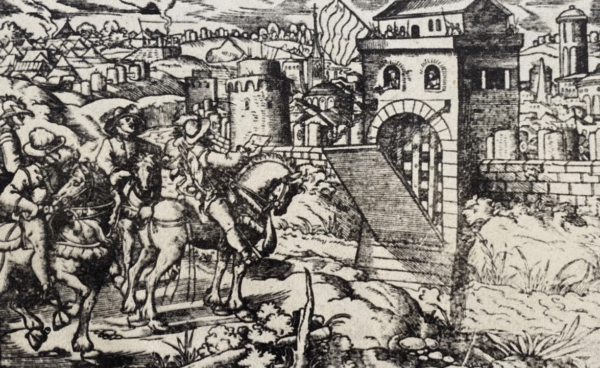
[From Wikipedia – Public Domain]
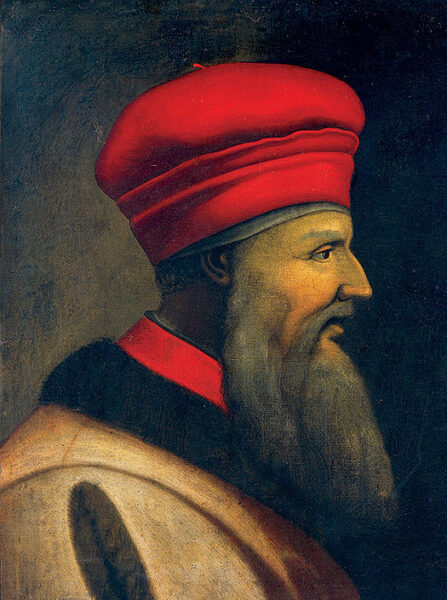
He reverted to Christianity and commanded all his followers to do the same. He raised a red standard with a double headed eagle – the image that adorns the flag of modern Albania. Now we can finally come to Lezhë.
On 2 March 1444, he convened a meeting of eight of the most powerful Christian Albanian families (all loyal to the Republic of Venice) and the Serbian nobleman Stefan Crnojević. They formed the League of Lezhë and it was at this time that he began a 25 year campaign against the Ottomans in Albania.
[From The History Files]
His first notable victory came on the Plain of Torvioll in the summer of that year where his undermanned force of 18,000 defeated an Ottoman army of more than 25,000 in a pitched battle that marked one of the few times that an Ottoman army was defeated in a major battle on European soil. In January 1868, after a life marked by incessant battles and shifting alliances, Skanderbeg called another meeting of Albanian noblemen in Lezhë to restructure what remained from the League. He contracted an illness (Some sources say malaria. Others say he was poisoned) and died on 17 January 1468.
He never lost a battle and became and remains the symbol of Albanian independence. Notwithstanding his battlefield success, there would be no eucatastrophe for the Albanians. By 1479, the Ottomans had reasserted full control and Albania would be ruled by them for another 433 years.
Skanderbeg is said to have been buried in Lezhë on the site of the Katedra e Shën Kollit (Cathedral of Saint Nicholas) where a mausoleum was constructed in 1981.
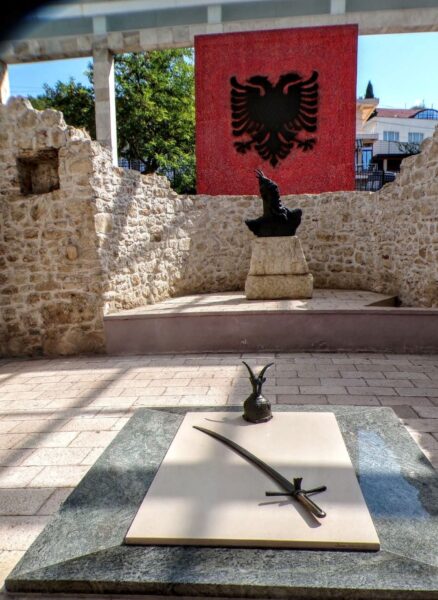
His remains, however, aren’t there. Historical accounts suggest that his sarcophagus was found empty during excavations, and one theory proposes that his bones were hidden to protect them from the Ottomans. The site remains an important Albanian cultural and historical monument.
In the next post, we’ll continue on our way north to Lake Koman and the Shala River.
-
Photos and their stories – Lisbon – Summer 2026 part two – plus an egg-straordinary bonus
August 21, 2026 -
Photos and their stories – Lisbon – Summer 2026 – part one
August 21, 2026 -
The indigenous people of Da?ow?aga? (Olympic Valley and me supplement three)
August 19, 2026 -
The indigenous people of Da?ow?aga? (Olympic Valley and me Supplement two)
August 17, 2026 -
Olympic Valley in the time before humans (Olympic Valley and Me Supplement one)
August 14, 2026
3 responses to “Driving slow on Sunday morning – Goodbye for now to Tirana”
I like my ottoman.
At your feet?
Yep. Prop my feet up while sitting on the couch. It even has some storage inside!