All Things Must Pass – Tirana Day 2 – Morning
As I’ll learn on my walking tour this morning, in some ways the history of Tirana left me jargogled regarding its age, its settlement, and its importance. We can look at the area anthropologically by traveling 25km or so southeast from the Kapallan Pasha Tomb in the city center
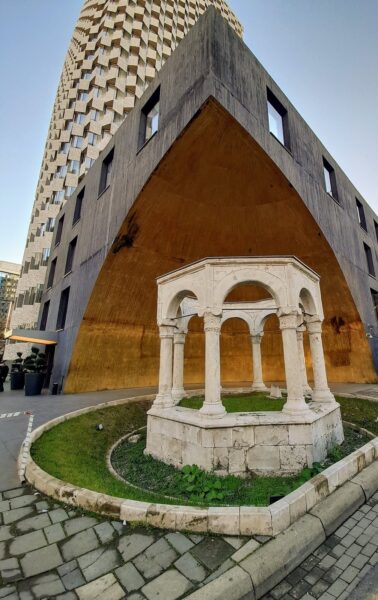
to reach Pëllumbas Cave – a neolithic site occupied more than 6000 years ago. Come 10km closer to the city and the presence of a 2,600 year old fortress at Petrelë (now the site of Petrelë Castle built in the fifth century by the Byzantine Emperor Justinian I) indicates the importance of the plain Tirana currently occupies.
Historians will note that the city wasn’t officially established until 1614 when the Ottoman Albanian general Sulejman Pasha Bargjini built a mosque, a hammam (public bath), and a bakery there. The Bargjini mosque, seen below, was partially destroyed during the Second World War and was razed under the dictatorship of Enver Hoxha later in the twentieth century.
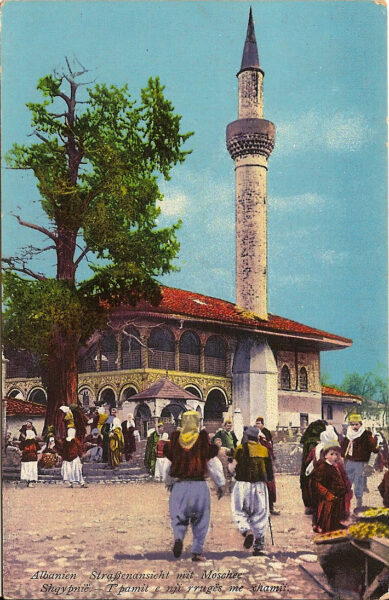
[From Wikipedia – Public Domain]
However, Venetian documents show that the name Tirana predates his arrival by two centuries. So what was in that location that needed a name?
What have the Romans ever done for us?
While there’s considerable archaeological, genetic, and linguistic evidence supporting Albanian ethnogenesis, the territory has long been subjugated under various invading empires. We met the Illyrians in the previous post but the Romans defeated their loose tribal confederation in the three Illyrian Wars. They controlled the territory from 168 CE until 395 CE when the Byzantine Empire took control and ruled from Constantinople (Now it’s Istanbul, not Constantinople.) rather than Rome. It’s during Byzantine rule or Emperor Alexius I Comnenus that we find the first recorded reference to a distinct area of land known as Albania and to its people in the 11th century.
Groups of Slavic tribes interrupted Byzantine rule in the seventh century until the Byzantines regained control in 1014. While fighting between the Byzantine Empire and various Slavic groups continued, the next critical change came from the east in the form of the Ottoman Empire which began its conquest in 1388 and assumed complete control of the territory in 1430. Sixty years of armed resistance – led for the first 25 years by Gjergj Kastrioti (AKA Skanderbeg) – from the late 15th to the early 16th century kept the Ottomans at bay but the Turks fully reoccupied the country in 1506 and ruled there until Albanian independence in 1912.
Looking at the map from Bing Maps below, will identify a number of cities that held greater importance than Tirana beginning with the Illyrians for whom Shkodër in the north at point A was likely their most important city.
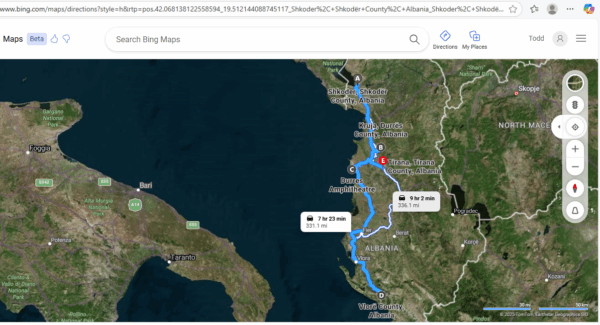
If you scan down to point C where the label reads Durres Amphitheatre, it will take you to Durres – perhaps, Albania’s most important city for most of its history. Turning around to Kruja at point B, you reach Skanderbeg’s stronghold from which he frustrated the Ottomans for a quarter century. Head far to the south to Vlorë which was the first capital of the independent state of Albania from 1912 until 1920. It was finally in this year that Tirana became the “temporary” capital. This status became permanent on 31 December 1925.
Cosmic empire
As I learned on my first trip to this part of Europe, the Balkan Peninsula may be the most war-prone region in Europe. In the section above, I touched upon some of the imperial conquests but even these failed to generate long periods of peace. After the fall of Rome, for example, the region saw invasions from Goths, Huns, Avars, Slavs, Bulgars, and others.
The imperial wars stretching from antiquity through the early twentieth century fall of the Ottoman Empire were generally about the acquisition of wealth and territory or local resistance to conquering invaders in continuing recrudescence. Through the twentieth century and into the present, it seems to me that religious differences have been at least one aspect motivating the combatants. Thus, I found it curious when our guide Aurora began stressing the degree of religious harmony in Albania today. It would become something akin to a bombination from guide after guide over the ensuing two weeks and I would frequently hear, “The main religion of Albanians is Albanianism.” As if to hammer home the notion, she made a point of walking us to three different houses of worship that are less than 2ooo meters apart as seen and highlighted on this screenshot from Bing Maps.
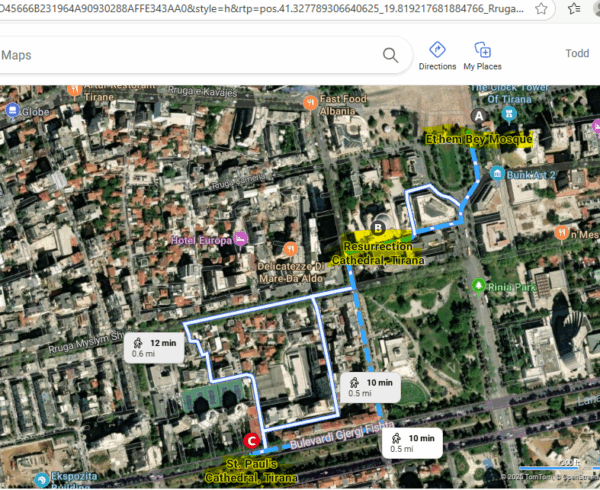
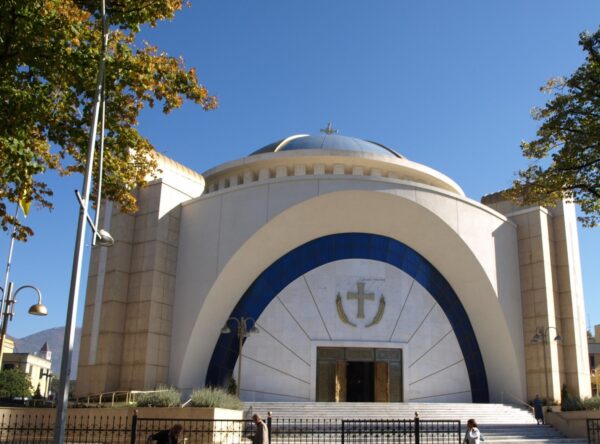
They are the Et’ Hem Bey Mosque on Skanderbeg Square (that you saw in the previous post), the Orthodox Resurrection Cathedral (B on the map)
and Saint Paul’s Cathedral (for the Catholic population).
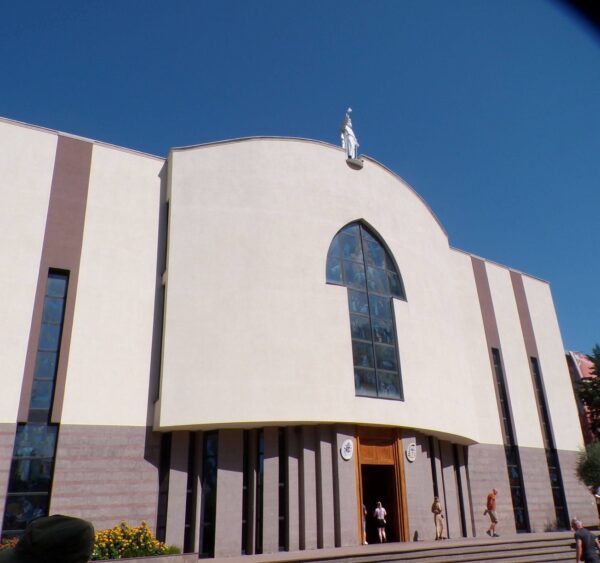
(Those of you who have read my posts about Sarajevo know how I found the degree of religious tolerance and coexistence in that war-ravaged city to be particularly illecebrous.) While on this tour, I wondered whether this tolerance has been a longstanding characteristic of the Albanian people or an outgrowth of their return to religiosity after the decades spent as an atheist state under Hoxha’s dictatorship – a time nearly everyone describes as “in the communism” or “under the communist time.” The answer became clearer for me over the coming weeks and I hope it will do so for you as you read through this journal.
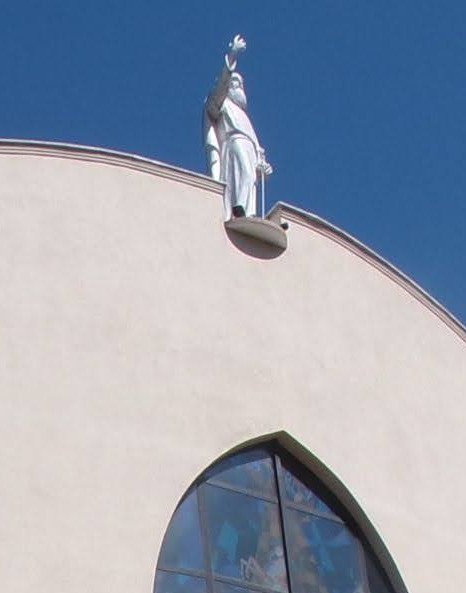
I was among those on the tour who opted not to enter the cathedral and those of you who have read some of my posts about other trips will find this unsurprising. When the group had regathered, Aurora pointed to the statue of Saint Paul atop the building and joked that many in Tirana call it Saint Paul taking a selfie. I’ve cropped and enlarged that section of the photo so you can judge for yourselves.
Two items before we go
First, she took us past two of the infamous bunkers constructed under Hoxha’s direction. There’s no official count of the number of bunkers Hoxha insisted on building to prepare for an invasion that never came. His oft repeated refrain was that all citizens must prepare for guerrilla warfare and be “vigilant for the enemy within and without.”
One source noted that Hoxha wanted to build between 24 and 27 small or qender zjarri bunkers, plus one larger pikë zjarri bunker per square kilometer across the country. If this is correct, the arithmetic says he planned to build between 700,000 and 800,000 bunkers. Estimates of the number actually built range from 175,000 to 750,000. However, if the estimate on the Wikipedia page of an average of 5.7 per 1km² is correct, the lower number would be accurate.
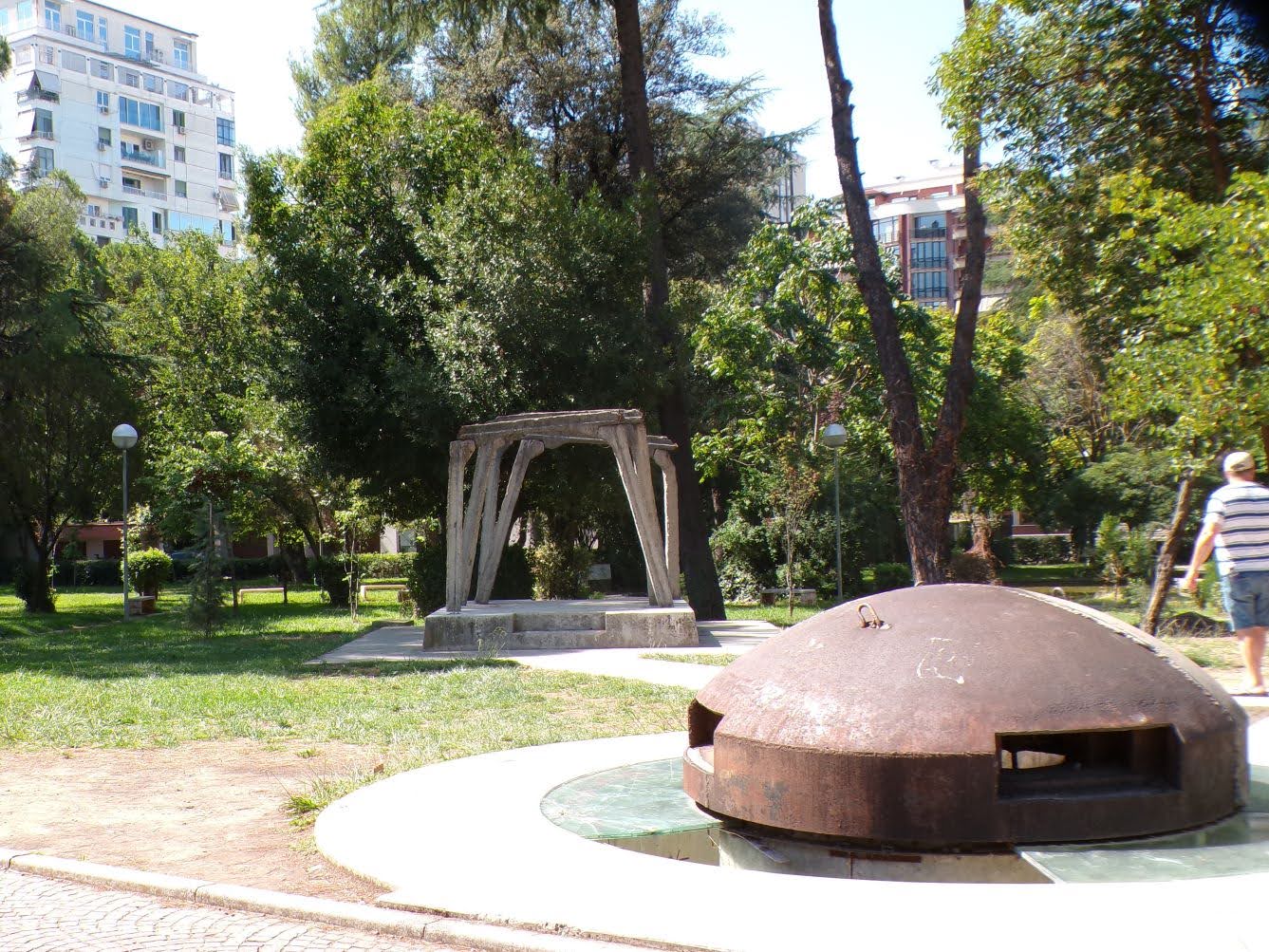
One website points out that, “although they were built to withstand intense bombardment in a ground invasion that never came, they are succumbing to the peacetime forces of economics, public safety, and abhorrence of the past.” On this morning we walked past two bunkers. As we were about to enter the Blloku District that was once home to the country’s political elite, we stopped at the Postbllok Memorial –
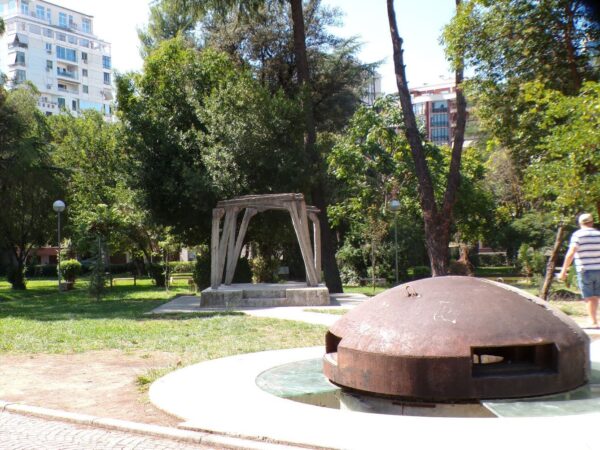
honoring the people who suffered under the atrocities of the Hoxha regime. You can see two of the three pieces – a qender zjarri bunker and a sculpture made from concrete girders taken from Spaç Prison – in the photo above. The third element, seen below, is a gift from Berlin, Germany to Tirana.
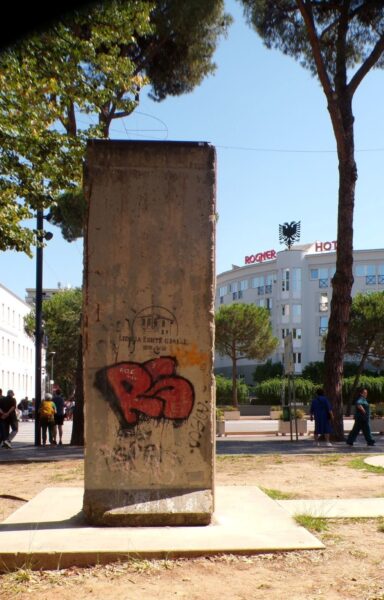
There’s another bunker that’s quite prominent in this part of the city. It’s now known as Bunk’Art2. It was built for Hoxha and the political elites and though I didn’t tour it, you can see a few photos of it and read more about the bunkers on the Messy Nessy website. And on the site Works That Work, you can read about some of the creative ways Albanians are repurposing a few of them.
Of course Aurora talked in considerable detail about Skanderbeg. She was trying to help us understand why this fifteenth century soldier is so revered throughout the country. I’ll postpone my discussion of Skanderbeg until our group stops at his grave in Lezhë on our way to Shala River. However, I’ll return to Skanderbeg Square to stand at the base of his statue and provide the proper way to look at a building I showed you in the previous post.
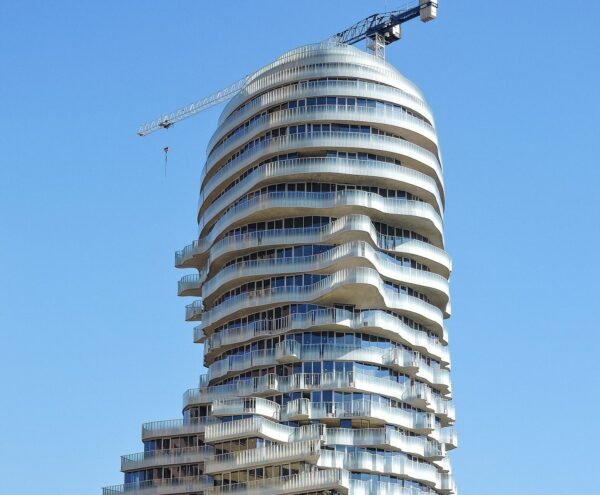
Yes, that is Skanderbeg looking back at his statue looking at his building. And here are the remaining photos I haven’t included in the first two posts about Tirana.
-
Photos and their stories – Lisbon – Summer 2026 part two – plus an egg-straordinary bonus
August 21, 2026 -
Photos and their stories – Lisbon – Summer 2026 – part one
August 21, 2026 -
The indigenous people of Da?ow?aga? (Olympic Valley and me supplement three)
August 19, 2026 -
The indigenous people of Da?ow?aga? (Olympic Valley and me Supplement two)
August 17, 2026 -
Olympic Valley in the time before humans (Olympic Valley and Me Supplement one)
August 14, 2026