
Notes on the VII Olympiad – (Antwerp and me – addendum two)
The driving force behind establishing the modern Olympic Games was Baron Pierre de Coubertin and, before the first Games were held in Athens in 1896, he remarked, “I do not approve of the participation of women in public competitions. In the Olympic Games, their primary role should be to crown the victors. A woman’s glory rightfully comes through the number and quality of children she produced, and that as far as sports are concerned, her greatest accomplishment is to encourage her sons to excel rather than seek records for herself.”
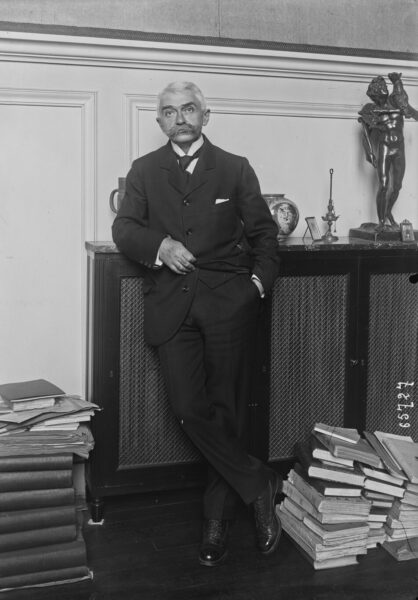
[From Gallica Digital Library and is available under the digital ID btv1b53067505m.]
That ban lasted only until the Games of the II Olympiad in Paris in 1900. Still, only 22 of the 967 athletes were women and they were limited to competing in tennis, sailing, croquet, equestrian, and golf. But, although progress would be fitful, the barrier had been broken.
In 1912 in Stockholm, women competed in aquatic events for the first time. The three events were the 100m freestyle, the 4×100 meter relay, and 10-meter platform diving. Although these were the only events for women, the United States elected not to send any competitors because it was an era when American women were only allowed to participate at the Olympics in sports in which they could wear a full skirt. So pervasive was this constraint that American women who simply wanted to swim recreationally were expected to cover their legs and, in some places, legally required to do so.
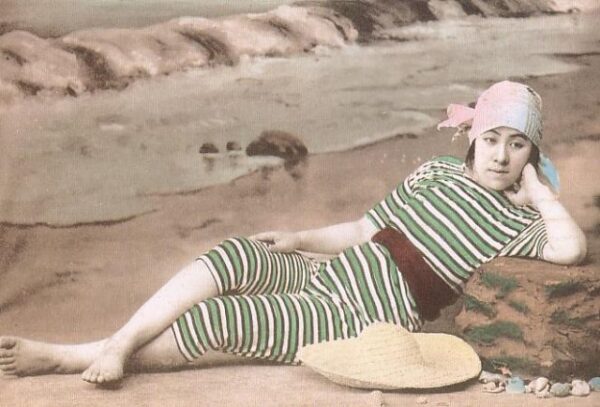
Ethelda Marguerite Bleibtrey was born on 27 February 1902 in Waterford, NY – not far from the state capital of Albany. The daughter of a mortician and his wife, she began swimming at the age of six in Saratoga Lake but was rather indifferent to the activity until she contracted a non-paralytic form of polio at age 15. Using it as a form of therapy for the resulting curvature of the spine she began swimming with intent – soon doing so competitively.
And she achieved rapid success. By the spring of 1919, she held world records in the 100-yard backstroke and 440-yard freestyle. That year she also won Amateur Athletic Union (AAU) titles in the 440-yard and 880-yard freestyle events.
Then, sometime in 1919, the teenage Bleibtrey would spark a small flame in a corner of the nascent women’s rights movement. I could find no source that cited her motivation or specified a date but, at Brooklyn’s Manhattan Beach, she had the affrontery to remove her stockings. (It could have been late summer because she would have been even more well-known for having bested the 1912 Olympic champion, Australian swimmer Fanny Durack, in a 100-yard exhibition race.) Regardless of why or when, she was promptly arrested for “nude swimming.”
Public outrage soon followed. She was quickly released and never tried. Her action led directly to changes in the regulations and women were soon permitted to swim without stockings. The incident had a wider impact than simply allowing women to wear more practical and less restrictive swimwear, however. Her bold gesture became symbolic within the broader push for women’s rights by highlighting the need for greater equality and autonomy for women in both public and athletic spaces.
She also benefited directly from her gesture. Recall that the US didn’t allow women to compete in the swimming events in Stockholm in 1912 because the USOC would only allow women to compete in events where they could wear a full skirt. With the ban lifted, Bleibtrey could now travel to Antwerp and compete in an expanded competition that added a 300m freestyle.
Most of her competitors in Antwerp wore long, dark-colored garments made from wool, cotton or silk. Most were heavy and rather unpleasant to wear. Bleibtrey wore apparel that was cut high on the back and under the arms, with a longer cut for the legs that looked more like a short dress than a swimming costume.
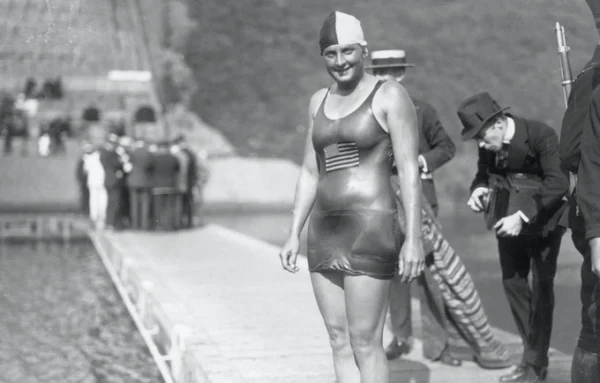
[From ISSUU]
Patricia Reymond, Collections Manager at the Olympic Foundation for Culture and Heritage, provides some additional context, “The sartorial emancipation of women began after the First World War. They started wearing their hair short, corsets became a thing of the past, flowing and tighter-fitting dresses became the norm, and skirts became shorter.”
Whether she had a physical advantage, an edge from her swimsuit, or some combination of the two, once Bleibtrey hit the cold Belgian water, she was a wunderkind. She set her first world record of the Games completing the third heat of the 100m freestyle in 1:14.4 seconds.
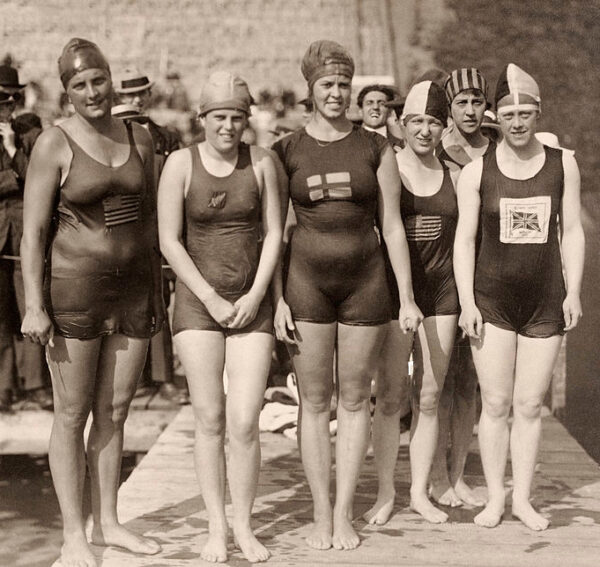
(The finalists in the women’s 100 metre freestyle swimming event at the Olympic Games in Antwerp, circa August 1920. Left to right: Ethelda Bleibtrey of the USA, gold; Violet Walrond of New Zealand, fifth; Jane Gylling of Sweden, sixth; Irene Guest of the USA, silver; Frances Schroth, USA, bronze; and Constance Jeans of Great Britain, fourth.)
[Photo from Wikipedia – Public Domain]
Forty-eight hours later, on Wednesday 25 August, she claimed her first Olympic title, beating another American, Irene Guest by nearly four seconds and setting a new world record of 1:13.6 – a record that would last for three years.
The day after her victory in the 100m, she swam her 300m semi-final in a world record time of 4:41.4, winning the race by 16 seconds. In the final, on 28 August, Bleibtrey claimed her second gold medal lowering her previous world record by more than seven seconds. Silver medalist Margaret Woodbridge finished more than eight seconds behind Bleibtrey.
She wrapped up her gold medal sweep by anchoring the US team in the 4x100m relay. The Americans secured victory and swam to a new world record of 5:11.6. The reigning champions from Great Britain finished almost 30 seconds behind them and Bleibtrey became the first woman to win three gold medals at a single Olympic Games.
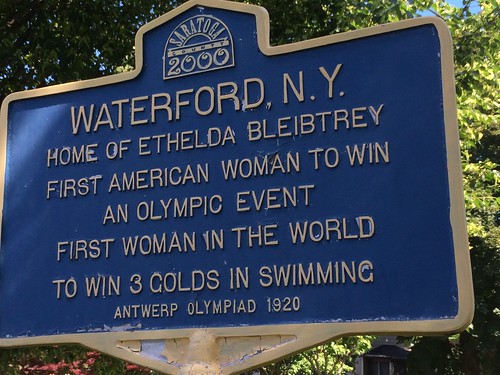
Not lacking for confidence, she later proclaimed that had the competition included the backstroke, she would have captured a fourth gold. “At that time, I was the world record holder in backstroke, but they didn’t have women’s backstroke, only freestyle in those Olympics.”
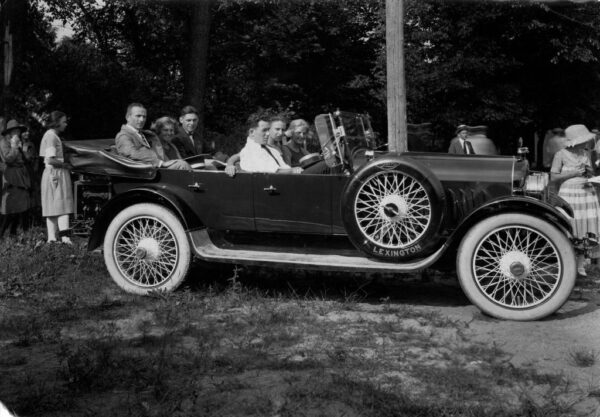
Her bravado was well grounded. Throughout her amateur career that continued until 1922, she never lost a race and won every national championship at distances ranging from 50 yards to three miles. Seen below, Bleibtrey is one of six world record holding swimmers in the car. (Starting in the rear left to right they are: Ludy Langer, Charlotte Boyle, Johnny Weissmuller, Norman Ross, Robert L. Pearson, and Bleibtrey.)
[From International Swimming Hall of Fame]
Though her career was short lived, one can’t help but compare her dominance to a great American swimmer of our time. It might not be outrageous to say that Ethelda Bleibtrey paved the way for Katie Ledecky.
But, while she would go on to a long and successful career as a coach, swimming teacher,

[From A Mighty Girl]
and occasional magazine writer, she was also not quite finished with raising a ruckus to advance the sport she loved. In 1928, Bleibtrey stood at the edge of the Central Park Reservoir in Manhattan – a spot where swimming was prohibited for health reasons. She dove in and was promptly arrested and taken to a local jail where she spent the night. New York Mayor Jimmy Walker intervened and she was released the following day.
It was later revealed that the incident was a publicity stunt that Bleibtrey had orchestrated with the New York Daily News to highlight the absence of public swimming pools in New York City. The city developed a plan but the Great Depression intervened and it wasn’t until 1936 with funding from President Roosevelt’s Works Project Administration that any significant construction began. By the end of that year the city had 11 major outdoor pools.
Ethelda Bleibtrey was inducted into the International Swimming Hall of Fame in 1967. She died on 6 May 1978 at age 76.
-
Photos and their stories – Lisbon – Summer 2026 part two – plus an egg-straordinary bonus
August 21, 2026 -
Photos and their stories – Lisbon – Summer 2026 – part one
August 21, 2026 -

The indigenous people of Da?ow?aga? (Olympic Valley and me supplement three)
August 19, 2026 -
The indigenous people of Da?ow?aga? (Olympic Valley and me Supplement two)
August 17, 2026 -
Olympic Valley in the time before humans (Olympic Valley and Me Supplement one)
August 14, 2026