Lake Placid and Me – part two
At the end of the previous post, I explained how Lake Placid managed to display snow outside in late July. I was still in the center of the village and about to begin what I expected would be a full day of exploration of various Olympics related sites. This turned out to be only partially true.
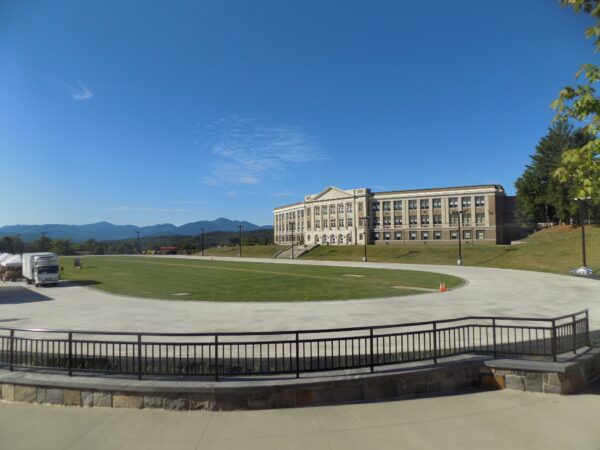
I arrived as planned a few minutes before the scheduled opening of the Olympic Museum because I wanted to take a minute or two to walk over to the adjacent James C Sheffield Speed Skating Oval in front of Lake Placid High School. The oval hosted the speed skating events for both the 1932 and 1980 Games.
My next stop was the Lake Placid Olympic Museum that had artifacts from more than the two Lake Placid Winter Olympiads. I’d have to candidly admit that, because of the research I’ve done for this series, much of the information in the museum was already lodged in my memory banks. I suspect, however, that this wouldn’t be the case for most people.
Among the items on display were 16 Olympic torches used in the relays to light the flame that burns throughout the games. I took photos of eight from cities that have hosted the winter games and that I’ve visited. Here’s the one from the 1980 Lake Placid Games.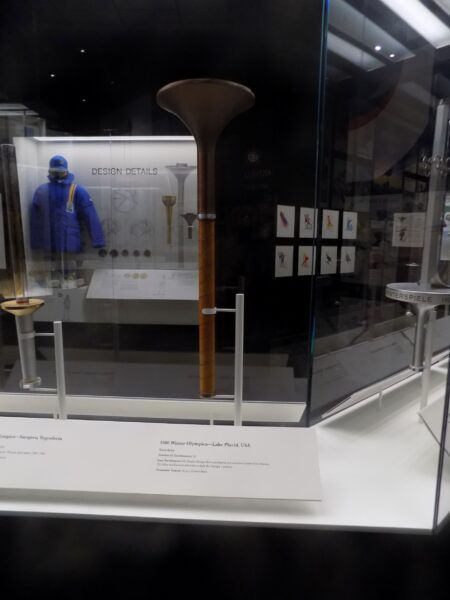
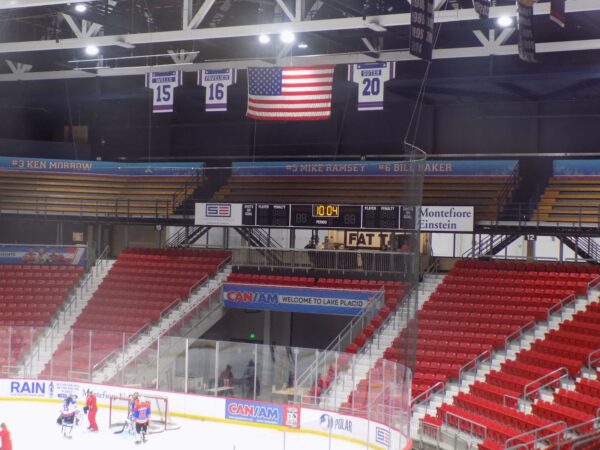
Of course, I also visited the two ice rinks and chose a seat in the 1980 arena where I spent a few minutes imagining the roar that had filled the arena at the end of the 1980 semifinal game.
From there, it was off to brunch at a highly praised specialty restaurant called The Breakfast Club, etc. I had their version of a rösti. This is a traditional Swiss dish served on a potato base that would probably evoke hash-browns for most Americans. Rather than shredded potatoes, however, the BC version used cubed potatoes. I opted for the veggie rösti with two eggs sitting atop spinach, tomato, mushrooms, peppers, caramelized onions, and melted cheddar cheese. While the combination was tasty and filling, this time I thought the potato base was overcooked but maybe that’s the way they like things in the Adirondaks.
After lunch I walked back to the hotel to get my car because even though Lake Placid isn’t very big and none of the venues are onerously far from the village, they are far enough that walking would have been an impractical choice. For example, the Lake Placid Horse Show that was the site of the 1980 Opening Ceremony and torch lighting is about three miles from my hotel and while the Ski Jumping Complex is only a half mile from that, the next closest venue – the Mt Van Hoevenberg Bobsled Run is six miles farther. Whiteface Mountain, site of the Alpine skiing events is farther still. And, I had to keep in mind that anywhere I walked likely meant returning in the same fashion. (The 1932 Opening Ceremony was held at what was called the Olympic Stadium. It’s the same site as the speed skating oval.)
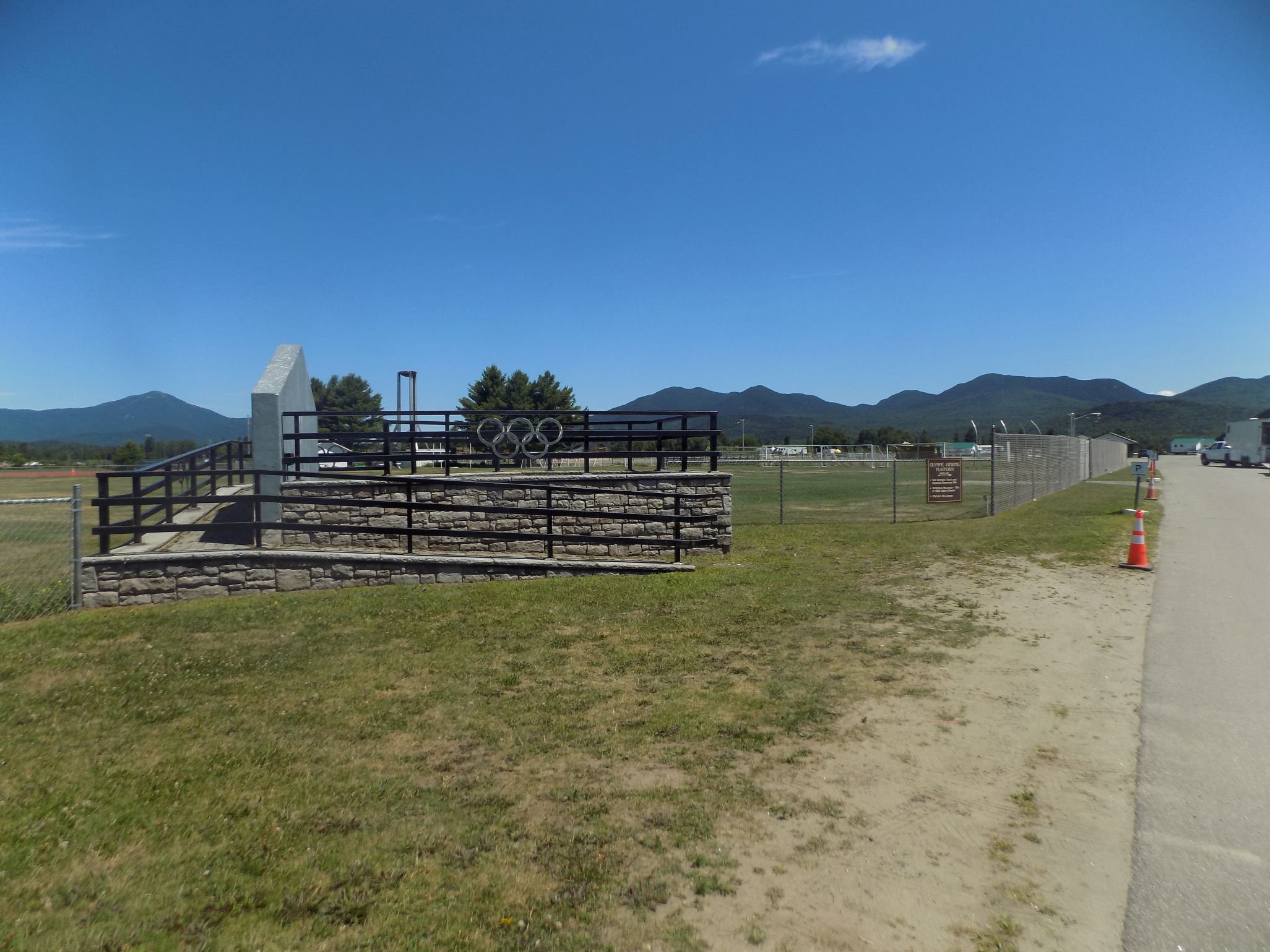
The official name of the site is the North Elba Showgrounds and it has a small Olympic viewing platform
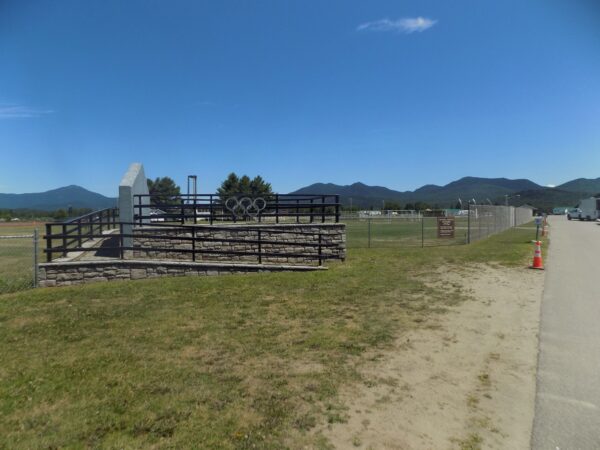
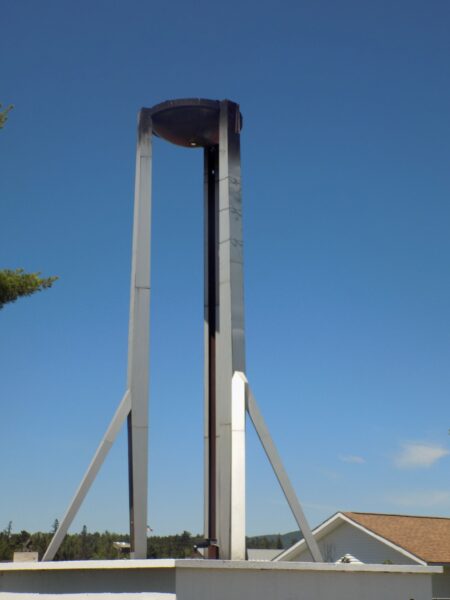
From which you can see the Olympic cauldron and, I believe, that’s Whiteface Mountain site of the Alpine skiing events in 1980. I opted for a closer look at the cauldron.
And when I turned around to walk back to the car, I got a clear sense of just how close I was to the Ski Jumping Complex.
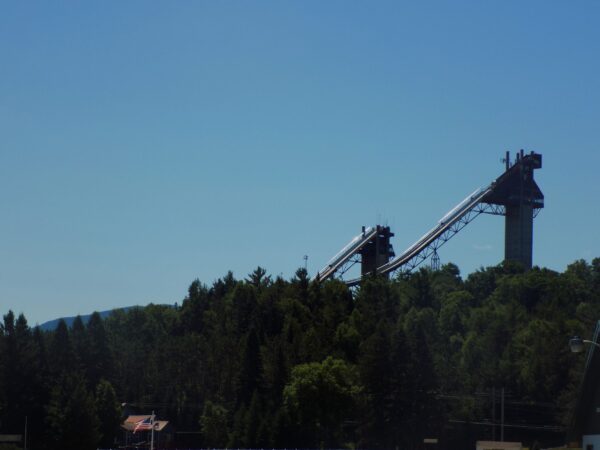
Ch-ch-changes
It was close enough that I would have normally walked from one to the other. I would have done so had I been more secure in leaving my car on the Showgrounds. However, since I’d seen several horse trailers enter and leave during my short stay there, I decided to drive against the possibility that they were preparing for some sort of event. When I pulled into the empty parking lot I wondered if the venue might be closed. Fortunately, there was a sign directing me to the lower parking lot just outside the Intervales Ski Lodge. From there, the jumping complex looked like this.
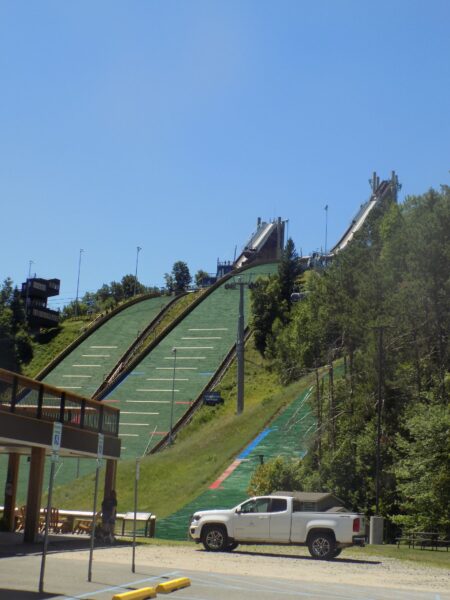
As one might expect, the hills I saw were quite different from the hill I would have seen had I attended the Games in 1932
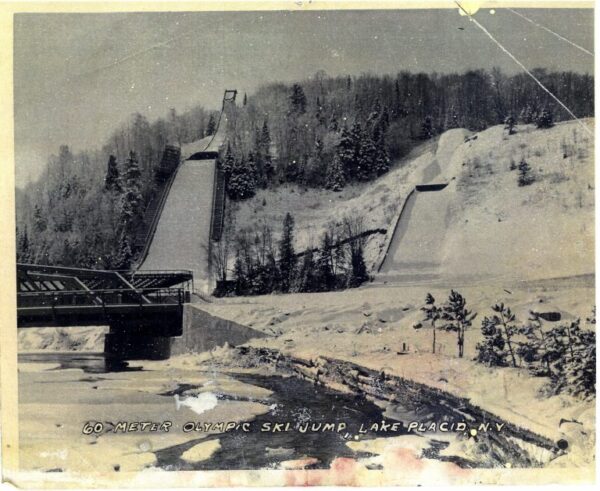
[From orda.org – Photo from Lake Placid Olympic Museum]
or those constructed for the 1980 Games.
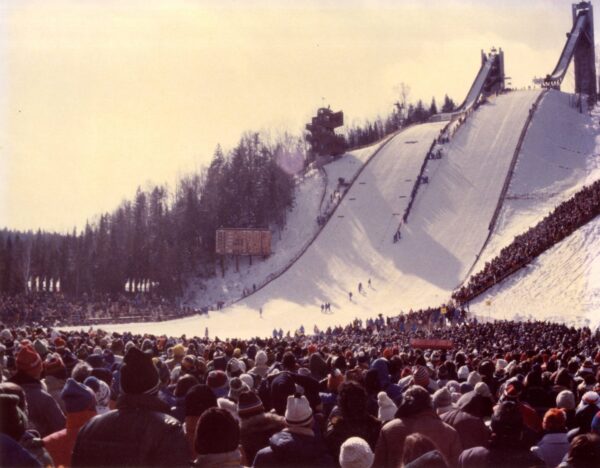
[From orda.org – Photo from Lake Placid Olympic Museum]
However, as humans are wont to do in many endeavors and, sometimes it seems particularly so in athletics, we are constantly pushing to extend our boundaries and make the seemingly impossible possible. The 1980 towers stand at heights of 70 and 90 meters respectively. In 2025, the height of the towers has increased to 90 and 120 meters.
These modifications are more than two decades old and were built to comply with updated competition rules and standards. Technically, the larger hill is described as “HS128 with a K-point of 115 meters” where HS simply means hill size. In this instance hill size describes the hill’s landing area and the 128 means it safely extends 128 meters (about 420 feet) from the takeoff point and reflects what’s currently considered the safe limit for jumps. K-point is the calculation point for the target distance the jumpers aim to reach and is used in scoring their jump with points added or deducted for jumpers landing beyond or short of the K-point.
Entering the lodge to purchase a ticket for the ride to the top of the hill and the bottom of the tall tower, I learned I had two options. One was to purchase a round trip on the gondola that, in 2019, replaced the chair lift that had taken competitors and visitors up the hill.
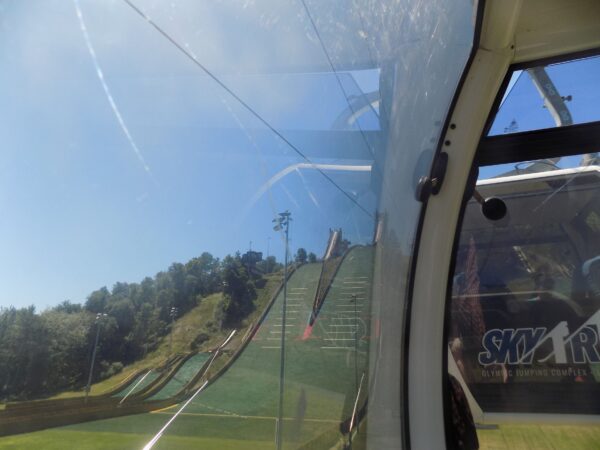
The other (costlier) option was to ride up on the gondola but down on a zip line. Since I’m rarely zippy, often out of line, not to mention slightly acrophobic, I opted for the tamer, and to my mind, safer option.
The Sky Ride takes you to the base of the tower and you ride an elevator to the top. As you should suspect, when you reach the enclosed (thankfully) viewing platform, you can see for miles and miles And miles and miles (Oh yeah). For example, the white squiggly line in the photo below is the bobsled and luge run at Mount van Hoevenberg more than five miles distant.
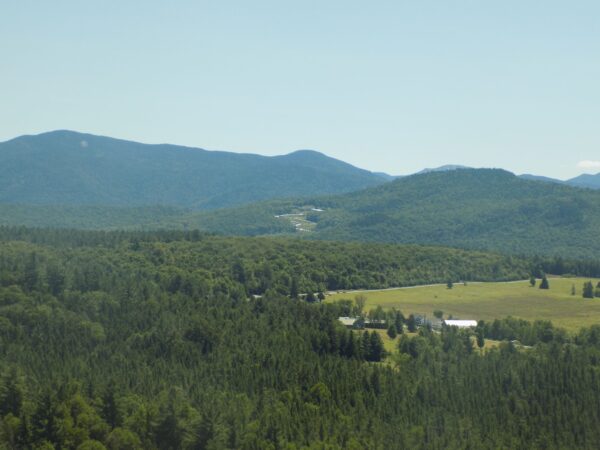
In writing about my time in Hawaii, I often mentioned the travel fatigue I experienced at the end of that nine week trip that included time in Australia and Aotearoa. By the end of my time at Intervales, I was feeling a bit of Olympics fatigue. Fortunately, one other view we had from the top of the tower
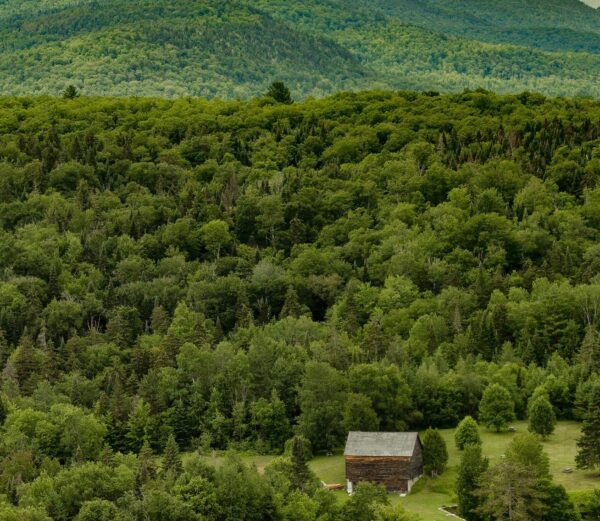
together with the accompanying description suggested an alternative. That’s coming in the next entry. While you’re waiting for that to post, you can look at some additional photos from the morning here and of the Showgrounds and Intervales here.
-
Photos and their stories – Lisbon – Summer 2026 part two – plus an egg-straordinary bonus
August 21, 2026 -
Photos and their stories – Lisbon – Summer 2026 – part one
August 21, 2026 -
The indigenous people of Da?ow?aga? (Olympic Valley and me supplement three)
August 19, 2026 -
The indigenous people of Da?ow?aga? (Olympic Valley and me Supplement two)
August 17, 2026 -
Olympic Valley in the time before humans (Olympic Valley and Me Supplement one)
August 14, 2026