Santa in a red canoe
It’s Christmas Eve and, upon reflection, a day when my emotions had more peppermint twists than the stripes on a candy cane. At the time, it was a day I’d been eagerly anticipating for months but when the day arrived, the excited anticipation became tinged with a bit of anxiety. Sitting at my computer some considerable time later, it’s the day I should want to write about the most but also the day about which I think I should write the least. It was a day for personal connection more than travel adventures and for ‘ohana – old and new. Since I can only twist again if I delay writing about it any longer I’ll get started with a shout about our early morning hike on Makapu’u Point.
On a magic sea of blue
Drive about 15 miles east from Waikiki on Route 72 and you’ll reach Makapu’u Point – the easternmost tip of O’ahu as you can see on this image from Bing Maps.
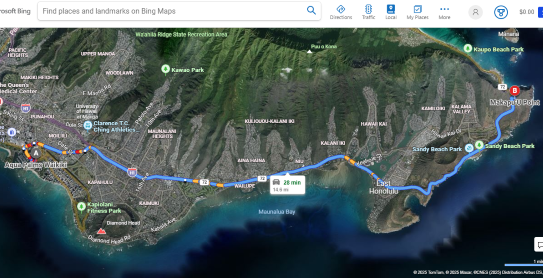
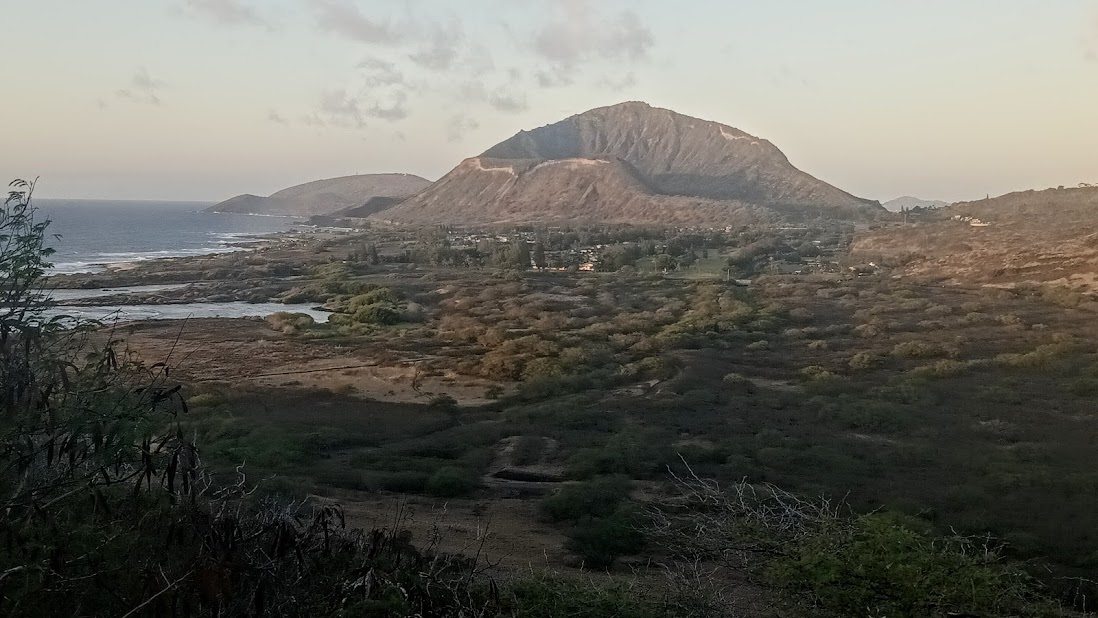
From this view, you can spot a pair of craters if you look closely – one named on the map and one not. The named one closest to Honolulu is Diamond Head. Farther east, close to Sandy Beach Park you can spot another crater. This is Koko Head and Koko Crater. Hiking up the trail to Makapu’u Point, the pair look like this.
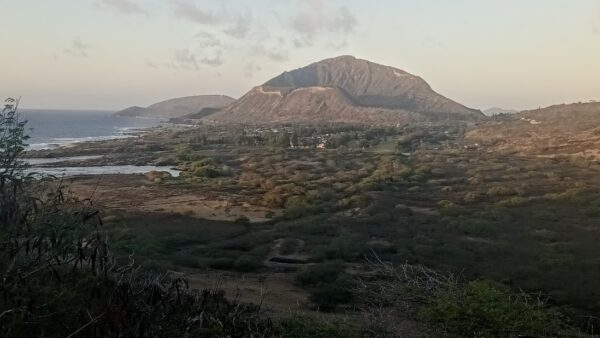
The Hawaiians call these formations Kuamo’okāne and Kohelepelepe respectively and the legend behind the latter is entertaining and interesting but also NSFW. The formations are called tuff cones.
(Tuff cones and craters are formed when rising magma interacts with water – typically groundwater or surface water. This type of phreatomagmatic or hydrovolcanic eruption is usually quite violent and it fragments the magma into fine ash and volcanic debris called tuff that accumulates around the vent creating a cone-shaped landform with steep flanks (greater than 25 degrees) and a broad, bowl-shaped crater at the summit.)
We started quite early in the morning and were on the mile-long trail shortly after 07:00. We walked at a moderate pace taking 20 minutes or so to complete the 500-foot ascent giving the day a particularly invigorating start. After spending some time at the top enjoying the conversation and the views, we ambled down the hill to embark on what my notes called the “beach tour.”
On the surface, this might sound a bit flippant but it isn’t intended in any way to be that. Recently, my sister emailed me a photo of a sign that read, “Some talk to you in their free time and some free their time to talk to you. Learn the difference.” We made our first stop quite close by at Makapu’u Beach – a place that K told me had been her father’s favorite beach.
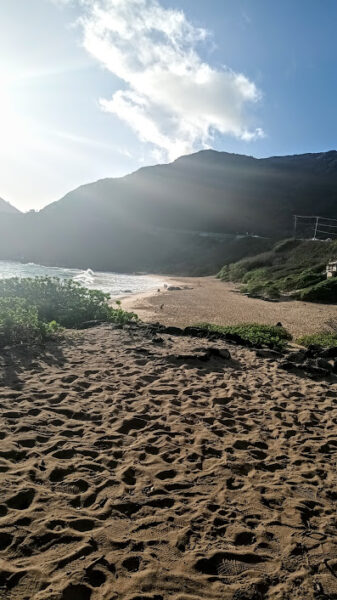
She shared many personal stories here and as we proceeded through the day stopping at several windward side beaches. It was a way to deepen our connection through shared memories. I was making the time to not only talk but to listen. As I had at many points in the Australia and Aotearoa segments of this trip and as I had at the top of Haleakala, I focused on being present. Enjoying the moment. Enjoying the company. I took few pictures and made even fewer notes.
It’s Christmas in Aloha Land
As we were traveling from beach to beach, K & P began to fill me in on the weblike intricacies connecting generations of their ‘ohana – many of whom I’d be meeting for Christmas Eve supper that night. As I noted in the first paragraph of this entry, it created a tinge of anxiety. However, I also wrote that I’d try to explain ‘ohana and now it’s time for me to fulfill that promise and save you the trouble of looking it up yourselves. (CAVEAT: Keep in mind that what I write expresses my understanding and that this understanding has not arisen as an outgrowth of extensive study or, in this instance, extensive personal experience. Although I make every effort to come to terms with any cultural and scientific principles and to communicate them with clarity while simultaneously distilling them into concentrated, easily consumed quaffs, everything I write should be considered as having low informational content.)
I think it’s fair to say that Hawaiian culture embodies seven core foundational principles. Alphabetically these would be: Aloha, Kuleana, Laulima, Lōkahi, Mālama, ‘Ohana, and Pono. Each of these Hawaiian words can be translated into English but to Hawaiians they carry much deeper meaning than the simple translation. Many readers are likely familiar with aloha as a greeting. And it is. But it’s also much more. It’s a way of being intended to foster peace, kindness, and harmony through love, compassion, and respect.
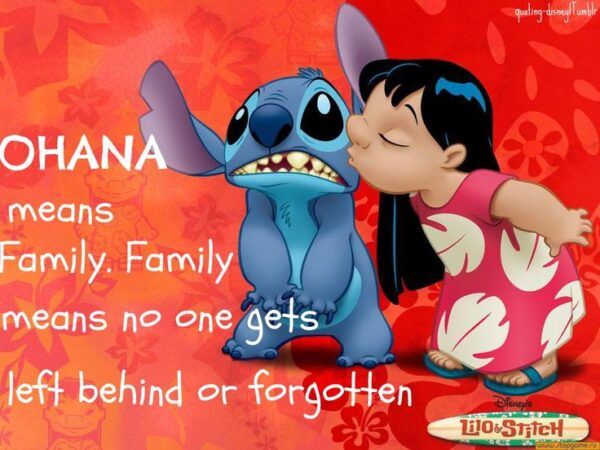
Similarly, enter the word ‘ohana into your translator (or look it up in a Hawaiian – English dictionary) and the result will be family. That’s the word. It’s not the concept. And the concept is even broader than Disney’s attempt to concentrate in a pithy, easily memorized aphorism. (Recall my visit to Hanapepe the place that billed itself as the home to Lilo and Stitch and, by the time this is published, the live action version will have been circulating for months. From this film, we have the tag line, “‘Ohana means family. Family means no one gets left behind or forgotten.”)
In Hawaiian cosmology, the land and the people trace to the union of Papa and Wākea. Wākea is the Sky Father or god of light and the heavens. Papa also called Papahānaumoku, is the Earth Mother and goddess of the earth and underworld.
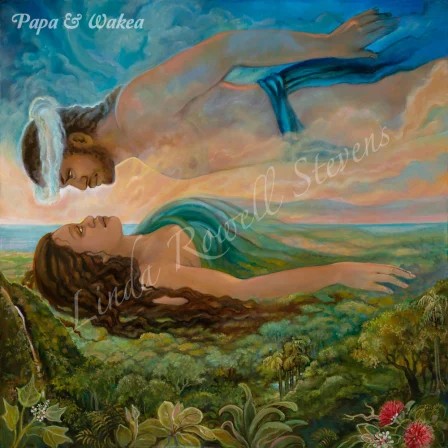
[From Journeying to the Goddess]
They are regarded as the creators of the earth and sky and as the first parents in Hawaiian genealogy. Their union produced not only the islands but also the first humans and the staple plant central to Hawaiian sustenance and culture – kalo (taro). Part of their legend has it that Haloa, their first child who was both still born and had no limbs, became the first taro plant after his burial.
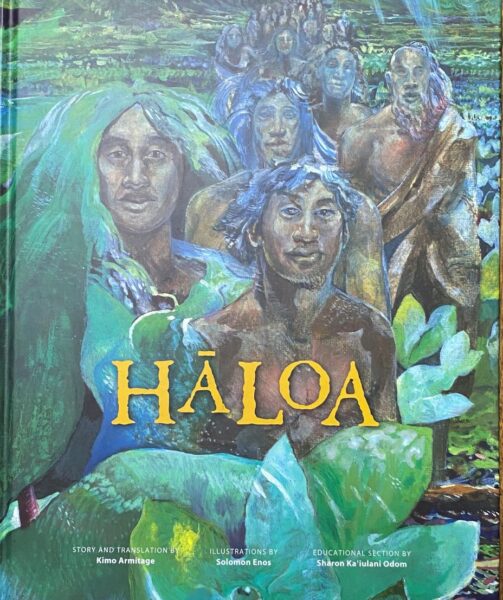
[From Papahanakualoa]
The word ‘ohana is derived from ‘oha, meaning the shoot of the taro. This connection to taro symbolizes the idea that all members of a family or community are linked by shared roots and mutual support. ʻOhana traditionally encompasses not just the nuclear family but also extended relatives, friends, neighbors, and even those who are adopted or chosen as family and this is the case with K & P who are not linked to their Hawaiian ‘ohana by genetics but have been chosen as family and chosen their ‘ohana in return.
The concept also encompasses spiritual and community dimensions. Here, mutual support, reciprocity, and shared values are central. ʻOhana is seen as the foundation for personal identity, cultural continuity, and community health.
One aspect that made me a little nervous was that within ‘ohana there exists a hierarchy of respect and care. This shapes social interactions, with people often referring to elders as “auntie” or “uncle” and close friends as “brother” or “sister,” highlighting the inclusive and supportive nature of these relationships. I worried because I’m someone que pode tropeçar frequentamente figuratively as much as physically.
With a stocking full of joy
We arrived at the home and gathering of K & P’s ‘ohana and any anticipatory nerves or slight misgivings I had quickly vanished as warmth and hospitality washed over me in waves. Even with this open welcome I remained mildly concerned (and perhaps as a result slightly guarded) about two possible missteps – one regarding the propriety of my choosing to address the family matriarch as “auntie” and, of course, identifying someone by another person’s name (something I did at least once). None of it mattered. Or, certainly I had that impression. Perhaps I’ll reach a different conclusion if I learn that my faux pas have resulted in K & P being barred from future gatherings of this sort.
When the time came for gift distribution, I was surprised (but perhaps shouldn’t have been) to hear my name called more than once. Most of what I received was comestible. Some of it survived my remaining day and a half on the island. Much did not. Of course, the former fact is rather shocking since the quality and breadth of the food was brilliant and broad. It was one of those gatherings where, even lingering long after the food has been packed away, you leave feeling so satiated that you wonder whether you’ll ever eat again.
Though one more day remained, I had little doubt that this would be my best and most memorable day not only on Oahu but of my entire time in Hawaii.
I have no photos from the party and but a few from the day.
-
Photos and their stories – Lisbon – Summer 2026 part two – plus an egg-straordinary bonus
August 21, 2026 -
Photos and their stories – Lisbon – Summer 2026 – part one
August 21, 2026 -
The indigenous people of Da?ow?aga? (Olympic Valley and me supplement three)
August 19, 2026 -
The indigenous people of Da?ow?aga? (Olympic Valley and me Supplement two)
August 17, 2026 -
Olympic Valley in the time before humans (Olympic Valley and Me Supplement one)
August 14, 2026