On the island, we do it Island Style
As I recall, P & K arrived a bit early and had some brief time to explore the Visitor’s Center before we met and I turned over the remainder of the day to them. Much as we had spent a significant amount of time eating our way around Lisbon, we would spend a good part of this day eating our way around the North Shore before finding more to eat back in Honolulu. The early part of our route looked like this.
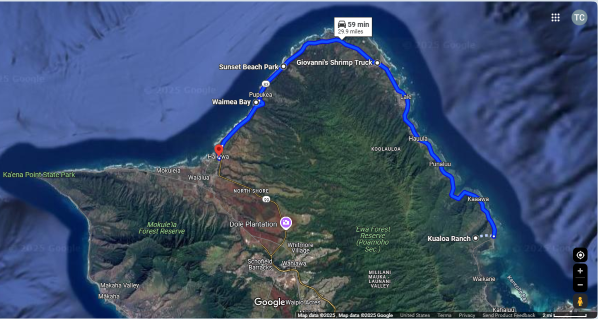
Without traffic or stops the drive from Kualoa Ranch to Haleiwa shown on the Google Maps screen capture is about 30 miles and should take about an hour. We had both stops and traffic. I didn’t note the time we left Kualoa but I’d guess it was between 14:45 and 15:00.
He ‘ono a he ‘ono a he ‘ono
Our first stop was at Giovanni’s Shrimp Truck. (I’ll peel back the shell and stress that this is a food truck specializing in shrimp not a roadside attraction of a truck made of or even meant to look like shrimp.)
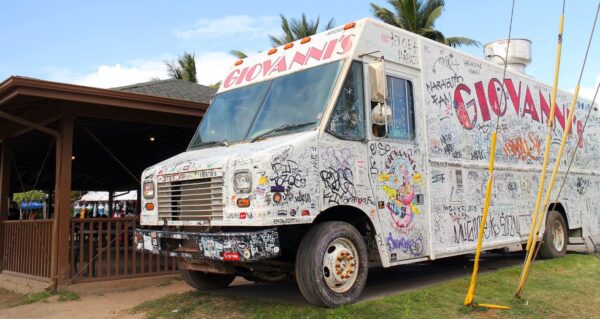
The entrepreneurs who started the operation, initially drove to various locations around the North Shore and developed such a reputation for delicious (he ‘ono) shrimp that in 1996 they parked their truck in its current location. (I believe they’ve replaced the original truck.) In 2006, they purchased the land and built the pavilion behind it in 2010. It’s not the only food truck using the pavilion any longer.
Like some of the places we ate in Lisbon, Giovanni’s reputation has spread far beyond its humble local origins. However, if K & P hadn’t been serving as my island guides, it’s unlikely that I would have found Giovanni’s on my own even had I planned a North Shore excursion.
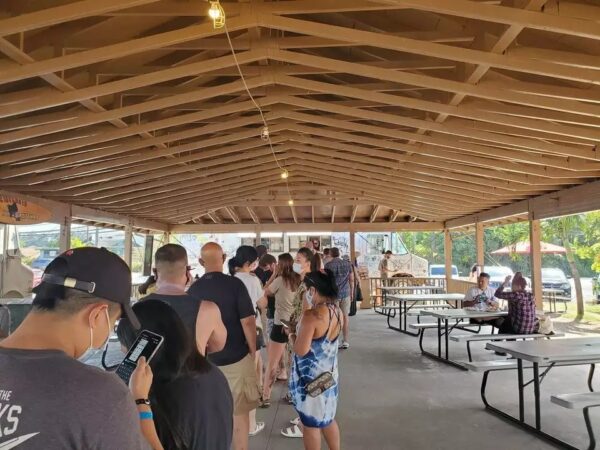
Perhaps because we arrived at something of an in between time – a little late for lunch and a lot early for supper – the line was short. We were lucky. Here’s a picture from Yelp of what we might have faced.
If you like shrimp, olive oil, garlic, and lemon butter, I can assure you that your reaction to the Shrimp Scampi from Giovanni’s will be, “‘i’o nō a he ‘ono nō.” (Indeed, how delicious.)
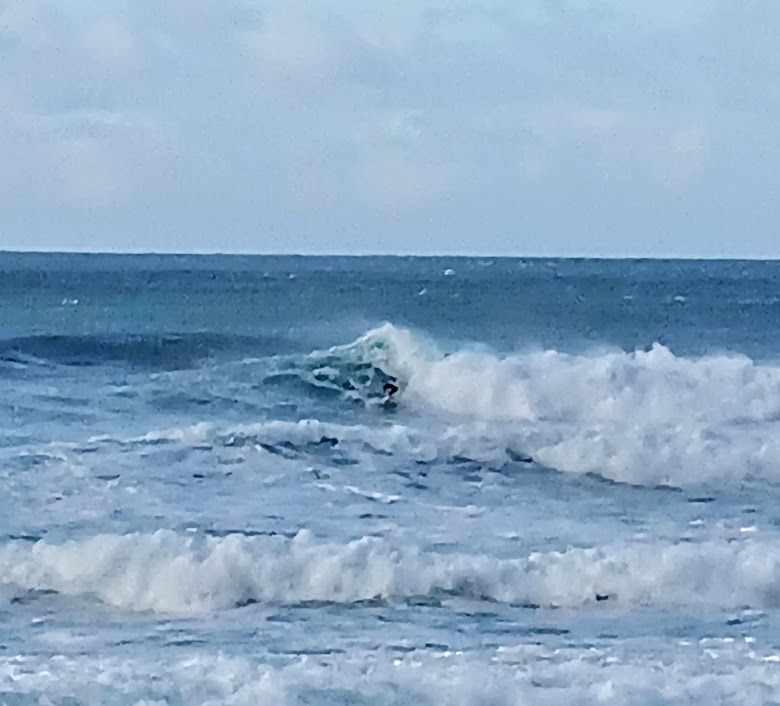
In a previous post, I mentioned that I’d missed The Eddie by mere hours and while the contest was over, the big waves crashing along the North Shore weren’t. So, while the crowds weren’t as large as they would have been yesterday, it’s likely that thousands of people remained behind and many of them would be surfers who would challenge the big waves themselves. I took this picture at Sunset Beach and
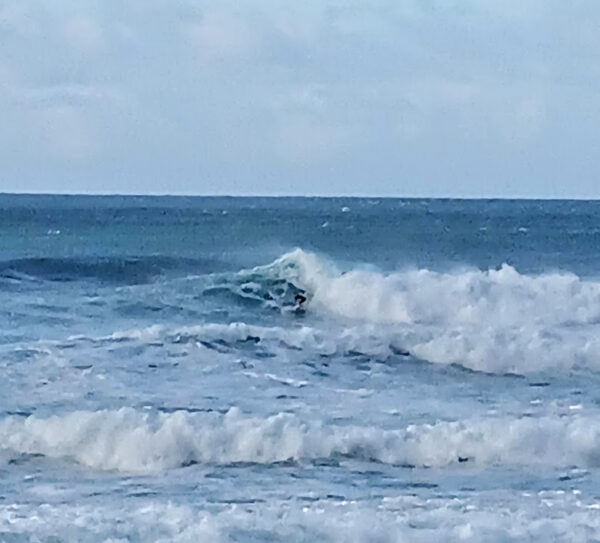
the small black spot in the center is a surfer. We also stopped for a peek at the peak waves of Waimea Bay but, like my less than accomplished attempts to photograph the Nakalele Blowhole, I was unable to take an acceptable shot of the waves crashing in at Waimea. I saw them nevertheless.
And now it’s time for shave ice. If you’ve never been to Hawaii and I asked you to quickly name five foods closely associated with the islands, I’m not sure shave ice would jump to the top. Almost certainly the list would include poi, poke, and kalua (roast pig). Some might know loco moco (rice topped with a hamburger patty, fried egg, and brown gravy) that’s perhaps the best known Hawaiian comfort food. And many might also cite Spam (the kind made by Hormel not the kind that floods your email inbox). So there are five foods for your list and shave ice isn’t among them.
(By the way, if you’ve ever had sno cones or snowballs, don’t equate either of those experiences with shave ice. Hawaiian shave ice is made by shaving ice into a fine, powdery, snow-like consistency and a soft, fluffy texture. Even the snowballs I remember from my Baltimore youth weren’t quite this fluffy and sno cones are even coarser. And in Hawaii, it’s shave ice not shaved ice.)
Although I elected to have K & P expose me to my first shave ice, you can find it on each of the islands putting forth only minimal effort. Once we passed Waimea Bay, the traffic that had kept us creeping along eased a little and it probably took us little more than 15 minutes to reach our next stop in Haleiwa – Matsumoto Shave Ice.
The North Shore shop began life as a grocery store but at some point in its history the Matsumotos started selling shave ice with their own homemade syrups. Both locals and visitors to the small town of Haleiwa turned a small operation into one that regularly had lines like this
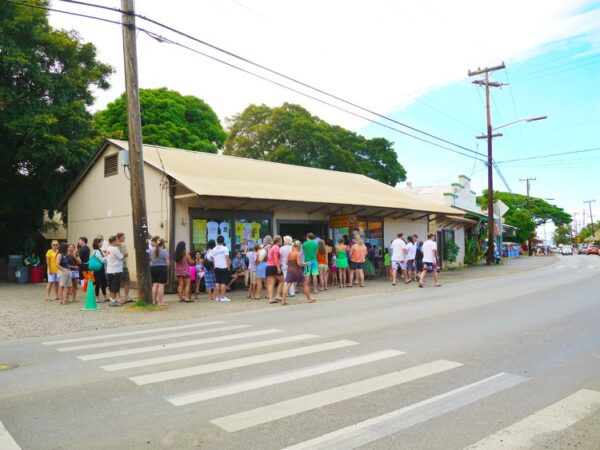
[From Matsumoto Shave Ice]
that now sells upwards of 1,000 per day from this menu.
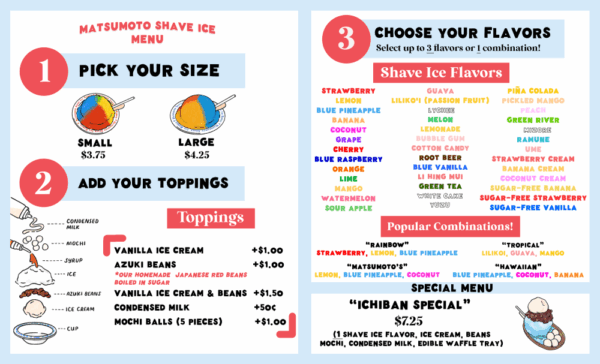
I chose a large green tea with vanilla ice cream.
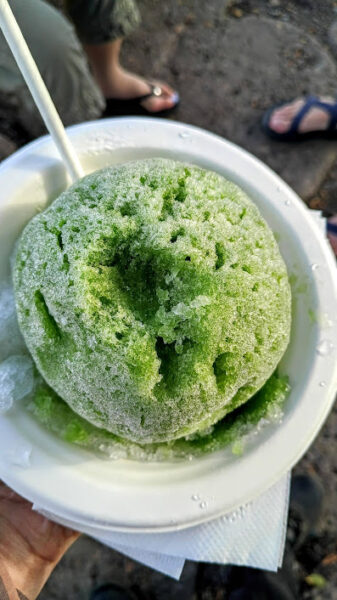
He ‘ono.
I think P & K had hoped to take me from Matsumoto to a stop at the Dole Pineapple Farm Tour but it had grown late and while it might have been possible to get there before the plantation closed at 17:30, tours end at 17:00. Thus we started back to Honolulu.
From the mountain to the ocean from the leeward to the windward side
We took a few minutes to refresh ourselves before setting out for the International Market Place. On our way, K told me a bit about the history of this spot and it seemed to me to be a story of retail gentrification Island Style. (Of course, as I’m prone to do, I’ve researched it in additional depth.)
It all started with the creation of Waikiki Village by Donn Beach – a transplanted Californian who had gained some fame for his Don the Beachcomber tiki bar in Hollywood and his Polynesian Village at his ranch in Encino. Waikīkī Village was a Polynesian and Asian Pacific themed collection of small “villages” along Kalākaua Avenue. The Villages represented Japan, Korea, China, and Polynesia with thatched stalls for vendors,
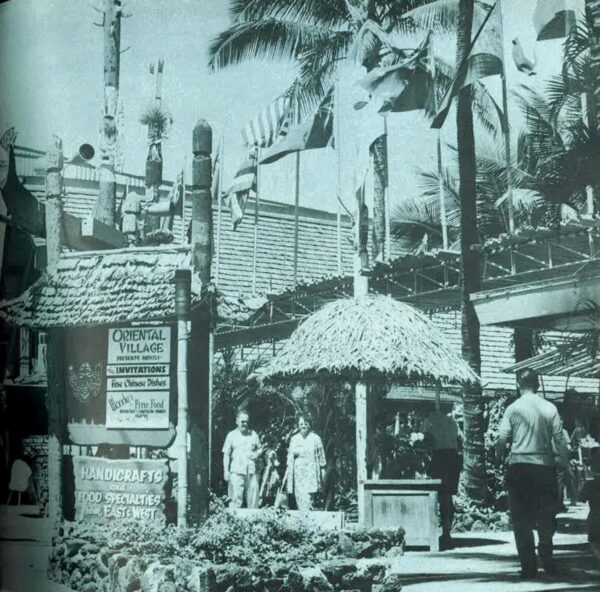
an amphitheater for Polynesian dancers and open spaces for crafts makers. Merchants typically sold folk art and an eclectic assortment of souvenirs.
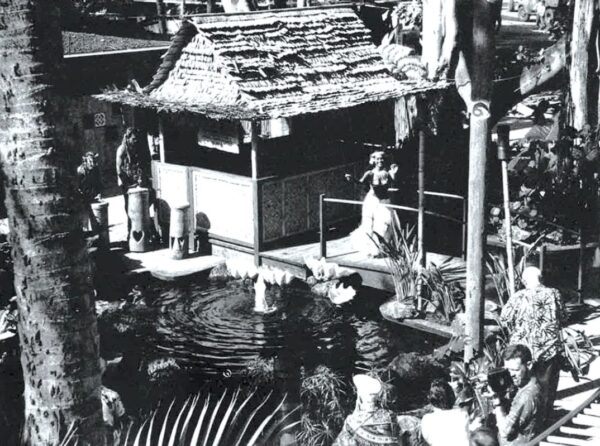
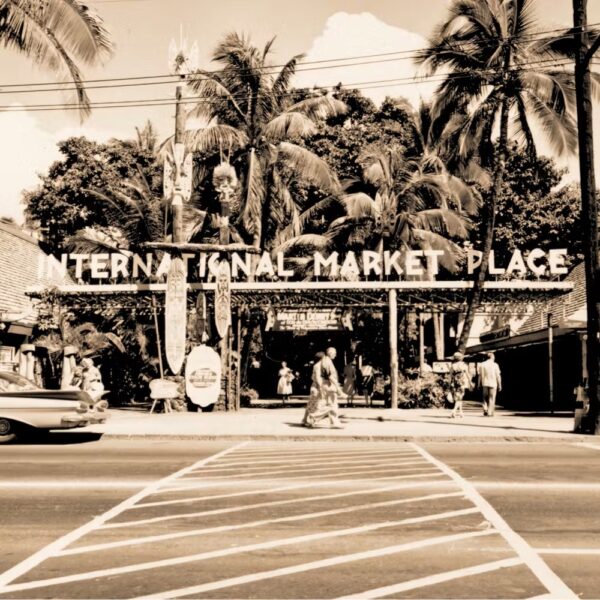
Over time, Waikiki Village would evolve into the International Market Place (I-M-P). However, this evolution wasn’t in a direction that developers and some locals found pleasing. The I-M-P, in the heart of Waikiki became populated by mom-and-pop stands helmed by “aunties” and “uncles” (some of whom were reportedly very pushy), kiosks with rainbow arrays of fake lei, towering tiki statues, and endless offerings of shell and pearl jewelry. In the eyes of some, the outdoor bazaar with its tradition of price haggling had become a hamajang collection of corny crap far removed from selling goods and goodies that represented Hawaii’s multicultural society.
The previous iteration of I-M-P
[From Honolulu Magazine]
closed on 31 December 2013 with between 130 and 180 small vendors forced to relocate. It was razed and rebuilt as an upscale mall featuring nearly 100 retailers and restaurants (many of which can be found in any large city). For the displaced small business owners, many of whom were immigrants, the closure meant the loss of affordable retail space and a reliable customer base. Some were able to relocate to Duke’s Marketplace while others were “scattered to the winds.”
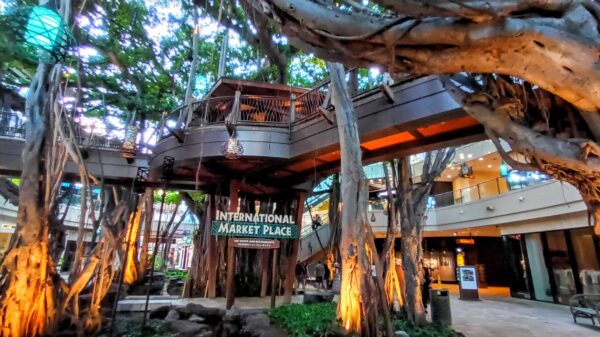
Two pieces remain. The last iteration of the sign outside the bazaar and the astonishing 175 year old banyan tree in the market’s center.
We’d rushed a bit to see as much as we could of the O nā Lani sunset Stories Hula Show that’s performed for free three nights a week.
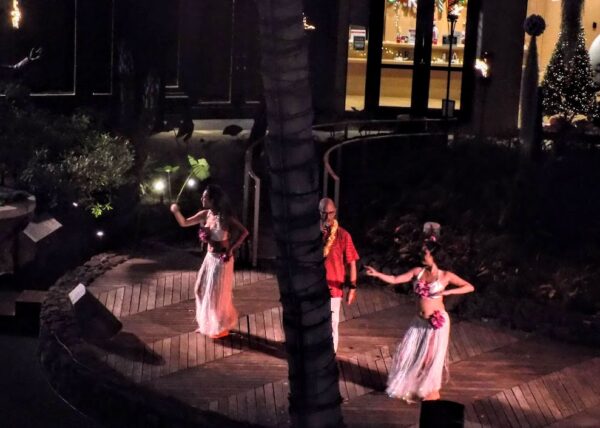
From there it was off to Eating House 1849 by Roy Yamaguchi where I had a lovely Kale Salad that felt like my first main course salad in weeks and was plenty after the late afternoon shrimp and shave ice.
But we weren’t done eating quite yet. P & K had one last treat in store for me – a stop at Liliha Bakery for a malasada. In some ways, malasadas have become something of a quintessential Hawaiian bakery treat. They’re usually round (or round-ish) and filled with custard, chocolate, haupia, ube, lilikoi, guava, or other sweet creams. In Hawaii, a malasada looks like this.
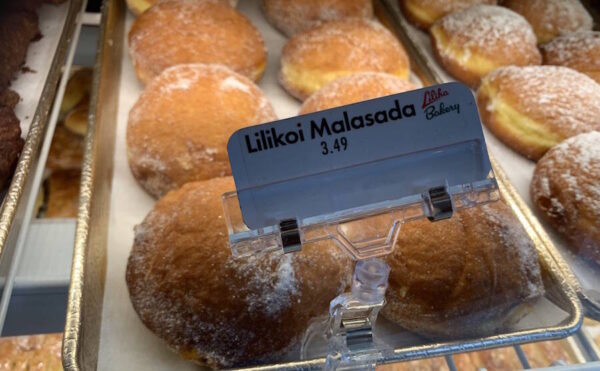
[From YAHGlobal]
I don’t recall whether K & P knew the history of the malasada. But the word itself contains a hint. Much as the Portuguese brought the ukulele to Hawaii, they also brought the malasada. Originating in the Açores and Madeira, these fried pastries were traditionally prepared for Carnaval to use up sugar and fat (especially lard) before lent. A traditional Portuguese malasada would have no filling and might look rather like this.
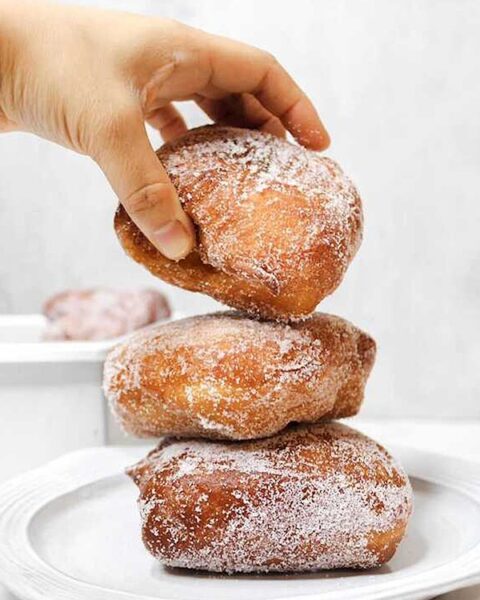
[From Taste Atlas]
He ‘ono.
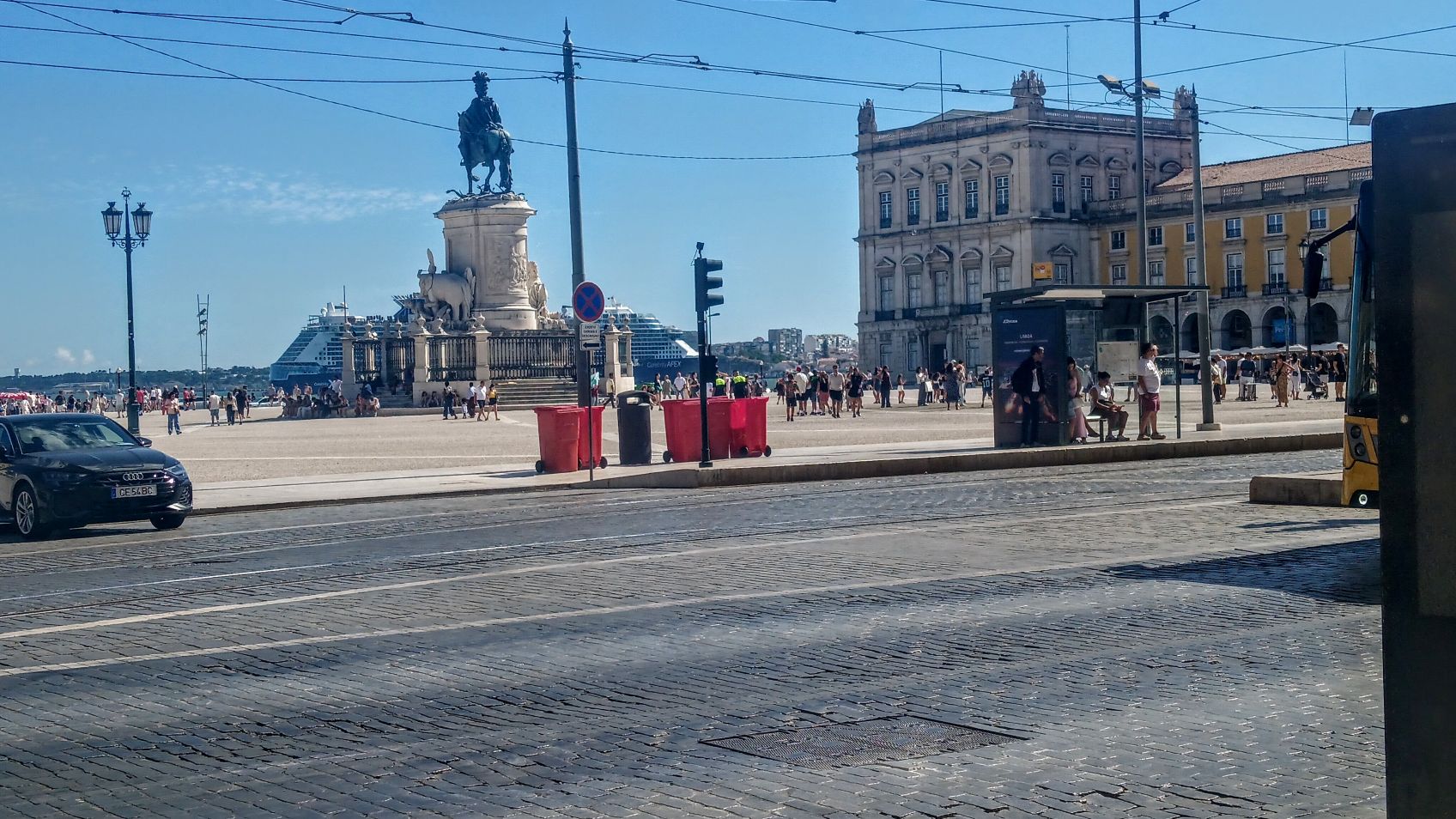
There are only a few pictures left to see but they’re here.
-
Photos and their stories – Lisbon – Summer 2026 part two – plus an egg-straordinary bonus
August 21, 2026 -
Photos and their stories – Lisbon – Summer 2026 – part one
August 21, 2026 -
The indigenous people of Da?ow?aga? (Olympic Valley and me supplement three)
August 19, 2026 -
The indigenous people of Da?ow?aga? (Olympic Valley and me Supplement two)
August 17, 2026 -
Olympic Valley in the time before humans (Olympic Valley and Me Supplement one)
August 14, 2026