Oahu – Pearl Harbor and the start of the K & P tour
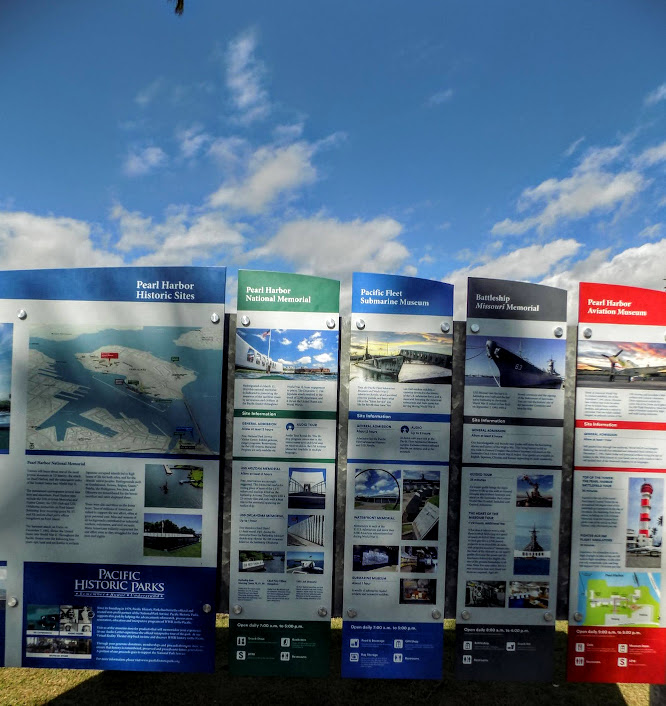
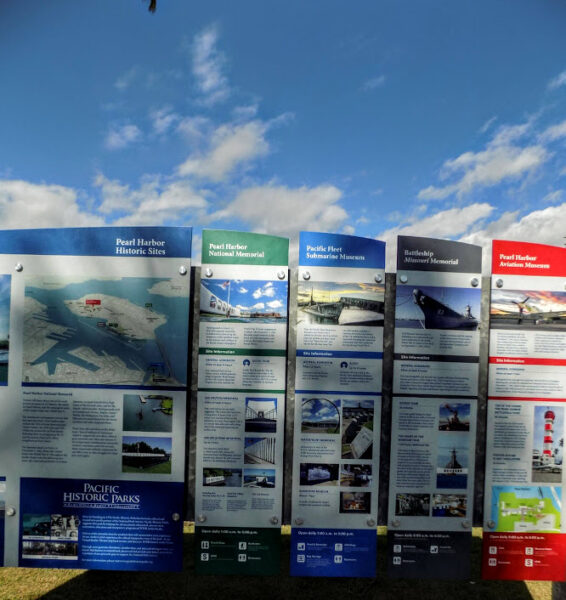
I landed in Oahu and, seemingly like magic, K & P materialized outside the terminal and whisked me off to the Pearl Harbor National Memorial for which K had secured the necessary tickets. Once we found a place to park we had a few minutes to explore the site where there’s much more to see than the USS Arizona Memorial that provides what is likely the most iconic image associated with the entire complex.
Remembering 7 December 1941
Tensions between the US and Japan had been growing for a decade beginning with the Japanese invasion of Manchuria in 1931 and a subsequent invasion of China in 1937. While Japan’s actions were widely condemned internationally, from the standpoint of the conflict that was about to erupt in war, it’s likely more important that they threatened American interests in the region – particularly in China where the U S saw real economic opportunities.
Tensions escalated throughout the 1930s with the U S imposing sanctions that increased with every Japanese conquest and that culminated with an oil embargo that directly threatened Japan’s military ambitions. The positions of the two sides were both intractable and untenable with the U S demanding that Japan withdraw from its conquests and Japan refusing to cede any of its territorial gains. Game theory in a situation like this points to war as the inevitable outcome.
Thus, as negotiations were ongoing, Admiral Isoroku Yamamoto began planning the attack in early 1941 and as early as February of that year, Secretary of the Navy Frank Knox said, “If war eventuates with Japan, it is believed easily possible that hostilities would be initiated by a surprise attack upon the Fleet or the Naval Base at Pearl Harbor.”
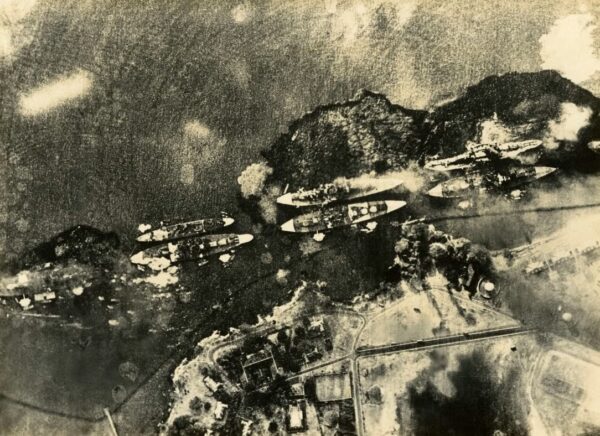
[Image of Battleship Row from The Gilder Lehrman Institute]
Admiral Yamamoto wrote, “The most important thing we have to do first…is to fiercely attack and destroy the U.S. main fleet at the outset of the war.” He believed this would prevent the Americans from interfering militarily in Japan’s expansionist plans.
If that was his goal, history shows that the plan had the opposite effect. The attack came on a Sunday. Monday, President Roosevelt and a near unanimous Congress declared war on Japan. (In 1916, Montana’s Jeannette Rankin was the first woman elected to Congress.
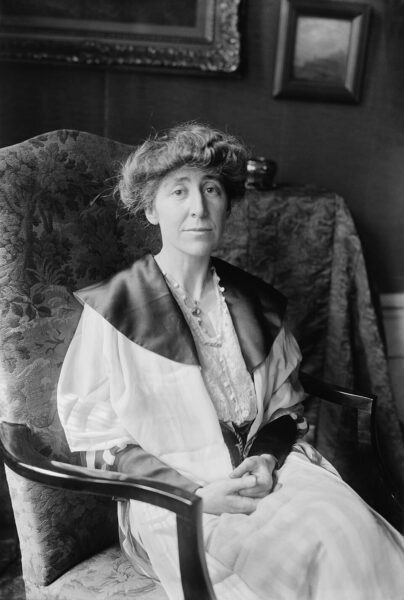
[From Wikipedia – Public Domain]
On 8 December 1941, Rankin cast the lone vote opposing the war.)
By 11 December, Germany and Italy had declared war on the United States and, within hours, America responded with its declaration against them.
Before boarding the boat for the solemn ride to the Arizona we were ushered into a theatre to see a short 23-minute film about the tensions that led to the attack, the surprise raid itself, and the immediate aftermath. It makes no attempt to recreate the attack but does use some actual footage from the day.
Between the film and my own research I learned a number of facts I hadn’t previously known. The attack sunk seven American ships and damaged many more. All but three – the Arizona, the Utah, and the Oklahoma – were refloated and returned to service. All three aircraft carriers were at sea during the attack including the USS Enterprise (It was not captained by James T Kirk.) and were undamaged.
(Of all the resurfaced ships, I found the story of the USS Nevada particularly interesting.
It was the only battleship that managed to get underway during the attack but was hit by one torpedo and at least six bombs in the process. This forced the captain to beach the ship at Hospital Point.
After the Nevada was refloated and repaired
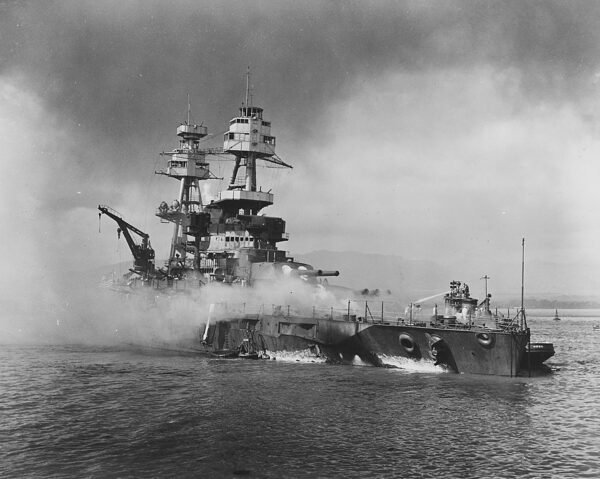
[From Wikipedia – Unattributed]
it served as a convoy escort in the Atlantic and as a fire-support ship in four amphibious assaults. Here’s where the story got interesting. At the end of World War II, the Navy assigned it as a target ship in the atomic bomb experiments conducted at Bikini Atoll. They retired the ship in 1946 and sunk it during naval gunfire practice in 1948.
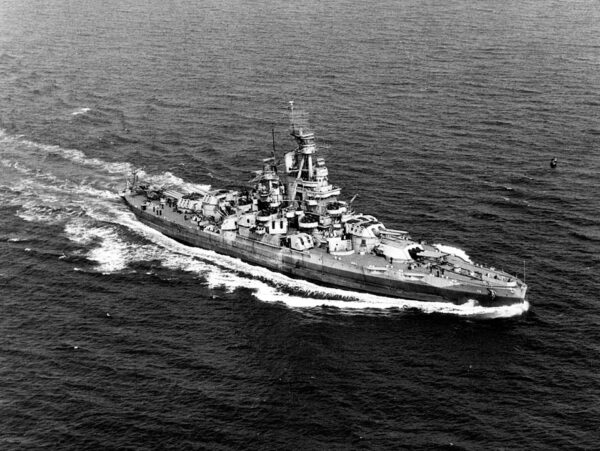
[From Wikipedia – Public Domain]
I found it interesting because within three years the main U S test site for nuclear weapons moved from Bikini Atoll to the NTS near Nellis Air Force base that’s located in the southern portion of the ship’s namesake state.)
One last bit of data I found interesting was that one element that contributed to the success of the Japanese attack was that a radar operator detected the incoming Japanese planes but his warning was dismissed as a flight of American B-17s expected from the mainland. This mishap would repeat itself just over two months later when the Japanese made their first attack on Darwin, Australia. In the post in the name of all the angels or the devils, I wrote,
As had happened at Pearl Harbor barely two months earlier, the incoming Japanese aircraft were initially misidentified. Australian radar operators thought they were 10 USAAF P-40s that were returning to Darwin after aborting a flight to Java due to bad weather.
The official American death toll on that day was 2,304. It includes Navy, Army, and Marine servicemembers and 68 civilians who died in the attack. Of that total, more than half – 1,177 – died on the Arizona. Thus, visitors need to take quite seriously the reminders from the Park Rangers that we are, in effect, visiting a cemetery – albeit a cemetery unlike any I had ever visited or would likely ever visit again.
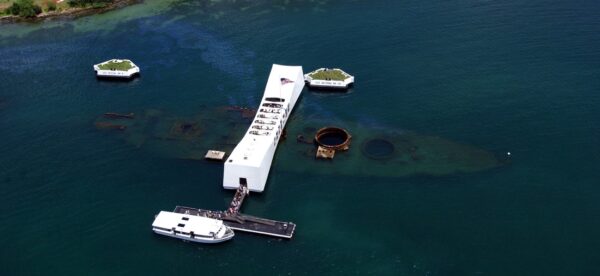
(I used the above picture from NPS because it provides a perspective unavailable from the boat or the memorial itself and because I took very few pictures of my own.)
The K & P tour begins in earnest
It’s probably inaccurate to say that our visit to Pearl Harbor wasn’t part of the official K & P tour because they made all the arrangements to make it happen. I’m treating it as a gray area because I don’t know if they consider this part of “their Oah’u.” (I never asked!)
What I do know is that after that visit and checking into my hotel we met for supper and they took me to a favorite Japanese restaurant called Teishoku. It’s in a strip mall about five miles from my hotel and it’s certainly not a place I would have found without their local knowledge. I think I had Misoyaki Butterfish. (I write I think because I might not be reading my scrawled note from the night correctly. I also couldn’t read the restaurant’s name and, when I sat down to write this, had to ask K to refresh my memory.)
After we returned to the neighborhood of the hotel, we walked through and around Fort DeRussy Park
(photo from a later day)
before eventually finding our way to Lappert’s near Hilton Hawaiian Village. Let’s just say I had two scoops and while supper was delicious, there’s very little I enjoy more than spooning ice cream down my gullet. (I believe my two flavors were ube haupia and nene tracks.)
Eventually we found our way to the Moana Surfrider Hotel for a nightcap. This hotel resides in a special place for K because it was here that her parents made the first connection that would become ‘ohana.
I fear my meager pictures from the day may disappoint you. Nevertheless, here’s that link.
-
Photos and their stories – Lisbon – Summer 2026 part two – plus an egg-straordinary bonus
August 21, 2026 -
Photos and their stories – Lisbon – Summer 2026 – part one
August 21, 2026 -
The indigenous people of Da?ow?aga? (Olympic Valley and me supplement three)
August 19, 2026 -
The indigenous people of Da?ow?aga? (Olympic Valley and me Supplement two)
August 17, 2026 -
Olympic Valley in the time before humans (Olympic Valley and Me Supplement one)
August 14, 2026