Catch a wave and you’re sitting on top of the world
Today started with a farewell to the folks at Volcano Village Inn and the 45-minute drive to the airport in Hilo followed by the 55-minute flight back to Oahu where, for the first time in three landings there, I’d actually exit the airport. I would spend more time on Oahu than I had on any of the three previous islands yet I had less idea of how I’d fill the coming four days than I did for my shorter stays. You see, I’d be meeting my friends K & P who were generous enough to fly from California to show me their Hawaii.
K (and by extension P) have ‘ohana there and, although they spend Thanksgiving on the island, this was to be their first Christmas visit. And Christmas with her Hawaiian family was one of only three things I knew I’d be doing. (I’ll explain the broad embrace of ‘ohana – which is an essential part of Hawaiian culture – later in this blog.) The other two things I knew in advance of my arrival were a trip to Pearl Harbor and a half day at Kualoa Ranch. Otherwise, I’d left all the planning to them.
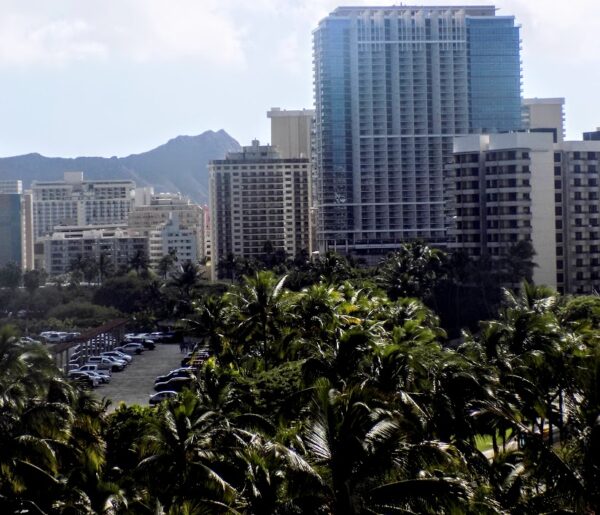
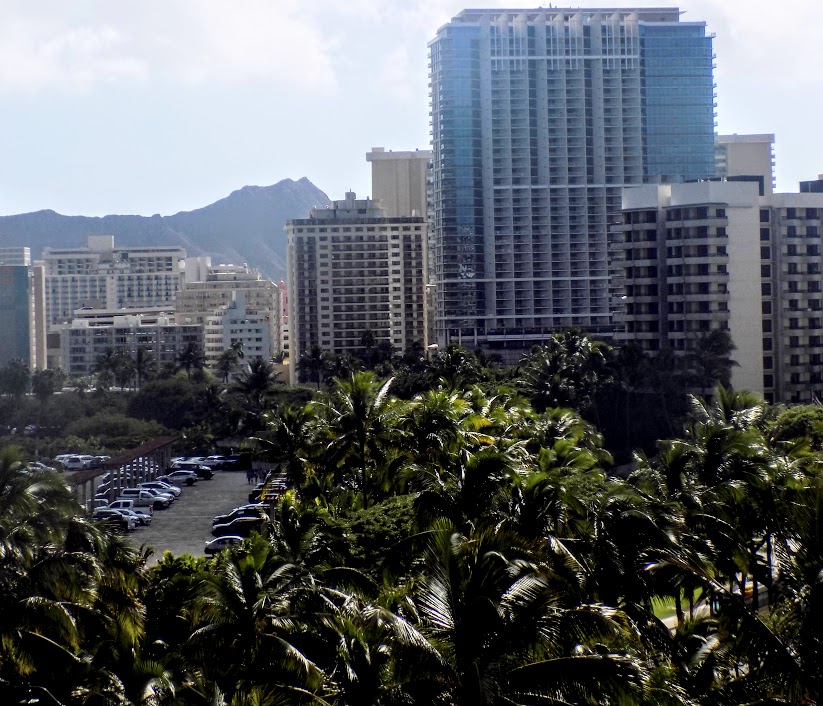
(This is the view I had from my hotel. It’s out of sequence but I thought your eyes deserved a photo break.)
Unfortunately for K & P they’d face a taller task at keeping me entertained than I did when they visited me in Lisbon earlier in 2024. The main obstacle they’d have to overcome was my travel fatigue. However, their burden grew heavier as I became aware of a pair of events that were out of my control but that frustrated me (at least briefly) nevertheless.
The first came via a text message I received (and promptly deleted) from my friends at Volcano Village Inn that Kilauea had awakened. As this photo by M Zoeller from the USGS shows,
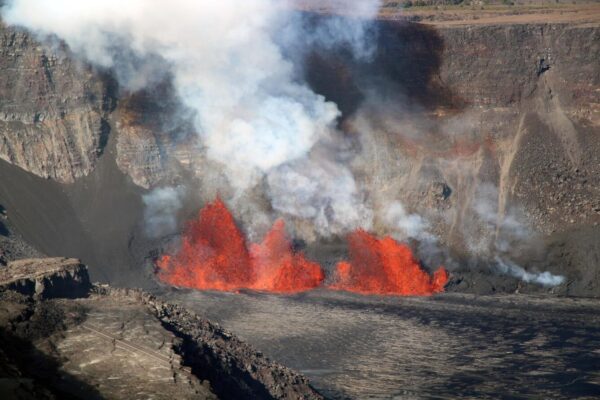
it wasn’t a massive eruption but it would have been cool to see. And I’d missed it by a day.
You paddle out, turn around and raise
Have you heard of Eddie Aikau?
If you’re a surfing enthusiast, the answer to the above question is probably yes. If you’re a fan of big wave surfing, the answer is definitely yes. For those of you who are neither and probably haven’t, here’s a little background about Eddie and the contest that bears his name.
Eddie Aikau was born in 1946 in Kahului, Maui and in 1968, at age 22, he became the first lifeguard hired by the City & County of Honolulu to work on the North Shore. His initial beat covered a seven-and-a-half mile stretch from Sunset Beach to Haleiwa.
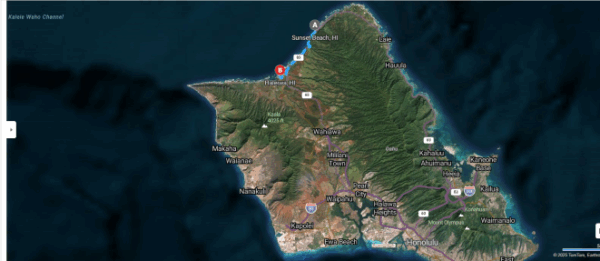
Eventually, Eddie’s bailiwick became Waimea Bay where it’s said that no one ever drowned while he was on duty and he rescued more than 500 people. Waimea Bay is one of the spots that’s known for its big waves sometimes reaching heights exceeding 30 feet. Others might have found the waves and currents daunting but it was said of him that, regardless of the danger, “Eddie would go.” In 1971, Eddie was named the Lifeguard of the Year.
Eddie had two other passions – surfing and Hawaiian culture. Part of Eddie’s legend is that no wave was too big and, while it’s not a big wave competition, Eddie won the 1977 Duke Kahanamoku Invitational Surfing Championship. Then came 1978. Boardmasters told the story:.
In 1978, the Polynesian Voyaging Society was seeking volunteers for a 30-day, 2,500-mile journey to follow the ancient route of the Polynesian migration between the Hawaiian and Tahitianisland (sic) chains. At 31 years of age, Aikau joined the voyage as a crew member. The Hokule’a left the Hawaiian islands on March 16, 1978. The double-hulled voyaging canoe developed a leak in one of the hulls and later capsized about twelve miles south of the island of Molokai. In an attempt to get help, Aikau paddled toward Lanai on his surfboard. Although the rest of the crew was later rescued by the U.S. Coast Guard Cutter Cape Corwin, Aikau was never seen again. He removed his life jacket since it was hindering his paddling of the surfboard. The ensuing search for Aikau was the largest air-sea search in Hawaiian history.
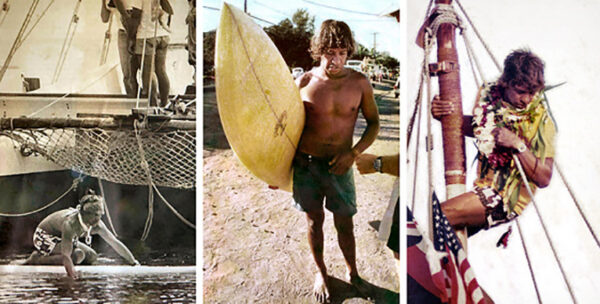
[From Boardmasters Internet Archive]
And, baby, go catch some rays on the sunny surf
The Eddie Big Wave Invitational was established in 1984 to honor Eddie’s bravery and contributions to Hawaiian culture and surfing. The first official event took place in 1985 at Waimea Bay. It’s known worldwide as simply, The Eddie.
To truly capture the essence of Eddie’s fearlessness, the event set a unique condition: it would only run when the waves at Waimea reached a minimum height of 20 feet Hawaiian scale which is based on open ocean swells. This translates to 30-40 feet face height when they crash into Waimea Bay.
The first Eddie was called for 3 January 1985 and the waves were huge even by those standards. They considered canceling the event but Mark Foo, one of the scheduled competitors, looked out and said, “Eddie would go.” And thus, the phrase became legend.
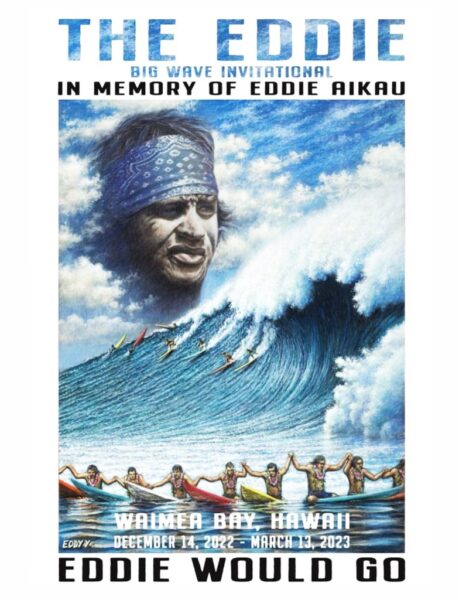
[From Bombasurf.com]
This poster shows the waiting period for the event. If the waves don’t reach the minimum size, it’s simply called-off. And it’s been called-off more than it’s been held.
The phrase “The Bay Calls the Day” is the essence of the event. When conditions align, a green light is given, and within days, Waimea Bay transforms into a global surfing spectacle crowded with surfers, spectators (as many as 30,000), and safety crews.
Unlike other contests, there are no elimination heats. Originally, every surfer in the 28 invitees got two chances to ride their best waves. The highest scoring rides determined the winner. In the current format, surfers compete in two rounds having four or five heats each. The competition day begins at 8:00 and ends no later than 17:00. Each heat in the first round lasts 45 minutes, and 50 minutes in the second round. Surfers’ four best-scoring waves over both rounds make up their total score.
And now another diversion
There’s a variation on the phrase “Eddie would go.” It’s “Eddie wouldn’t tow.” To help you understand this, I need to take you not only across the Pacific but the continental U S and the Atlantic to the small Portuguese town of Nazaré that has become famous for its gargantuan waves. It’s not a daily occurrence but waves at Nazaré have been measured at between 90 and 100 feet. In order to surf these massively fast and powerful waves, surfers use jet skis to tow them into the wave and provide enough speed to catch the swells.
(A class of big wave surfers believe that being towed-in to waves is a cheat. They will maintain that paddling into big waves requires a higher level of skill, risk-taking, and ocean knowledge than being towed-in. They see paddling as a true test of fitness, timing, courage, and commitment. For them, being towed into a wave reduces these demands, and allows less experienced surfers to ride waves they otherwise couldn’t.
As a non-surfer, I have no position on the matter and I cannot make any judgement. Even for those among you who are surfers, I’ll suggest that you watch this video before reaching any conclusion.)
For only the eleventh time since its inception in 1985, the call went out to the competitors on 22 December 2024 – the very day I arrived on Oahu in mid-afternoon and the day on which I left Kilauea decided to erupt meaning I missed them both. So, in addition to my travel fatigue, K & P had to overcome my new belief that somehow the state of Hawaii had it in for me.
If you’re curious about how they fared in their task, you can join me in the next post when I meet them.
-
Photos and their stories – Lisbon – Summer 2026 part two – plus an egg-straordinary bonus
August 21, 2026 -
Photos and their stories – Lisbon – Summer 2026 – part one
August 21, 2026 -
The indigenous people of Da?ow?aga? (Olympic Valley and me supplement three)
August 19, 2026 -
The indigenous people of Da?ow?aga? (Olympic Valley and me Supplement two)
August 17, 2026 -
Olympic Valley in the time before humans (Olympic Valley and Me Supplement one)
August 14, 2026