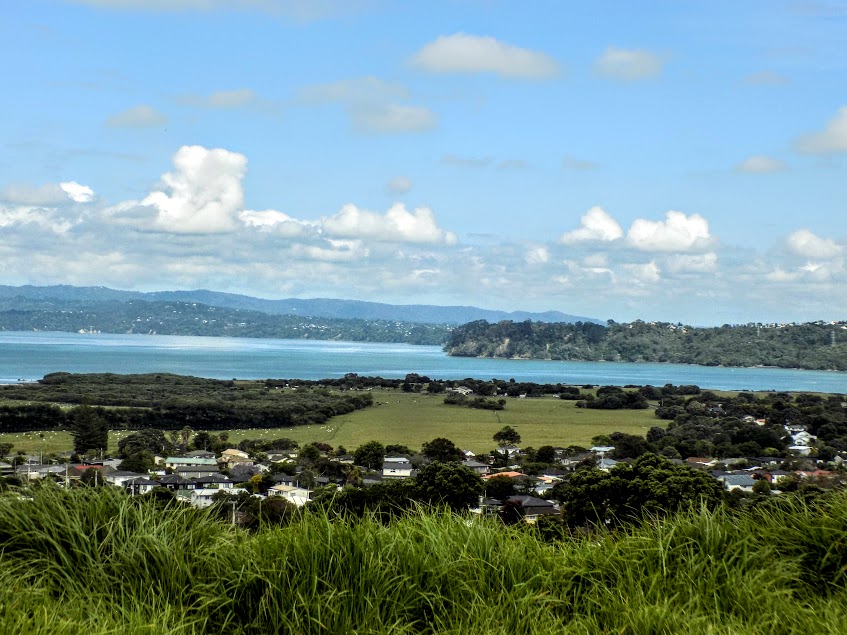
…Back of my neck gettin’ dirty and gritty – Māngere Mountain
For me, one of the great frustrations of travel is the way in which it continually exposes the limits of my knowledge be that geological, historical, or cultural. For me, one of the great joys of travel is the opportunities it presents to accumulate new information, expand what I know, and come to appreciate all the differences and similarities our planet and humanity can offer. Sharing my joy and limiting your frustration is one of the reasons I write this blog in this format.
Visiting Te Pane-o-Mataaho
Te Pane-o-Mataaho translates to English as “the head of Mataaho” as you might see in this aerial photo.
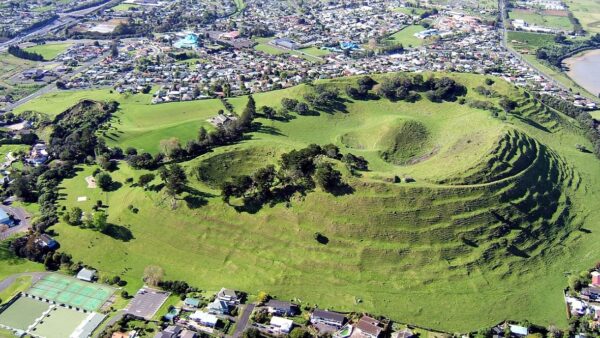
[From Wikipedia By Bruce Hayward – Own work, CC BY-SA 4.0]
Mataaho is a Māori deity considered the guardian of secrets hidden in the earth and who, with his brother Rūaumoko, is also associated with volcanic forces for several iwi of the Tāmaki Makaurau (Auckland) region of Aotearoa. (For ease of reference, I will generally refer to the mountain by another Māori name – Māngere [pronounced Mahn-guh-REH] meaning “the idle breezes.”)
Māngere Mountain is a prominent feature of a monogenetic volcanic field called the Auckland Volcanic Field. What, you ask, is a monogenetic volcanic field? A monogenetic volcanic field consists of a group of small volcanoes, each of which erupts only once thereby differentiating it from polygenetic volcanoes that have repeat eruptions over some often undefined period of time. Here’s a public domain map from 1859 of the Auckland Volcanic Field.
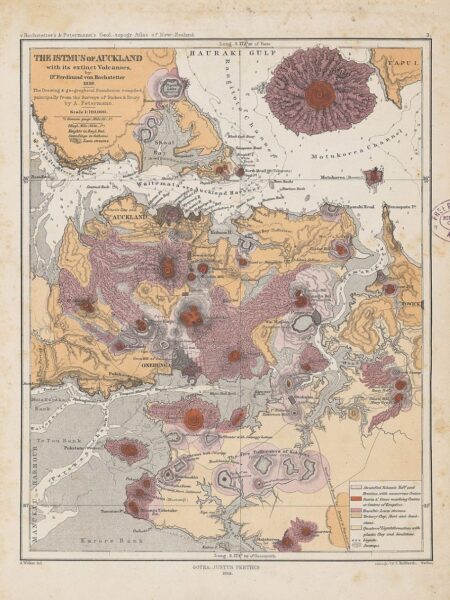
The estimated 53 volcanoes in the field have produced a diverse array of remnant formations including maars (explosion craters), tuff rings (low profile aprons of volcanic fragments), scoria cones (a steep conical hill of loose pyroclastic fragments), and lava flows. Excepting Rangitoto, which is the only known eruption since Māori reached Aotearoa, no volcano in the Auckland field has erupted more than once. Some of the monogenetic eruptions, however, lasted for periods ranging from a few weeks to several years.
In Māori legend, Mataaho and Rūaumoko created the features of the volcanic field as punishment against a tribe of patupaiarehe (supernatural beings living in the Waitākere Ranges) who used deadly magic from the earth to defeat a war party of patupaiarehe from the Hunua Ranges. In another legend, Mataaho lived in the crater with his wife who left him and took all his clothes. This prompted the fire goddess Mahuika to send fire into the Earth to warm Mataaho. This formed Ngā Huinga-a-Mataaho or the gathered volcanoes of Mataaho.
Or is it Te-Ara Pueru?
Calling the 106 meter tall hill Te Pane-o-Mataaho shows that the site has spiritual importance to the Māori. Its other names, Te-Ara Pueru and Ngā Hau Māngere, embody some of its historical importance. Te-Ara Pueru means “the dogskin cloak path” and describes a battle strategy used by Te Taoū warriors of Ngāti Whātua in a successful raid of a Waiohua pā in a conflict that predates the arrival of pākehā and eventually led to Ngāti Whātua control of the area.
(Prior to the arrival of Europeans, a pā might have taken the form of a series of defensive terraces used to protect food supplies and the most fertile land of an iwi.
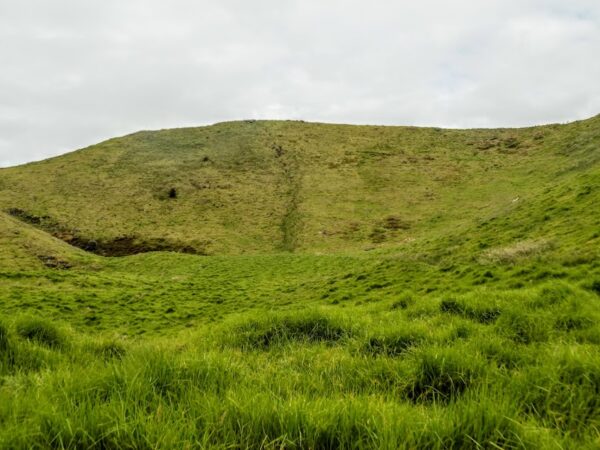
By the middle of the 19th century after the Europeans arrived and after muskets were introduced into Māori warfare, the pā would have adapted to become a more fortified village.
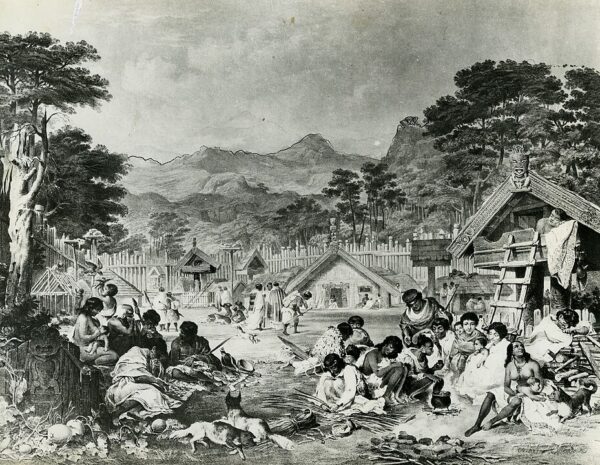
[From Wikipedia By Archives New Zealand from New Zealand – Putiki Pā, Whanganui, CC BY-SA 2.0]
In the battle referenced above, Waiohua spread pipi shells around the base of the mountain as a sort of early warning system. Te Taoū warriors covered the pipi shells with dog skin cloaks muffling the sound of their approach making their surprise attack successful.)
Recall that Māori called the settlement in this area Tāmaki Makaurau – “the place desired by many.” By at least the 14th century, Māori were using the mountain’s slopes for extensive gardens, particularly for growing kumara – a major staple food in their diet. By the early 18th century, it was a major pā for the Waiohua confederacy until they were displaced by Ngāti Whātua in the middle of that century.
Our group had two proud and knowledgeable young women who introduced themselves as Kimi Ora and Te Arangi and who shared the duty of guiding us around Māngere. They began the walk with a mihi whakatau (an informal welcome) that acknowledged the mana whenua stressing that the land is seen as both a source of sustenance and a spiritual entity tied to Māori identity and well-being. They reminded us that mana whenua is the collective responsibility of hapū or iwi, rather than individuals and includes maintaining cultural traditions. It was a fascinating morning in which the lovely views
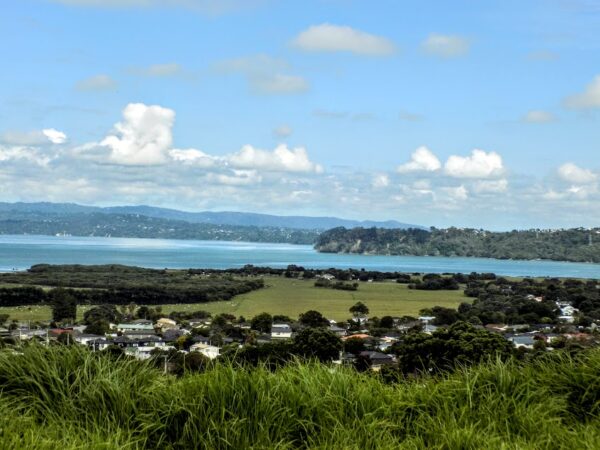
were merely supplemental.
To the North Shore and back again
After our morning at Māngere, we boarded the bus and crossed back to the North Harbor to Devonport where we had a buffet lunch at a spot called McHugh’s of Cheltenham. It was a nice enough buffet and I was able to indulge in some green-lipped mussels as part of my main course and Baked Alaska for dessert. As for Devonport, we walked past a young, thickly blooming pohutukawa
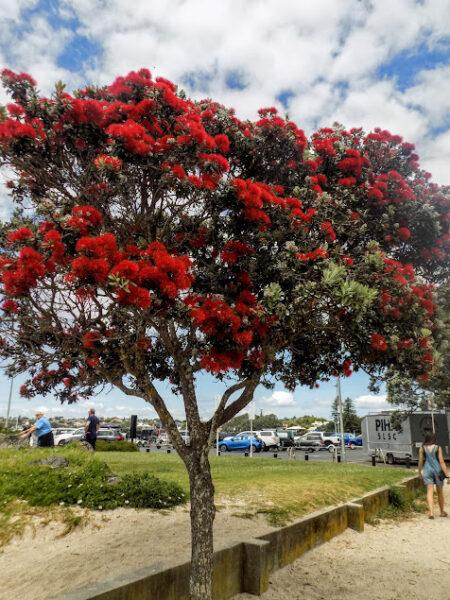
and it had a somewhat interesting shoreline
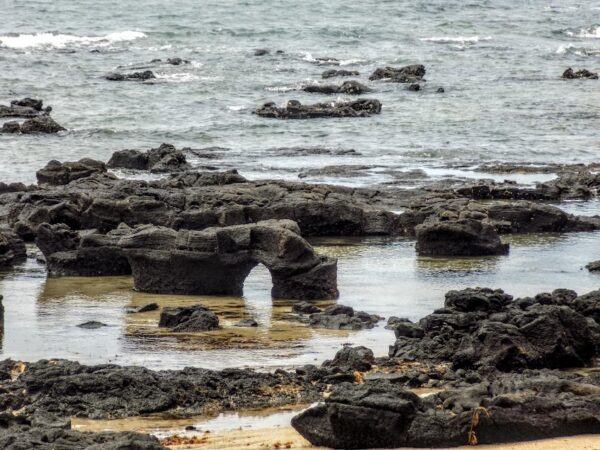
but with a planned 14:00 ferry back to Auckland’s CBD and our afternoon free, I had to wonder why we couldn’t have stayed closer to the city center.
After lunch and the ferry ride back to the CBD, much of my afternoon was rather prosaic. I cleared up an issue with my credit card that had arisen the previous night, found a barber to give me a trim since my hair had become utterly unruly, bought a few small and very packable gifts (even for this nine week series of trips, I travel with only a carry-on and personal item), did some laundry at the hotel, and managed to squeeze in a short visit to the nearby Auckland Art Gallery or, as it’s called in Māori Toi o Tāmaki. (Toi means art or treasure and Tāmaki should be familiar from the Māori name for the city – Tāmaki Makaurau.)
And I do mean a short visit. This museum, founded in 1888, isn’t dauntingly large but its collection is certainly large enough to merit more time than I gave it. The museum’s website notes that the collection’s focus on “European and British art, we now have more than 18,000 works in the collection”. To provide some perspective on the size of the collection the National Gallery of Art in Washington, DC claims more than 150,000 works in its collection. The impressionist Musée d’Orsay in Paris has some 15,000. So, not daunting but big enough.
Sitting at the base of Albert Park, we’d passed the museum on our first day walking tour. Its new building, opened in 2011 has a striking entrance of columns representing Aotearoa’s kauri tree – a tree that can grow as tall as 50 meters and that can live for 2,000 years.
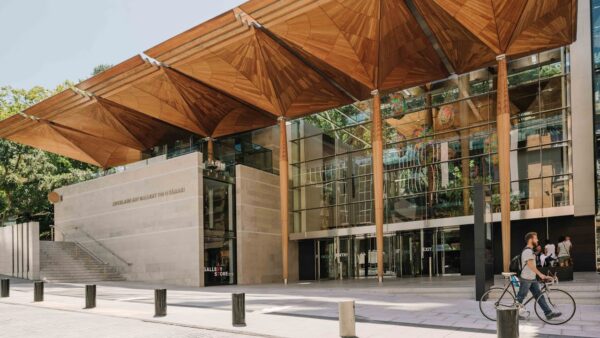
Since it was less than a kilometer walk south from our hotel, it seemed like a logical place to visit on an afternoon when I’d been so mundanely busy. I managed to walk through one exhibition or contemporary art that provided perspective on Aotearoa
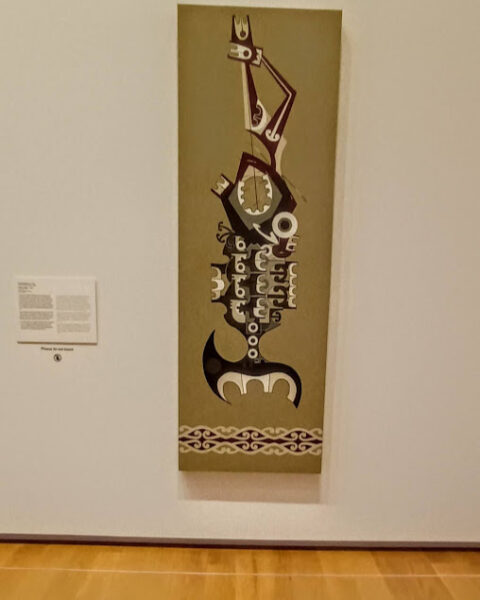
and Maori.
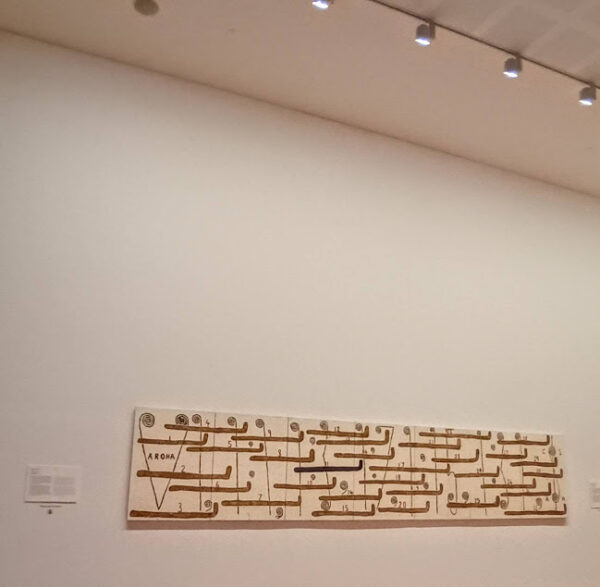
Supper was on our own and I wandered around the corner from the hotel to a place called Shucker Brothers where I shared an outdoor table with two Americans and a chap from Mexico who were on something of a working holiday and whose job descriptions left me a bit befuddled. I had three raw oysters (what else at a place called Shucker Brothers) followed by cockles in garlic with squid ink pasta and a Coopers Pale Ale. (Funny how I remember the non-included meals, eh?)
After supper it was back to the hotel to pack for our trip to Waitomo and Rotorua. And now, the moment you’ve been waiting for, pictures!
-
Photos and their stories – Lisbon – Summer 2026 part two – plus an egg-straordinary bonus
August 21, 2026 -
Photos and their stories – Lisbon – Summer 2026 – part one
August 21, 2026 -
The indigenous people of Da?ow?aga? (Olympic Valley and me supplement three)
August 19, 2026 -
The indigenous people of Da?ow?aga? (Olympic Valley and me Supplement two)
August 17, 2026 -
Olympic Valley in the time before humans (Olympic Valley and Me Supplement one)
August 14, 2026