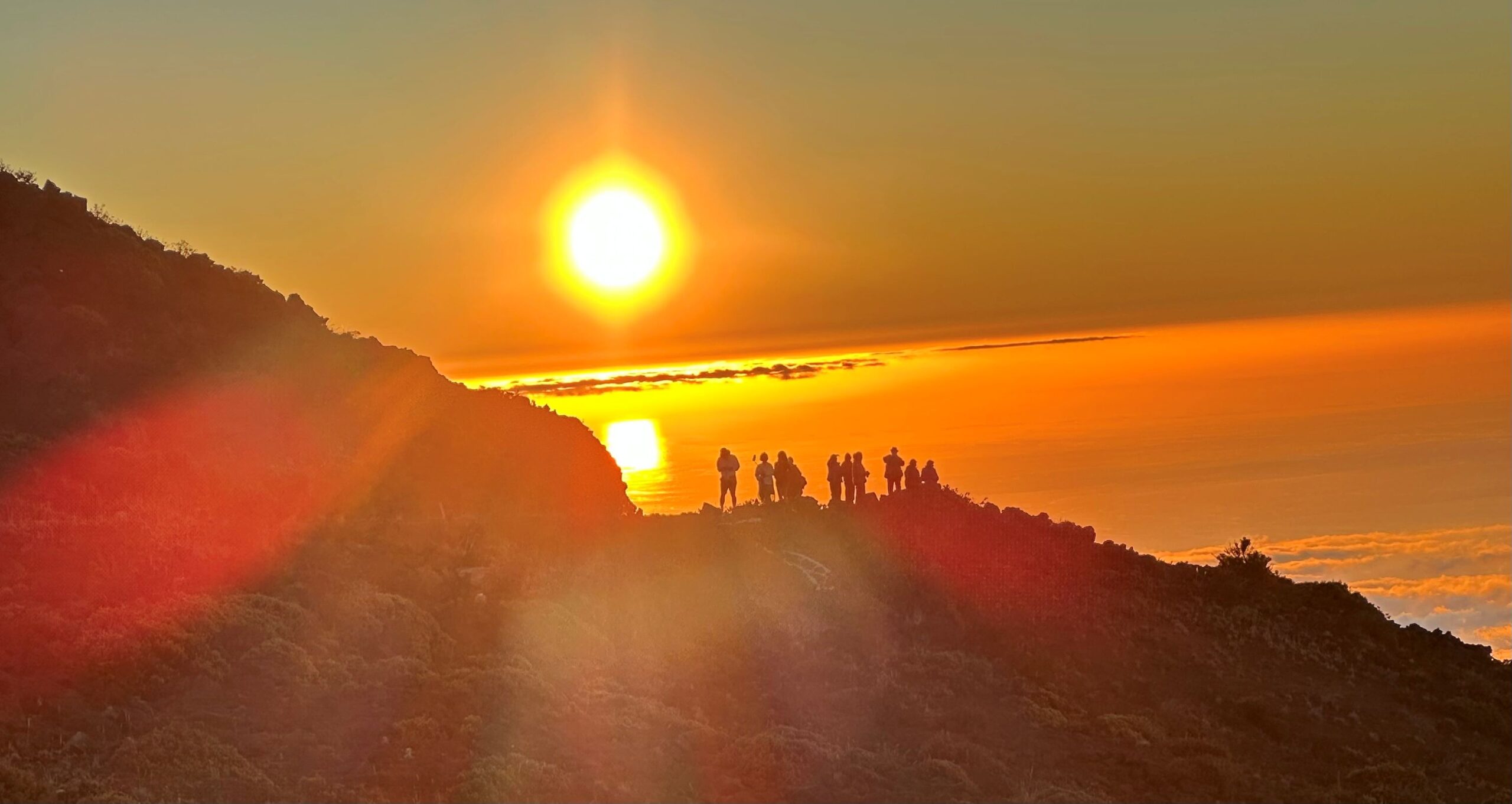
Are the stars out tonight?
Today, my time on Kauai ended with breakfast, a farewell to Phil and the staff at the Kauai Inn, a rental car return and a short flight to Kahului Airport on Maui. Arriving on Maui was a bit of the inverse of my morning on Kauai. I rented a car, checked-in to the hotel a few miles away, found a spot for lunch, and relaxed before joining the nighttime stargazing tour at the top of Haleakalā.
For lunch I chose a local spot
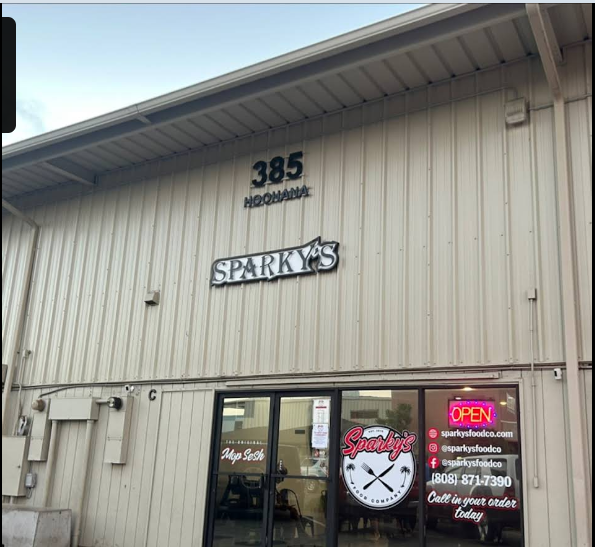
called Sparky’s that’s the permanent location for a business that started with (and maintains) a food truck. It looked interesting to me based on my internet search. I think I must have been feeling a bit nostalgic for Portugal because I added a side of Hurricane Fries to my mini order of Mochiko Chicken that came with a small salad and a scoop of rice. (French fries and rice are a common combination in Portugal). The chicken was fine but I have to admit that the fries didn’t blow me away.
I don’t know if we’re in a garden
You may not sense it but once you’re on Maui, almost anywhere you go you will be in the presence of Haleakalā – “The House of the Sun.” Geologically fascinating, the mountain ascends to a height of 10,023 feet above sea level and an estimated 28,000 feet from its base on the ocean floor. It’s an active shield volcano comprising 75% of the island.
Like all the islands and mountains in the Hawaiian archipelago, Haleakalā was built by repeated volcanic eruptions over millions of years. It has three rift zones: southwest, east, and a less active north/northwest rift that have contributed to its elongated shape and created the iconic depression often called the “crater.”
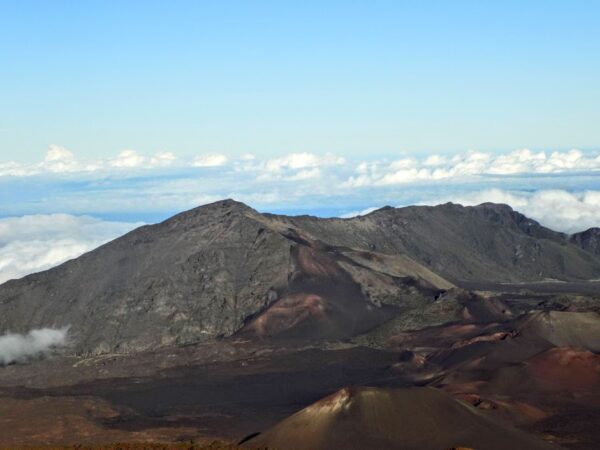
However, it’s actually an erosional valley formed by the merging of two massive valleys and not a caldera.
Visitors looking for a dramatic encounter with the mountain generally have two choices – sunrise or sunset. Until February of 2023, companies offered sunrise views from the peak followed by a bicycle descent to the ocean. However, safety and other concerns have now limited the descent to between mile markers 3 and 9-point-five on the Haleakalā Highway.
Be mindful that the sun also sets. And the adventure I chose provided not only a sunset viewing but also the opportunity to view the night sky through a 12-inch-aperture Dobsonian telescope guided by a specialist in locating both near and deep space objects.
To my eyes, the day didn’t have the most promising look as we began our ascent up the mountain.
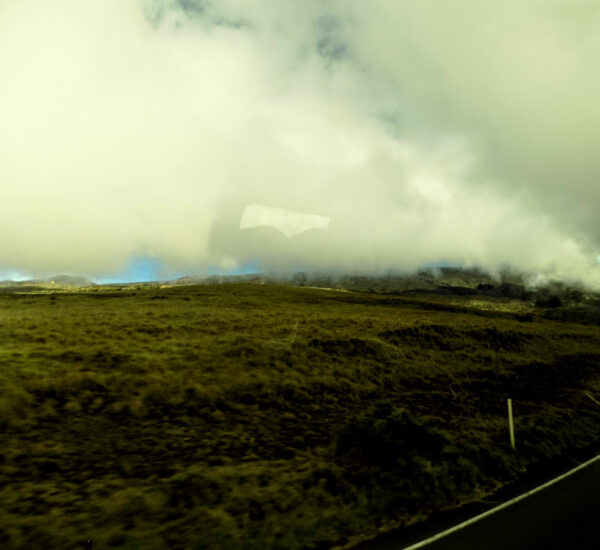
Jan, who would be our guide for the night and is the founder of Maui Stargazing, was confident that the night would be ideal. We all trusted her judgement and experience and the reason for her optimism became clear as we ascended the mountain
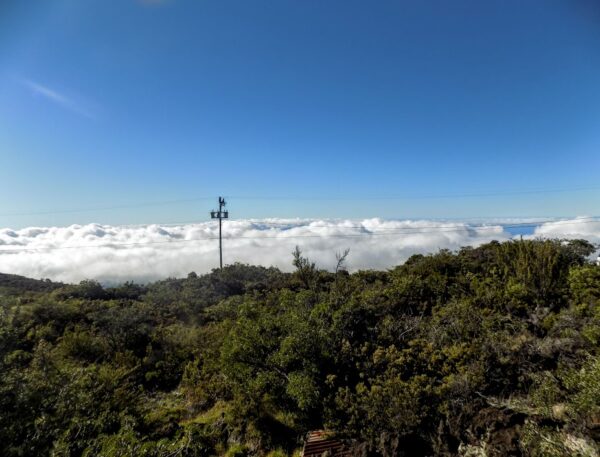
and left the clouds below us.
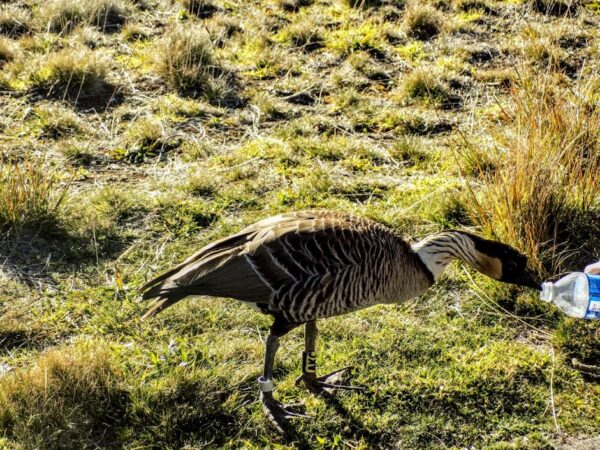
A favorite among editors and constructors, nene should be a familiar word to anyone who does American style crossword puzzles. Hawaii’s state bird is on the endangered species list but is recovering thanks to conservation efforts and its reintroduction into protected areas such as Haleakalā National Park. Among the stops we made as Jan drove us up the mountain was a parking lot where she suspected we would be able to have a nene encounter. Again, she was correct.
Outside the Visitor’s Center, we were treated to an up close view of the ‘āhinahina or silversword. Ninety percent of Hawaiian native flora are endemic and ‘āhinahina is among that group. It has long, slender leaves and a silver-white color (the Hawaiian word translates as ‘very gray’) and it has the unusual trait of only flowering once in its lifetime. The plant in the photo below is in its rosette stage that lasts for between 10 and 30 years.
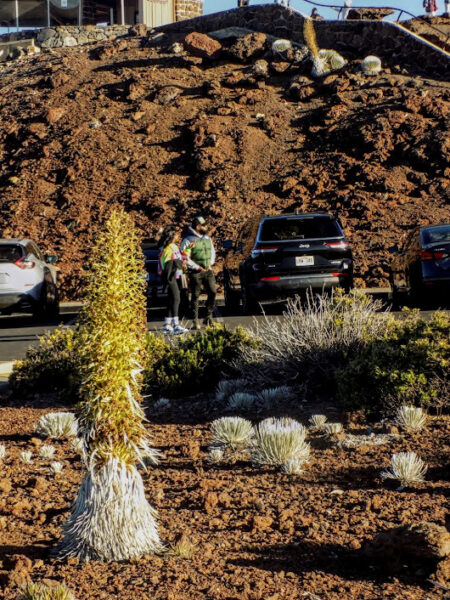
When its time comes, thousands of aromatic flowers erupt from a human-sized stalk. These are then pollinated by native Hylaeus bees and at the end of this cycle, the parent plant dies.
I don’t know if it’s cloudy or bright
Jan took us to a spot she hoped would be both isolated and quiet so actually, I did know. Below us it was cloudy.
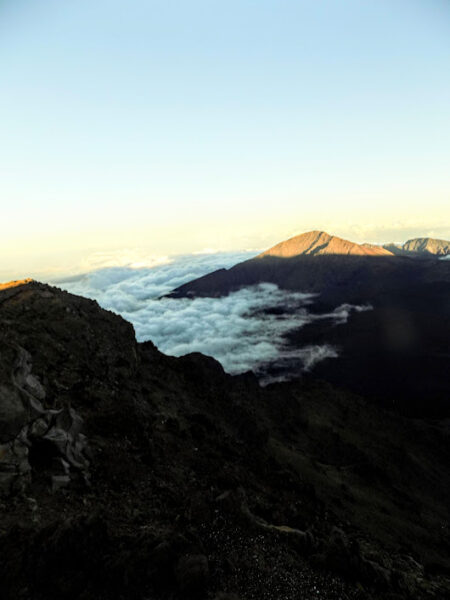
Above us it was bright (at least for a while.)
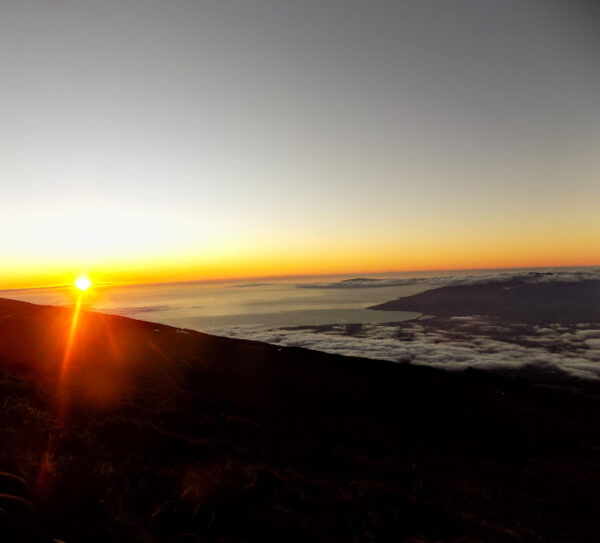
Although I’d dressed in layers and had, for the second time, both the chance and the need to wear the sweatshirt I’d been toting around for nearly two months, once the sun set, it got quite cold quite quickly and I was happy that Jan had provided winter jackets and snow pants to everyone who wanted them. (She also had gloves and fleece hats but I’d bought gloves in Aotearoa and wore my traveling hat.)
At Jan’s request, our group of 10 moved in the same general direction and we soon discovered why. She was busy snapping photos.
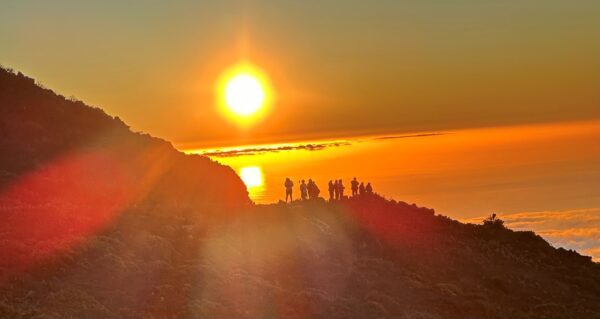
She sent us several. If you’re wondering, I’m in the group of three people on the right.
But they all disappear from view
Pareidolia. This phenomenon makes regular appearances in the stream of this blog. If the term is new to you, here’s how Live Science defines it, “a brain phenomenon in which a person sees or hears something significant in a random image or pattern. Pareidolia is what causes peoples (sic) to see faces in inanimate objects, such as an image of the Virgin Mary in grilled cheese or the man in the moon,” and the patterns of the constellations are, in many ways, a classic example of it. I usually have little problem spotting the face in the rocks or the ice cream castles in the air. But when it comes to constellations or asterisms, I’m at a total loss. I think you could remove every other object from my field of view and I will still fail to see the pattern. Here’s an example of both a constellation (Ursa Major) and an asterism (Big Dipper) from the Milwaukee Astronomical Society.
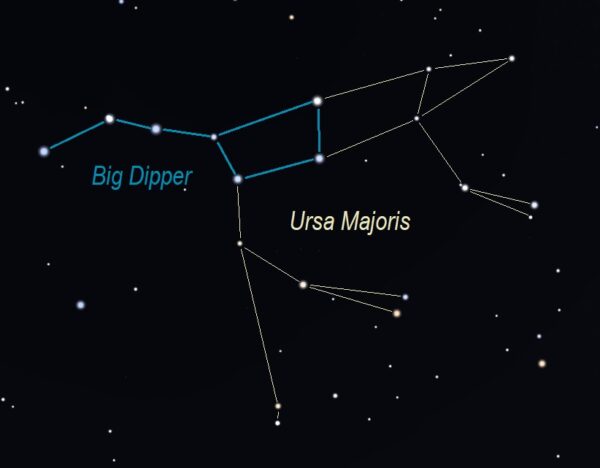
Without the connecting lines provided by the Society, I’d see neither (and even with them I don’t see a bear and the Big Dipper looks nothing like Wilt Chamberlain to me). Thus it was that when Jan took us to our viewing spot where she’d use a combination of the telescope and a laser pointer to identify objects and patterns I wondered what exactly I might see.
When she focused on the three visible planets (Venus, Saturn, and Jupiter) and four Galilean moons of the latter (Calisto, Europa, Ganymede, and Io) I saw them clearly. The galaxies and nebulae were a bit more problematic. When the laser pointer came out and started tracing as many as 20 constellations and a dozen asterisms, my interest faded. (She later emailed us a complete list of what she showed us or, in my case, tried to show me. I’ll be happy to post it should anyone make the request.) I have many photos from the day but none from the stargazing.
She also explained to us why, despite the clarity of the night and lack of light pollution, we saw so little of the Milky Way and the reason was simple. It was nearly winter in Hawaii and our galaxy’s center lies in the southern hemisphere at this time of the year.
In truth, I didn’t attempt to look at several objects toward the end of her presentation. You see, other than my tinnitus and the rustling clothes and whispers of our 11 person group, the place she’d taken us was utterly silent. And sometimes, the best choice is to simply enjoy the silence and observe the majesty of the universe of which we are such an infinitesimal part.
-
Photos and their stories – Lisbon – Summer 2026 part two – plus an egg-straordinary bonus
August 21, 2026 -
Photos and their stories – Lisbon – Summer 2026 – part one
August 21, 2026 -
The indigenous people of Da?ow?aga? (Olympic Valley and me supplement three)
August 19, 2026 -
The indigenous people of Da?ow?aga? (Olympic Valley and me Supplement two)
August 17, 2026 -
Olympic Valley in the time before humans (Olympic Valley and Me Supplement one)
August 14, 2026
2 responses to “Are the stars out tonight?”
Yeah, we experienced that absolute silence when in Arches National Park this spring. Living in Maryland between DC and Baltimore, the sound of traffic or planes flying over is always present. We reveled in the silence and majesty in Utah.
Agree. It’s a different, different feeling.