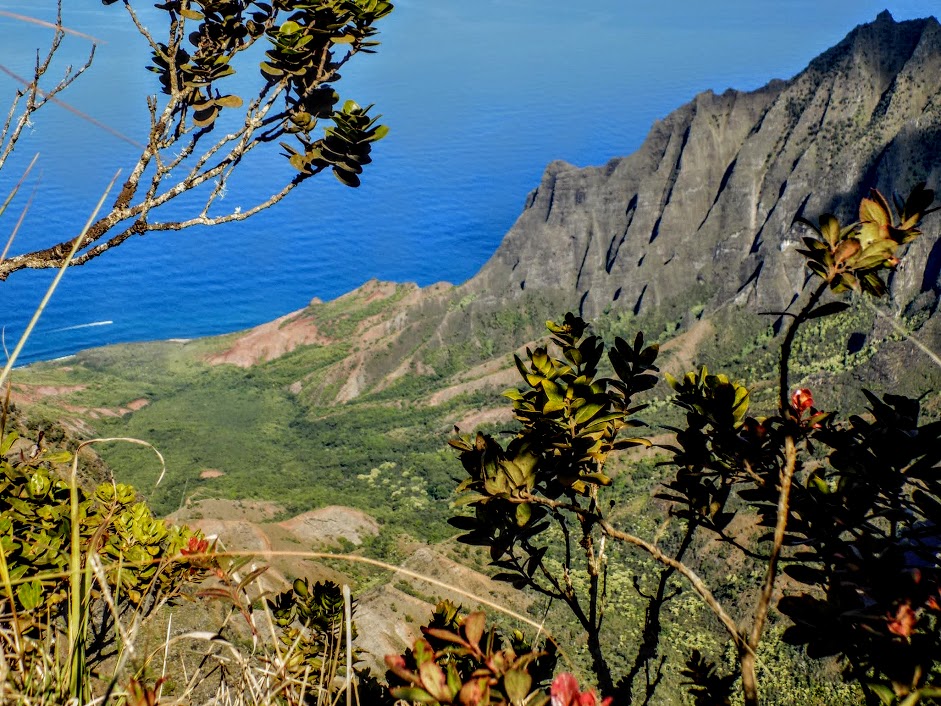
I just keep searching for that island in the sun
It’s not what you’ve got it’s what you give
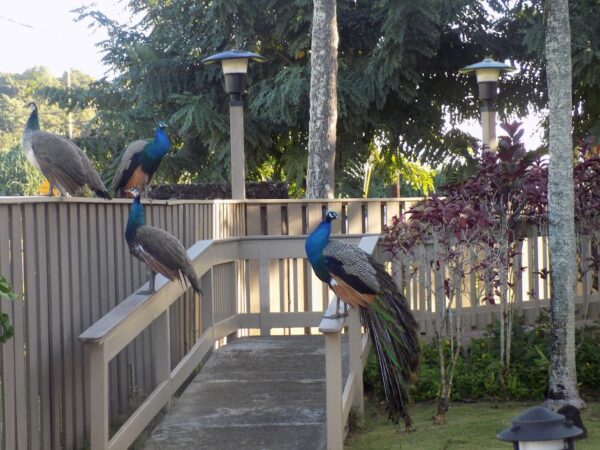
It’s Monday morning and, after breakfast, I’ll once again be heading west from Lihue. I mention breakfast because on my way downstairs from my room, I passed through a colorful flock.
Once I leave, I’ll bypass Hanapepe and drive the full 30 miles to Waimea Canyon ofttimes called the “Grand Canyon of the Pacific.”
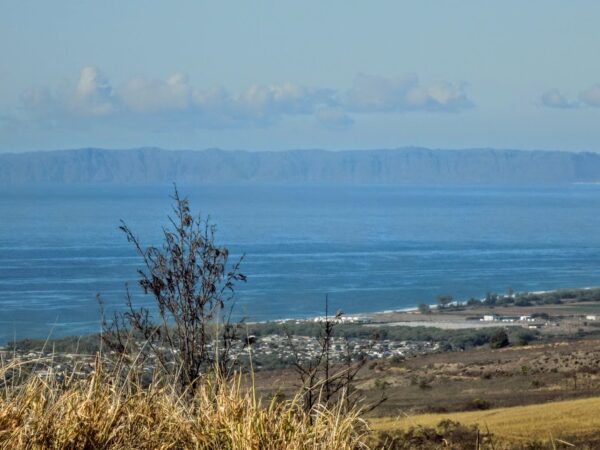
On my way, I’ll get a look across the water at the island of Ni’ihau. It’s notable because the island is privately owned by the Hawaiian Family Robinson who are descendants of the original purchasers – the Sinclair family who bought the island sometime in the 1860s. There are several other aspects of the island worth noting:.
- It’s considered the smallest inhabited island in the Hawaiian archipelago.
- At 4,900,000 years of age, it’s nearly as old as its neighbor Kauai and was formed from a single shield volcano.
- The permanent population is between 100 and 250 people nearly all of whom are native Hawaiians.
- It’s generally closed to outsiders and is the only island in the chain where Hawaiian is the primary language.
- With a goal of preserving Hawaiian culture and traditions, most residents primarily live off the land through fishing and farming. Some work on the Robinson family ranch.
- There are no paved roads, grocery stores, or other modern amenities, and the island is largely off-grid.
This is how I saw it.
I just keep on searching
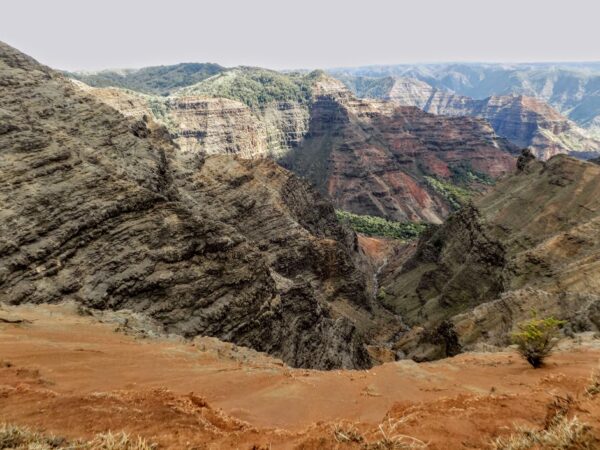
I noted above that many people call Waimea Canyon the “Grand Canyon of the Pacific.” While there are some similarities between the two, I’d suggest maintaining comparative perspective and reining in your expectations. Just as the Grand Canyon is the most expansive canyon in the continental United States, Waimea is the most expansive canyon in the Pacific region and its rugged, layered cliffs can understandably evoke some measure of comparison.
However, its age, size, and the forces that shaped and created it are quite different. It’s generally believed that although the rocks visible in the canyon are as old as 1,500,000,000 years, the Colorado River only began carving the Grand Canyon between five and six million years ago (MYA). As noted in a previous post, the island of Kauai emerged from its volcanic accretion only five MYA.
Waimea canyon began forming about four MYA when the volcanic shield that formed Kauai (unlike a toddler) went boom and fell down creating a large depression on the island (there’s no record, though, of how the island actually felt). Nevertheless, subsequent lava flows gradually filled parts of the caldera creating distinct layers of volcanic rock on the canyon walls such as those seen above.
As the island moved away from the lava flows belched up by the Hawaiian hotspot, erosion became the dominant force shaping the canyon with the Waimea River
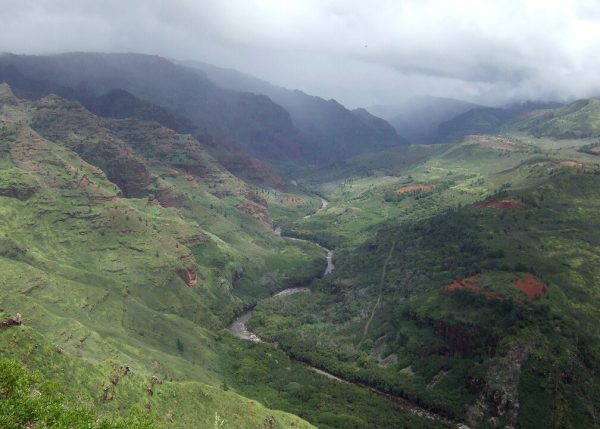
[From Wikipedia By Bryan Ochalla from Seattle, WA, USA Uploaded by Magnus Manske, CC BY-SA 2.0]
scoring most of the erosional points with weathering from wind and rain garnering the hockey style assist.
Thus, the basis for the formation of Waimea Canyon is volcanic accretion and collapse. For the Grand Canyon it was the uplift of the Laramide Orogeny some 75 MYA followed by the opening of the Basin and Range Province and capped by the tectonic rifting that opened the Gulf of California significantly lowering the river’s base level thereby increasing its erosive power.
As there are in the Grand Canyon, there are many trails and hikes in Waimea and you can read about some of them at All Trails. I limited my viewing to a few specific spots and opted not to take the Rim Trail hike (a bit over 4 miles round trip with an elevation change of 1,600 feet). A one way trip on the Grand Canyon Rim Trail is more than three times this round trip.
Some other differentiating facts and figures: The Grand Canyon is 277 miles long. Waimea is 14. The Grand Canyon has an average width of 10 miles compared to one mile at Waimea. And the average depth of the Grand Canyon is 4,000 feet with a maximum of 6,000 feet. Waimea’s depth is about 3,600 feet.
Perhaps I would have been more impressed had I not been suffering from a bit of travel fatigue and I don’t intend to diminish the grandeur of some of the views into the canyon’s interior
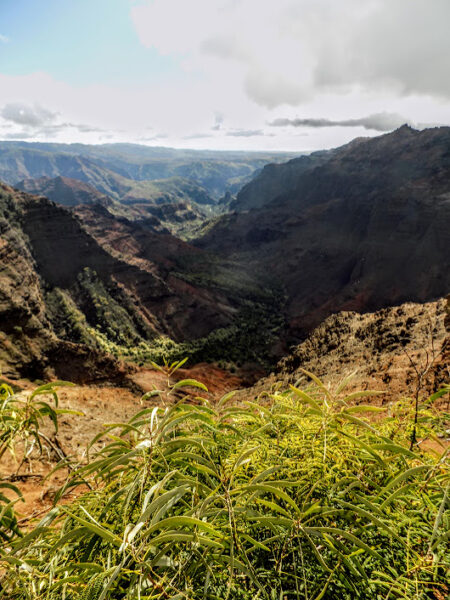
or its ocean views
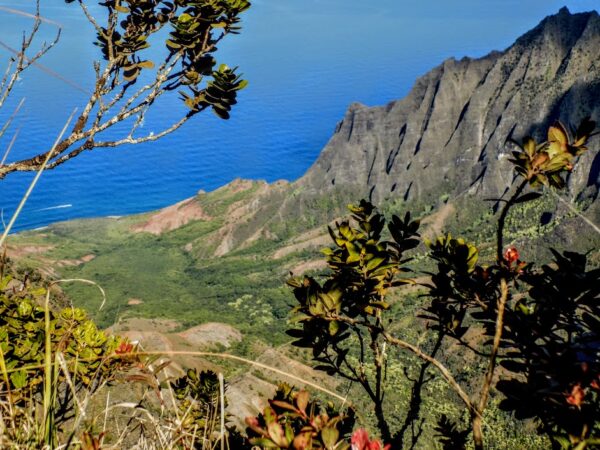
or the chance to walk at or near the top of Mount Wai’ale’ale a place that receives an average of 450 inches (1143cm) of rain annually
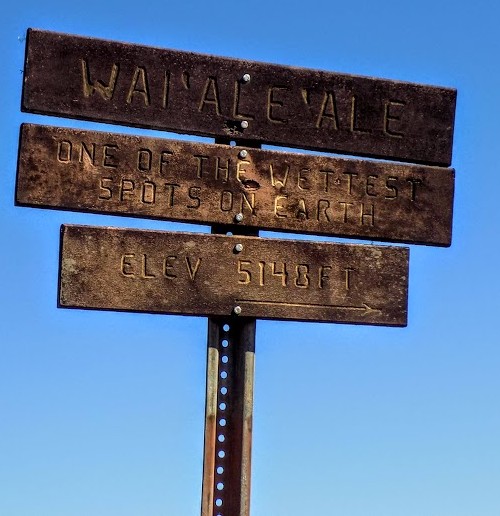
making it perhaps the wettest spot on Earth. Perhaps I was secretly disappointed because while I saw some Mamas and some Papas and was certainly there at Twelve-thirty, I saw no young girls coming to the canyon. However, it’s certainly demanding of a visit if you are on Kauai. Just don’t expect it to be quite as grand as the canyon in Arizona.
Don’t worry about the future don’t forget about the past
(No plane. No plane.)
When I’d had my fill of Waimea Canyon, it was back to the island’s east side with my first intended stop at Wailua Falls. This iconic double and sometimes triple-tiered waterfall holds important significance for native Hawaiians and frivolous significance to a tv addled teen.
Here, ancient Hawaiian warriors would prove their bravery by jumping from the top into the pool some 85 feet below. I may be borderline ancient in some eyes but I’m certainly neither Hawaiian nor a warrior in any sense so I had no intention of attempting that jump (as some people apparently still do). No. I was drawn to Wailua Falls because of its appearance some twenty seconds into the video below.
But Wailua isn’t the only waterfall of note on Kauai’s east side. Nearby, one can also visit Opeaka’a Falls. Like Wailua Falls, Opeaka’a is multi-tiered showing three thin cascades tumbling 151 feet to the pool below on the day of my visit.
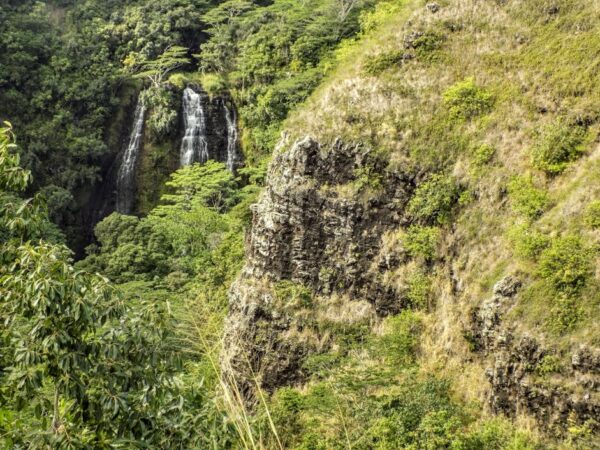
At least one source I happened across in my post trip research indicated that this cascade has some significance in the Tale of Pele and Lohiau. Apparently, it’s a central saga in Hawaiian mythology, intertwining themes of love, jealousy, rivalry, and supernatural power. However, there are several versions of this moʻolelo that are all rather long and I couldn’t find one that cited this waterfall. But while I was here a certain travel weariness took hold again and I thought of having visited Niagara, Victoria, and Iguassu Falls all of which overwhelm these puny by comparison falls perhaps more than the Grand Canyon overwhelms Waimea.
Doesn’t really matter where I’ve been or what I’ve done
I wanted to make a last stop at Whalers Cove on Kauai’s south shore hoping to spot some honu in a spot where they weren’t basking on the beach. I had some time so on my way, I stopped at Shipwreck Beach. Once known for an old wooden shipwreck that rested near the shoreline but that has long been washed away – possibly by Hurricane Iwa in 1982 – the beach is now renowned for its cliff that challenges the foolish to dive.
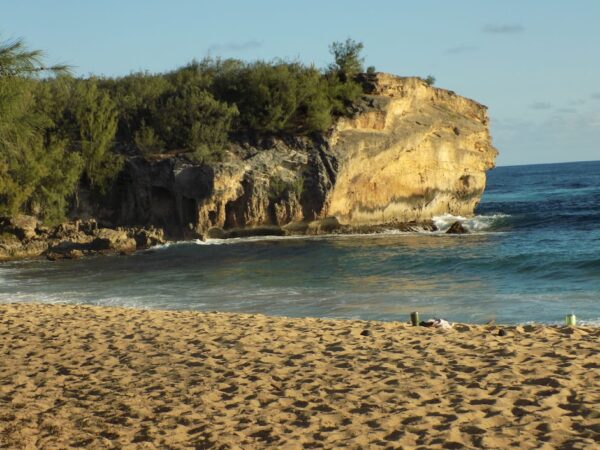
From my perspective, foolish because cliff jumpers here who dare the forty-foot fall face additional risks from strong tides, swift currents, large swells, undercut cliffs, a rocky ocean bottom, and a challenging swim back to shore with no lifeguard on duty. There have been fatalities.
My last stop for the day at Whalers Cove posed a small challenge because it’s on a private resort so I needed to park quite far or risk being towed for parking on private property. I chose the latter because it had been a long day and I was a bit tired. My concern shortened my visit but not long enough to keep me from spotting the well-camouflaged honu I’d come to see.
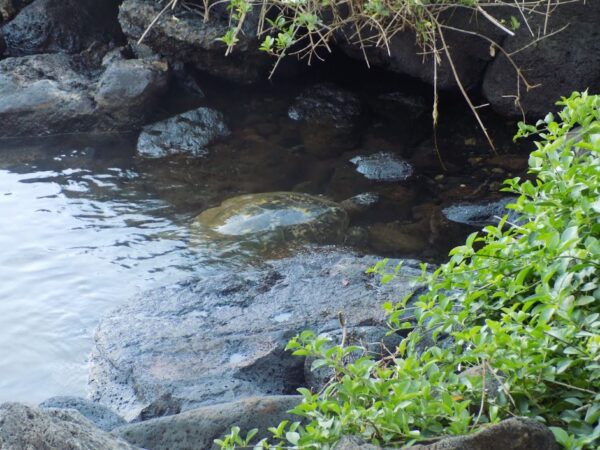
Like many things in life, dining is personal. People have different tastes in food. Having scanned at least one of the internet websites for a suggestion, I settled on picking up my dinner from Smiley’s Local Grinds (4.6 stars on Google; 4.4 on Trip Advisor and Yelp) not too far from the hotel. It was carry-out only and I settled on trying the garlic chili chicken with an additional side of lomi salmon. For me, everything in the dinner was too salty. Obviously this isn’t the case for the people who collectively rated it. This reflects why I tend not to recommend restaurants even when I report on my reaction to a meal.
Tomorrow, I leave for Maui and one of the highlights of my time in Hawaii. Meanwhile, as always, here are the day’s photos I’ve not included in this post.
-
Olympic (Squaw) Valley and Me – part one
August 3, 2026 -

Here are the songs from the México City and México City Olympics posts
May 18, 2026 -

Notes on the XIX Olympiad – the quiet protest – (México City and Me addendum three)
May 18, 2026 -
Notes on the XIX Olympiad – Successes, failures, and a Flop – (México City and Me addendum two)
May 15, 2026 -
Notes on the XIX Olympiad – Understanding Carlos and Smith – (México City and Me addendum one)
May 13, 2026