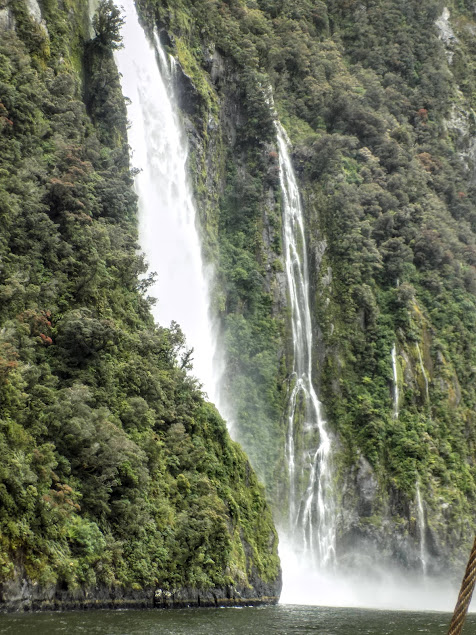
…came blowin’ in from across the sea – a wet and windy day at Piopiotahi
Those of you who have read many of these posts have probably noticed – consciously or otherwise – my tendency to use indigenous or local names for places and objects whenever I can. For me, it’s a way of showing respect to the local culture and people. While this is true in Aotearoa New Zealand it’s equally true that, in many cases, this is reflecting facts on the ground. For example, yesterday we visited Riverton / Aparima. Pākehā settlers named the town Riverton but the town was officially designated Riverton / Aparima as part of the Ngāi Tahu Claims Settlement Act 1998. Thus it is that today we will be visiting Piopiotahi /Milford Sound.
Sounds like a fjord to me
I’m sure you know that there’s a difference between a Ford and a Djodge but do you know that there’s a difference between a fjord and a sound? I pose the question because although one name for Piopiotahi is Milford Sound, but geologically, it’s not a sound it’s a fjord. So what’s the difference?
The essential difference between the two lies in the manner in which they’re formed. You need a river to make a sound but only a glacier can make a fjord. As it advances and retreats, a glacier can carve a U-shaped valley. If the floor of the valley is below sea level, water will rush in to fill the valley as the glacier retreats. Typically, fjords have steep walls on either side
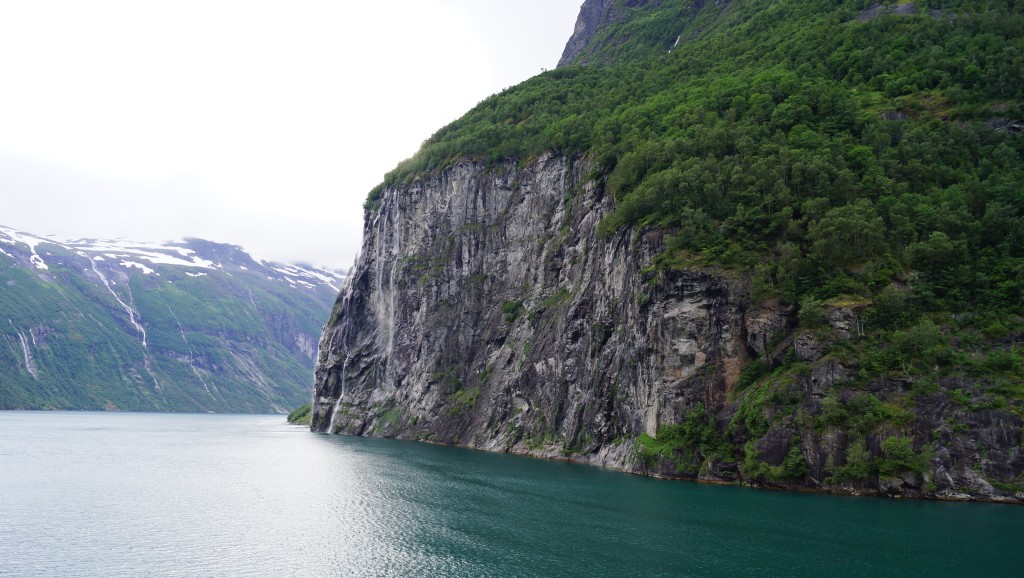
such as those that I saw in Norway’s Geirangerfjord in 2015 and the head of the fjord can often be quite deep inland and far from the sea itself.
When a river valley floods and creates an inlet from the sea, it creates a sound or it can happen in the opposite direction when the sea floods a river valley. Sounds are generally wider and tend to have more gently sloping sides than fjords. Sound can also refer to a sea or ocean channel between two land masses. A section of King George Sound (or Mammang-Koort in the local Mineng Nyungar language) on the southern coast of Western Australia looks like this.
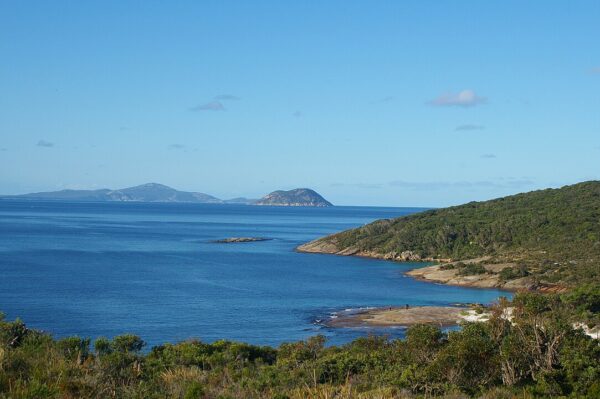
[From Wikipedia by hughesdarren – Public Domain]
Māori named the body of water we’re visiting today Piopiotahi. The atua (godly figure) Tu-te-raki-whanoa was responsible for shaping the Fiordland coast. Using his toki called Te Hamo, he chanted a powerful karakia (prayer) and carved the fjords from the earth. Later, after Māui (whom we first met when he fished up Te Ika-a-Māui) failed in his quest to gain immortality for humankind and was killed by the goddess of death, Hine-nui-te-pō, the piopio bird (now extinct), which had accompanied him, flew to this place to mourn his passing. Piopiotahi means “a single piopio.”
As for the name Milford Sound, the first European to sail into the fjord was a sealer named John Grono in 1823. He named it Milford Haven after a long narrow inlet on the Welsh coast. In 1851, John Lort Stotes (whom you encountered in this post about Darwin) sailed into Milford Haven as captain of HMS Acheron and decided to rename it Milford Sound supposedly because he found it a sound place to harbor. For Pākehā, it has been Milford Sound ever since.
Rain, rain go away. Or maybe not.
It wasn’t particularly cold when we mustered for the roughly two hour bus ride to Piopiotahi but it was cool, grey, and quite rainy. F, our site coordinator, expressed some hope that, given the time and distance of about 120km (and with a stop or two on the way, our ride would be closer to three hours) the day would clear enough to make our cruise through the fjord more pleasant.
Although the weather wasn’t conducive to maximizing our first stop at Mirror Lakes where, on a clear day it would look like this
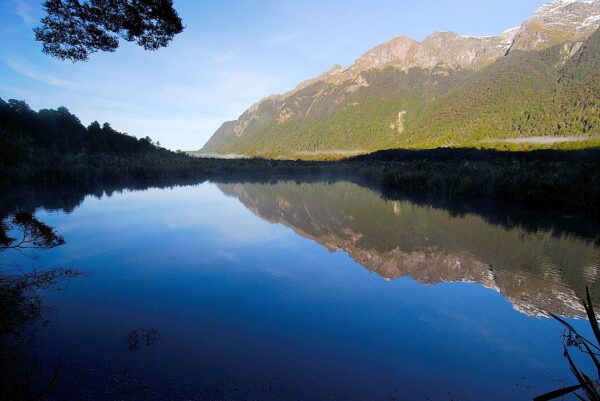
[From Wikipedia By Jenny from Taipei – mirror lake in New Zealand, CC BY 2.0.]
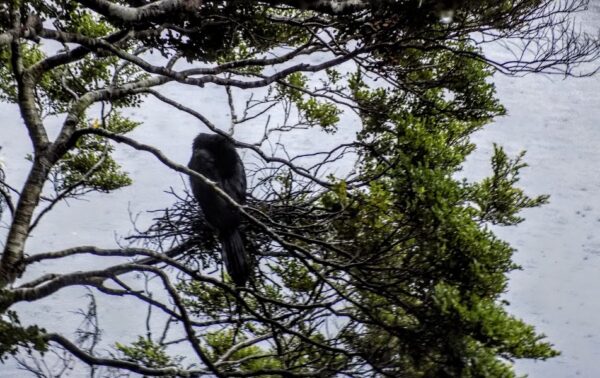
the best I could manage was this photo of a tree bound cormorant or shag in the local lingo.
The rain had eased when we reached Eglinton Valley where we stopped for another brief photo opportunity. However, as you can see from the photo below,
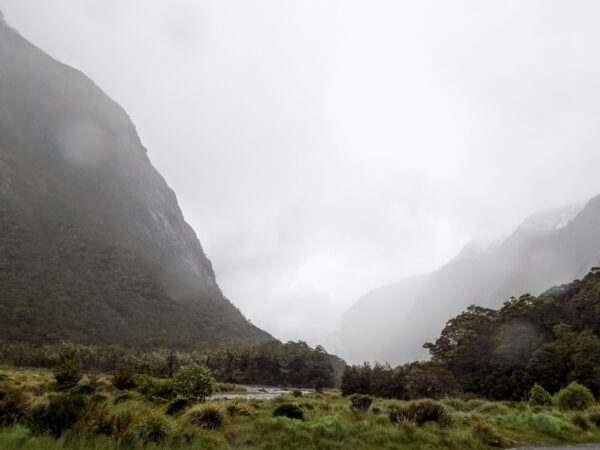
fog and mist still ruled the morning.
We remained hopeful as we stood waiting to board the boat that would take us through the harbor. One benefit of the rain is that it feeds scores of cascades along the cliffs framing the fjord. You see, Piopiotahi has only two permanent glacially fed waterfalls. One is Waimanu also called Stirling Falls
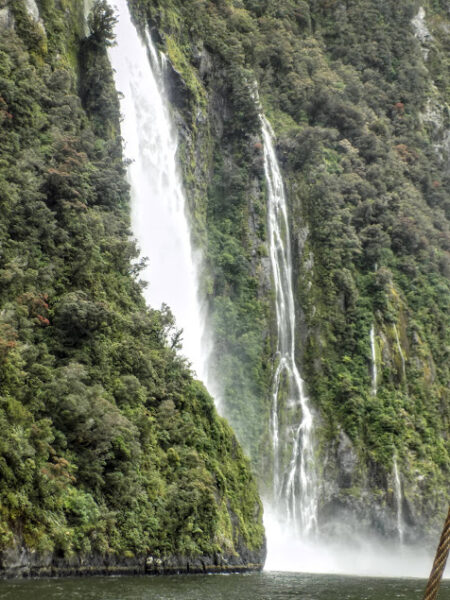
and the other is Bowen Falls
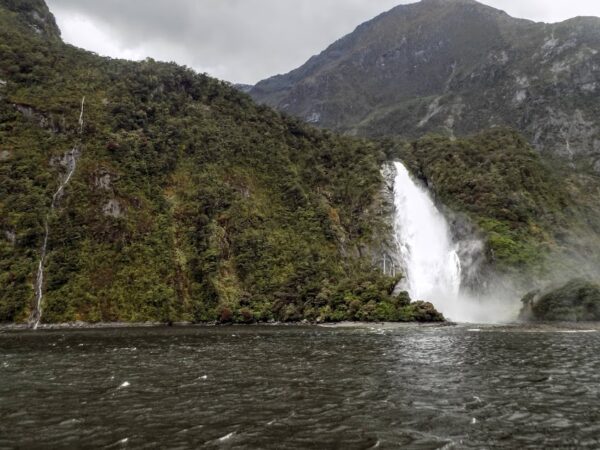
called Hineteawa in Māori. On a day without rain, Piopiotahi might look something like this
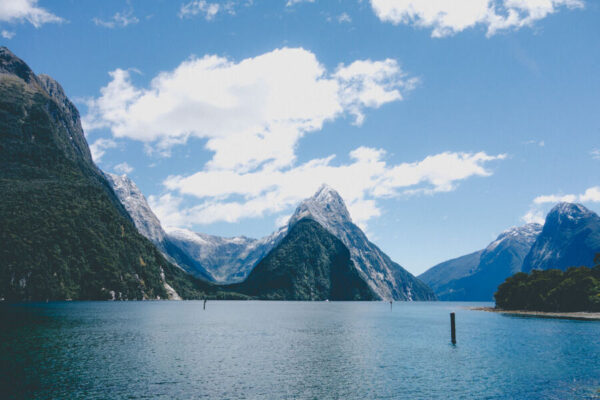
[From BucketListly Blog]
and we had some calmer moments when it was safe to leave the interior of the ship and take a photo like this one
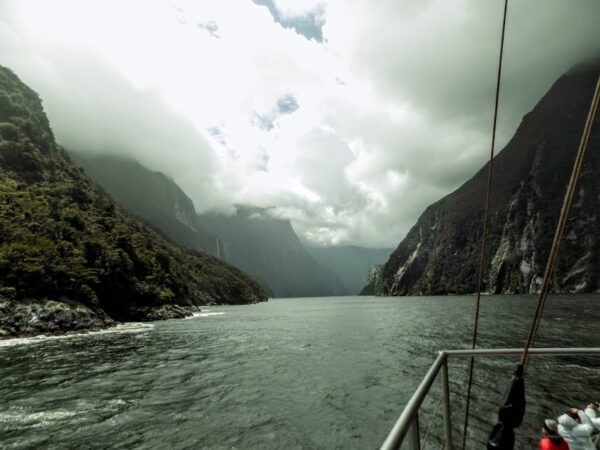
but we also experienced it more like this.
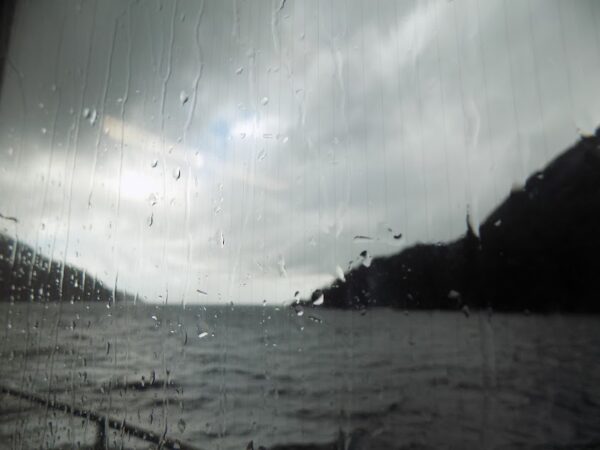
Yes, not only had the rain begun again but we were sailing with gale force wind gusts of 40 knots (75km/hr) buffeting the ship.
We did see a plethora of short lived waterfalls
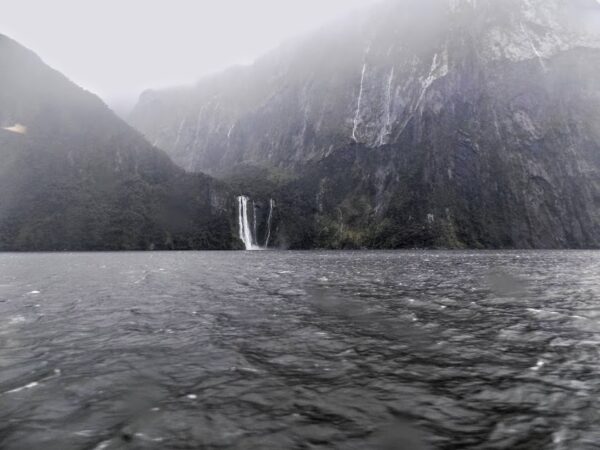
that F told us would be dry within hours of the rain stopping so there was some benefit to having sailed the fjord on a rainy day.
Still, and I think this admission shocked at least one of my fellow RS travelers, having sailed through fjords in Alaska and Norway, I found Piopiotahi little more than another fjord. Perhaps the weather was a factor in my experience or perhaps if it’s your first experience sailing through a body of water like this one, you might find it worth all The Sound and the Fjordy. For me, it was nice but much as I had done with the Great Barrier Reef, more a place where I could now put a check mark as having seen one of the more famous natural wonders of Aotearoa.
And then there were the birds
We returned to Te Anau and when we reached there the rain had mostly stopped. F offered to take those of us who were interested on a walk through town, near the lake, and into Punanga Manu o Te Anau or the Bird Sanctuary of Te Anau. As had been the case with all the sanctuaries I’d visited on this trip and in Australia, most of the birds here had been injured in some way and wouldn’t survive if returned to the wild. Some, however, were part of breeding programs.
One of the birds for which the sanctuary has a breeding program is the endangered Whiowhio or Blue Duck. While predation from introduced mammalian predators such as stoats, ferrets, possums, feral cats, and dogs is responsible for an estimated 80% of the bird’s decline, human activities including deforestation, river modification, and water pollution has drastically reduced its suitable habitat to about 1% of its original extent.
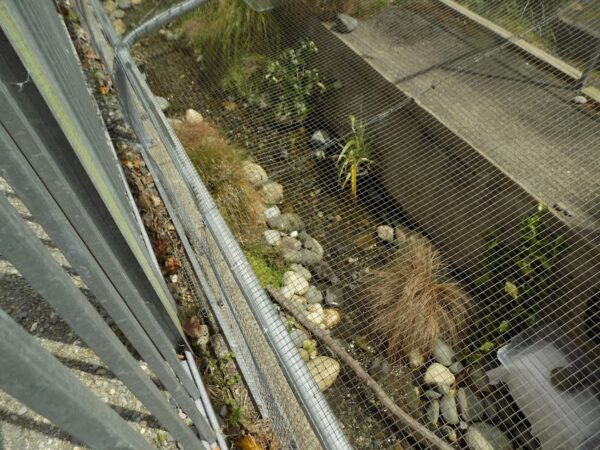
You can see the bill or one duckling if you look down from the stone on the ledge at the top of the photo.
There were several other birds in the sanctuary but the star of the show (so to speak) is the Takahē. Like many of Aotearoa’s native birds, Takahē, facing no ground predators, lost the ability to fly. Unfortunately for Takahē, as they had done with the moa, Māori hunted the bird to extinction (or so it was believed). In fact, during the first two centuries of European colonization, Pākehā saw only four Takahē. Their dogs caught three of them including one in 1898 near lake Te Anau. Declared the last of its kind, it was stuffed and mounted in the Otago Museum in Ōtepoti (Dunedin).
In 1948, Geoffrey Orbell who had, according to this article, been obsessed with the bird for nearly 30 years, discovered (or rediscovered) it along the shores of a lake in Te-Puhi-a-noa in what is now Fiordland NP. The bird managed to survive by locating in a remote alpine habitat that delayed predator and human incursion. Since they were surviving on low nutrient vegetation such as snow tussocks and sedges, they needed to forage for up to 19 hours daily and the remoteness of their location permitted them to do that. Conservation efforts began shortly after their rediscovery.
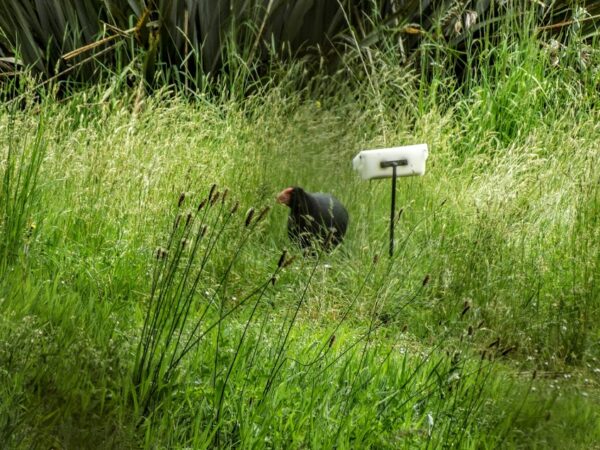
According to a sign in the sanctuary, Takahē, “has a special cultural, spiritual, and traditional significance to Ngāi Tahu.” Further, they, “value Takahē as a taonga (treasure)” and you can find its name in at least half a dozen places in Southland. I found this veneration curious since they were responsible, at least in some part, for the bird’s near extinction.
After a walk around some of Lake Te Anau, we had a bit of time to freshen up before we set off for dinner at the Moose Tavern that struck me, despite its views of the lake, as something of a dive bar. I think I had a chicken burger.
Here are all the day’s pictures.
-
Photos and their stories – Lisbon – Summer 2026 part two – plus an egg-straordinary bonus
August 21, 2026 -
Photos and their stories – Lisbon – Summer 2026 – part one
August 21, 2026 -
The indigenous people of Da?ow?aga? (Olympic Valley and me supplement three)
August 19, 2026 -
The indigenous people of Da?ow?aga? (Olympic Valley and me Supplement two)
August 17, 2026 -
Olympic Valley in the time before humans (Olympic Valley and Me Supplement one)
August 14, 2026