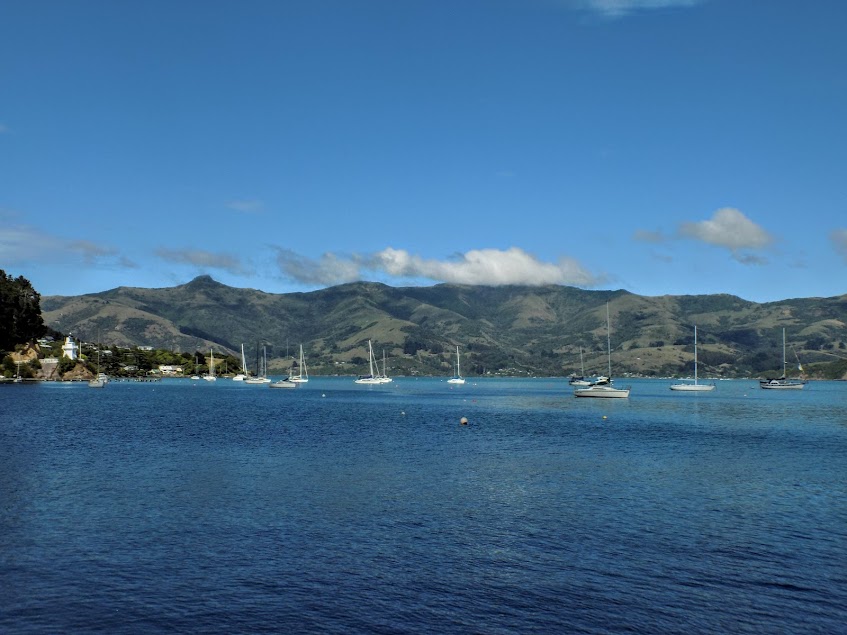
…wakes you up with a kiss to start the morning off – dolphins and Akaroa
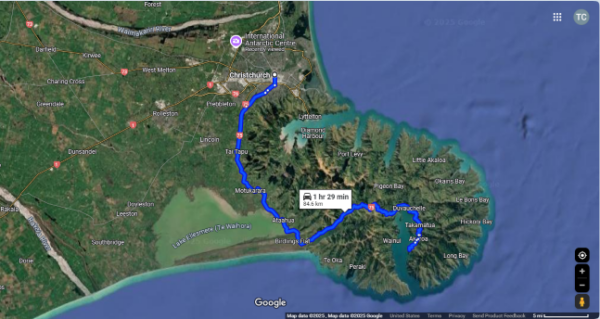
Today was very much a needed antidote to the previous day’s busyness. We started out at 08:00 for an hour-and-a-half bus ride to the town of Akaroa (pronounced Ah-kah-roe-ah) where we’d have a “Nature cruise on Akaroa Harbour,” some time to wander around this small town on the Banks Peninsula, have lunch, and return to Christchurch for a somewhat abbreviated walking tour of the central city before dinner.
But the band wasn’t there
Our daily schedule listed a stop at Little River on our return to Christchurch “time permitting.” Since we stopped at this small town with a population of about 1,200 on our way from Christchurch, I have to assume that we were a bit ahead of schedule. The stop was brief and although there’s an important Ngāi Tahu Marae called Wairewa, we did little more than visit the now out of use train station that
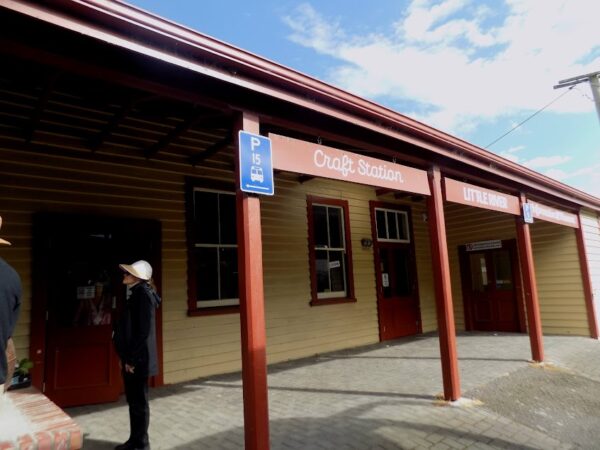
played a key role in connecting rural areas with urban centers and was an important connecting node between rural and urban areas. I must have seen little reason to stop there because I have nothing about further it in my day’s notes. Interestingly, the population has grown nearly fivefold since the 2018 census so it must have something attracting the Kiwis that I didn’t notice.
As we continued our southeasterly journey the passing scenery was, as it would often be on Te Waipounamu, something beyond photo-worthy but demanding of photos nonetheless.
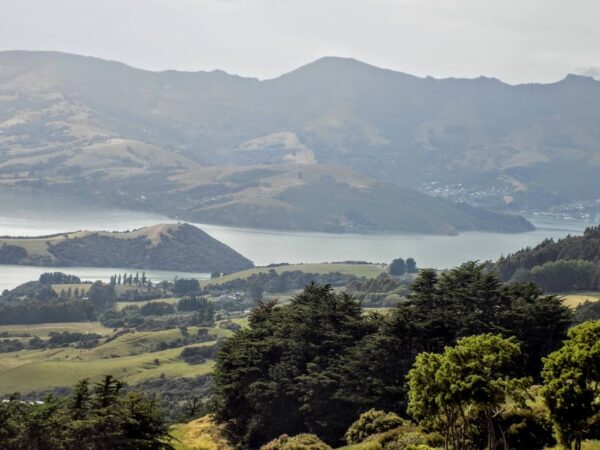
We were traveling along an extinct volcanic complex – the Banks Peninsula Volcano. It’s a composite of two main eruptive centers – one originating at Lyttelton Harbour and the other at Akaroa Harbour – that, while highly eroded, forms the majority of the Banks Peninsula.
The volcanic activity occurred in the Late Miocene and possibly extended into the Early Pliocene Eras and were mainly basaltic. The Christchurch earthquakes of 2011 (which I’ll discuss in some detail later) led to worries about a possible eruption, however, there is no known magma chamber beneath the volcano and there has been no sign of volcanic activity in the last 5,ooo,ooo years. I think we were safe.
Akaroa, roa, roa your boat
Akaroa is a place of some bloody and violent historic importance. In the post Pākehā Arrive, I noted that, for many Europeans, New Zealand had a caricatured image as an untamed lawless frontier and cited the 1830 Elizabeth Incident as something that contributed to that perception. The Māori kāinga (an unfortified village) Takapūneke was a major trading post for the local bit east of present day Akaroa and home to the Ngāi Tahu – a South Island iwi.
John Stewart, captain of the brig Elizabeth helped Te Rauparaha – leader of the North Island Ngāti Toa – kidnap Ngāi Tahu chief Te Maiharanui, his wife, and daughter and held them prisoner on the Elizabeth. Te Rauparaha was seeking utu to avenge the killing and eating of several Ngāti Toa chiefs at Kaiapoi in 1829. His warriors then destroyed Te Maiharanui’s settlement, Takapuneke and committed what was, effectively the mass murder of hundreds of Kāi Tahu. (You can read more about it here.)
Akaroa is an historic town in Aotearoa and I’ll dive into a bit more of that history later in this post. But the main reason RS scheduled this field trip is to cruise the harbor for the opportunity to see New Zealand fur seals and the smallest of all dolphin species, the Hector’s Dolphin. Setting out from the wharf we had some lovely harbor views,
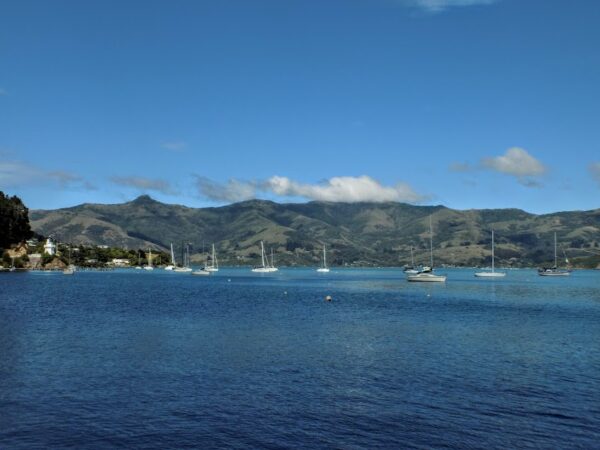
and passed Ōnuku Marae, where two Ngāi Tahu chiefs, Iwikau and Hone Tikao, became the first on Te Waipounamu to sign the Treaty of Waitangi.
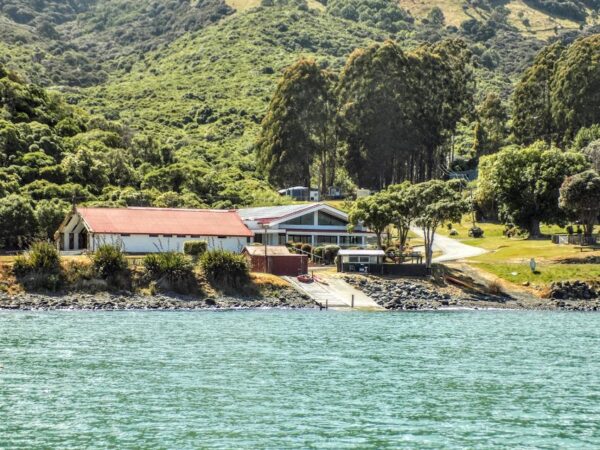
It is also the location where the British Crown issued its formal apology to Ngāi Tahu for its repeated failures in its dealings with that iwi, including acting “unconscionably” and breaching Treaty principles during land purchases.
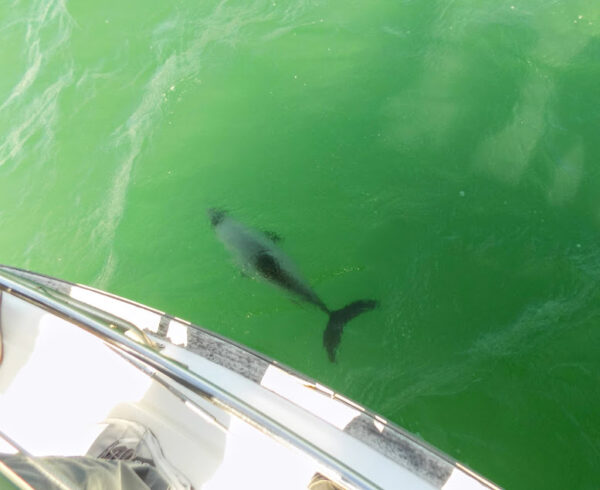
We continued on waiting for the signal from the little three-legged dog whose job onboard is alerting the passengers to the presence of the Hector’s dolphins. We’d seen the tiny blue penguins at a rescue yesterday but now, we were on the lookout for the tiny dolphins in their natural habitat. After a few failed tries, I managed to capture one with my camera.
I also got a group photo.
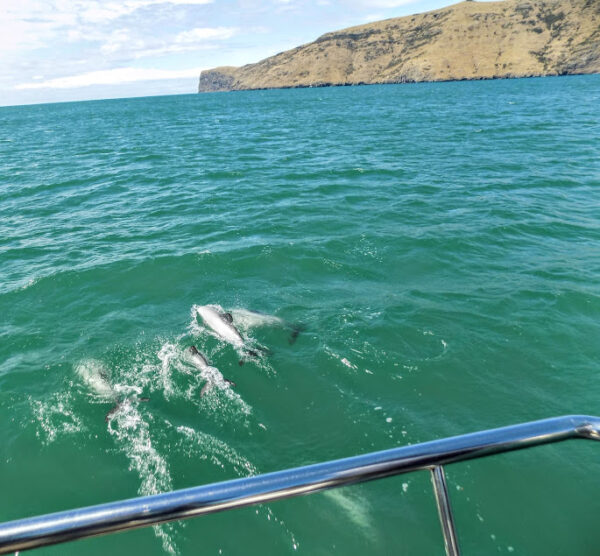
And through sheer luck, my photo of the day.
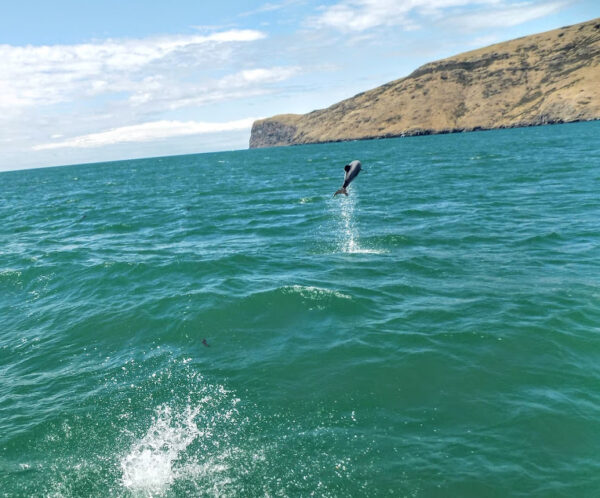
(If you’re wondering why they’re called Hector’s dolphins {scientific name Cephalorhynchus hectori}, it’s because Sir James Hector was the first to describe this endemic Aotearoa species.)
Although they were in constant motion, once we spotted the dolphins, they were easy to photograph. The sedentary kekeno or New Zealand fur seals, sunning themselves on the rocky coast were harder to capture. I managed only this one.
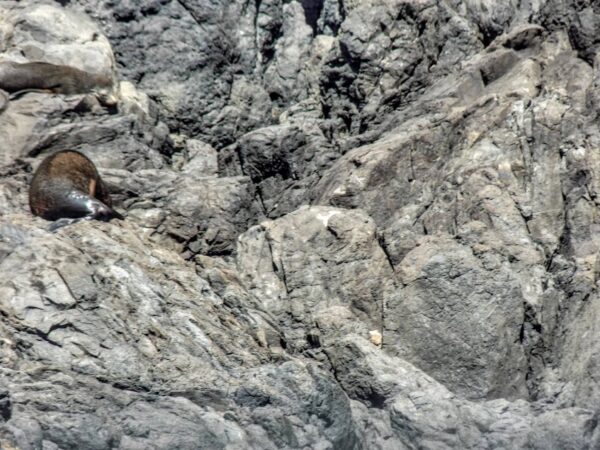
Kekeno are, however, an interesting species. With their external ear flaps and ability to rotate their hind flippers, they’re more like sea lions than seals. Kekeno dive deeper (up to 230 meters) and longer (as long as 11 minutes) than any other fur seal. The reason we could spot them hauled-out on the rocks is because they feed almost exclusively at night diving continuously from sundown to sunrise.
And it’s lunchtime
When we returned to the wharf we had some time to wander about the town and choose where we wanted to eat lunch. As you walk about the town of Akaroa, you might find yourself crossing streets named Rue de Malmanche or Rue Benoit
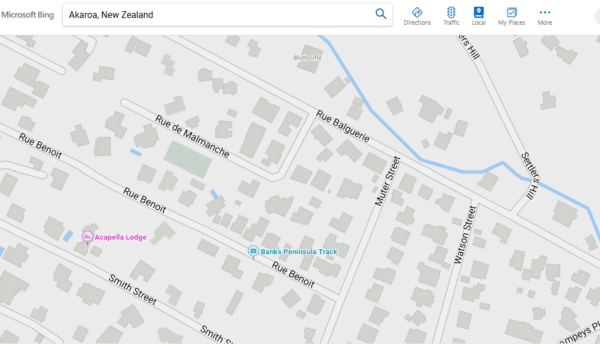
[From Bing Maps]
and, if you’re anything like me, find yourself wondering why a town in a British colony would have French street names.
In the post linked above, I noted that the British had an interest in preventing other European powers, most notably France, from establishing colonies in Aotearoa New Zealand. Through the Anglican Church Missionary Society that had been on the islands for some time, they had a basis for relations with Māori and appointed Captain William Hobson
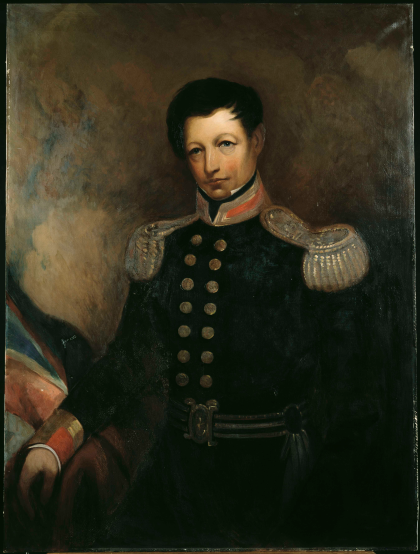
as lieutenant governor authorizing him to negotiate with Māori chiefs. This led to signing the Treaty of Waitangi in 1840 that the British used to declare the country a Crown colony.
In 1838, a whaler, Captain Jean François Langlois, claimed to have purchased “the greater Banks Peninsula” signed by twelve Kāi Tahu chiefs. He made a down payment and returned to France promising the balance upon his return with settlers.
French ships with 57 surviving settlers onboard arrived in the Bay of Islands on 11 July 1840. However, Hobson had declared British sovereignty over the whole of the country on 21 May based on the 6 February signing of the Treaty of Waitangi.
To dispel any questions the French might raise, he dispatched the HMS Britomart to Akaroa. Although Britomart had planted the Union Jack, the French began settling at Akaroa 18 August 1840 based on Langlois’ purchase thereby making it the oldest town in Canterbury. The settlers’ land was around Takamatua (German Bay) and Akaroa.
Meanwhile, the British dismissed the French claim asserting that it was not based on British law. Wanting to avoid conflict, particularly given the fact that the settlers arrived believing they owned the land, ownership discussions dragged on until 1849. During this period, everyone acted as if the Nanto-Bordelaise Company (the French equivalent of the New Zealand Company) did, in fact, own the land. Then, facing severe financial difficulties, the Nanto-Bordelaise Company sold the land to the New Zealand Company effectively leaving the French settlers on their own. Still, their influence had taken root and remains to this day.
Thus, fellow RS traveler C and I had a lovely lunch at Ma Maison. I had a few oysters on the half shell and the crispy squid with white pepper mayonnaise and fried curry leaves accompanied by the house lager. A very good lunch.
While you’re waiting for my next post about the afternoon’s walk through Christchurch, feel free to look at some more photos.
-
Photos and their stories – Lisbon – Summer 2026 part two – plus an egg-straordinary bonus
August 21, 2026 -
Photos and their stories – Lisbon – Summer 2026 – part one
August 21, 2026 -
The indigenous people of Da?ow?aga? (Olympic Valley and me supplement three)
August 19, 2026 -
The indigenous people of Da?ow?aga? (Olympic Valley and me Supplement two)
August 17, 2026 -
Olympic Valley in the time before humans (Olympic Valley and Me Supplement one)
August 14, 2026
2 responses to “…wakes you up with a kiss to start the morning off – dolphins and Akaroa”
How did the 3 legged dog know when the dolphins were nearby? How did it signal the group?
As I understand it, the dogs can hear the clicks the dolphins make to communicate with other dolphins and for echolocation. They then alert a nearby crew member by nudging their leg or some other gesture. The crew member then communicates that to the passengers.