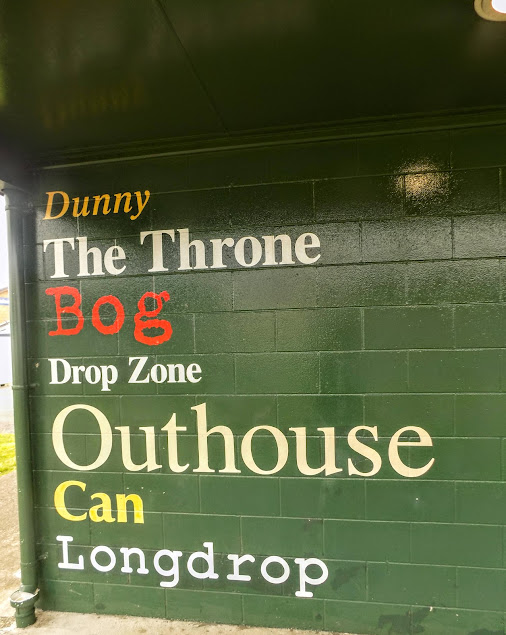
…it happened one time – Glowworms and sulfur
Our group was supposed to be on board our “coach” (actually a bus) to Waitomo Caves by 08:10 Wednesday morning. Although I didn’t note the reason in my notes, I believe this was the morning our driver had been told the wrong time and thus we left the hotel behind schedule. Fortunately, it had little impact on our day. We were able to stop for a coffee break midway along the drive, admire some lovely north Island scenery
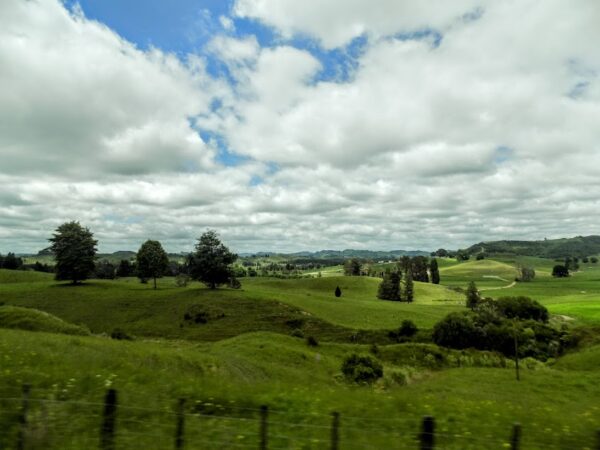
as our bus whizzed past on a day with more clouds than sun, and reach the Roselands Resort where we had a buffet lunch that was a bit more buffet than I could handle. I’m sure RS chose this spot not just for its sumptuous buffets but because of its proximity to
Waitomo Cave.
Waitomo Cave is famous worldwide for it’s glowworms. (that, of course, glow but aren’t worms) but more on that later. It’s so famous that it’s listed in the Guinness Book of World Records for being the world’s most visited glowworm site with between 450,000 and 500,000 annual visitors. (Waitomo is a compound of the Māori words wai meaning water and tomo meaning sinkhole.)
The first humans known to enter the cave were Māori Chief Tanetinorau and an Englishman named Fred Mace in 1887.
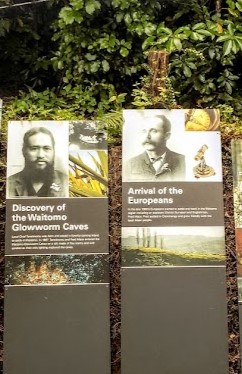
Mace was the assistant District Surveyor for England and Tanetinorau settled in the area after moving inland from Kawhia where his Tainui iwi had settled when they arrived on their waka hourua or voyaging canoe.
It’s taken only an estimated 30 million years for the combination of tectonic movement to raise the limestone followed by the forces of erosion – mainly rainwater containing carbonic acid – to create the underground Waitomo river and cave system. (For comparison, the famous Postojna Caves System in Slovenia that I visited in 2016 is a mere 2-3 million years old but some of its limestone is as old as 100 million years.)
The caves in the Waitomo system are both shallow and short because porous limestone sits atop harder sandstone. Water doesn’t easily penetrate the sandstone and this limits the depth of the cave. The limestone continues eroding but does so from the bottom up. Like other karstic systems, the landscape and cave system constantly changes. Aided by the region’s more than 2,350mm annual rainfall, the limestone dissolution process continues apace at an annual rate of about 70 cubic meters per square kilometer of outcrop.
We entered the cave on foot
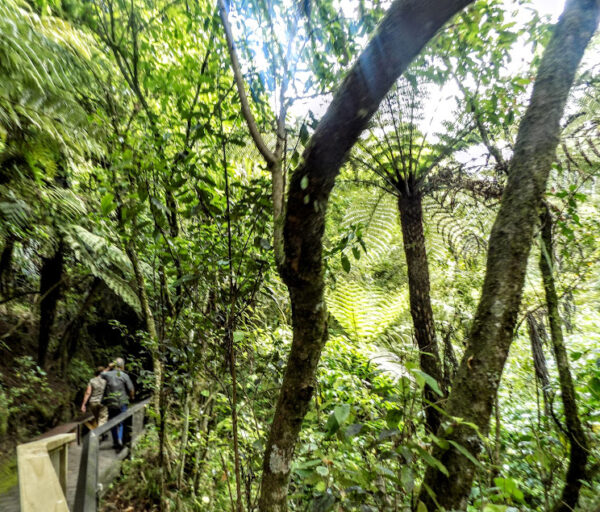
with no additional photos permitted until we reached the exit. (There are three main caves with guided tours in Waitomo and RS booked our group on the Waitomo Glowworm Caves that is, I think, the shortest of the three both in duration and in the length of the walk. Conversely, it’s the one with the most glowworms. The Ruakuri Cave tour is the longest and it allows photos. However, from what I’ve read, the glowworms there are neither as prevalent nor as spectacular.)
As with any cave system filled with stalactites, stalagmites, helictites, columns, and pillars, there are myriad examples of pareidolia. However, we were walking in the dark so I couldn’t make notes recording any of their names (and wouldn’t have photos to share regardless). We did, at one point, enter a large area perhaps identified as the Cathedral where an annual concert is held because of the spectacular acoustics. We were invited to sing and while we did, I can’t remember what tune our group sang.
While glowworms are visible through the walking part of the tour, their presence is rather underwhelming. However, patience is rewarded because the highlight of the tour is the boat ride on a dark underground river illuminated only by what could be a skyful of glowworms.
If they’re not worms, what are they?
Glowworms are the larvae of fungus gnats. They thrive in dark, damp, and sheltered environments like caves where their bioluminescence is most visible and there is little wind to disturb the sticky silk threads that the glowworms construct to capture prey.
The life cycle of a glowworm consists of four distinct stages: egg, larva, pupa, and adult.
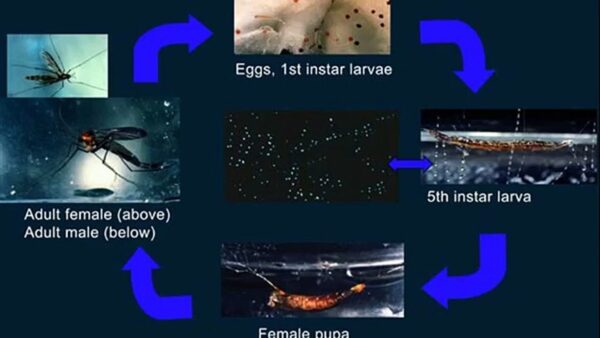
[From Daily Motion]
Female glowworms lay 50-100 eggs in moist environments that hatch in 2-3 weeks. The gnats live most of their lives – 9-12 months – in the larval stage (which is what we see in the cave). They will undergo 4-5 molts during this stage while using their bioluminescence to act as a lure that attracts small flying insects such as midges, mosquitoes, and moths any of which have mistaken the glowworm’s light for the open sky or stars and fly toward it.
As the prey is drawn to the light, they become entangled in the sticky hanging silk threads mentioned above. These vertical silk threads are coated with mucus and can be up to 40cm long. One curious aspect of their bioluminescent capacity is that the glowworm larvae can detect each other’s light and synchronize it with neighboring individuals thereby creating a more intense collective display and increasing the effectiveness of their traps. Once prey is caught in the sticky threads, the glowworm pulls it up and begins to feed.
The larva will then enter the pupa stage creating a cocoon for its metamorphosis into an adult fungus gnat. At this point, they are nearly at the end of their lives because they have no mouth and cannot feed. Males, with a maximum lifespan of 96 hours live considerably longer than the females that live only up to 76 hours. Sometime within these few days, they will have (hopefully for the continuation of the species) mated and the female will have laid her brood of eggs.
This National Geographic video will provide a bit of an idea what it’s like to ride through the glowworm cave.
Next stop Ōtorohanga
It requires about two hours to drive from Waitomo to Rotorua and since it had been awhile since our lunch break, we made a brief rest stop in Ōtorohanga – a place that calls itself the “Official Kiwiana Town of New Zealand” – some 15 minutes after leaving the caves. Step into the Ed Hillary Walkway
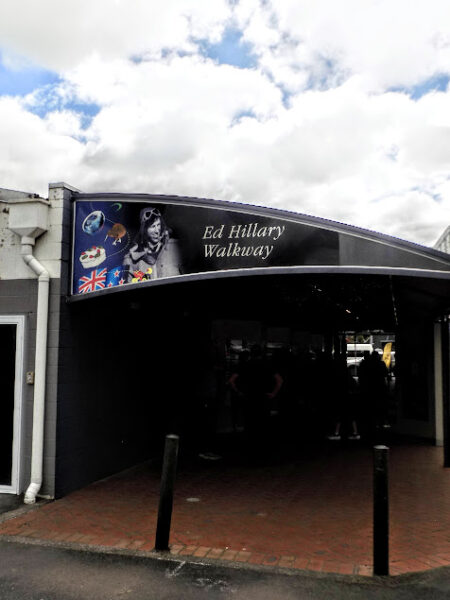
for displays of nearly everything one might consider authentically Kiwi. Whether you’re looking for the Buzzy Bee (a children’s toy that gained great popularity in the post WW II baby boom with its own postage stamp), pavlova (Aussies claim they invented the dessert named for the famous Russian ballerina but Kiwis beg to differ), gumboots (first worn unpretentiously by the country’s dairy farmers and ANZAC troops), to the haka, and the vote for women (in 1893 New Zealand became the first country in the world to enfranchise women) you’re likely to find it on display here.
Of course, since it was a rest stop, I applied one of my most consistent travel practices, summarized as NPUaC2P
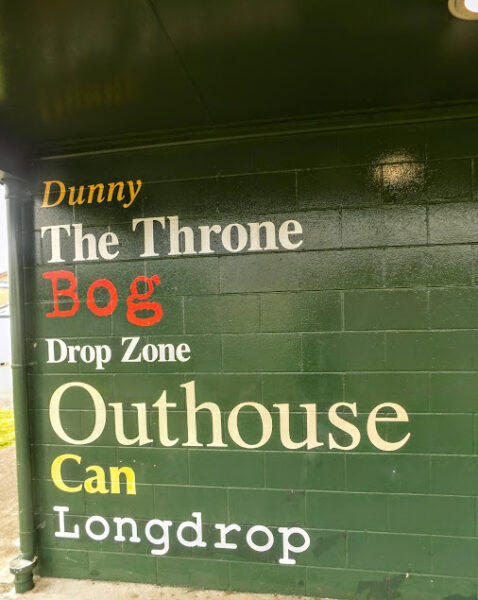
(Never Pass Up a Chance to Pee).
At the end of the day, it’s Rotorua
For many people, visiting the center of Aotearoa’s Te Ika-a-Māui, stopping at Rotorua is a must. The town is in a volcanic region rife with geothermal features such as geysers, hot springs, and mud pools. As many such areas do, these geothermal areas contain sulfur deposits. As many such areas do, these features naturally emit geothermal gases including everyone’s favorite – hydrogen sulfide. The readily recognizable rotten-egg odor of H2S pervading much of the city has earned Rotorua the moniker “Sulphur City.”
Once again, we had supper at the hotel and, in this instance, it must have been among those for which we had pre-selected our main course and either an accompanying entrée or appetizer (as had been in Australia having both included was rare) because I have no note that it was either a buffet or memorable.
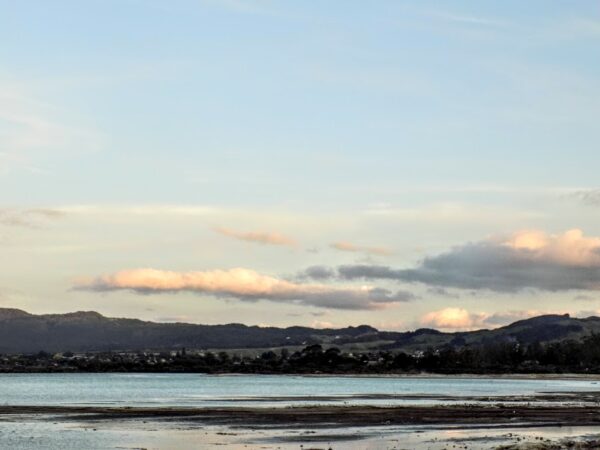
We had some free time after dinner and I know some in our group indulged in a soak in one of the nearby spas. I simply used my free time after supper to wander around the town a little and take a few photos.
-
Photos and their stories – Lisbon – Summer 2026 part two – plus an egg-straordinary bonus
August 21, 2026 -
Photos and their stories – Lisbon – Summer 2026 – part one
August 21, 2026 -
The indigenous people of Da?ow?aga? (Olympic Valley and me supplement three)
August 19, 2026 -
The indigenous people of Da?ow?aga? (Olympic Valley and me Supplement two)
August 17, 2026 -
Olympic Valley in the time before humans (Olympic Valley and Me Supplement one)
August 14, 2026