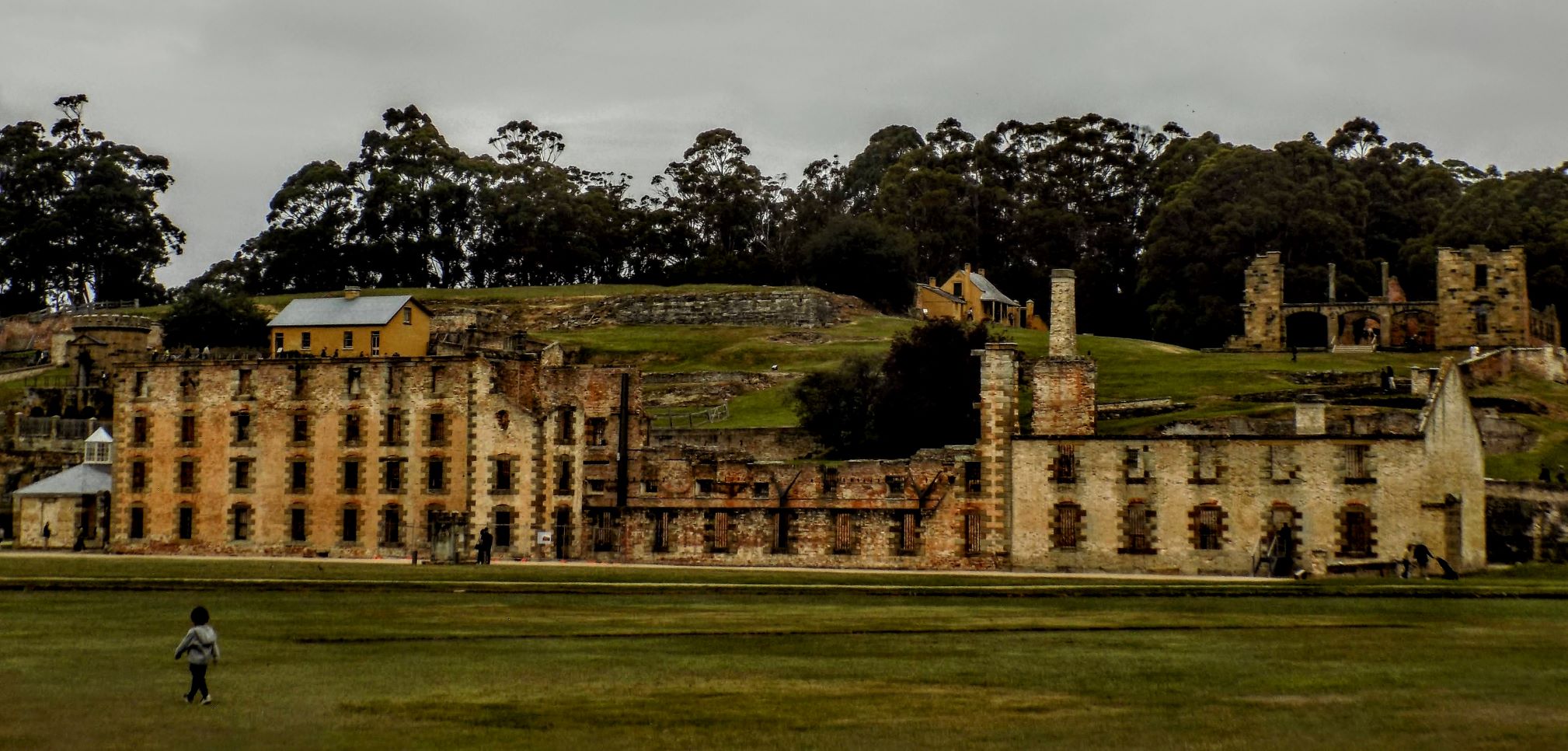
the quiet pause was audibly expressive
There’s a lot to do in Tasmania and a considerable number of activities in and around Hobart but it’s probably not an unreasonable guess on my part to opine that if you’re only going to be a few days in Tasmania and all of those days are in and around Hobart that the must do items on your tourist list would be an ascent of Kunanyi and a trip to Port Arthur. I had my trip to the summit of Kunanyi Saturday and I’d be leaving for Melbourne Monday. This left Sunday for a day trip to Port Arthur.
I acknowledge that I am on the land of the Pydarerme People of the Paredarerme language group. I acknowledge their custodianship. The Dreaming is still living. From the past, in the present, into the future. Forever. I would also like to pay respect to the Elders past, present, and emerging and extend that respect to other Aboriginal people present.
I don’t often write contemporaneously but I did at Port Arthur. Here are my
First Impressions
(I didn’t come to hold up the walls)
In November 2024 the prison complex at Port Arthur is a haven of serenity. It may be that the looming walls of the stone and brick buildings that survived fires in 1895 and 1898
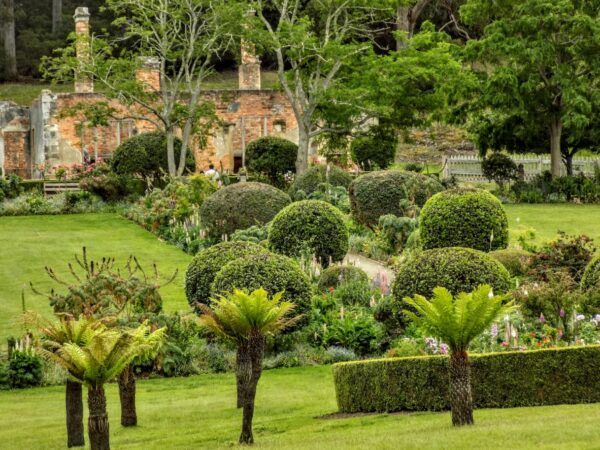
bear witness to the decades of brutality and human suffering men inflicted on one another. But on this day the air is filled with birdsong, the greenery lush,
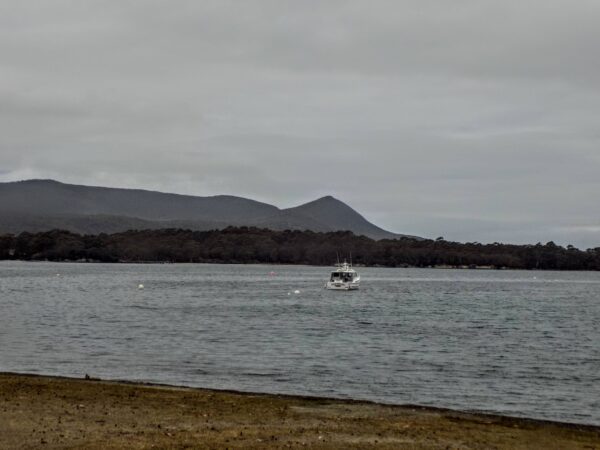
and the deep harbor is calm beneath a low hanging grey sky.
Wander the grounds and you can find a memorial to the 28 April 1996 mass shooting that killed 35 people but unless one is convinced they can sense the echoes of that terror or of the prison and its savage punishments Port Arthur in November 2024 is a place of reflection, calm, and beauty.
A short history
The British had been on Van Diemen’s Land since 1803 and were looking for ways to make the island more self-sustaining and for a place where they could unload more convicts and Port Arthur (named for Lieutenant Governor George Arthur) was a propitious location.
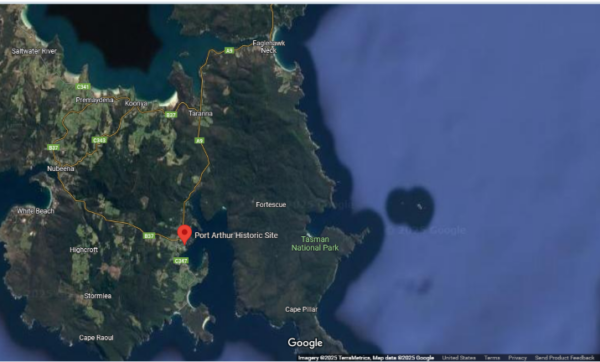
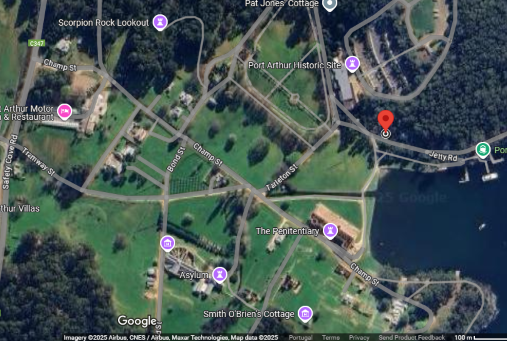
Initially, established in 1830, the abundant forests and natural harbor made the area well-suited for its original purpose as a timber station albeit one where the labor would be provided by convicts whose unpaid or at best underpaid labor facilitated colonization. With dense forests on one side and water on the other, the relative geographic isolation constricted any potential escape routes. (Eaglehawk Neck – seen at the top of the Google Maps screen capture – provided a point of literal constriction. By 1832, a dog line along the narrow strip of land further restricted potential escape attempts. The dogs not only alerted the guards at the approach of potential escapees who were often walking across beds of shells, they were vicious enough that the British artist Harden S Melville described them as “every four footed black fanged individual among them would have taken first prize in his own class for ugliness and ferocity at any show.”)
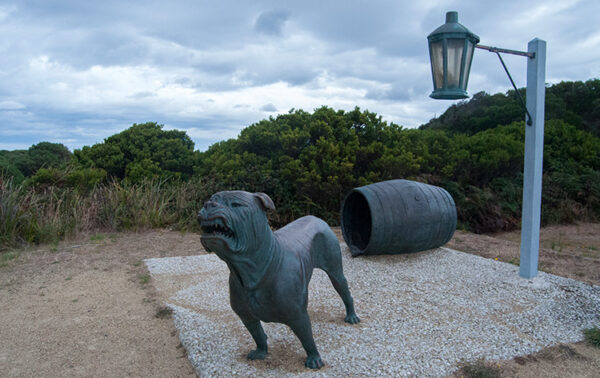
[From TheAndyTChannel]
While many of the people transported to Australia had committed petty crimes such as theft of bread to feed a family, poaching or other property destruction, or crimes such as forgery, some had been convicted of more serious criminal activity. Many others were political prisoners from Ireland and Scotland, so recidivism was a problem. By 1833 Port Arthur was converted into a penal settlement that housed recidivists and some of the most hardened and intractable convicts. The idea was that the remote location and harsh conditions would create an environment of ultimate punishment and possible reform. It also happened to provide substantial labor for the colony as an additional benefit.
Records show that the punishment at Port Arthur was brutal and unrelenting. The convicts were subjected to psychological abuse intended to strip them of their identities and dignity, forced to work under barely imaginable conditions often with inadequate food and clothing, and commonly whipped, flogged and beaten.
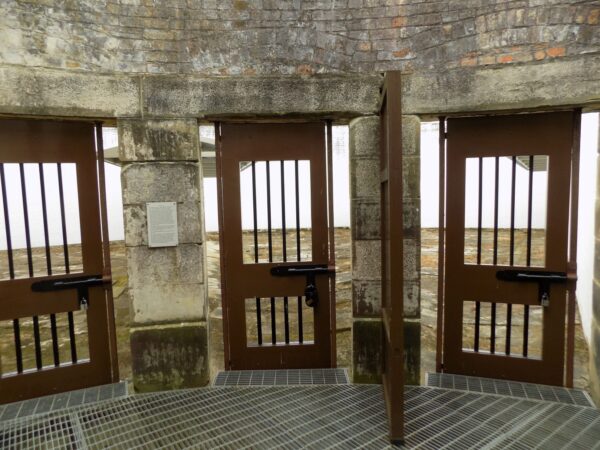
One of the most notorious punishments at Port Arthur was Isolation – a system of solitary confinement designed to further break the spirit of the convicts. They were placed in cells
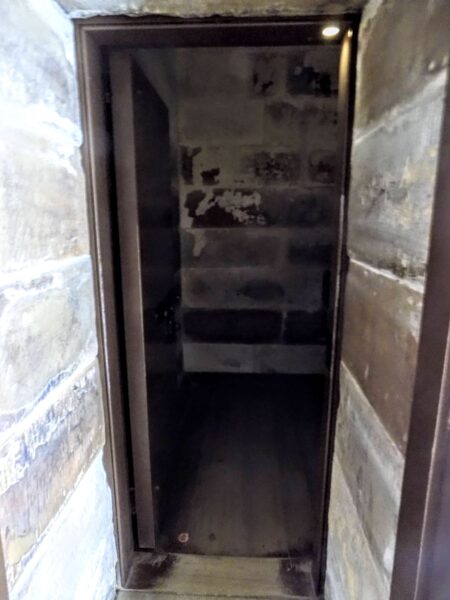
barely large enough for them to lie down in, and otherwise completely isolated. They weren’t permitted to speak, read, or write and were allowed to exit their cells for only an hour per day to exercise in a small yard under strict regulation.
By 1840, the population – including convicts, soldiers, and civil staff had swelled to more than 2,000 and it had become a major settlement in addition to a prison site. More than merely a timber station, Port Arthur now produced hewed stone and bricks, furniture, clothing, and even boats and ships.
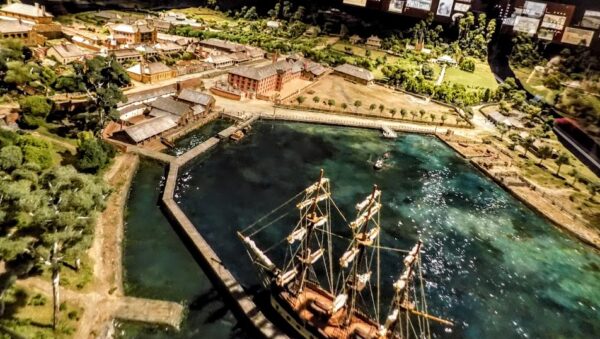
This relative prosperity began to wither when transportation to Van Diemen’s Land ended in 1853. As the prison population aged, the labor force dwindled. The prison closed officially in 1877 and some of the buildings were dismantled. Hoping to erase the “convict stain”, the remaining residents decided in 1884 to rename the town Carnarvon after Henry Howard Molyneux Herbert, 4th Earl of Carnarvon who was twice British Secretary of State to the Colonies. But the designation of the site as one of ‘historic interest’ by the Scenery Preservation Board in 1916 began undermining the new name. In 1926, the town name was changed back to Port Arthur.
28 April 1996
In the very early morning of 28 April 1996, 28-year-old Martin Bryant walked in to the Seascape Cottage near Port Arthur and shot and killed David and Noelene Martin. At about 13:30 he walked into the Broad Arrow Café at the Port Arthur Historic Site
pulled out a Colt AR-15 SP1 Carbine semi-automatic rifle from a sports bag and began shooting indiscriminately, and within 90 seconds had killed 20 people and injured 12 others in the café.
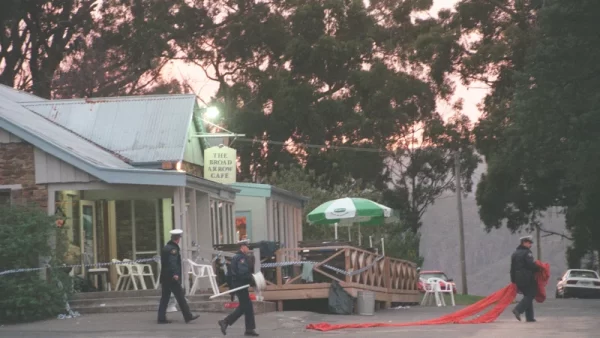
[From TheAge.au]
He continued his rampage in the parking lot, drove to a toll booth, and stole a car killing more people in both places. He went to a service station where he killed another woman and took a hostage before returning to the Seascape Cottage. On the morning of 29 April, after a standoff with police, he set fire to the building and was captured while trying to flee.
Thoughts and prayers, perhaps, but assuredly action
Bryant’s rampage happened just more than a month after John Howard was sworn in as Prime Minister. Almost immediately after the massacre, he moved to enact uniform national legislation banning pump-action, automatic and semiautomatic firearms. The legislation passed despite fierce opposition from pro-gun groups such as the Sporting Shooters’ Association of Australia.
Known as the National Firearms Agreement, it limited the sale or supply of weapons and established licensing, registration, and safe storage requirements together with extensive background checks and a mandatory waiting period. Additionally, it had a buyback provision intended to encourage the removal of privately owned weapons from circulation. Funded by a tax increase, by 1997, the Australian government had spent nearly $230,000,000 to buyback more than 650,000 guns and rifles or about one-fifth of the country’s guns.
My (admittedly cursory) research found that the worst gun violence since the passage of the NFA happened in Darwin in 2019. Four people were killed.
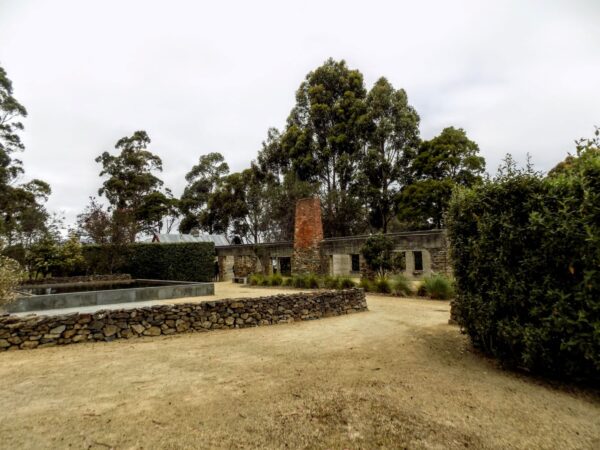
Today, the shell of the Broad Arrow Café remains standing as part of the memorial to the victims.
More than Port Arthur
Port Arthur is about a 90km drive from Hobart and our tour made one stop going and two returning. On the way to Port Arthur we stopped for a brief walk and look at Richmond Gaol and the Richmond Bridge – a convict built bridge that’s the oldest bridge in continuous use in Australia.
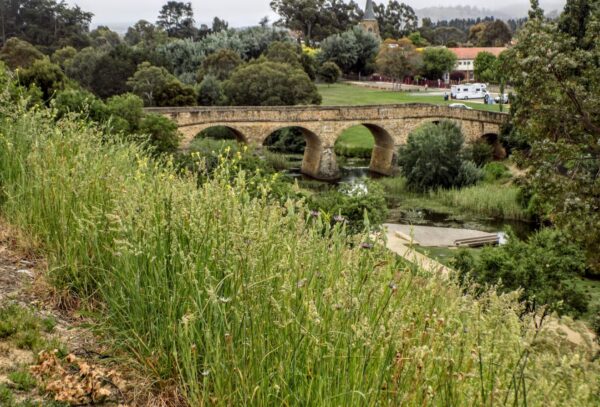
Before returning to Hobart, we ventured a little farther south to Remarkable Cave and Maingon Bay Lookout. Yes, I had the chance to add photos of a remarkable cave to those of the Remarkable Rocks on Kangaroo Island. The cave is remarkable for its mix of different types of sandstone, its two entries (though I was only able to get an angle to photograph one) and, in a bit of pareidolia,
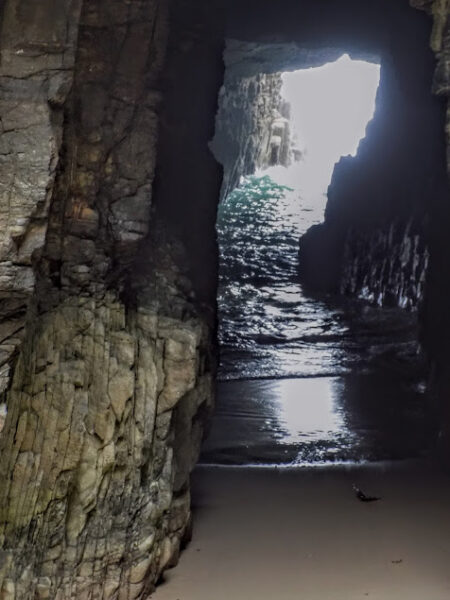
some folks claim to see a map of Tasmania outlined in this entrance.
Our final stop was at Tasman’s Arch which was on the way back to Hobart. The arch is what’s left of the roof of an erosion created sea cave.
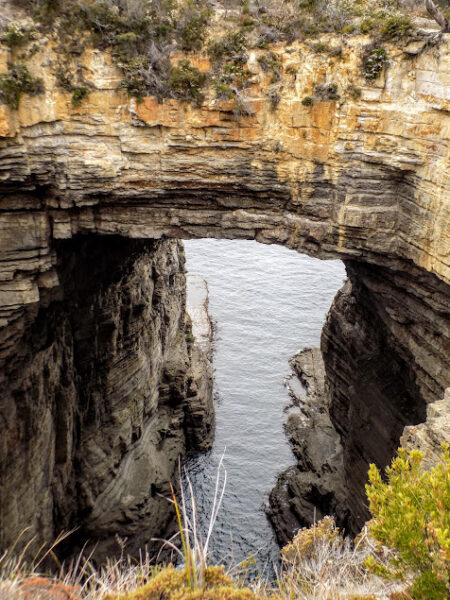
Like all such arches, it will eventually collapse.
Tomorrow, I set off for Melbourne – the last stop on my great Australian adventure.
Interested in more pictures? Follow this link.
-
Photos and their stories – Lisbon – Summer 2026 part two – plus an egg-straordinary bonus
August 21, 2026 -
Photos and their stories – Lisbon – Summer 2026 – part one
August 21, 2026 -
The indigenous people of Da?ow?aga? (Olympic Valley and me supplement three)
August 19, 2026 -
The indigenous people of Da?ow?aga? (Olympic Valley and me Supplement two)
August 17, 2026 -
Olympic Valley in the time before humans (Olympic Valley and Me Supplement one)
August 14, 2026