Notes on the XVI Olympiad (Melbourne and Me addendum two – Stories of love and war)
Olga and Hal – the love story.
Perhaps it started on the first day of competition when Czechoslovakia’s Olga Fikotová launched her discus more than two meters beyond her previous personal best. It was good enough for her to win the gold medal – her nation’s only gold medal of the games – shocking two competitors from the USSR who had coached her for several days believing she was a wholehearted participant in the East versus West dynamic pervading these games. (As the only Czech athlete not to have joined the Communist Party, she wasn’t.)
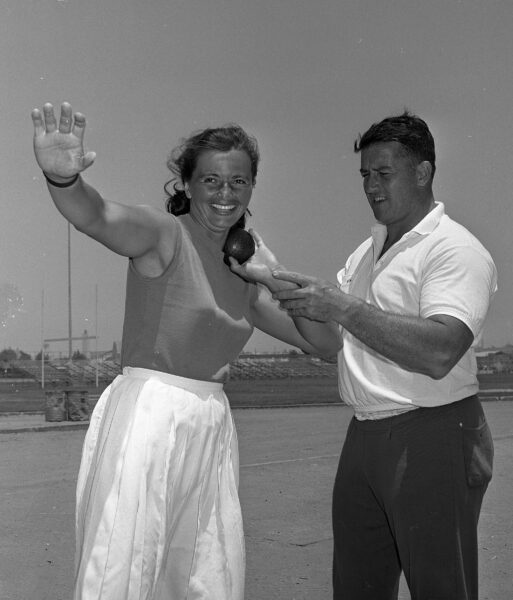
Its actual beginning came in an equipment shed for athletes competing in the discus, shot put, javelin and hammer competitions. It was there that Olga Fikotová met Harold ‘Hal’ Connolly. Connolly had won a gold medal of his own in the hammer throw the day after Fikotová won hers in the discus. Connolly also bested two Soviet throwers and his gold in the event was the first by an American in 28 years.
Although Fikotová spoke only a little English and Connolly a bit of German, the two connected. Of their meeting, Fikotová later wrote,
we found that although we were from opposite or far away corners of the world, and definitely from political systems that seemed to be completely incompatible, that when it came to basic human values and observations, we were extremely similar. We were trying to converse in my very fragmented English, and his fragmented German, because he’d travelled in Germany before. We were kind of putting together ideas and views and we were surprisingly close together. From that developed, besides curiosity and friendship, also a feeling of love.
[Photo from Wikimedia Commons Los Angeles Times, CC BY 4.0]
Fikotová had just turned 24 . Connolly was 25. With their competitions over and their gold medals safely packed away, they began doing things that came naturally to a pair of twenty somethings who felt a mutual attraction and had time on their hands. Since they weren’t trying to hide it, it didn’t take long for the press to latch-on to their budding relationship. Naturally, the two sides took opposing views with the Western press painting a generally positive picture while in Czechoslovakia, Fikotová was portrayed as having brought her homeland 50% honor by winning the gold medal and 50% shame for her romance with “an American Fascist.”
Such portrayals notwithstanding, Connolly proposed and Fikotová agreed but insisted that the wedding be held in Czechoslovakia. It’s unlikely that the Czech government would have given its stamp of approval but the pair had two very important allies – Emil Zátopek and his wife Dana Zátopkova. Once they publicly agreed to be witnesses at the wedding, it became all but impossible for the government to deny the match.
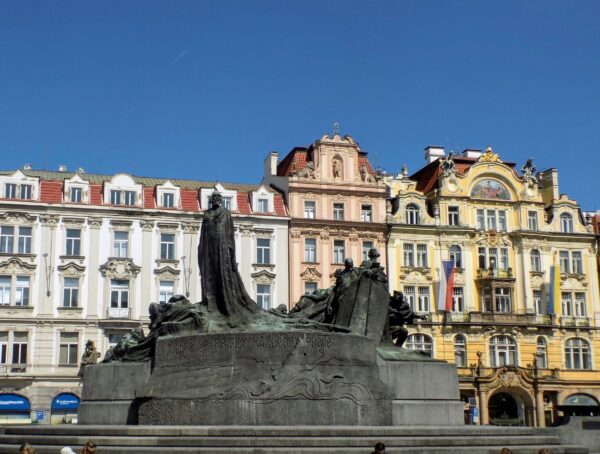
Reportedly, once word leaked about their wedding between 25,000 and 40,000 people jammed the streets in Prague to see the couple marry in the Old Town Square.
However, in 1956, competitors in their events were truly amateurs. After the wedding, Hal Connolly reportedly had to sell his hammer throwing equipment to raise enough money for their return to the United States. Although married to an American, Olga Connolly wanted to continue competing for Czechoslovakia but that country’s Olympic Committee refused her requests and she competed for the United States thereafter.
But all love stories don’t have happy endings. Hal Connolly competed in the three subsequent Olympic Games while Olga represented her adopted country four more times and, despite being an outspoken opponent of the Vietnam War, was elected to be the team’s flagbearer in Munich in 1972. Neither finished higher than sixth. The couple had four children but divorced in 1973 after 17 years of marriage.
Blood in the Water – the war story
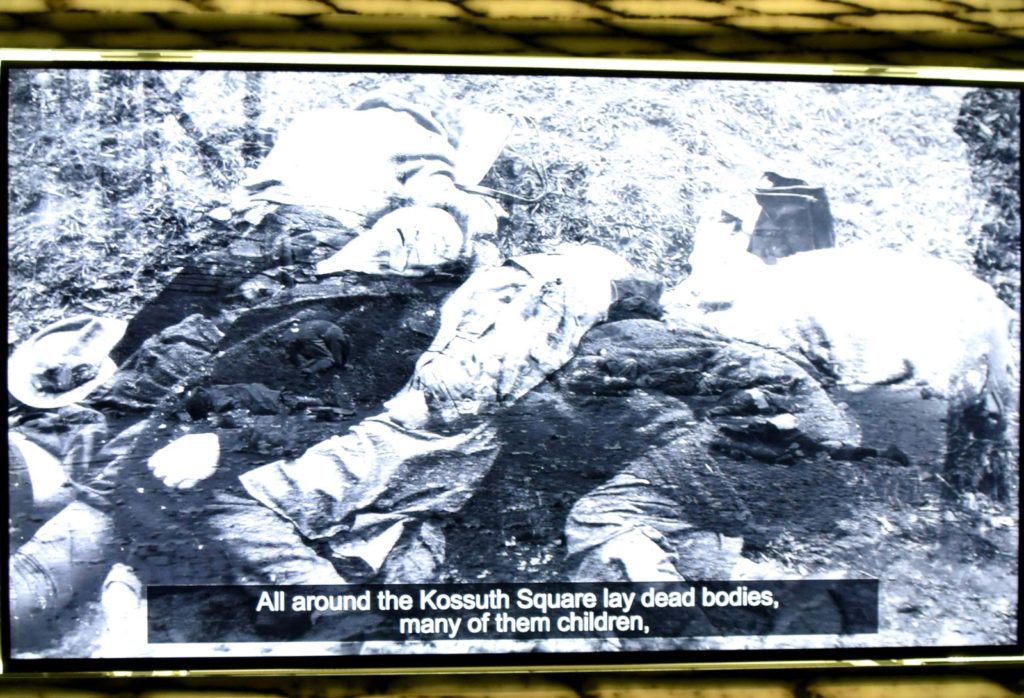
The Opening Ceremony for the Games of the XVI Olympiad took place in Melbourne on 21 November 1956. A month earlier on 23 October, Hungarian university students and the Hungarian Writers Union began a series of anti-communist demonstrations in Budapest. Late on the night of the 23rd, Ernő Gerőm the Secretary General of the Communist Party requested Soviet intervention and by 02:00 on the 24th, Soviet tanks were rolling into the streets of Budapest.
Although strategically positioned, the Soviets didn’t engage the demonstrators and the protests began to spread into the countryside. When it became clear that the western alliance would provide only rhetorical support the Soviets began to act. On 4 November more than 150,000 Soviet troops and 2,500 tanks entered Hungary and within days nearly 20,000 Hungarians were dead, at least as many were imprisoned, and ten times that number had fled the country. (Remember that Spain, Switzerland, and the Netherlands had elected to boycott the Games to protest the Soviet action in Hungary.)
[Photo from Cleared and Ready for Takeoff]
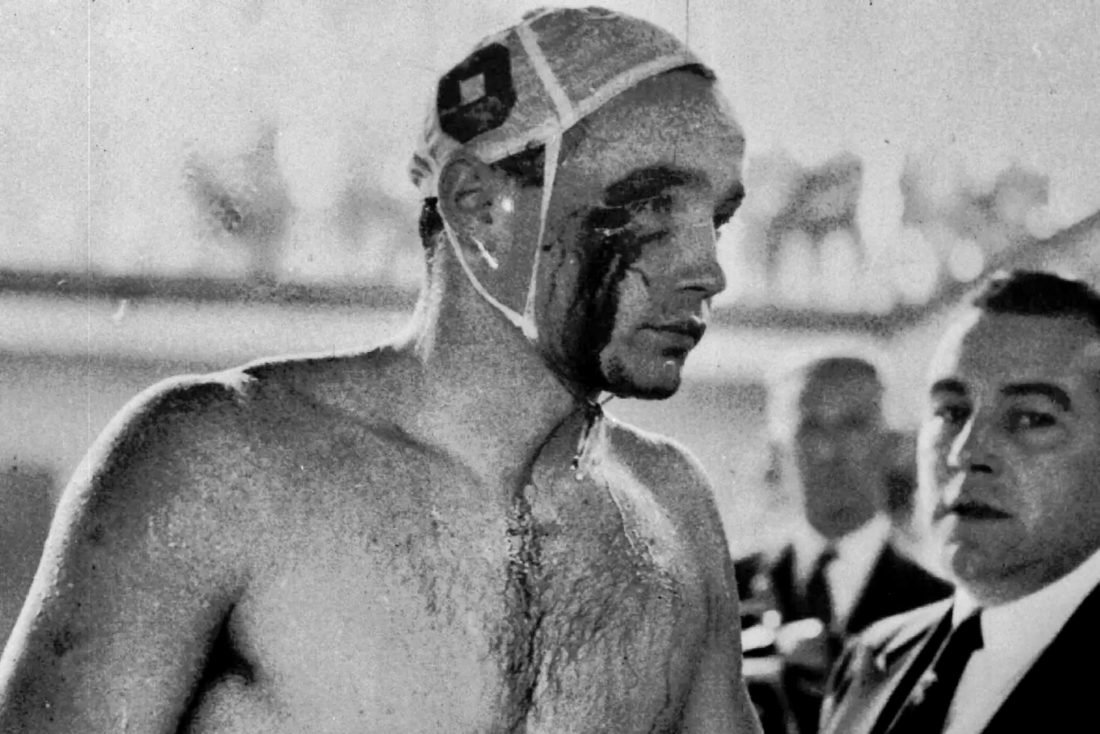
A team from Hungary had won the gold medal in water polo at the 1954 Helsinki Olympics and the squad the nation sent to Melbourne was favored to repeat as champions. The teams from Hungary and the USSR met in the semifinals and the match was characterized by tense and overly rough play from the opening whistle. The combination of verbal taunts, punches and kicks resulted in 5 players being ordered out of the water for penalties – 2 Hungarians and 3 Russians.
Still, Hungary was the superior squad and led 4-0 when, with just over a minute to play and the ball at the opposite end of the pool, the USSR’s Valentin Prokopov punched Hungary’s Ervin Zádor opening a cut above Zádor’s eye that began bleeding profusely and that would require 13 stitches to close.
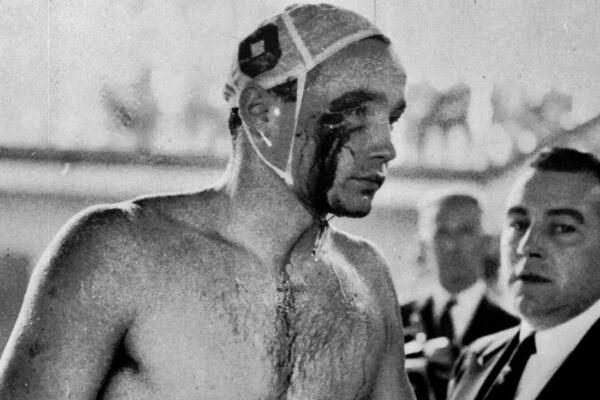
[Photo from Sports history weekly]
The crowd, that throughout the contest, had been nearly as intense as the competition in the water, exploded into such an uproar that the police were called to maintain some semblance of order. The officials stopped the match and declared Hungary the winner. Although Zádor, who had scored two goals in the match before the incident, was unable to play in the final, the Hungarians defeated Yugoslavia 2-1 to repeat as Olympic champions.
The press labeled the semifinal the “Blood in the Water” match and it became a symbol of Hungarian resistance against Soviet oppression. A documentary film about the match called Freedom’s Fury was produced in 2006, in honor of the fiftieth anniversary of the Hungarian uprising. The film, which you can watch for free here on YouTube, is narrated by Mark Spitz who, as a teenaged swimmer, had been coached by Ervin Zádor.
The happy-ish ending
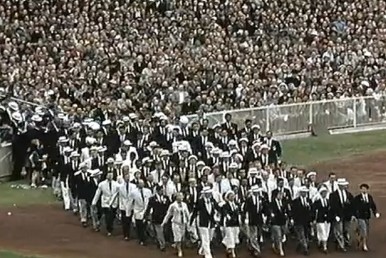
This now infamous match took place on 6 December 1956 just two days before the Closing Ceremony was scheduled to take place and tensions remained so high that officials feared they would have to cancel that event. A 17-year-old high school student named John Ian Wing who had been dismayed at the political overtones took it upon himself to write a letter that he hand delivered to the office of the local Olympic Organizing Committee. In it, he suggested that, rather than entering in the Parade of Nations as they did in the Opening Ceremony (and as had been done in previous closing ceremonies) the athletes should simply enter the stadium behind the Olympic flag without regard to nationality.
[Photo from Olympic Century]
Wing’s suggestion not only changed the tenor of the Melbourne Games but began an Olympic tradition now called the “Parade of Athletes” that continues to this day.
-
Photos and their stories – Lisbon – Summer 2026 part two – plus an egg-straordinary bonus
August 21, 2026 -
Photos and their stories – Lisbon – Summer 2026 – part one
August 21, 2026 -

The indigenous people of Da?ow?aga? (Olympic Valley and me supplement three)
August 19, 2026 -
The indigenous people of Da?ow?aga? (Olympic Valley and me Supplement two)
August 17, 2026 -

Olympic Valley in the time before humans (Olympic Valley and Me Supplement one)
August 14, 2026