The Ray Brook legacy (Lake Placid and Me – addendum three)
Any city not in Europe that wants to host the Olympic Games faces something of an uphill climb – even if it’s done it successfully in the past. The climb isn’t quite as steep if the city is in the USA but even for the wealthiest country on Earth reaching that mountaintop isn’t easy. (I quickly scanned a list of the 55 Olympiads that have held competitions and counted eight that were held in Asia, eight in the USA, four in other North American cities, two in Australia, and one in South America. The remaining 32 have been in Europe.)
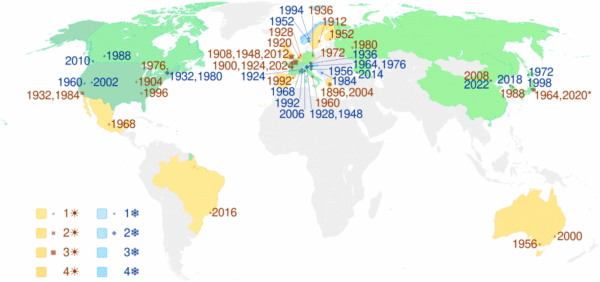
[From Wikipedia under Creative Commons Attribution-Share Alike 4.0 International]
Lake Placid needed nearly a quarter century of planning, lobbying, and three bid submissions to have the IOC decide in 1974 to hold the 1980 Games in that New York venue for a second time. Of course, the city got a major boost when Vancouver-Garibaldi withdrew before the final vote leaving Lake Placid as the only remaining candidate.
Once the bid was secured, as is always the case, the town faced staging challenges. While they had maintained most of the venues from the 1932 Games, many had become outdated with the passage of nearly five decades.
In terms of competitive venues, the town renovated and expanded the 1932 Olympic Center complex by updating the 1932 Rink, adding two indoor rinks, and constructing the Speed Skating Oval. The 1932 bobsled run also underwent a renovation and the town built a separate luge track marking the last time these sports would compete on different tracks. The Intervales Ski Jump Complex that had been upgraded in 1932 was completely renovated including constructing new jumps at 70 and 90 meters that were built to meet the standards of the time.
But it takes a village
There’s a mild debate whether Paris in 1924 or Los Angeles in 1932 built the first Olympic Village specifically to house the athletes. In recapping the 1932 Los Angeles Olympics I wrote,
Los Angeles had the first true Olympic Village to house the competitors. (In 1924, the organizers of the Games in Paris constructed a series of cabins close to the Olympic Stadium – the Stade de Colombes – and called it le Village Olympique, the Guinness Book of World Records mentions it but calls it “quite primitive in design” and seems to award the title of first to Los Angeles. The Olympic Museum confers that first on Paris.)
Whichever side is declared the winner we can be certain that there was no corresponding construction in Lake Placid when it hosted the Games in 1932. By 1980, however, housing for the athletes was simply another element included in a potential host’s bid. The map below shows the venue sites. Marked 1 on the map’s western edge is the site of the Athlete’s Village at Ray Brook about seven miles from the village and Olympic Center.
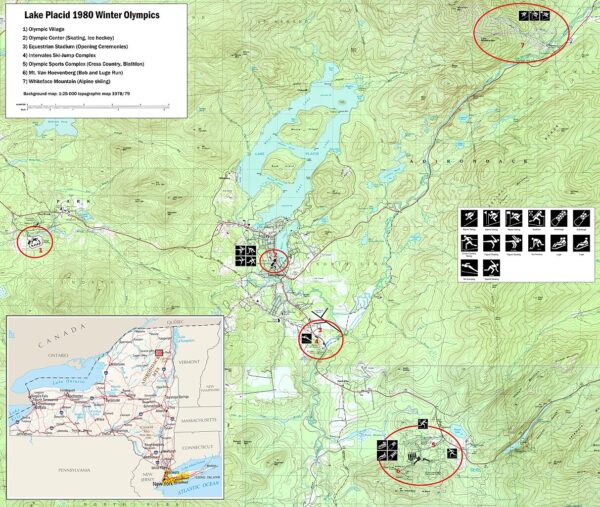
[From Wikipedia under Creative Commons Attribution-Share Alike 3.0]
The original budget for the Games was $30,000,000 (about $116,000,000 in 2025 dollars). As is often the case, this budget was overly optimistic and factors such as the high inflation rate, environmental protection concerns, a compressed construction schedule, and a bit of scope creep contributed to one of the largest cost overruns in Olympic history. The final tab would exceed $169,000,000.
As these costs became apparent, the town had to approach both the federal and state governments for financing and the federal funding came with strings attached. With the intent of avoiding building facilities that might be abandoned or underused, the Congressional appropriation required that any federally financed construction have a secondary use after the Games.
Robert McEwan, the Congressman from New York’s 21st Congressional District, proposed turning the Athlete’s Village into a hospital, converting it to public housing, or making it a permanent athletics facility. None of these ideas gained any traction.
Even if the village feels like a prison
Black September’s 1972 abduction and the eventual deaths of 11 Israeli athletes at the Munich Games wrought permanent changes in the security requirements for the construction of athlete housing at all subsequent Olympic Games. These measures included features such as cinderblock rooms, steel-reinforced windows, heavy doors, and electrified fences.
As the members of the Lake Placid Organizing Committee saw one proposal after another fall by the wayside, one federal agency was willing to accept the responsibility for taking over the Olympic Village after the Games. The Lake Placid site was particularly suitable for a partnership since this agency had, for some time, been seeking a location for a new facility in upstate New York. The agency was the US Bureau of Prisons. Legislators quickly seized the opportunity to promote a facility that could transition into a prison as a practical investment that would provide lasting jobs for the region. This then played a major role in its design.
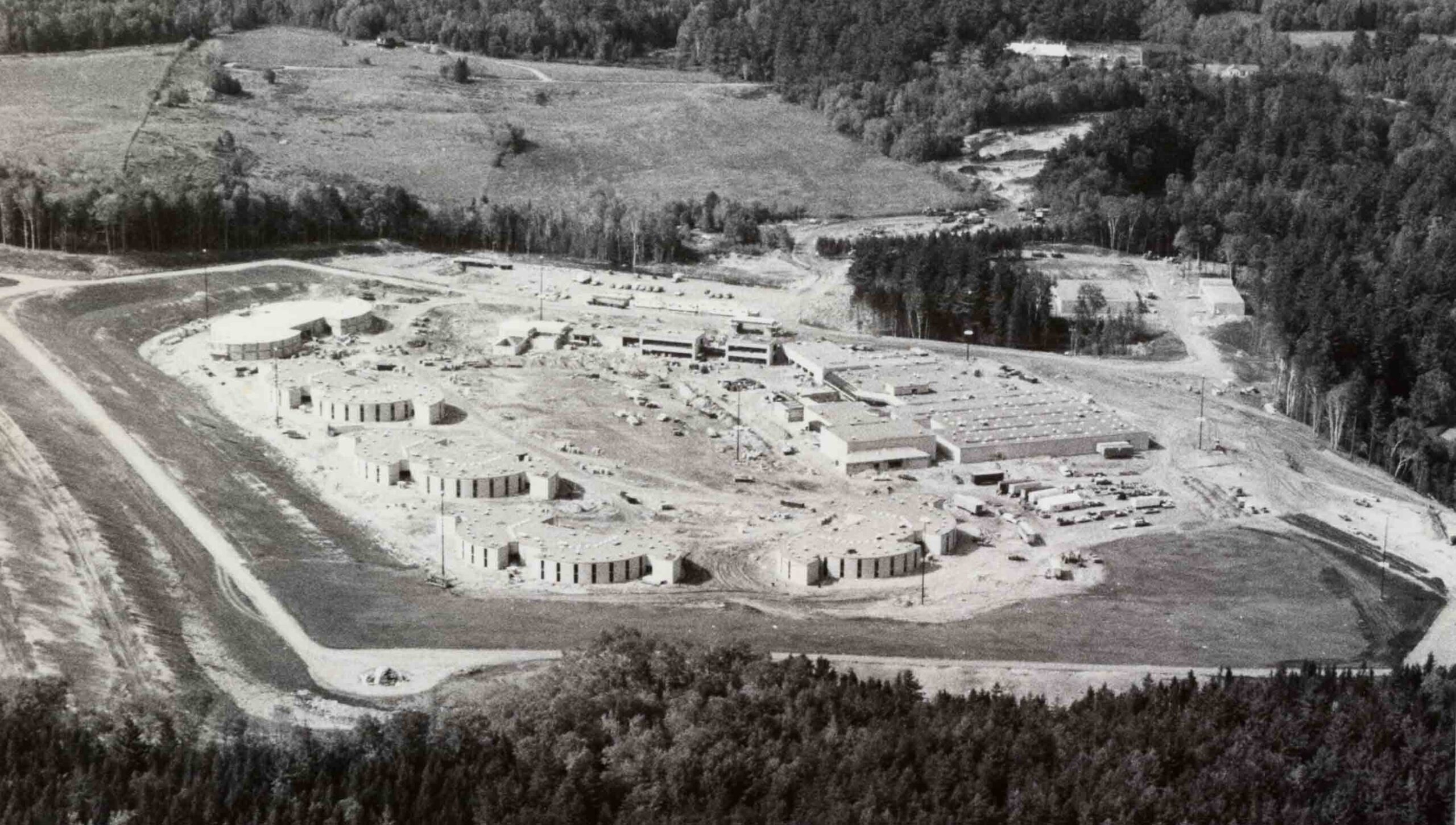
The Olympic Village was built with 937 so-called sleeping rooms. These were essentially cells that could be quickly converted to this secondary use after the Games. Opposition arose on both ideological and practical grounds. The photo below shows the facility under construction.
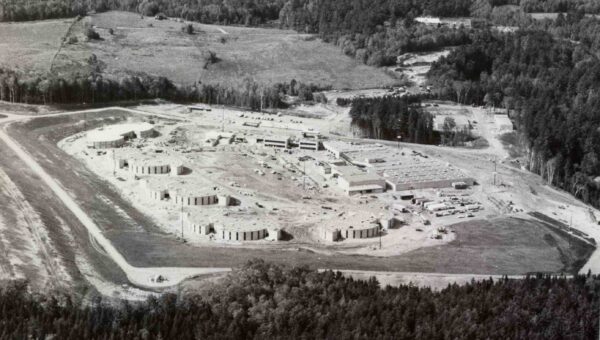
[From Atlas Obscura Courtesy of Lake Placid Olympic Museum]
When Gianfranco Cameli, a member of the Italian Olympic Committee, toured the Village before the Games, his report to Rome read, in part, “After four years of hard training we cannot expect competitors to live in such a lousy place. The rooms clearly show what they are meant for. Two persons cannot be in them. If two stay inside with the door closed for privacy, they’d feel as if they were in prison – suffocating.”
Atlas Obscura provides this description,
Each room was about 8-by-13-feet with cinderblock walls. The cells had bunk beds to accommodate two to four athletes, along with a wardrobe, equipment lockers, and a writing table and chair for each occupant. The majority of the rooms featured a single, narrow window with a steel rod running down the middle of the glass to discourage escape—or, in the case of potential Olympic terrorists, entry. Some rooms had no windows at all. Athletes entered through doors constructed of heavy steel with small peep-windows that guards would later use to check in on inmates.
The site’s barbed wire fences weren’t installed until after the games at the insistence of Harry Fregoe, chair of the IOC’s athlete housing committee. “We’re a little bit afraid of the concentration camp atmosphere for some people from European countries,” he said.
Another factor at that time was the escalation of the Cold War between the US and the USSR. Recall that President Carter had imposed sanctions on the Soviet Union after their December invasion of Afghanistan and, even before that, there was talk of a Western boycott of the Summer Games that were scheduled for July in Moscow in protest of Moscow’s human rights policies. This wasn’t a good look for a country that wanted to convince the world that it held the humanitarian high ground.
Of course, once the news broke of America’s “Olympics Prison,” The Soviet government turned it into a propagandistic tool by announcing their plans to convert the Moscow Olympic Village into public housing for 14,000 needy Russian citizens. (Apparently, this didn’t happen. The Moscow Olympic Village ultimately became a complex of three hotels and I stayed in one in my 2013 trip there.)
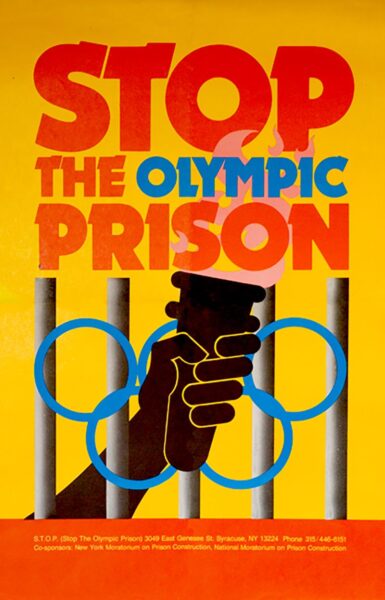
Reverend Graham Hodges of the United Church of Christ in Watertown – an activist in the Stop the Olympic Prison (STOP) movement wrote in a letter to the Washington Post, “One would have thought the two nations would have just the opposite kinds of villages, but not so. It is we Americans who are hosting Olympic athletes in a prison, the first time in nearly 3,000 years of history of the games.”
[From Atlas Obscura]
STOP, stressing the contrast between the different emerging models of international and American criminal justice models encouraged European countries to write letters of disapproval to the US government. While Holland, Sweden, Japan, England, and other nations were reducing their use of prisons in favor of community sanctions, the US Federal Bureau of Prisons had doubled its number of prisons in the previous ten years.
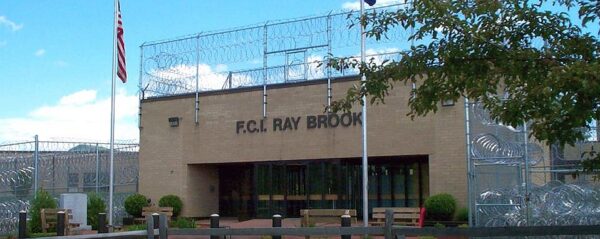
Soon after the Games, the sleeping rooms were converted to cells and the recreational and dining facilities were repurposed for prison operations. By September 1980, the site reopened as the Federal Correction Institution Ray Brook.
[U.S. Department of Justice – Public Domain]
Today, FCI Ray Brook houses approximately 8oo men in the medium security facility. The promised jobs arrived and that total has remained steady between 225 and 250. In 2014, a manager at the Adirondak Museum told North Country Public Radio that she tells tourists who want to visit the 1980 Olympic Village, “In order to visit that Olympic Athletes’ Village (today), you would have to commit a federal crime.”
In truth, while I didn’t attempt to visit the prison, visits can be scheduled. You can read about one such experience here.
-
It’s just a shot away – Prizren
March 6, 2026 -
Some things looking better, baby – Getting into Kosovo
March 4, 2026 -
Here, where the sky is falling – Kukës
March 2, 2026 -
That’s when we fall in line ’cause we got Berat
February 27, 2026 -

Walking on the big stuff – a climb to Tragjas
February 25, 2026
2 responses to “The Ray Brook legacy (Lake Placid and Me – addendum three)”
“In order to visit, you would have to commit a federal crime”. Wow….
Pretty wild, eh?