The Footsteps Die Out Forever
Or at least I expect mine will. Today is my final walk through Melbourne and although I find the city quite appealing, I don’t anticipate ever returning.
Straight from my notes
In much the same way that I broke my inclination to avoid contemporaneous writing at Port Arthur, I’m going to break another tradition and share with you my first travel note from my last full day in Australia. “Today was the day active travel caught up with me. This is already my longest trip and I’m barely halfway through it. Yes, I spent two months in Lisbon last year but it wasn’t day after day of sightseeing, packing and unpacking, early mornings, and making plans. And, other than a single overnight trip to Portimão, I was only in Lisbon. Everything I did there I did at my own pace or the pace of my visitors when they arrived.”
By population, Melbourne is Australia’s largest (or second largest) city depending on the timing of the census and whether you’re talking with a Melburnian or a Sydneysider. It has oodles of history and culture and, thus, no shortage of activities to amuse a visitor like me. However, I’d reached a point where I simply didn’t want to think about any of them so I fired up my laptop and registered for a free walking tour.
It began at 10:30 in front of the State Library of Victoria
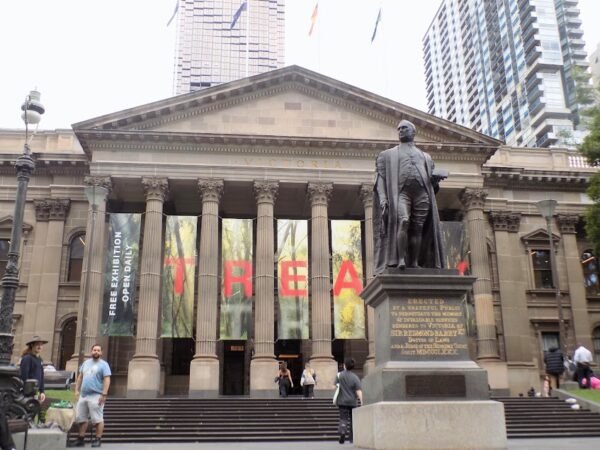
– an easy 2km walk or half that if I decided to ride the tram. This meeting point also had the advantage of positioning me to see two small Atlas Obscura items.
The bunyip
The first of these has been in its present location since 2012. It’s a casting based on Ron Brooks’ illustrations for Jenny Wagner’s 1973 children’s book called The Bunyip of Berkely’s Creek. While the book explores universal themes of identity and self-acceptance, it appears to use the mythical creature without acknowledging its Aboriginal routes and changes its nature from a fierce thing to be feared into something far more benign. Where the Bunyip of Berkeley’s Creek looks like this,
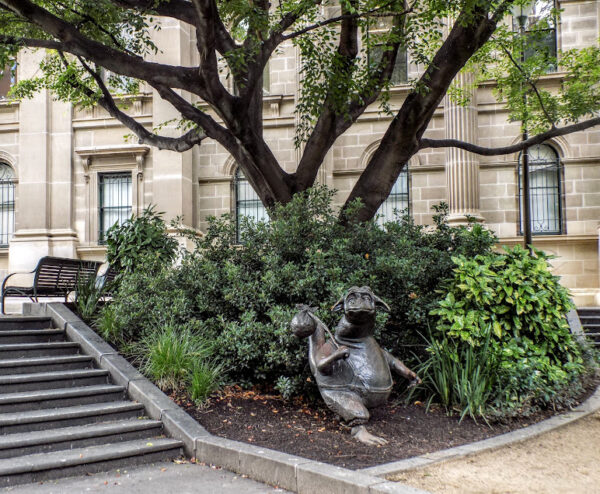
the bunyip of the Wemba-Wemba People – whose language gave us its name – looked more like this.
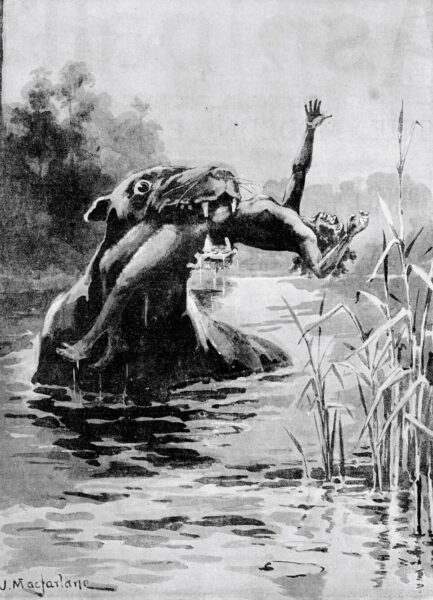
[From Wikipedia – Public Domain]
Although descriptions of the bunyip tend to vary widely, its role in Aboriginal mythology is to often serve as a cautionary tale to keep children away from dangerous water bodies. It may have arisen from encounters with such animals as the southern cassowary or the Australasian bittern. There’s also some interesting speculation that it could have some basis in encounters some of the earliest Aboriginal people had with one of Australia’s extinct megafauna marsupials – the Thylacoleo or marsupial lion.
Mr Lizard & Gumnut Baby
May Gibbs published the first of her series of Snugglepot and Cuddlepie children’s stories in 1918. With characters and settings based on plants found in the bush of her childhood, such as eucalyptus and banksia, Gibbs created a fairytale Australia unpopulated by Aboriginal People and an environment where her characters sought to domesticate the bush and apply European land management principles.
The statue, created by artist Smiley Williams,
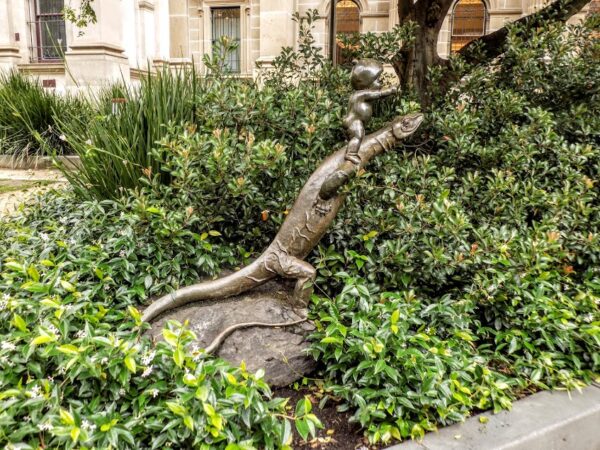
depicts Snugglepot riding Mr Lizard, a Goanna who is a great friend to all the babies. It’s just on the other side of the square in front of the library.
8-8-8
The tour, which had a surprisingly large group, got started a little late and I can’t say if it was my fatigue or the fact that I’d covered some of this ground on my own that had me only marginally attending to the guide’s banter. That is until we reached the pillar of the 8-8-8 Monument.
This monument salutes yet another Australian fact of which I was utterly ignorant. Officially known as the Eight Hour Day Monument, it commemorates the Eight Hours Movement that began in Victoria in March 1856 and culminated less than a month later with an agreement that permitted stone masons working at the University of Melbourne the right to work an eight-hour-day for the same wage they had previously earned for working 10-hours.
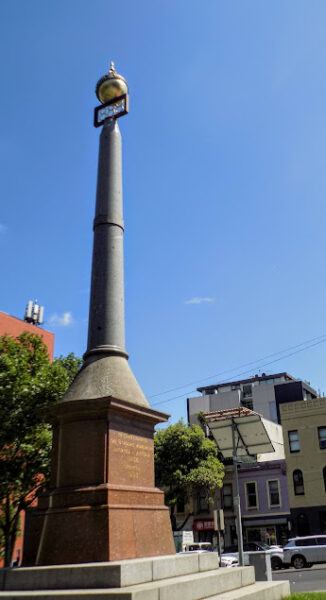
Although there had been other eight-hour-day experiments such as that granted carpenters in Wellington, NZ, this achievement by Melbourne’s stone masons was a significant milestone in the labor rights movement. Still, it would be another six decades until the Eight Hours Act was passed in the state of Victoria. The intertwined 8-8-8 near the top represents the ideal of eight-hours for work, eight hours for rest, and eight hours for recreation and education.
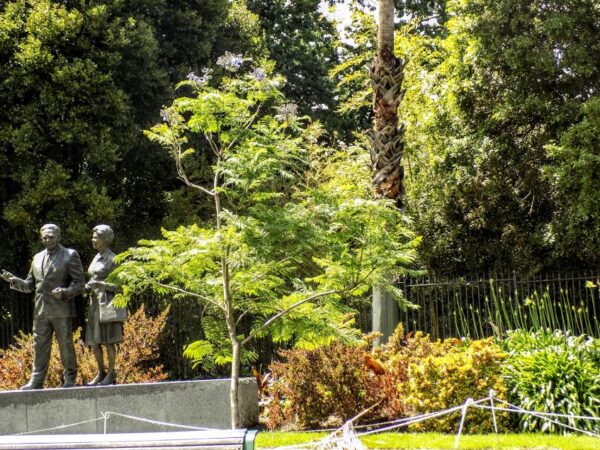
In a happy coincidence, the tour also walked us by another of AO’s 54 things to do in Melbourne – the statue honoring Sir Douglas and Lady Gladys Nicholls in Parliament Gardens. It’s not odd, quirky, or out of the way but it is important. Born on the Cummeragunja Reserve, Nicholls became a prominent Australian Rules Football player, Aboriginal Activist, first Indigenous Australian to be knighted, and the 28th Governor of South Australia.
A few more odds before my Australian journey ends
(I’m on the road to see If anything is anywhere)
After a few more stops, our guide suggested we take a lunch break but I’d reached the point where I’d simply had enough of guided touring so I tipped him and went off to spend a few hours on my own.
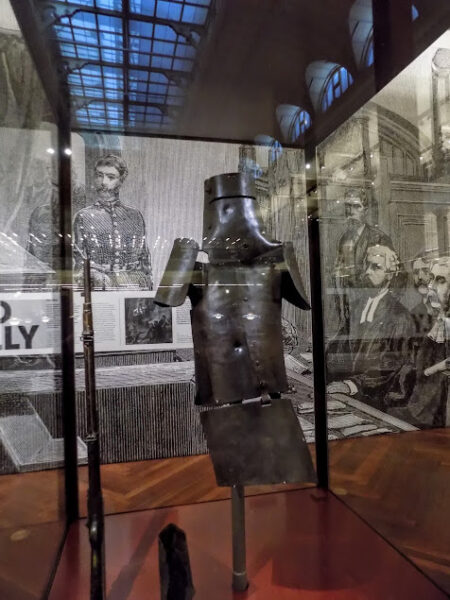
I started with a trip back to the Victoria State Library to get a glimpse of Ned Kelly’s last armor. Ned Kelly was a notorious outlaw who is, for some hard to fathom reason, (at least for me) one of Australia’s great folk heroes. He seems to be respected in a way that some of the outlaws if the American west are not. They might be famous but they’re not admired. Still, I was there so I thought I should indulge in this bit of Australian history.
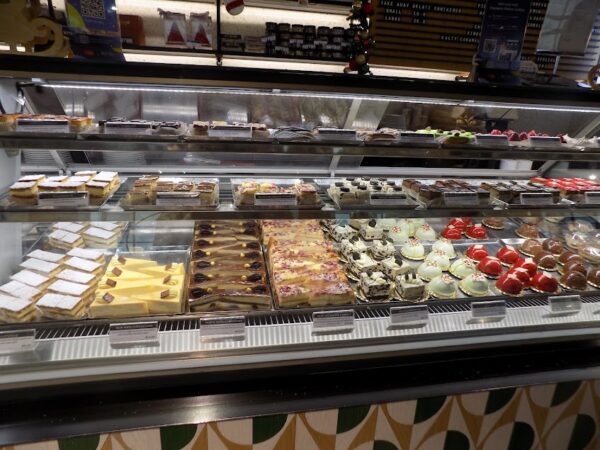
I had skipped lunch so after my visit to the museum, I made my way to an Italian bakery and café called Brunetti that my sister and brother-in-law (who is from Melbourne) had given their highest recommendation. Their pastry case – of which about one-third is visible in the photo below – is impressive, indeed.
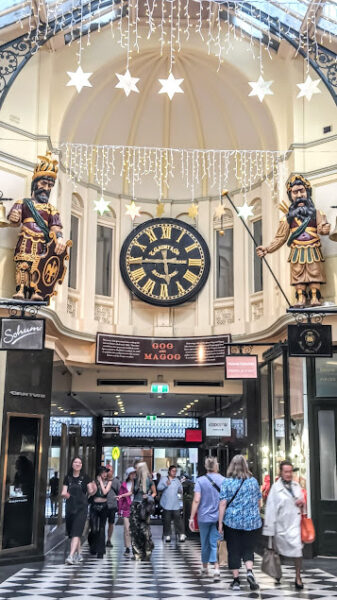
I had a tasty snack that satisfied my notoriously voracious sweet tooth and a cup of tea and then continued my walk. I found my way to the Royal Arcade on Elizabeth Street for a look at one last AO suggestion – the Gog and Magog Clock.
Since 1892, these two medieval warriors have watched over the southern side of the arcade, striking the chimes with their mechanical arms. Each is about seven feet tall, and carved from pine by a man named Mortimer Godfrey. He modeled the two on similar figures that watch over Guildhall in London, where the same characters have been the guardians of the city since the 15th century.
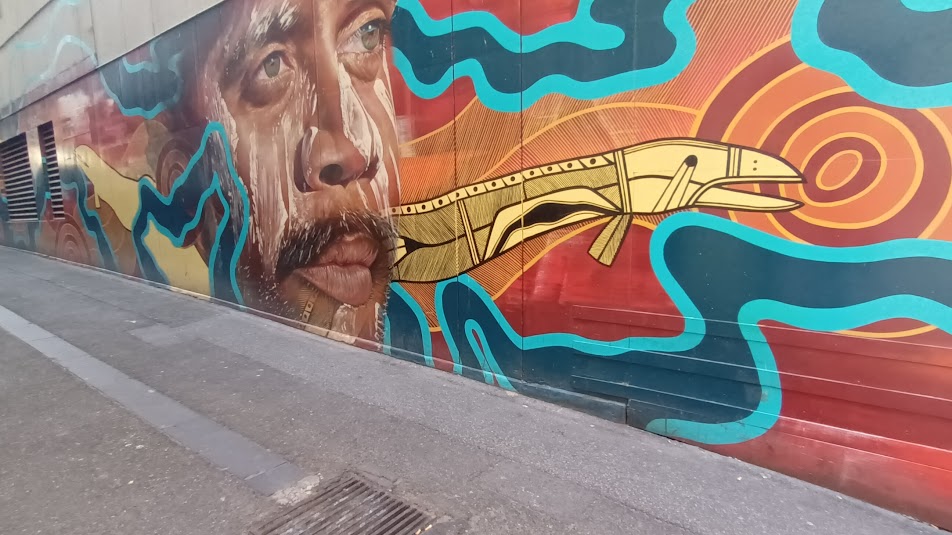
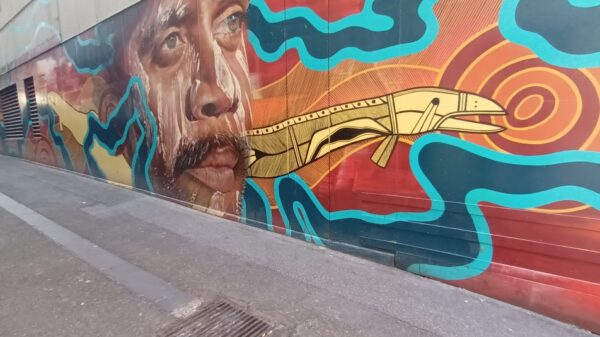
Exiting there, I spotted some interesting additional street art with a clear Aboriginal theme (if not in a clear aboriginal style),
saw several instances of an American marketing invasion of Australia,
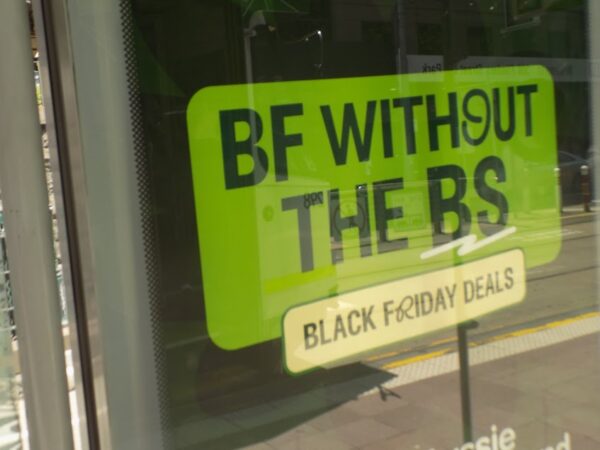
(It struck me as odd given that they don’t celebrate the American Thanksgiving holiday in this land down under.)
and had to take a photo of an Australian Christmas decoration
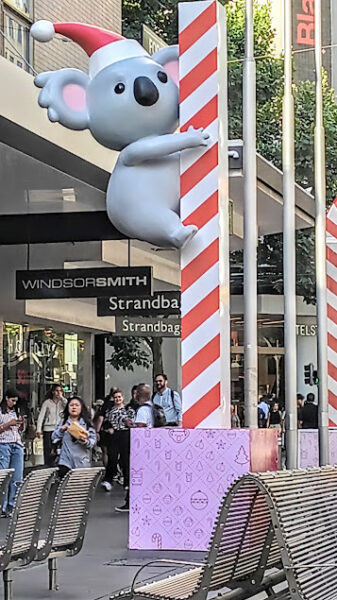
that, to me, looked like a koala humping a candy cane. I think it will be for me the quintessential Christmas symbol for the remainder of my days.
My final supper in Australia would be at Momo Central – a restaurant that presented itself as serving authentic Nepali street and comfort food. Having never been to Nepal, I can’t speak to the authenticity or accuracy of this assertion. The restaurant is on Little Collins Street and I had a medium spice rated chicken with chili peppers that wasn’t overly spicy and was, perhaps, a slightly above average meal.
Since Melbourne hosted the 1956 Summer Olympics, I’ll take another detour into that series before moving on to my time in Aotearoa New Zealand.
And if you’re wondering about other pictures, try this link.
-
It’s just a shot away – Prizren
March 6, 2026 -
Some things looking better, baby – Getting into Kosovo
March 4, 2026 -
Here, where the sky is falling – Kukës
March 2, 2026 -
That’s when we fall in line ’cause we got Berat
February 27, 2026 -
Walking on the big stuff – a climb to Tragjas
February 25, 2026
2 responses to “The Footsteps Die Out Forever”
Lots of cool pics there. What was the dessert you decided on? Looks amazing..😋
It wasn’t easy but I believe it was the strawberries and cream eclair. (Not quite a pastel de nata but definitely enjoyable.