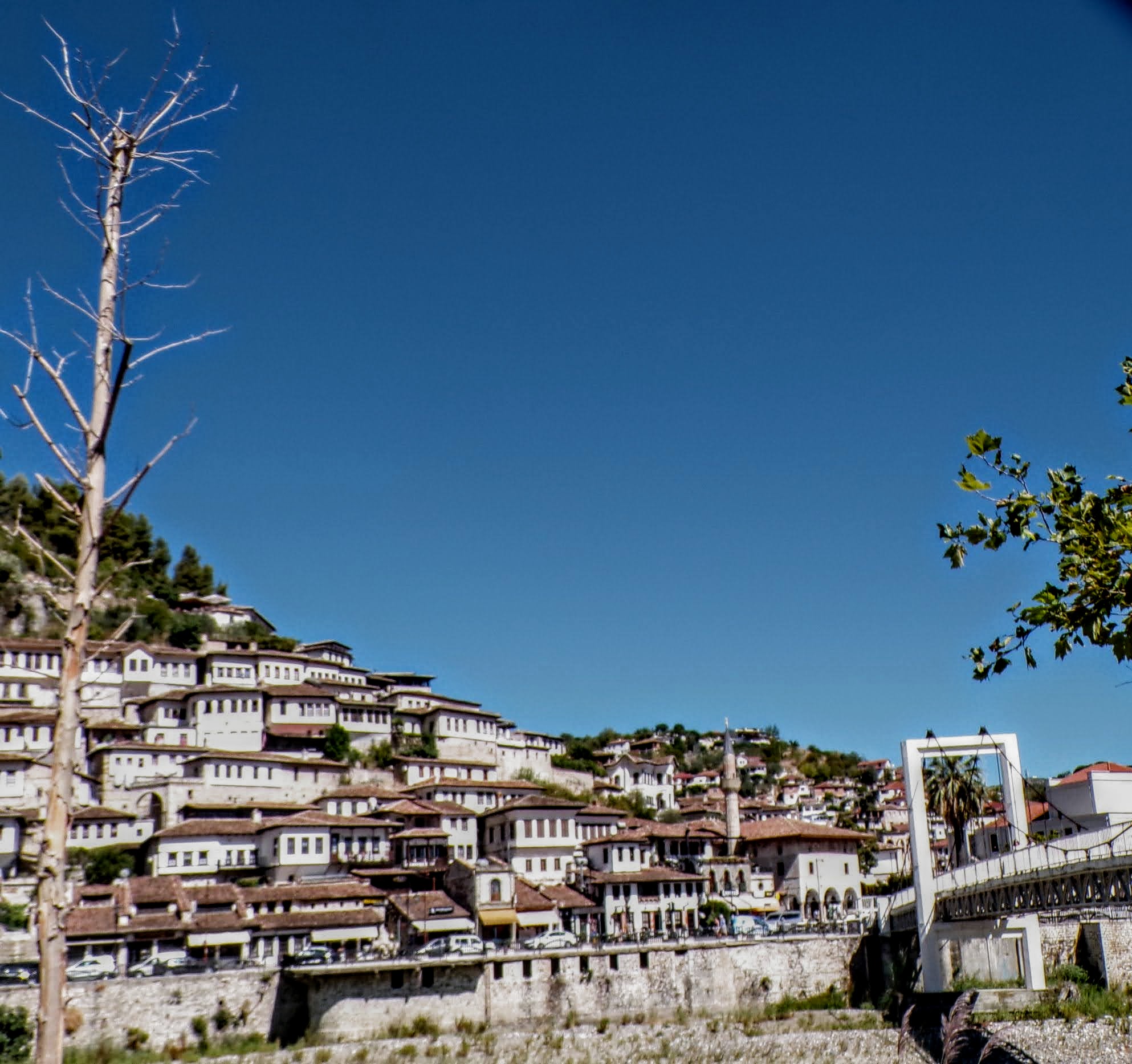
That’s when we fall in line ’cause we got Berat
I’m on the thinnest of twigs with the pun in this post’s title but, “So it goes.” I’ll be continuing my Balkan and Albanian explorations for another few days but today is our last day together as a group. We’ll be on our bus for between three and four hours in total with our first stop coming in about two hours in Berat before we finish things up in Tirana.
Before it was the City of 1,000 Windows
Berat is among Albania’s oldest cities, possibly founded by the Illyrians, later known as the Macedonian city Antipatreia in the 3rd or 4th centuries BCE. It remained under Macedonian control until the Illyrian Wars and the Romans fully gained control of Albanian territory after the Third Illyrian War in 168 BCE.
We’ll stay in this historical context for a little longer before we arrive in Berat but we will spring forward both temporally – about 440 years – and geographically to hover over the ancient town of Naissus about 5ookm to the northeast. If we arrive on 27 February 272 we should be able to observe a woman called Helena giving birth to a son she would name Flavius Constantinus after his father Constantius Chlorus
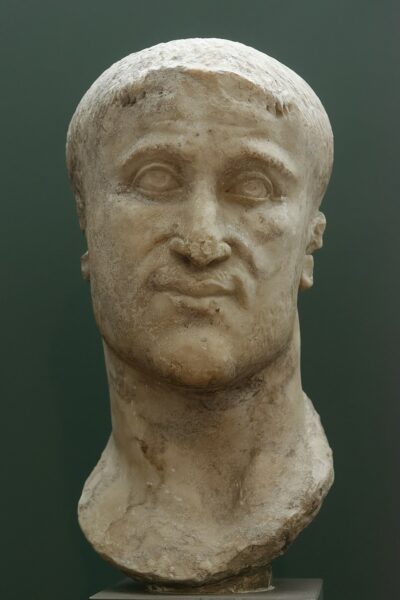
[From Wikipedia – Public Domain]
– an Illyrian soldier who became one of the four emperors of the Tetrarchy established by Diocletian. The young Flavius would, as an adult, become known to the world as Constantine the Great – the first Roman Emperor to both accept Christianity (He was baptized in 312.) and, by issuing the Edict of Milan in 313, to legalize Christianity in the Roman Empire. As we would learn later in our visit, Berat has historically considered Constantine’s Illyrian heritage essential to the city’s narrative. When we reached the castle ruins, this bust
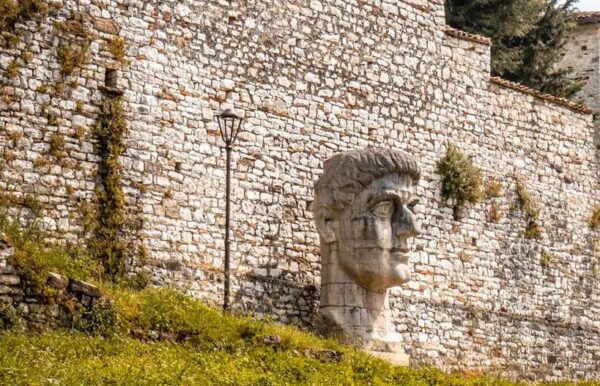
was a prominent feature.
As was the case in most of Albanian territory, a sequence of major regional powers controlled Berat. The Byzantines took control in the fourth century after the split with Rome. The strength of the Byzantine Empire began to wane and after the fourth Crusade in 1204, it began to fragment with the Angevins battling the Serbs for control over Berat. By 1347, the Serbs had complete command of the city. Their governance lasted about a century before they were displaced by the westward expansion of the Ottoman Empire.
Under Ottoman rule, Berat became an important urban center eventually becoming the capital of the Pashalik of Berat in the eighteenth century. (A Pashalik is a geographical area under the rule of a pasha, who was a high-ranking military or administrative Ottoman official.)
During the 19th century, Berat emerged as a center of a pair of important movements – one religious and one nationalist. The religious order known as the Bektashi is a Sufi Muslim sect that traces its beginning to the 13th century mystic and scholar Haji Bektash Veli. It adopted the tenets of Twelver Shi’ism in the 16th century under Balım Sultan and became a politically important force in the Ottoman Empire, closely associated with the Janissary corps. After 1780, the construction of key teqes (lodges) in Berat like Helveti Tekke,
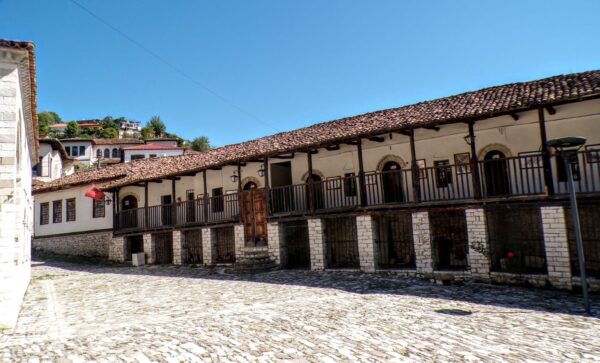
fueled the movement’s growth between 1790 and 1825.
The photo above are the quarters of the dervishes – a Muslim Sufi religious order practicing asceticism and seeking spiritual union with God through devotional exercises like chanting, meditation, and the famous spinning dance known as Sama. Yes, the Sama is the dance that gave rise to the description whirling dervish.
As we have seen from the history of Skanderbeg, Albanians long chafed under Ottoman rule. The principal Ottoman governing principle in Albania was the system of timar in which the sultan awarded landed estates to loyal military lords. These were the pashas. One, in particular, Ali Pasha Tepelenë held a despotic rule over southern Albania creating his own state within the empire until the sultan overthrew him. This effectively ended the timar system and power passed to local landowners – the beys.
The political movement had its roots in the mid nineteenth century as people throughout the Balkans began seeking to realize their own national aspirations. Recall that a group of beys met in Prizren in 1878 where they established the Albanian League. The League sought unification of the four vilayets into an autonomous state though still one that existed within the framework of the Ottoman Empire. It also spearheaded a movement to revive Albanian language, literature, and culture through a newly established educational system. Berat’s position as a regional capital made it an organizational hub for mobilizing support and coordinating political activity in the south in the decades before independence.
Now that we’ve looked at Berat’s historical significance, we can look at its modern claim to fame – the 1,000 windows.
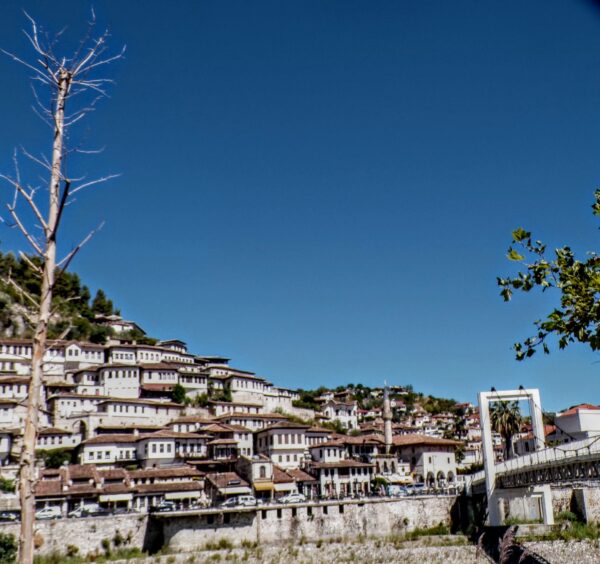
First, let’s set the record straight. There’s no source that indicates than anyone has actually counted the windows of the houses in Berat. However, standing on the western side of the Osum River looking at the homes ascending the hillside, clarifies the reason for the city’s nickname. The white façades and dense vertical windows exemplify Ottoman architecture and generate a distinctive – though as I would learn, not singular – mien.
Goodbye to the world that I know
Perhaps this section header is a bit overly dramatic but the reason for it will become clearer when I reveal the musical connection. After visiting the Helveti Tekke, we climbed to the castle where we met Constantine and had yet more lessons in Albanian religious tolerance.
(The Castle and its surroundings include multiple religious structures from different periods, including both Christian churches and Ottoman-era mosques within short walking distance, illustrating centuries of coexistence. From the vantage point of the castle, one can see both the King’s Mosque (Xhamia Mbret) and the Bachelors’ Mosque (Xhamia e Beqarëve) located in historic core and near other Christian churches within or adjacent to the fortress area.
Churches in the old town dating to Byzantine and post-Byzantine periods, along with nearby mosques and tekkes provide evidence of the way Christians and Muslims have shared the same urban space for centuries. Berat’s UNESCO-listed old town is repeatedly highlighted as an example of religious plurality expressed through architecture and urban layout.)
Following our descent, we boarded our coach for a final vectarious ride as a group. The culmination of our ride was our return to Tirana and a somewhat chaotic scene on our return to the Livia Hotel with significant confusion regarding who would stay in each room. It would have been helpful if E had stayed with us to bridge the language barrier. I don’t think we were running particularly late but he seemed in a hurry to meet his next group. In the end, everyone managed to find a room and several of us met for one final group supper.
Among the missing, were some of the other elders in our transitory crew. In some ways, I would miss the yin and yang of the loquacious P and his good friend the breviloquent G. Their complementary interactions provided me many momentary smiles – particularly contrasting G’s quiet enjoyment with P’s overly expressive eudaemonic pleasure in even small details. (I doubt anyone reading this blog would describe me as breviloquent.)
And there was another level of camaraderie I’d miss – one that became quite apparent after our very forgettable supper. It was Saturday night and I’d planned a day trip to Kosovo for Sunday. However, as of the end of our supper, I still had heard nothing from the tour operator regarding a pickup time and location and I was a bit on edge about it. He did contact me later that evening and when I reported this to our WhatsApp group, I received many supportive messages in return.
Now that you know where I’m off to tomorrow, you can look at some additional photos if you’re so inclined.
-
And then I’ll fly, so high across the sky – Tirana to Frankfurt
March 18, 2026 -
Reflections of the way life used to be – travel days
March 16, 2026 -
It’s getting to the point – Blue Eye and Gjirokaster
March 13, 2026 -

There’s bound to be a better ride Than what you’ve got planned – busing to Sarandë
March 11, 2026 -
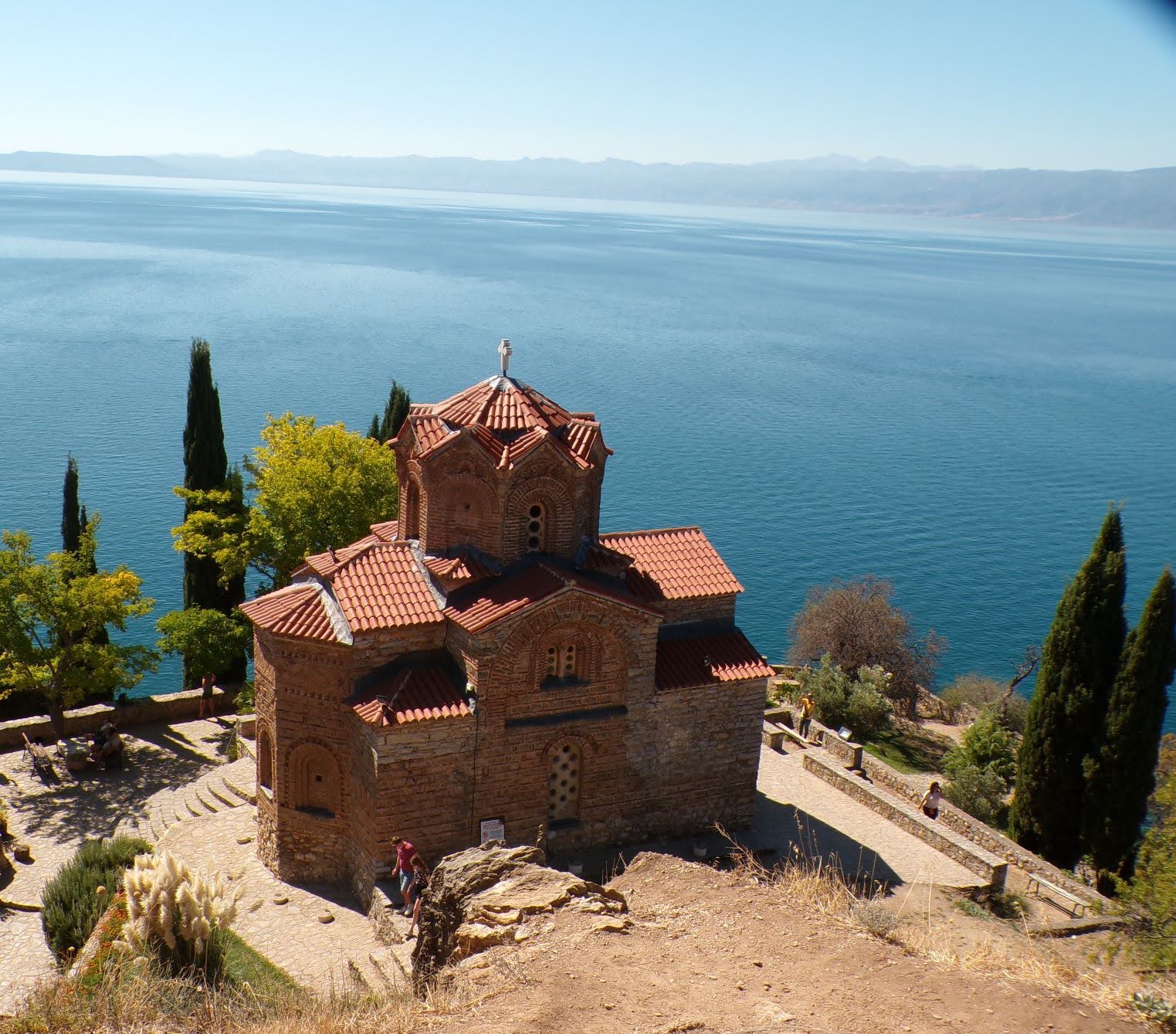
If you’re looking to find a place in the summer sun – Ohrid
March 9, 2026
2 responses to “That’s when we fall in line ’cause we got Berat”
Entertaining read Todd.
I had always wondered about the phrase – whirling dervish.
Now I kinda know more about it. Thanks.
Thanks, Shell. I try to include information that makes me think, “That’s interesting.” I figure at least one person will react that way, too.