So you think you know Aotearoa AKA New Zealand
Before I dive into the first surprise Aotearoa New Zealand has in store for you in this journal, I want to relate what was, for me, a remarkable event that happened on my Qantas flight from Melbourne to Auckland – something that had never happened to me on any flight. Since the flight’s duration was less than my five-hour trigger for upgraded seats, I was in the main cabin.
About 20 minutes outside of Auckland, Georgea, the lead member of the Auckland based cabin crew came and squatted in the aisle next to my seat. As she handed me a Qantas cap and a deck of cards (seen here in what I term, “the dreaded selfie”)

she told me that she and the crew so appreciated the way I’d interacted with them they wanted me to have these things as a sign of their appreciation. The gifts were accompanied by this lovely note.

I wasn’t aware that I’d done anything extraordinary but it is a story I’ve told and retold rather giddily I must admit.
What on Earth is a continent?
As I prepare for my 29 November arrival in Auckland on Te-Ika-Māui or, as we call it in English, New Zealand’s North Island, I might shock you by asserting that it’s not an island at all. Neither, in fact, is Te Waipounamu or the South Island. They might look and function like islands – as do all the other 600-700 islands that comprise the nation’s surface area of 268,680 km² – but, although they were only islands until 2017 they are only islands no longer. (Henceforth, I will generally prefer using the country’s traditional Māori name – Aotearoa.)
In 2017, a team of 11 geologists from Geological and Nuclear Sciences, Limited (GNS) presented evidence that Te Riu-a-Māui or Zealandia was, in fact, Earth’s eighth continent. It’s simply one with most of its nearly 5,000,000 km² submerged beneath the South Pacific Ocean.
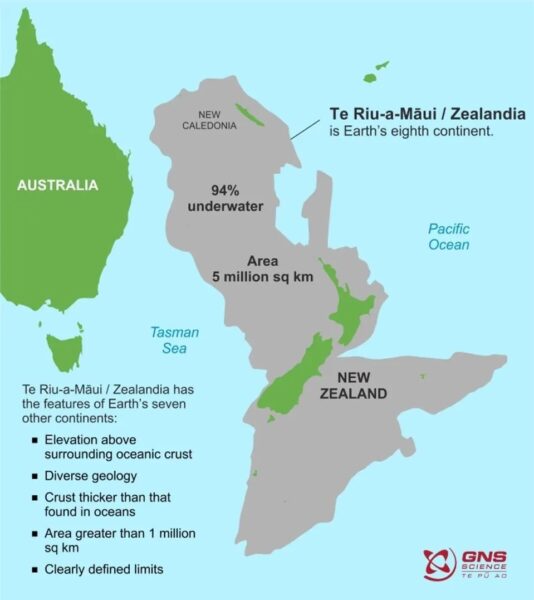
[Map from GNS]
At the beginning of my record of the Australia leg of this massive trip, I referred to that landmass as either the world’s largest island or its smallest continent. If you accept the addition of Zealandia as the Earth’s eighth continent, Australia would lose the second of those designations. Zealandia’s total area is between 50% and 60% of that of Australia. (Or, you could take the view of Dr Jordan Phethean from the University of Derby. His research suggests that North America and Europe are not separate continents but are still in the process of breaking apart. This implies that they could be considered a single continent thereby reducing the pre-Zealandia total to six. Another alternative applied by some geologists is the Eurasia Model that identifies the boundaries between Europe and Asia as more culturally than physically defined. But that could be stepping into a big pile of geopolitical manure.)
If we limit our analysis to only the physical characteristics geologists generally apply to define a continent, we’d find a list of eight primary constituents.
- A continental crust consisting of less dense granitic rocks than the surrounding oceanic crust.
- Higher elevation relative to the surrounding ocean floor because of their lower density composition.
- A significantly thicker crust compared with oceanic crust. Typically, continental crust ranges from 10-30km while oceanic crust will be from 6-7km thick on average.
- A diverse range of igneous, metamorphic, and sedimentary rocks rich in silica.
- Large stable regions called cratons that have remained mostly unaffected by mountain-building events since the Precambrian era.
- A continental shelf.
- Well-defined limits around a sufficiently large area. (The 1,000,000km² on the map above is somewhat arbitrary. There’s no agreed upon minimum continental size.)
- The lithosphere of a continent is too buoyant to be subducted into the Earth’s mantle at convergent plate boundaries over long geological time periods.
So, there you have it. As the map from GNS shows, Te-Riu-a-Maui or Zealandia has “the features of Earth’s seven other continents.” Whether you believe it’s a continent or not, I can say definitively that I have visited all of the Earth’s continents save one – Antarctica. And, unless that continent somehow comes to me, I suspect that status will remain unchanged.
The last human place of the southern hemisphere
A thousand years ago, Aotearoa wasn’t an easy place to find. If you set sail from today’s Ho Chi Minh City on a southeasterly course, you’d have to travel 5,000km to reach Port Moresby, Papua New Guinea and you’d still be less than three-fifths of the way to Auckland. Sail another 2,300km to reach New Caledonia and 1,500km farther along you will reach Auckland.
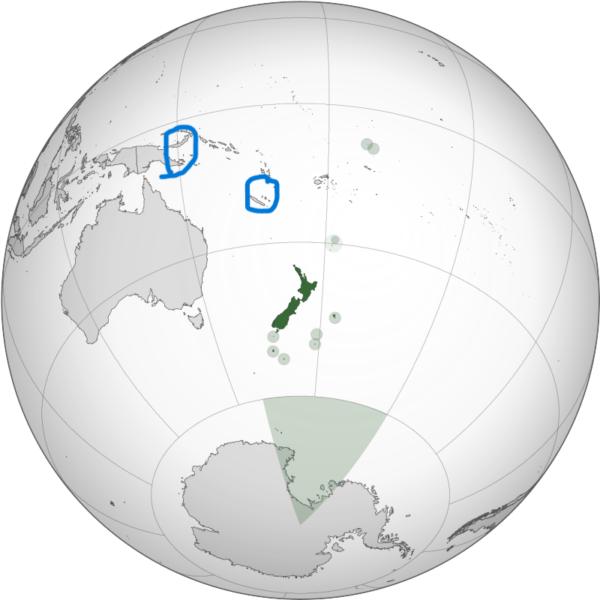
[From Wikipedia – Public Domain]
For the visually inclined, the topmost circle is Papua New Guinea, to its southeast is New Caledonia, and Aotearoa is in green. So far away, Vietnam isn’t on the map. Travel south from Aotearoa and the first land you reach is Antarctica – more than 6,000km distant. You “only” have to travel about 2,200km westerly to reach Tasmania and 2ookm farther to reach the Australian mainland. To reach the west coast of South America you need to cross nearly 10,000km of open ocean.
It should be little wonder then, that Aotearoa is usually considered one of the last places on Earth that humans settled. (In the northern hemisphere the last settled place was probably Iceland. The first settlers appear to have been a group of Irish monks called “Papar” and they might have first arrived on Iceland in the eighth century. However, while the earliest Norse settlers who arrived in 874 found evidence of the Papar in the form of books, crosses, and bells, they found no monks.)
Exactly how long ago it was that the first humans reached and settled on Aotearoa is a matter of some dispute. There’s general consensus that the Māori have been in Aotearoa for at least 800 years but some Māori oral histories point to an arrival centuries earlier. Here’s one suggestion of how and when they might have gotten there.
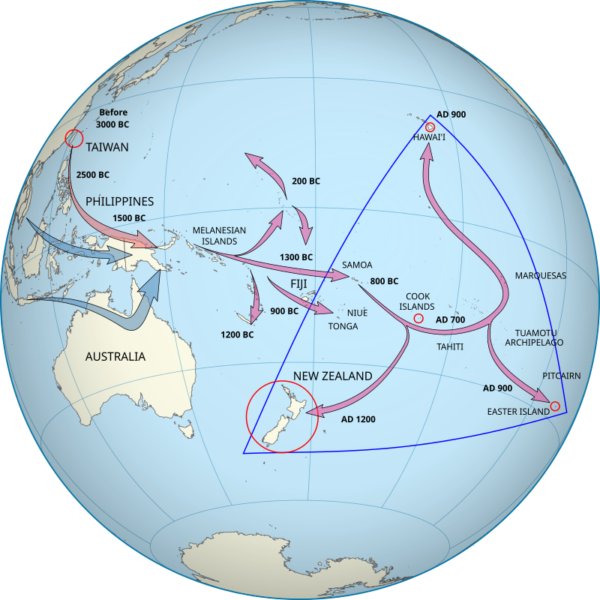
[From Wikipedia By David Eccles (Gringer (talk)) – Own work.]
Still not easy
Even today, with the convenience and speed of air travel, it’s neither easy to reach nor to enter Aotearoa. My three-an-a-half hour flight from Melbourne to Auckland is among the shortest duration flights to reach that city. From Honolulu, it’s about nine hours, 12 from Los Angeles, and nearly 20 hours from Washington, DC. It’s nearly 20,000km and 29 hours of travel time from Lisbon and, for my Asian friends, ten and a half hours from Tokyo. (Add roughly an hour from Seoul and Beijing.)
And, after your hours and hours of flying you need to have completed the New Zealand Travel Declaration or NZTD online or the Passenger Arrival Card (PAC). Nearly all countries ask travelers to provide personal identification, duration of stay, and to declare any items they may be bringing into the country. And, different countries might ban certain products. This is page three of Aotearoa’s PAC.
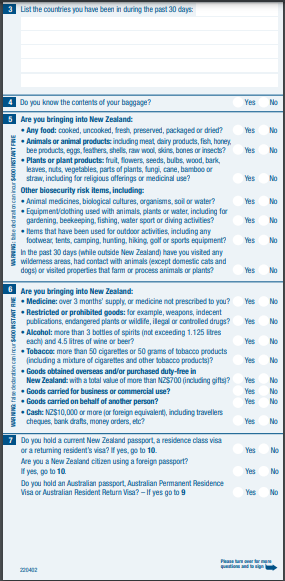
According to the NZTD website,
All individuals entering New Zealand are required to complete this declaration, providing details about their travel and any items they are bringing into the country.
Travelers can submit their declaration digitally prior to departure. The information gathered is used to support border risk assessments conducted by Immigration, Customs, Biosecurity, and Health agencies, as needed.
If you’ve been trekking through the outback in Australia and might have dirt on your clothes or gear, you’d better declare it and submit it to the Biosecurity folks. If the dogs smell it and you’re found to have committed an offense against the country’s very strict biosecurity laws, you can be subject to an immediate fine of up to $1,ooo. Aotearoa takes protecting its native biome very, very seriously.
Knowing my shoes could have some Australian dirt, I declared them. Although the inspectors x-rayed and opened my luggage, my declaration was overly cautious and I passed through without incident.
First Impression
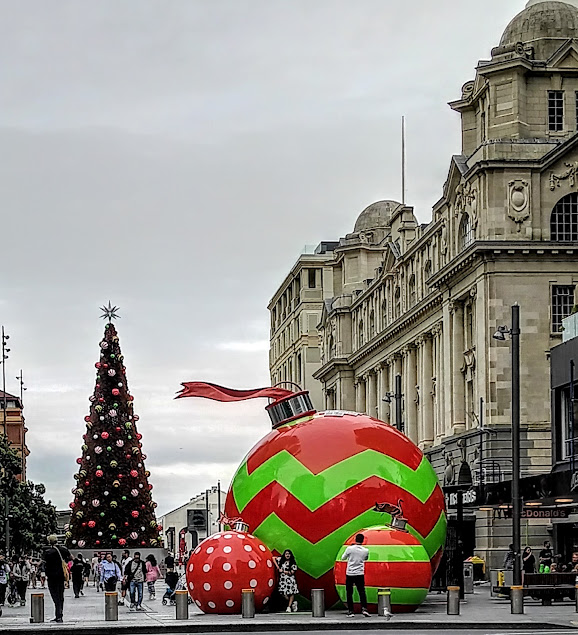
I hadn’t quite solved the puzzle of shared transportation from the airport to Auckland’s Central Business DIstrict (CBD) so I opted to take a taxi to the downtown hotel in the CBD, checked-in, and took a little orientation walk around the neighborhood. Although it still wasn’t the first of December, as had been the case in the urban areas of Australia,
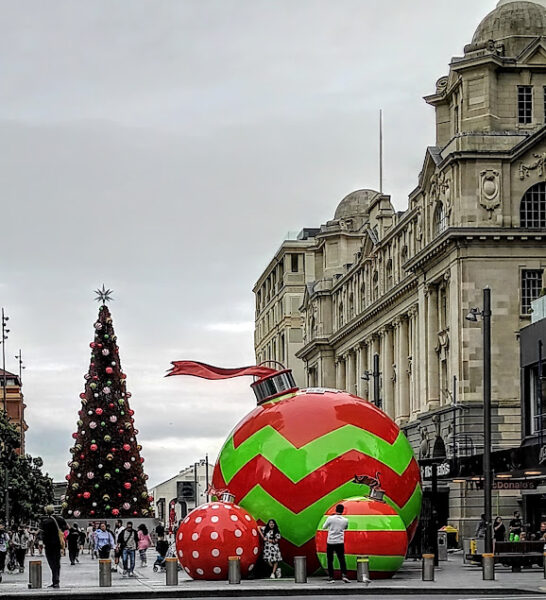
Auckland was getting dressed up for Christmas.
One of the general impressions I got was that Auckland had suffered significantly from the impact of Covid-19 and, even four years on, was still showing the signs of a lagging recovery. Perhaps this prompted the text I sent to my Melburnian brother-in-law that read, “Auckland seems nice but it doesn’t shine if the last city you’ve visited is Melbourne.” For me, Melbourne will never be Lisbon but it certainly tops the list of Australian cities I visited.
Perhaps Auckland will grow on me when I join the Road Scholar (RS) group and I’ve had a chance to explore a bit more. Before that, however, I have a day to visit an Aotearoa fantasy land.
-
It’s just a shot away – Prizren
March 6, 2026 -

Some things looking better, baby – Getting into Kosovo
March 4, 2026 -
Here, where the sky is falling – Kukës
March 2, 2026 -
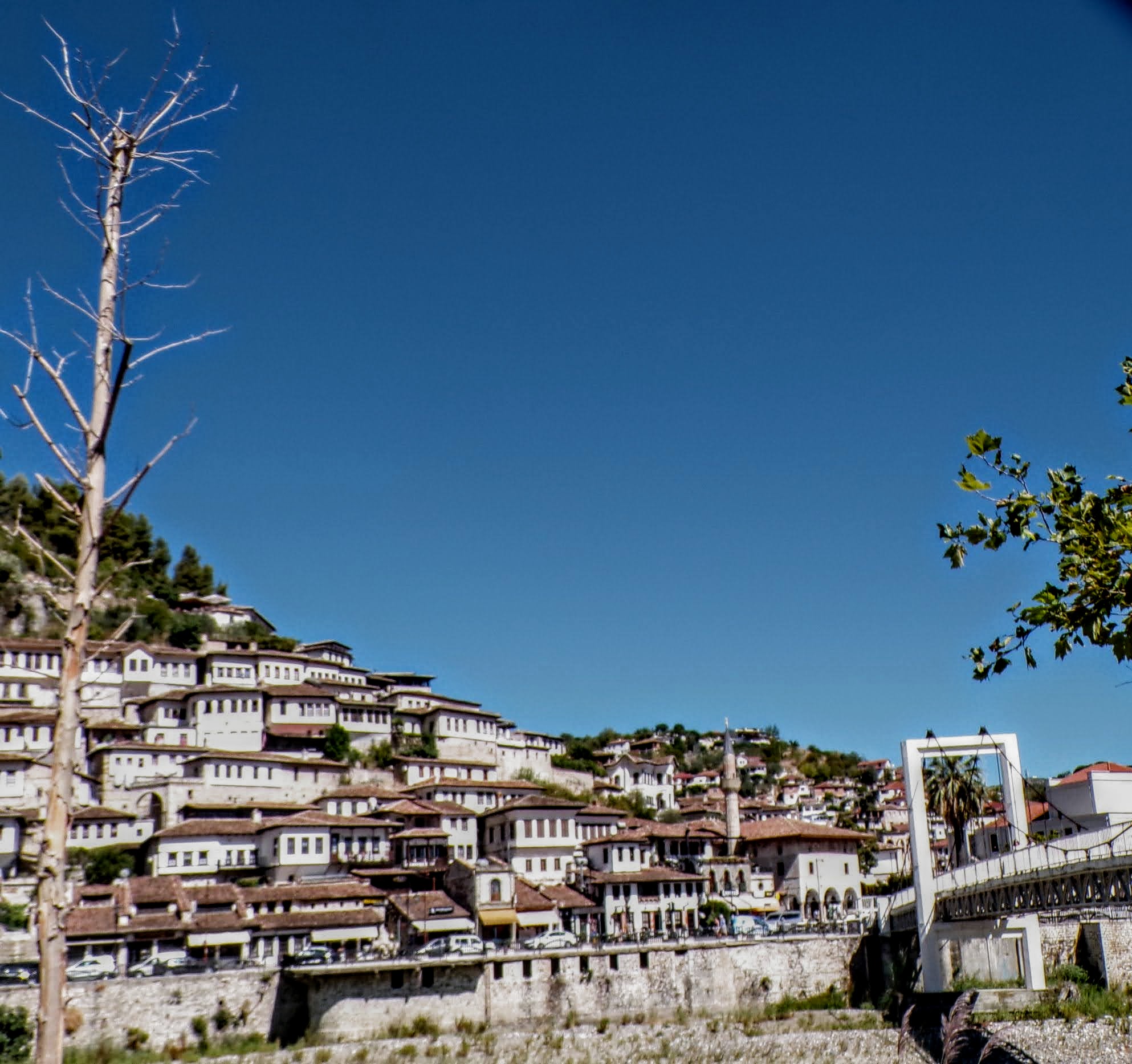
That’s when we fall in line ’cause we got Berat
February 27, 2026 -

Walking on the big stuff – a climb to Tragjas
February 25, 2026
2 responses to “So you think you know Aotearoa AKA New Zealand”
A new hat for The Hat! It’s nice that you were recognized for just being you. I don’t recall ever seeing you in a baseball cap. Ha!
Sometimes at a game in the rain because it’s okay for caps to get wet but less so for Mr. Hat’s hats.