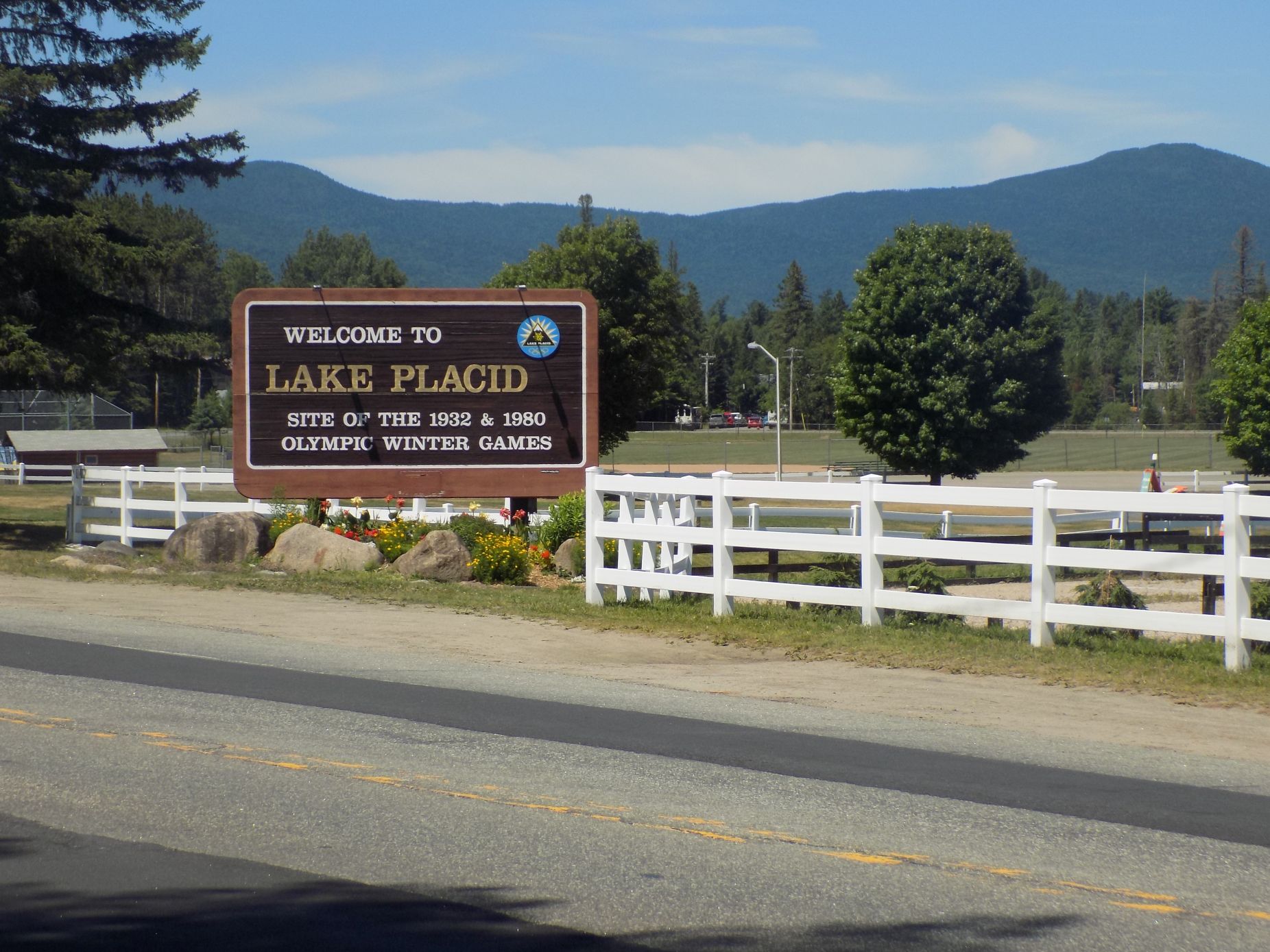
Lake Placid and Me – part one
My motivation to begin writing the category I’ve called Olympic Host Cities & Me sprung from a bit of boredom and a bit of serendipity. My trip to Lake Placid is unique because it’s the first city I’ve visited solely because it has served as a host for the Olympics. Every other city on the list has been part of a broader travel adventure. Thus, since the beginning of this project, I’ve found it ironic that I had yet to visit the host city closest to where I’ve lived for most of my life. And, in the case of Lake Placid, it hosted twice.
To remedy this situation, I rented a car and set out to drive to Lake Placid on a Tuesday morning in late July. I anticipated that this brief stay would focus on how the village has maintained its Olympic heritage. Additionally, since the blog has no other posts about Lake Placid, I’ll fully recount rather than summarize my time as I’ve done with previous entries in this series.
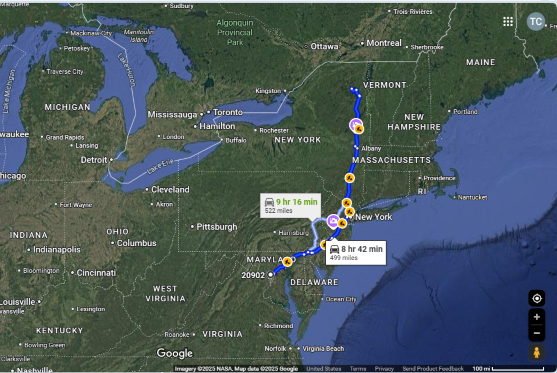
Since my rental car wasn’t equipped with a toll transponder and, wanting to avoid the aggravation inherent in keeping track of the tolls, having the various states bill Enterprise, followed by Enterprise billing me, I chose a longer route that avoided all tolled highways. Here’s the most direct route suggested by Google Maps
and here’s the route I chose.
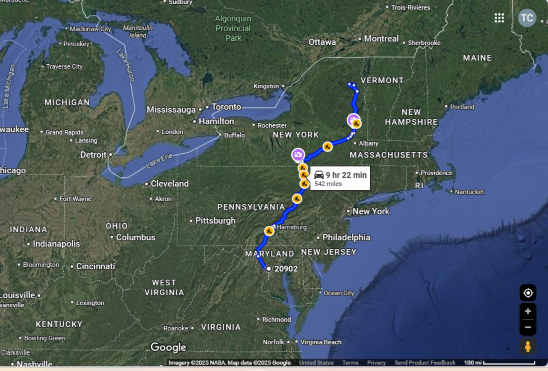
Had I been a bit more ambitious, I could have left earlier and included a stop at the Baseball Hall of Fame in Cooperstown as this route passes quite close to that institution. I considered leaving early enough on my return trip to allow time for a visit but ultimately decided I preferred the extra sleep.
Other than wanting to arrive before sunset, I had no particular time constraints so I was unconcerned about the additional time this route added. Frankly, it compensated me in other ways. The drive was relatively traffic-free and often quite scenic. My experience in and around Schenectady where I passed through not only the center of the city but many suburbs and the Google maps GPS directions had me making so many turns that I lost count added an unexpected layer of interest.
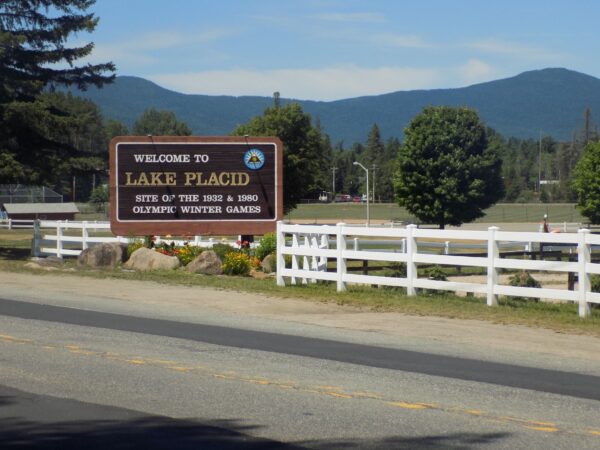
Parts of the drive along two-lane state roads had me thinking about my friend Shell and his YouTube driving videos. (His channel is LACFilms.) I think he might have given me the side eye for using the cruise control on the Interstates but would have been happiest along the final twenty or thirty mile stretch into the village of Lake Placid because it was particularly lovely. And, I was delighted to see this sign.
I made three stops enroute and reached my motel about 10 hours after I’d left home. After unloading the car,
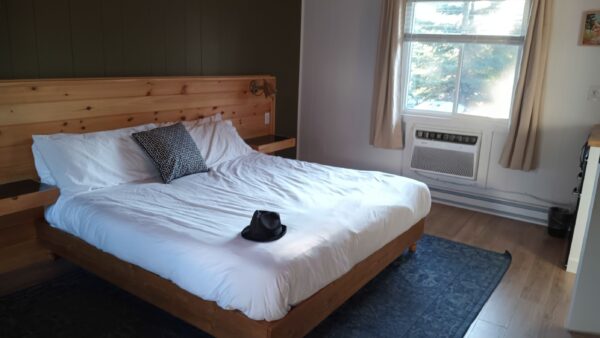
I walked a few hundred yards down the bustling Main Street before settling for a mediocre supper of seafood fra diavolo at the Black Bear. The scallops were cooked well but the shrimp and salmon were both overcooked and the sauce so mild it seemed devoid of any diavolo qualifying elements.
After supper I took a short walk south along Main Street to the band shell where a blues band had been playing when I arrived. Alas, the concert had ended so I reversed course and made my way up the moderately inclined hill (I’d guess about a 10% grade) to the hotel.
Of dogs and summertime snow
Lake Placid isn’t a large place so I planned to start my morning by walking back down the hill toward the town center and the Lake Placid Olympic Museum where I’d be able to also see the speed skating oval adjacent to the high school and the two arenas – the 1932 building named for Jack Shea and the newer rink named for Herb Brooks who coached the 1980 “Miracle on Ice” team to the gold medal. (I’ll have more about both in my posts about the Games.)
Before I got too far, I met Paul whose labradoodle Bear, managed to pull him toward me despite being strapped to Paul’s waist. (This isn’t Bear but is a reasonable facsimile.)
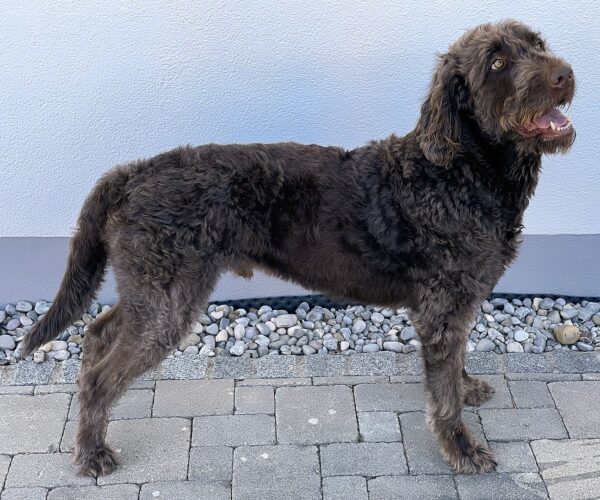
[From Wikipedia By Anton Porsche – Own work, CC BY-SA 4.0]
Like so many of the people I met in Lake Placid, Paul was more than willing to engage in conversation. Bear, while playfully affectionate, calmed down quickly. He was more taciturn. Although I’d only planned a day in the town, I was in no hurry and happy to get an extended lesson about the breed from Bear’s human.
Bear was an energetic three-year-old who, Paul told me, behaved more like his poodle father than his labradoodle mother.
(For those interested, the poodle likely originated in Germany as a water dog bred to retrieve hunted game from the water. Called a pudelhund or splash dog in Germany, the breed is called caniche in France. {This is likely derived from chien canard meaning duck dog.}
Caniches became closely associated with French aristocracy in the late 17th century during the rule of Louis XIV. By the mid-to-late 18th century, the poodle was widely recognized as a mark of French upper-class tastes. It was at this time that English speakers likely attached the French descriptor.
When Louis XVI ascended to the throne, his wife, Queen Marie Antoinette, helped cement the breed’s status as symbolic of luxury and fashion within aristocratic circles and it became the country’s unofficial national dog.)
Paul told me that Bear is great around people but that unlike other labradoodles can be aggressive with other dogs reflecting some of his sire’s traits. I asked if he’d worked with a trainer to better socialize Bear and he told me that the trainer seemed more interested in collecting his fee and teaching him how to socialize the dog than he did in actually working to socialize the dog.
I let it go and, after a bit more conversation, continued down the hill to the Olympic Center. On my way, though, I stopped to take a photo of the lake that the town abuts.
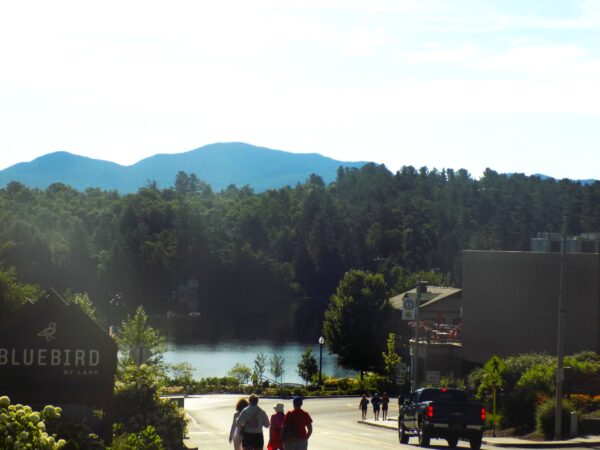
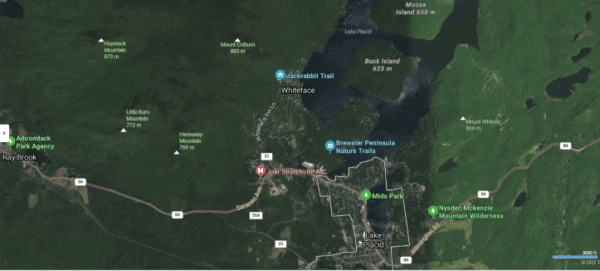
Note, this is Mirror Lake not Lake Placid. As this screenshot from Bing maps shows, the lake called Lake Placid is slightly north and west of the namesake town.
Continuing down the street, there’s a rather surprising display in front of the Olympic Center complex.
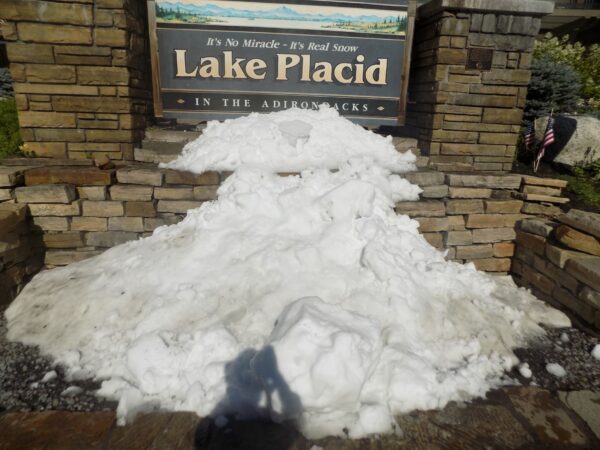
It’s certainly surprising to see real snow in July in a town that’s barely over 1,800 feet above sea level and is a bit south of the 45th parallel. And, as you might discern from the shadow of Mr Hat snapping the photo and the wet sidewalk, there’s enough warmth and heat to melt what’s there. How do they do it? Is it a miracle? Or is there a more prosaic explanation?
Unfortunately, it’s the latter. What I touched and you’re looking at in this photo is quite likely Zamboni poop. The website Zamboni.com explains the machine’s process:
The basic process involves the machine’s sharp blade, which shaves a thin layer of ice as screw conveyors (augers) rotate above the blade to remove the shavings. The shavings are collected in a large bin, known as the snow tank. Meanwhile, jets of water clean the ice by flushing dirt and debris from the remaining grooves in the ice into a vacuum hose. Finally, a towel spreads the ice-making water (usually warm water), which sprays out of holes at the back of the machine, leaving behind a smooth sheet of ice.
With a pair of ice rinks nearby, there’s no shortage of Zamboni shavings. Empty the snow tank et voila! Snow in July.
My Lake Placid Olympic experience begins in the next post and you’ll have to wait to see more photos.
-
It’s just a shot away – Prizren
March 6, 2026 -
Some things looking better, baby – Getting into Kosovo
March 4, 2026 -
Here, where the sky is falling – Kukës
March 2, 2026 -
That’s when we fall in line ’cause we got Berat
February 27, 2026 -
Walking on the big stuff – a climb to Tragjas
February 25, 2026
2 responses to “Lake Placid and Me – part one”
I apricate the reference to my You-Tube channel Todd.
Sometimes cruise control does matter on a long trip.
Lake Placid is an interesting place.
A friend of mine use to work as a chef near there.
Apricating with the top down, I presume.