How the III Winter Games came to the United States
According to the official records the Games of the III Winter Olympiad opened in Lake Placid New York on 4 February 1932 but perhaps this should have been only the second Winter Olympiad. As I noted in the post Notes on the VIII Olympiad – Paris 1924 (Paris and Me addendum two),
Held in association with the 1924 Summer Olympics, a series of sports competitions in Chamonix between 25 January and 5 February 1924 called Semaine des Sports d’Hiver (Week of Winter Sports) later became designated by the IOC as the first Olympic Winter Games.
Thus, it’s likely that the athletes in the six major categories of competition (bobsled, curling, ice hockey, figure skating, Nordic skiing, and speed skating) were unaware they were competing in the Olympic Games – much as had been the case in Paris in 1900. {You can read a little about that in this post – Notes on the II Olympiad – Paris 1900 (Paris and Me addendum one)} and it wouldn’t be unreasonable to call the Lake Placid Games the II Winter Olympics. However, since this was officially the III Winter Olympiad, let’s go with the flow and adhere to that designation.
A small town in upstate New York
A review of the records shows that the United States was particularly keen to host the Games in 1932. Lake Placid was one of nine cities, only two of which – Oslo and Montreal – were outside the US. One of the factors contributing to the IOC awarding the Games to Lake Placid was that it was well-established as a winter sports resort although it lacked certain facilities the Games required. Most notably, the town had no bobsled run. Here’s a view of Mirror Lake circa 1924.
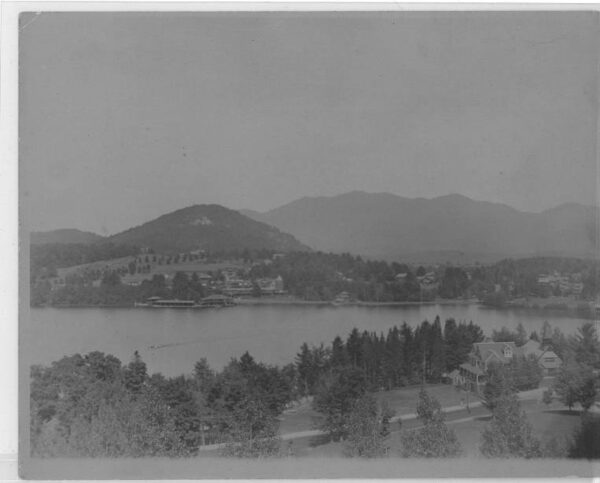
[From Lake Placid Public Library Photograph Archive]
However, the town did have Godfrey Dewey who served as President of the Organizing Committee. Dewey’s father Melville, built the family’s fortune as an entrepreneur selling library supplies, developing the Lake Placid Club, and his invention of the Dewey Decimal System – familiar to all librarians and library users. In addition to those assets, the younger Dewey had an important ally – the Governor of New York, Franklin D Roosevelt.
Dewey, armed with legislation supporting construction of a bobsled run on Forest Preserve Lands and with plans to extend the tower of the existing ski-jump from 60-meters to a height of 75-meters, convinced the IOC to award the games to Lake Placid which they did on 10 April 1929.
What he failed to tell the IOC was that the bobsled legislation was under litigation. It was declared unconstitutional under the Crane Decision. Fortunately, Roosevelt and the legislature were prepared and passed new legislation authorizing the state to build a bobsled run on private lands and the Dewey family was prepared to donate the land. In 1930, the legislature provided an initial tranche of $125,000 to build the run.
28 October 1929
The short-lived but severe recession that began in 1920 triggered by dramatic deflation of between 13 and 18 percent ended in August 1921. That recovery marked the beginning of the decade that became known as the “Roaring Twenties.” And no country in the world roared louder than the United States.
The decade’s first significant event for the U S came on 18 August 1920 when Tennessee became the 36th state to ratify the Nineteenth Amendment granting women the right to vote. The U S thus became the sixth nation joining Aotearoa-New Zealand (1893), Australia (1902), Finland (1906), Norway (1913), and the United Kingdom which had granted partial rights in 1918 to allow women to vote. (An interesting side note, Florida, South Carolina, Georgia, Louisiana, and North Carolina didn’t ratify the amendment until sometime between 1969 and 1971 and Mississippi was even more of a laggard becoming the last state to do so. In 1984!)
The pace of change proceeded at a dizzying rate. In 1922 less than 1% of American households owned a radio. By 1930, that number had topped 45 percent.
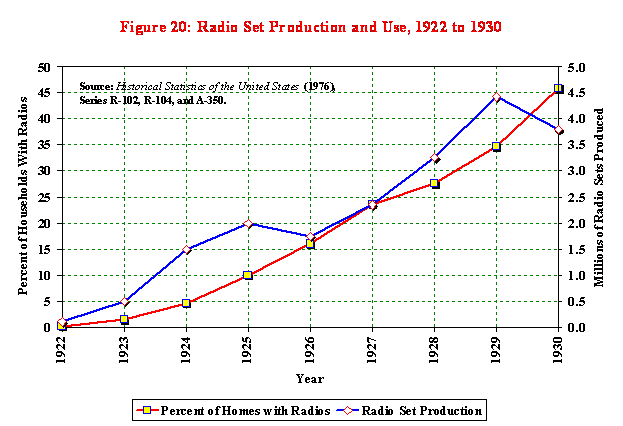
[From Economic History Association]
According to the Census bureau, “The 1920 census marked the first time in which over 50 percent of the U.S. population was defined as urban.” (In 1910, the minimum urban population was set at 2,500 for an incorporated jurisdiction.)
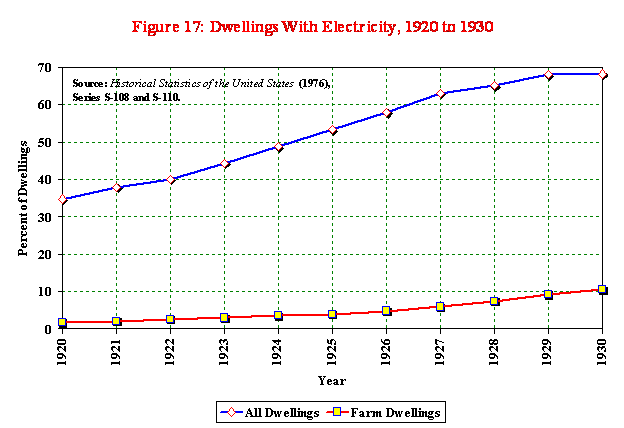
Reflecting this shift from rural to urban population, the decade saw the number of households with electricity nearly double although farm households lagged far behind the country’s urban areas.
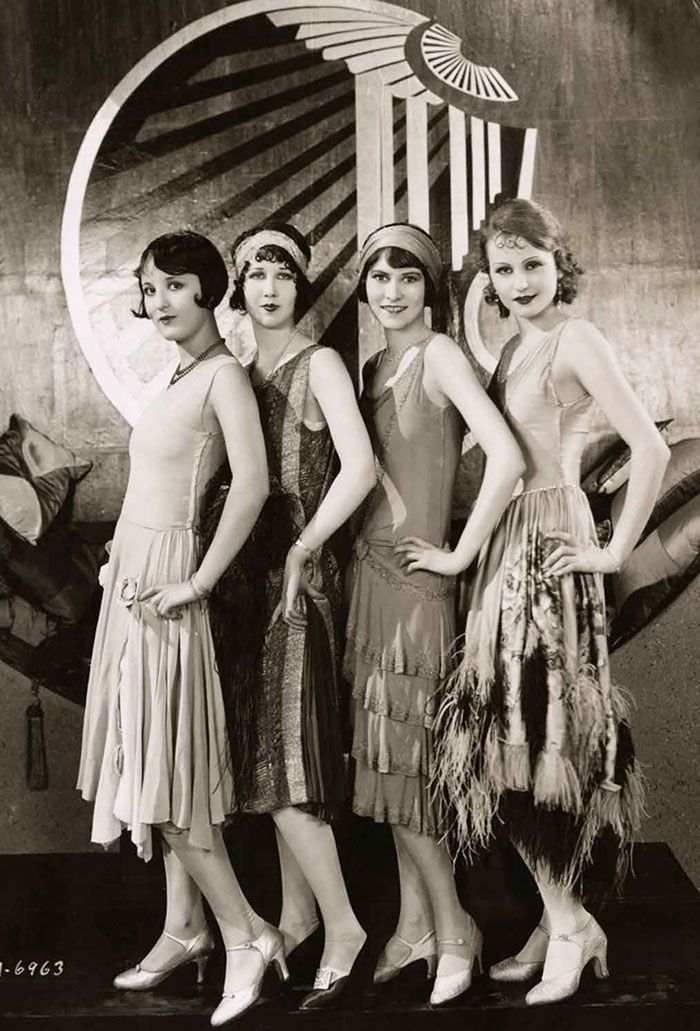
Films began to talk in the middle of the decade and by 1930 sound film production would outpace that of silent films. The sounds of jazz filled the air and women’s fashions made a dramatic shift from attire that might have looked like this
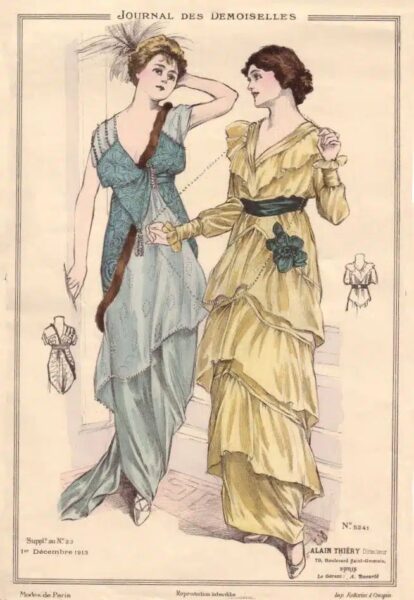
[From Fashion Era]
to one that looked more like this.
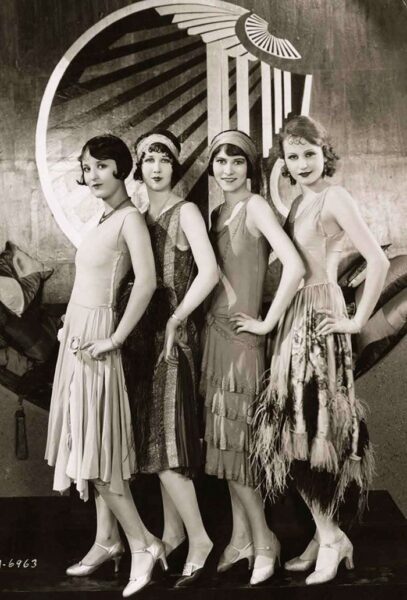
Automobile ownership tripled giving rise to large increases in petroleum refining, infrastructure construction, and other industries. All of these factors combined to lay the groundwork for the decade’s economic boom.
And what a boom it was. In August 1921, the Dow Jones Industrial Average (DJIA) sat at 63.90. It peaked in September 1929 closing at 398.20 – an increase of nearly 500 percent. No single decade has come close. (For perspective, in the boom of the late 20th century, the DJIA rose about 284 percent from 1990 t0 2000 after having risen 152 percent from 1982 to 1990.)
But there were some rumblings of an unhappy stock market. By the end of September, the DJIA had already dropped 13.7% from that high closing at 343.61. It continued this decline and on 25 October 1929 nearly ended the month down a further 13% to 298.97. Then, on the fateful day that’s come to be known as Black Monday, it plunged to 260.64 nearly matching in a single day the declines of each of the two preceding months.
Suddenly, with all that needed to be done, staging the 1932 Olympics faced much greater challenges than when they had been awarded the games just six months earlier.
A smaller games
Godfrey Dewey was apparently an exceptionally persuasive man. In addition to the construction of the Mount Van Hoevenberg Olympic Bobsled Run noted above, he also convinced the legislature and the local authorities to fund the construction of the Olympic Stadium adjacent to Lake Placid High School and the Olympic Arena. The former hosted speed skating and most of the preliminary ice hockey games while the latter moved the figure skating and ice hockey final indoors for the first time.
By the time the Games arrived, the worldwide depression had taken a toll. Only 17 countries sent athletes to Lake Placid – down from 25 that had competed in Saint Moritz four years earlier. The number of athletes fell by nearly half from 464 to 252.
And then there was the snow
Rather, I should say the absence of snow. With the Games scheduled to start on 4 February, upstate New York was experiencing the warmest January in 147 years with days when the temperature reached as high as 50 degrees. Although not quite on a par with the Sarajevo Miracle of 1984, two major storms dropped enough snow in the days prior to the Games to allow most events to proceed as planned.
Still, some events experienced significant delays. The most notable of these was the four-man bobsled event. Due to poor ice conditions from a thaw and subsequent blizzard, it was postponed and not completed until two days after the official closing ceremony.
Now that we’ve established the circumstances leading up to the Games, we can jump into the competition in the next post.
-
It’s just a shot away – Prizren
March 6, 2026 -
Some things looking better, baby – Getting into Kosovo
March 4, 2026 -
Here, where the sky is falling – Kukës
March 2, 2026 -
That’s when we fall in line ’cause we got Berat
February 27, 2026 -

Walking on the big stuff – a climb to Tragjas
February 25, 2026